|
May 23, 2010
Frank Gohlke is an American landscape photographer who is o concerned with the world we made, rather than the natural world; preoccupied with the urbanization and the seamless mix between the human world and the natural world.
He entered the international scene in 1975 as one of ten artists featured in the groundbreaking George Eastman House exhibition New Topographics: Photographs of a Man-Altered Landscape, which is generating renewed interest due to a restaging of the show, now on a nine-city national tour in the US. New Topographics heralded an emerging generation of landscape photographers who questioned the prevailing romantic and pictorial paradigms embodied in the work of such canonical photographers as Ansel Adams.
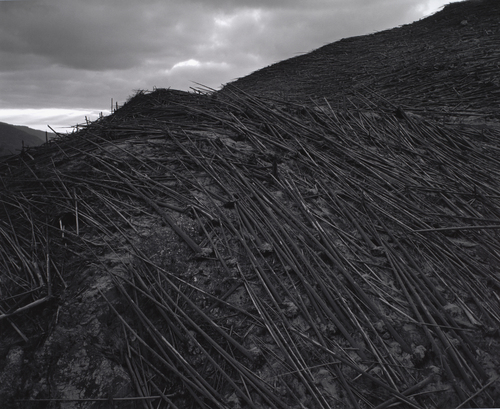 Frank Gohlke, Aerial View, Downed Forest Near Elk Rock, Approximately Ten Miles Northwest of Mount St. Helens, Washington. 1981. Gelatin silver print,
Gohlke's work is concerned with geography, topography, place, space and landscape. For instance, his work about Mount St Helens done from 1981 to 1990 explores the effects in the landscape of a volcanic eruption in 1980s and the clear-cutting by the logging industry.
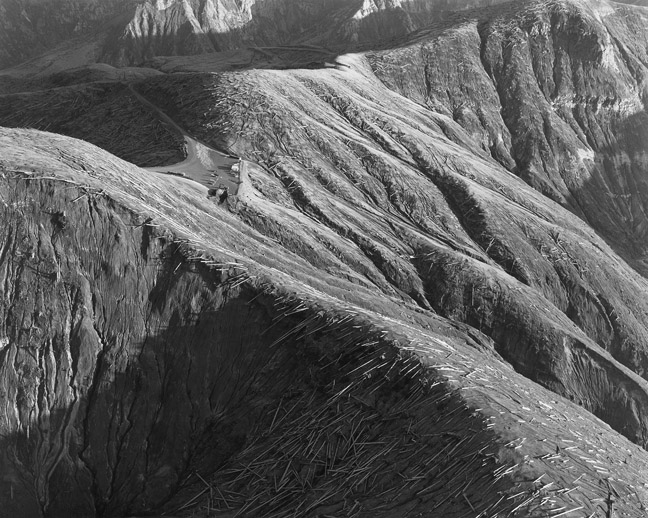 Frank Gohlke, Aerial view: looking southeast over Windy Ridge and visitors parking lot, 4.5 miles northeast of Mount St. Helens, Washington 1983, gelatin silver print.
What is interesting about Gohlke is his writing. He has written an essay on Photography and Place In it he says that:
places, like landscapes, do not occur naturally; they are artifacts. A place is not a landscape; places are contained within landscapes. Place is a possibility wherever humans linger, but it’s not inevitable. Sometimes we just occupy space. Places can be created intentionally or as a side effect of other actions with other intentions. Place seems to be more likely to come into being the longer we stay put, but many nomadic cultures roam in landscapes whose minutest features are named, recognized, and given a place in the story of a people and a world.
He adds:
Place has something to do with memory. The evidence of the actions of human beings in a specific locale constitutes a physical version of memory. In the visible traces of their passage I read the investment of desire, hope, ambition, sweat, toil, and love of people who set this location apart from raw space. I don’t need to identify the origin of every feature to sense its significance. The intentions of the inhabitants may be opaque to me; I only need to be aware that intentions were acted on here. Long-enduring Places demonstrate Wright Morris’s dictum that the things we care about don’t so much get worn out as worn in.
His color photographs of the Sudbury River in Massachusetts created between 1989 and 1992 represents the disconnect between the ideal of a bucolic, pastoral New England and the reality and complexity of an overgrown river that has been taken for granted.
|




I just saw some of Frank Gohlke's work at the Phoenix Art Museum. His pieces seem simple at first glance, but really have depth to them.