December 29, 2005
interpreting the enlightenment
I find Stephen Gaugroger'saccount of the philosophical criticism of the Enlightenment, and the legacy of the positivism-lebensphilosophie and scientism and romanticism divide it bequeathed, puzzling. Gaukroger says:
The European Enlightenment is generally seen as a formative event in Western modernity, replacing religion, superstition, and absolutist monarchy with reason and democracy. Yet since the middle of the 20th century the shift of values that the Enlightment apparently brought with it has been increasingly questioned. In a 1946 essay, influential German social theorist Max Horkheimer complained of ‘the collapse of a large part of the intellectual foundation of our civilisation’. For Horkheimer, the collapse was due to ‘technical and scientific progress’, which he traced back to the Enlightenment, and above all to what he identified as the ‘self-destructive tendency of Reason’ characterising the Enlightenment mentality.
Gaukroger then adds that Horkheimer was certainly not the first to trace the deleterious transformation of modern culture back to the effects of science. The 'effects of science'? Was not Horkheimer's concern with a particular philosophy of science, namely positivism? And with modernity's reduction of knowledge to the condition of scientific, mathematical conceptualization?
Gaugroger's remarks are made in a review of Peter Reill in Vitalizing Nature in the Enlightenment, which explores the traditional contrast between Enlightenment mechanism and Romantic vitalism.The above paragraph makes Horkheimer into a romantic who is part of a revolt against science in modernity, rather than critiquing a particular conception of scientific reason--an instrumental reason. The subject-centered reason of the Enlightenment has deteriorated into an instrumental reason. On this understanding reason cannot set goalsand c values cannot evaluate standards; it is purely instrumental in fulfilling given functions. The strength of subjective reason is its be the ability to calculate probabilities and thereby to co-ordinate the means with a given end. It has
become a mere tool to efficiently produce certain ends.
Horkheimer is not criticizing sceince or reason as such, but just the instrumentalized understanding of it.Nor is
Horkheimer anti-science. We do have a Frankfurt School conception of critical social theory to which Horkheimer contributed. This was counterposed to those social sciences that attempted to piggyback on the success of the natural sciences.
Was Horkheimer a vitalist then?
Nietzsche was, but Horkheimer? I cannot recall much on that in the Eclipse of Reason when I read it many years ago. It was not all that concerned with the ontology or metaphysics of the natural sciences.
Western Marxism was influenced by romantic Lebensphilosophie I guess it all depends on Horkheimer's understanding of the materialism, lebensphilosophie and irrationalism of the 19th century. Vitalism places the emphasis on life itself, or rather, the actual flow of life itself. Historically, vitalism stems from the romanticism of the 19th century, begins the 20th century as a right-wing philosophy, and during the late 20th century becomes a left-wing philosophy as well.
December 28, 2005
Derrida's influence on philosophy
One reason for my rejection of analytic philosophy was the way the big gun analytic philosophers treated Derrida. He was villified not engaged with. I saw that demonization as an example of cultural insularity, intellectual complacency, philistinism that undercut the universality and ethos of the analytic conception of philosophy.
Simon Crichtley outlines Derrida's significance for philosophy:
In my view, Derrida was a supreme reader of texts, particularly but by no means exclusively philosophical texts. Although, contrary to some Derridophiles, I do not think that he read everything with the same rigour and persuasive power, there is no doubt that the way in which he read a crucial series of authorships in the philosophical tradition completely transformed our understanding of their work and, by implication, of our own work. In particular, I think of his devastating readings of what the French called ‘les trois H’: Hegel, Husserl and Heidegger, who provided the bedrock for French philosophy in the post-war period and the core of Derrida’s own philosophical formation in the 1950s. But far beyond this, Derrida’s readings of Plato, of Rousseau and other 18th Century authors like Condillac and his relentlessly sharp engagements with more contemporary philosophers like Foucault, Bataille and Levinas, without mentioning his readings of Blanchot, Genet, Artaud, Ponge and so many others, are simply definitive. We should also mention Derrida’s constant attention to psychoanalysis in a series of stunning readings of Freud....Derrida’s philosophical exemplarity consists in the lesson of reading: patient, meticulous, scrupulous, open, questioning reading that is able, at its best, to unsettle its readers’ expectations and completely transform our understanding of the philosopher in question.
Crichtley says that Derrida has completely transformed our approach to the texts we rely on in our various disciplinary canons. Derrida cultivated what Crichtley calls a habitus of uncompromising philosophical vigilance at war with the governing intellectual common sense and against what he liked to call - in a Socratic spirit - the doxa or narcissistic self-image of the age.
December 27, 2005
One of the feminist critiques of traditional theories of science has as its target the Baconian paradigm of an active (read: male) scientist manipulating, describing, and laying bare the secrets of inert and pliable (read: female) nature. The critique holds that this model of scientific discovery leads to bad philosophy, bad politics, and, it is increasingly clear, bad science.
It leads to bad philosophy because it results in an alienated view of nature as essentially dead and meaningless, a view which, minimally, fails to capture our experience of the dynamism and interconnectedness evident in nature. It is bad politics because it does not recognize intrinsic values in nature; it encourages us (them) to view nature merely as a resource to exploit. And it is bad science because in refusing to acknowledge agency in nature, it fails to recognize many of the creative capacities of natural systems.
December 25, 2005
a Dionysian affirmation of the world
A quote from Nietzsche's The Will to Power (pp. 84-5):
My new path to a 'Yes'. -- Philosophy as I have hitherto understood and lived it is a voluntary quest for even the most detested . . . side of existence . . . . 'How much truth can a spirit endure, how much truth does a spirit dare?' -- this became for me the real standard of value. Error is cowardice -- every achievement of knowledge is a consequence of courage, of severity towards oneself, of cleanliness towards oneself -- Such an experimental philosophy as I live anticipates experimentally even the possibility of the most fundamental nihilism; but this does not mean that it must halt at a negation, a No, a will to negation. It wants rather to cross over to the opposite of this -- to a Dionysian affirmation of the world as it is, without subtraction, exception or selection - it wants the eternal circulation: -- the same things, the same logic and illogic of entanglements. The highest state a philosopher can attain: to stand in a Dionysian relationship to existence -- my formula for this is amor fati.It is part of this state to perceive not merely the necessity of these sides of existence hitherto denied, but their desirability; and not their desirability merely in relation to the sides hitherto affirmed (perhaps as their complement or precondition), but for their own sake, as the more powerful, more fruitful, truer side of existence, it which its will finds clearer expression (Section 1041).
It is not just countering the negative with the positive (affirmation of life).It also involves an unblinking and unbroken courage in the face of the horror and terror of life.
December 24, 2005
I've been struggling to switch over from dialup to broadband at the holiday shack in Victor Harbor these last two days. To no avail. Problems with the exchange or something I'm informed.

Leunig
Tis the best I can do.
December 21, 2005
an old theme revisited
A review of a book on the future of (analytic) philosophy edited by Brian Leiter. This tacitly equates philosophy with analytic philosophy--on a old rhetorical trick. The justification is provided by Leiter. Gary Gutting, the reviewer, notes Leiter's argument:
"'Continental' philosophy’ has . . . become a meaningless category” ...This so first because its foil, analytic philosophy, now includes such a variety of methods and substantive positions that it “survives, if at all, as a certain style that emphasizes 'logic', 'rigor', and 'argument'"...the point being, as he maintains a bit later, that “now . . . claims about stylistic distinctiveness [of Continental from analytic philosophy] are less tenable” ....More important, however, is the fact that we now realize that “the 'Continental tradition' . . . is no tradition at all, but a series of [seven to nine] partly overlapping philosophical developments that have in common primarily that they occurred mainly in Germany and France in the nineteenth and twentieth centuries”.
Gutting says that Leiter supports this point by noting exceptions to various doctrinal features proposed as distinctive of Continental thought. For example, Marxism and German materialism in general refute a characterization in terms of anti-materialism, while Schopenhauer’s critique of Hegel and Nietzsche’s ignoring of him exclude a shared Hegelian sympathy.
Can you imagine the Phenomenology of Spirit, Das Kapital ,The Birth of Tragedy, or Being and Time being written from within the analytic tradition?
Okay, there are different and antagonistic strands to continental philosophy--just as there are within the analytic tradition. So why say there is no continental philosophy but there is analytic philosophy? Maybe the divide has outlived its usefulness, and just refers to the history of philosophy in the 20th century?
I've always understood the central differences to be the differing responses to positivism, to the reduction of reason to natural science, and to the reduction of naturalism to scientific materialism (atomism & mechanism) and the different conceptions of everyday experience. In the continental tradition philosophersturn away from physical nature and toward human history and so they replace replace metaphysics and epistemology with social philosophy as the "core" of the discipline.
December 20, 2005
eternal recurrence
An example of the cosmological interpretation of Nietzsche's concept of eternal recurrence?:
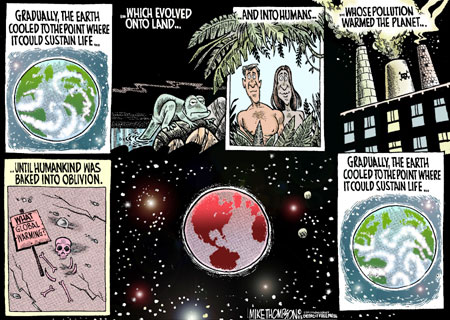
Or maybe it is the 'symbolic' interpretation -- eternal recurrence as a mere metaphor?
December 19, 2005
unreason, madness
I mentioned in this post that I was interested in a biopolitics concerned with the process whereby animals become human beings through a shaping or production of the human against a background of life defined as worthless and eliminable.
In The Infinite Conversation Blanchot addresses the inhuman unreason, madness and the great confinement of the insane. Referring to Foucault he says:
"...what is being constiuted in silence...is the very world of Unreason: a world of which madness is but a part and to which classicism annexes sexual prohibitions, religious interdicts, and all excesses of thought and of the heart." (p.198)
Blanchot goes on to say:
Such a moral experimentation with unreason, which is the other side of classicism, is tacitly carried out and becomes manifest in giving rise to this almost invisible arrangement: the closed space where dwell side by side the insane, the debauched, the heretical, and the disorderly---a sort of mumuring emptiness at the heaart of the world, a vague meance from which reason defends itself with the high walls that symbolize the refusal of all dialogue: ex-communication. There is no relation with the negative. (p.198)
We have a partition between the human and inhuman throughout classcism and the scientific Enlightenment that reduces madness to silence.
December 18, 2005
desire as productive
Desire produces reality. What does that mean?
Gilles Delueze understands desire as a primary active force rather than a reactive force to an unfillfulled need. Desire is productive in the sense that it produces real connections, investments and intensive states within and between bodies.
That understanding is directed against the Aristotlean, Hegelian and psychoanalytic conception of (unfulfilled) desire internal to the individual subject developing in terms of a well ordered formation. Does this lead to desire as law?
Deleuze and Guattari understand desire as a circuit of libidinal energy, that can be viewed as an assemblage that is akin to a production process as described by Marx. It is a process of connecting, encoding and consumption.
December 16, 2005
becoming human
As I wind down for Xmas I've started trying to read again. I'm currently reading Giorgio Agamben's The Open. Man and Animal on biopolitics in connection with Maurice Blanchot's The Infinite Conversation. The biopolitics that I find interesting is the process whereby animals become human beings against a shaping or production of the human against a background of life defined as worthless and eliminable.
I was educated in the Hegelian-Marxist conception of this process---we become human through the dialectical work of negativity and, in doing so, we humanize the natural world. I've always been puzzled by the remnants or leftovers of this process (eg., the ecological world, being animal, the other as the non-human, and unreason).
Like Bataille I had little sympathy for Kojeve's uptopian conception of the end of history as human beings being in harmony with nature in which wars and injustice have disappeared, we become natural again and live a life of art, love, laughter and play. I could not accept that history had ended, except for the epilogue, and that we humans as animals were living in a post-historical time, constructing our ediifices as birds built their nests.
Why should we become human only through transcending the animal (the body presumably) and destroying the animal?
December 15, 2005
machines of overcoding
I'm winding down for Xmas, thank goodness. So I may have a chance to do some proper reading.
In Dialogues Gilles Deleuze says
We should ask what ask to today which are the abstract machines of overcoding which are exercised as a result of the forms of the modern state. One can even conceive of 'forms of knowledge'which make their offfers of service to the State, claming to provide the the best machines for the tasks or the aims of the State: today informatics? But also the human sciences?
We can answer that easily: economics, of the neo liberal variety.
Deleuze goes onto say that:
There are no sciences of the State but there are abstract machines which have relationships of interdependence with the State. This is why....one must distinquish the devices of power which code the diverse segments, the abstract machine which overcodes them and regulates their reltaionship and the apparatus of the State which realizes this machine.
December 14, 2005
Globalization

Paul Zanetti
clever huh?
It indicates how we are enframed by a technological mode of being.
December 12, 2005
practical knowing
In an essay entitled "Merleau-Ponty and the Epistemological Picture," Charles Taylor describes the phenomenon of tacit knowledge:
As I navigate my way along the path up the hill, my mind totally absorbed in anticipating the difficult conversation I'm going to have at my destination, I treat the different features of the terrain as obstacles, supports, openings, invitations to tread more warily, or run freely, and so on. Even when I'm not thinking of themthese things have those relevancies for me. Taylor Carman & Mark B.N. Hansen, Eds, The Cambridge Companion to Merleau-Ponty, (Cambridge: Cambridge University Press, 2005, p.34.
We respond to these affordances in this situation-specific way when we are intensely involved in what we are doing, as when negotiating a dangerous intersection, and also when we are completely absorbed in something else. In either case, we are capable of coping concretely without thinking at all.
December 11, 2005
lay knowledge, illness, medicine
A significance of the tacit embodied knowledge, which was explored by Heidegger and Merleau Ponty as a form of everyday coping, is that it gives us an account of lay knowledge that can be juxtaposed to the expert knowledge of the medical profession.
If we are substantially present in the world and engaged with it as embodied beings, then we have some understandings of what makes us ill and causes us to be unwell. This kind of knowing is concerned with interpretation that makes sense of our illness, eg., obesity. Junk food and lack of exercise may be the way we do this--understand the meaning of illness through a narrative.
This is quite different from the clinical understanding of disease which is primarily evidenced based and so a different form of knowledge.
December 10, 2005
Two cultures
The year 2005 is the centenary of the birth — and the 25th anniversary of the death — of C.P. Snow, the British physicist, novelist, and longtime denizen of the "corridors of power". Snow's best-known work, was a highly influential polemic entitled The Two Cultures and the Scientific Revolution.
Delivered by Snow as the prestigious Rede Lecture at the University of Cambridge in 1959 before being published as a brief book shortly thereafter, this lecture is commonly interpreted as a public lamentation over the extent to which the sciences and the humanities have drifted apart in late modernity, to the extent that practitioners of either of the two disciplines know little, if anything, about the other and that communication is difficult, if not impossible, across the gulf of mutual incomprehension” between natural scientists and the “literary intellectuals.
I've interpreted Snow's thesis as an apology of the progressive scientific culture coupled to the death of the regressive literary culture; an apology for technoscience in the context of the Cold War. Throughout the text we have the slide from the humanities to literary culture to traditional culture to unscientific to the anti-scientific prejudice of the whole ‘traditional’ culture.” We end up with the literary intellectuals as the natural Luddites and scientists having the future in their bones.
Huh?
Plato, Aristotle, Descartes, Hobbes, Locke, Spinoza, Kant are “traditional” representatives of “the philosophical current of the humanites and are far from being anti-science. They are pro-science.
The critical reaction to natural science comes with Hegel, Nietzsche, Bergson, Heidegger and Gadamer then it is a philosophical criticism to the positivist conception of science, with its anti-theoretical bias, its ignorance of the metaphysical underpinnings of science, its correspondence of theory of truth , its reduction of knowledge to science, its emotivist conception of ethics etc etc.
Snow is in the traditon of T.H. Huxley and the scientific enlightenment tradition, which holds that literature and the humanities should, and inevitably would be, supplanted by natural science.
December 6, 2005
Deleuze---the flux of existence
The Nietzschean side of Deleuze is te philosopher of desire, flux, and multiplicity. Deleuze is the Dionysian thinker of becoming--- the flux of existence which has no transcendental level or inherent seperation.
Deleuze posits a primary flux from which all events and identities emerge. Deleuze focuses on relations as the process of differentiation that establishes identities. The result is an ontology of contingent, ever-shifting identities, which is the result of emergent and on-going assemblages and creations, rather than pre-given, essential ideas.
December 4, 2005
Deleuze & empiricism
I"ve always sbeen suprised by Deleuze's embrace of empiricism. I intiially thought that it was a return to an old style empiricism in the guise of a reaction against concepts in Anglo-American philosophy, or an appeal to the primacy of lived experience in phemonenology.
But the former (traditional empiricism) sits at odds with Deleuze's conception of philosophers as creators and inventors of concepts. In Dialogues he writes:
I have always felt that I am an empiricist . . . [My empiricism] is derived from the two characteristics by which Whitehead defined empiricism: the abstract does not explain, but must itself be explained; and the aim is not to rediscover the eternal or the universal, but to find the conditions under which something new is produced (creativeness)...Empiricism starts with ...analysing the states of things, in such a way that non-pre-existent concepts can be extracted from them. (p. vii)
However, Deleuzian empiricism can be read as a kind of detective writing in the sense of a figuring out what's going on and intervening to resolve local situations. This kind of acting on the present takes an untimely attitude to our present; one that acts counter to our time for the benefit of a time to come.
And the difference from the latter? I guess that is indicated by a transcendental empiricism (ie., the conditions
of experience are not themselves given in sensible experience) being an ontology that would grant primacy to difference rather than identity.
Update Jan 3 2006
In the a href="http://www.levibryant.com/transemp.pdf">article referred to above Levi R. Bryant says:
On the other hand, transcendental empiricism has epistemological implications insofar as knowledge too must be formed in a process of individuation. In other words, we arrive at a knowledge of difference through processes that are themselves ontological and productive of difference. As a consequence, knowledge cannot be conceived in disembodied representational terms that would maintain a strict distinction between the knower and the known, but must instead be thought in terms of becoming, wherein the thinker and the thought themselves form a new difference.
December 3, 2005
Gilles Deleuze on desire
In Dialogues 11 Gilles Deleuze says that there are three misunderstandings of desire :
..lack or law; a natural orsponstaneous reality ; pleasure, or above all, the festival. Desire is always assembled and fabricted on a plane of immanence or of composition which must itself be constructed a the same time as desire assembles and fabricates. We do not mean that desire is histoprically determined....desire is the real agent, merging each time with the variables of assemblage. (p.103)I've always seen desire as historically shaped and formed. Desire as agent suprises me.