November 28, 2005
Auschwitz as disaster
I presume that Auschwitz was a disaster. A disaster that we should act to ensure that it is not repeated.
How could we ensure this? Does it imply a new mode of life?
Does the modernist mode of ethical life or experience promise a form of life escaping nihilism?
November 26, 2005
disaster
If, as Blanchot says:
"...the disaster ruins everything, all the while leaving everything intact. It does not touch anyone in particular.. It, the disaster is not a force which directly causes an effect upon those held under its sway. It seems instead to be removed, or perhaps crossed out'.
Then can Friedrich Nietzsche 's death of God be viewed as a disaster? God cannot save us and he does not do anything for us. There is no salvation, no redemption.
Does that mean nihilism is a form of disaster?
November 24, 2005
writing the disaster
I'm struggling to understand Blanchot's poetics on this theme. So I turned to this
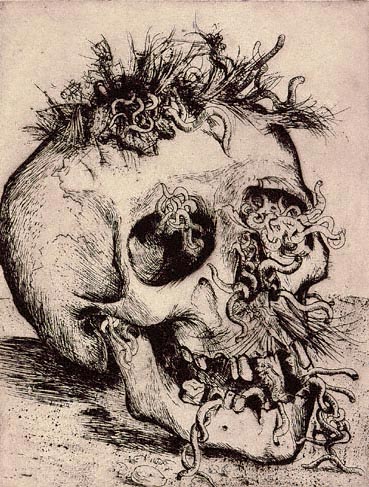
Otto Dix, The Skull, 1924
This is a gruesome image of decay and worms investing a human skull. It is meant to symbolize the indescribable horrors of the first World War. For Dix and other European artists of the WWI era, skulls were powerful tools to express the dark reality of death that the disaster of war inevitably brings.
November 23, 2005
pills for shopping
Drug marketers have been extraordinarily adept at selling SSRIs—even to people who may not need them. Consider that the drugs, once limited to treating major depression, are now prescribed for everything from shyness about peeing in public restrooms to shopoholism. The explosive growth of the drugs' market is largely a story of clever branding as makers of "me too" SSRIs sought to replicate Prozac's success. Pfizer, for example, positioned Zoloft, launched in 1992, as a versatile antidepressant that could also treat ills such as post-traumatic stress disorder. Glaxo targeted Paxil, launched in 1993, at anxiety disorders such as SAD (social anxiety disorder, or excessive shyness) and GAD (generalized anxiety disorder, or unremitting angst)—ills that had received little attention before Glaxo began promoting Paxil to treat them. Lilly countered by expanding Prozac's indications to include PMDD (premenstrual dysphoric disorder, or very bad moods some women suffer before their periods) and depression in children.
No therapeutic category is more accepting of condition branding than the field of anxiety and depression, where illness is rarely based on measurable physical symptoms." Why not drugs for compulsive shopping.
November 21, 2005
tacit knowing
A quote:
While infants acquire skills by imitation and trial and error, in our formal instruction we
start with rules. The rules, however, seem to give way to more flexible responses as we become
skilled. We should therefore be suspicious of the cognitivist assumption that, as we become
experts, our rules become unconscious. Indeed, our experience suggests that rules are like
training wheels. We may need such aids when learning to ride a bicycle, but we must eventually
set them aside if we are to become skilled cyclists. To assume that the rules we once consciously
followed become unconscious is like assuming that, when we finally learn to ride a bike, the
training wheels that were required for us to be able to ride in the first place must have become
invisible. The actual phenomenon suggests that to become experts we must switch from
detached rule-following to a more involved and situation-specific way of coping.
November 20, 2005
embodied knowledge
A nice piece on embodied knowledge and the failure of mechanism by Herbert Dreyfus.
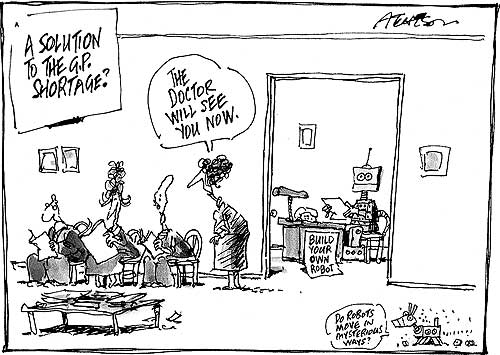
Achinson
Drefyus says that cognitive science, which looked to be a:
"....promising proposal for understanding human intelligence, while bypassing the body and, indeed, experience altogether, seems to have run its course. In mid-twentieth century, philosophers, linguists, psychologists, and computer scientists joined in proposing a new discipline called Cognitive Science that promised to work out how the logical manipulation of formal, symbolic representations enabled minds and suitably programmed computers to behave intelligently......In the early seventies, however, Minsky’s AI lab ran into an unexpected problem.Computers couldn’t comprehend the simple stories understood by four-year-olds."
Drefyus goes on to add that:
it seemed to me that the real problem wasn’t storing and organizing millions of facts; it was knowing which facts were relevant. One version of this relevance problem is called the frame problem. If the computer has a representation of the current state of the world and something changes, how does the computer determine which of the represented facts stay the same, and which representations have to be updated? It seemed to me obvious that any AI program using frames to solve the storyunderstanding problem by organizing millions of facts was going to be caught in a regress, and that therefore the project was hopeless. And, indeed, Minsky has recently acknowledged in Wired Magazine that AI has been brain dead since the early 70s when it encountered the problem of common sense knowledge.
Cognitive sieince always struck me as a dead end and I was never interested in it, even when the analytic philosophers went ga ga.
Dreyfus then asks a question:
How, then, do we manage to organize the vast array of facts that supposedly make up commonsense knowledge so that we can retrieve just those facts that are relevant in the current situation? The answer is: “We can’t manage it any more than a computer can, but fortunately wedon’t have to.” Only if we stand back from our engaged situation in the world and represent things from a detached theoretical perspective do we confront the frame problem. That is, if you strip away relevance and start with context-free facts, you can’t get relevance back. Happily, however, we are, as Martin Heidegger and Maurice Merleau-Ponty put it, always already in a world that is organized in terms of our bodies and interests and thus permeated by relevance.
November 19, 2005
the new academia
A nice quote about the new academia where the argument for partnership between sceince and commerce is reasonable. It is held that science aims to acquire knowledge but needs money to invest in research. Industry wants to develop products for a profit, but needs a sound base of knowledge on which to do so. In other words, both activities need each other and their interests are complementary. The quote is from this review
Consider a naive undergraduate student embarking on a career in biomedicine, seeking to 'make a difference' and 'do good work' in 'the public interest'. It is likely that she will have to spend many years earning her academic spurs, first as an impoverished graduate student, then through a seemingly endless series of postdoctoral positions. Now at the zenith of her career in a top university, our scientist is faced with having to find funds to buy the latest new piece of equipment, to keep her laboratory stocked with reagents and to support the next generation of keen young post docs, graduate and honours students. Public funding is getting more and more scarce and funding agencies are requiring evidence of national benefit. The university's technology transfer office requires her to report any commercial opportunity likely to arise out of her team's research, no matter how remote. Collaborations with industry partners are viewed favourably in promotion applications and patents are becoming recognised measures of academic excellence. Colleagues are seen to be reaping the benefits of entering into commercial arrangements, both professionally, through increased research funding, and personally, through shareholdings, consultancy fees and the like. It is not surprising that our scientist might seriously consider a move to the 'dark side'.
This is the new commercial reality in which university science becomes entangled with entrepreneurship; knowledge is pursued for monetary value; expertise with a point of view can be purchased and science seeks an immediate economic payoff.
The above quote is an example of how universities have become instruments of wealth. This shift in the ethos of academia away from disinterested inquiry and free expression of opinion works against the public interest because universities have sacrificed their larger social responsibilities to accommodate the privatization of knowledge---by engaging in multimillion-dollar contracts with industries that demand the rights to negotiate licenses from any subsequent discovery.
This is the argument of Sheldon Krimsky in his Science in the Private Interest: Has the Lure of Profits Corrupted Biomedical Research? Universitieiss have moved away from an ethos based on the education of students to be informed and capable democratic citizens to producing people who can contribute to a knowledge economy. In this economy where knowledge is just one more commodity to be traded, we have drug company marketing dressed up as legitimate medical science.
November 17, 2005
philosophy weblog
A new philosophy weblog I've come across---Philosophy Times run by Roberto. It works in terms of essays. There is a nice post on Nietzsche and truth that leads to this:
Reality comes to us in all different types of shades and degrees. Perspective is simply an interpretation of reality. Thus, we are left with Nietzsche’s grand revelation: a philosophy that embraces Perspectivism, is a philosophy that goes beyond the antithetical values, that is to say, it is a philosophy that goes beyond “good and evil”, “truthfulness and falsity”, and finally, beyond all dogmatic philosophies.
Nicely put.
November 16, 2005
painful existence
Sanaa Abdul Jabar documents the effects of her loveless, abusive marriage and the role of religion in her life within contemporary Syrian society:

Sanaa Abdul Jabar
"My life was marginalized, and I lost my ambition. It seemed as if I was in a terrifying nightmare. I am lost in life's maze, and I have no way out. I wished that I would wake up and find out that everything had worked out differently. Now nothing is left except the painful memories.”
November 13, 2005
Hegel: philosophy & historical ethical life
In contrast to Deleuze's conception of philosophy as the creation of new concepts stands Hegel's understanding of philosophy as a 'thinking-over' of the content given in pre-philosophical experience--in feeling, intuition, desire and willing--- of say ethical life. For Hegel, all experience involves thinking, and thinking pervades all our activities.
In our pre-philosophical modes of experience thinking is active, but it remains implicit, submerged in an immediate form. It is in philosophy that this thinking becomes explicit: a translaton and interpretation of this implicit thinking into explicit thoughts and concepts.
As it is the comprehension of the present and the actual philosophy avoids fleeing the actual world to seek a beyond. The development that is traced in terms of these concepts is a conceptual one and so it does not acquiesce to the actual world or whatever exists in history. It is concerned with what is substantial (essentialities, or what makes a thing what it is) in things, processes and relations.
November 12, 2005
Blanchot and writing
Blanchot begins The Writing of the Disaster ( L'Ecriture du désastre) with:
"The disaster ruins everything, all the while leaving everything intact. It does not touch anyone in particular; "I'" am not threatened by it, but spared, left aside. It is in this way that I am threatened; it is in this way that the disaster threatens in me that which is exterior to me ---an other than I who passively become other. There is no reaching disaster. Out of reach is he whom it threatens, whether from afar or closeup, it is impossible to say: the infiniteness of the threat has in some way broken every limit. We are the edge of disaster without being able to siutate in the future: it is rather always already past and yet we are on the edge or under the threat ...."
That is how the text begins. I'm left struggling to understand. Presumably the book is in part about how one deals with disaster, the trauma of past disasters and the knowledge of the disaster to come, specifically our own death. I presuppose that the text it also cpncerned with of finding an adequate language for the expression of disaster. Hence it is on, or, the limit of writing.
I am not even sure what 'disaster ' refers to.
November 9, 2005
antidepressants,
Biomedical psychiatry is a form of rhetoric: it knows how to produce effects without knowing how to treat causes. A quote:
Antidepressants... 'recruit' depressives, and do so because they work. Each new one must first go through controlled trials intended to prove that it is more effective than a placebo and competitor drugs. In order to pass these tests, the proposed medication must yield results significantly better than previous drugs among a group of patients who have been selected because they present a pathology likely to respond to it. ... Each new molecule, if it is effective, creates a new group of patients, defined by the effects it produces: depressives needing stimulation, depressives needing to be tranquillised, anxious depressives, aggressive depressives etc. The new pathologies then spread throughout society as the drug penetrates the market and recruits (regroups) ever-increasing numbers of 'clients'.
It is from this article.
November 8, 2005
The Worried Well#2
Depression and mental illness have become a big public health problem. In this article in The Guardian, which was reprinted from London Review of Books in 2002, Mikkel Borch-Jacobsen says that:
Fortunately, however, we're told on all sides that depression is no longer a fate. Antidepressant drugs have been around since the mid-1950s, and the new generation - the selective serotonin re-uptake inhibitors (or SSRIs) - work wonders. Under the influence of Prozac, Zoloft or Paxil, people for whom existence had been an unbearable burden suddenly find renewed pleasure in life, without having to suffer the unpleasant side-effects of the older generation of antidepressants, the tricyclics and the MAOIs (monoamine oxidase inhibitors). Admittedly, SSRIs sometimes lead to diminished libido and even, among men, to impotence, but that is surely a small price to pay for a restored capacity for happiness. 20 million people worldwide are now thought to be taking Prozac, and we are hearing reports of a new era of 'cosmetic psychopharmacology', in which drugs will be used to treat not only clinical depression, but daily mood swings and existential angst. So farewell Kierkegaard and Heidegger.
Mikkel Borch-Jacobsen says that there is a problem with this therapeutic optimism. If it is indeed true that antidepressants cure depression, how is it that the illness is spreading ever more widely? The incongruous fact is that depression was never so prevalent as it has been since the introduction of antidepressants. It has always been with us, though it went by other names and sometimes assumed different shapes, depending on the era. MIkkel says:
If more and more people are depressed, might it not be because we live in a society that is more and more depressing? Left-leaning commentators often argue that the pharmaceutical industry has over-medicalised a real social misery, created by the stress of modern life, the loss of identity markers, the isolation of the individual, unemployment and so on.... The problem with this sociological explanation is that it explains nothing. Even supposing that society is more inhuman than in the past, when socialised medicine and unemployment benefits didn't yet exist, why would this give rise to depression rather than anxiety, fatigue, 'nervous breakdown' or just plain anger?
And yet it has to do with the subjectivity of individualism in a competitive market society.
I have just come across this text. I'm not sure that I agree with the proposed alternative to the drug base cure (ie. taking drugs for depression ) that Gail Bell advocates. Bell says:
For an alternative to drugs, Gail goes back to the 1600s and quotes from Robert Burton's The anatomy of melancholia. Eat well and get enough sleep, says Robert, wear clean clothes and comb your hair; seek the company of others and get out in the sunshine. Cognitive behavioural therapy is another more modern technique which teaches us to recognise negative thought patterns and to retrain our brains into a positive outlook
The 'worried well'. I'm not sure that I like the term. It sounds like a term of disdain--a way of dismissing or downplaying depression, despite the current acceptance of different kinds of depression.The distress of depressives is in every way real; but this reality is not hard-wired in their genes or neurotransmitters.
Mikkel Borch-Jacobsen says that:
Just as Freudian neuroses were the pathology of a subject defined by prohibition and internal conflict, so contemporary depression is "the reverse of the sovereign individual, of the man who believes himself to be the author of his own life". In that sense, depression is not directly provoked or caused by contemporary society. Rather, Ehrenberg suggests, it is the negative 'counterpart' to the subjectivity created and so highly valued in this society.
November 7, 2005
the worried well
A suggestion. The reason why many people take anti-depressants is to aoid what philosophy recommends: the process of reflecting and rethinking by which one's fears and anxieities and unconscious feelings are reclaimed. Isn't the latter the way that relationships are built with others?
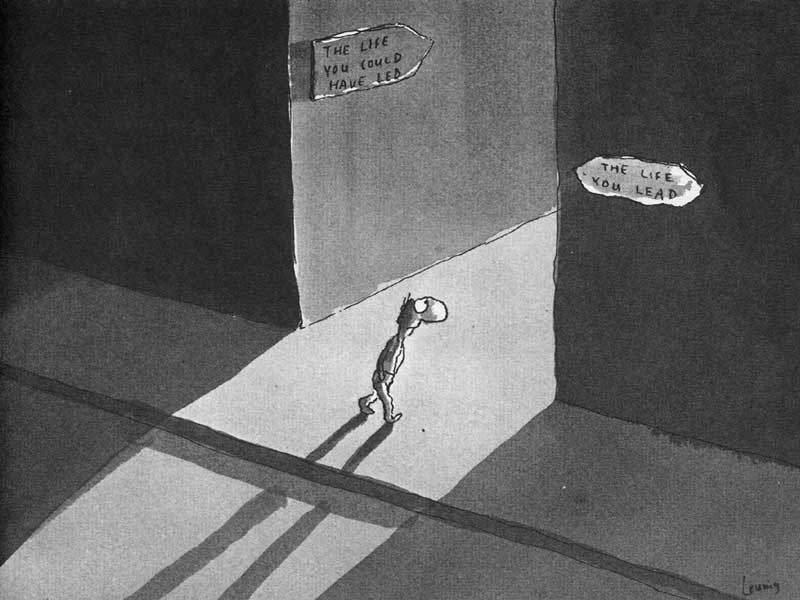
Leunig, The life you lead
Yet our market culture places an emphasis on rugged individualism, selfishness, hardness, social life as competition, and the neo-liberal shaping oneself for great success and the high life, power, recognition.
No time for therapy in that culture. That admits something is wrong or we are a failure. Hence the ethos of taking chemicals in postmodernity?
November 6, 2005
depression, mental illness, psychiatry
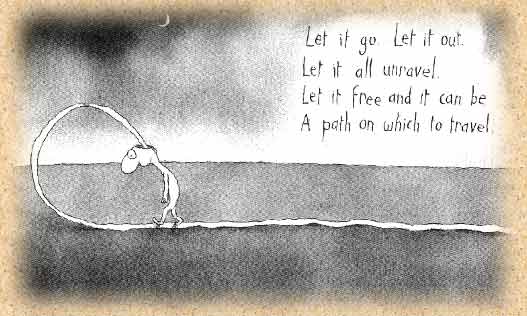
I want to link back to this earlier post on psychiatry and psychoanalysis in relation to everyday life and depression. Depression has been reconceptualized and relabelled as a disease (a cluster of symptons) rather than an illness, in order to render it visible to the medical gaze.
Big Pharma was instrumental in that shift to seeing depression as a psychiatric disorder--a broken brain?-- conceptualized by biological medicine with the solution being to take drugs--anti-depressants-- for the rest of their life because no other treatment is available. Other than pulling one's socks up and getting a grip on oneself instead of taking medication.
Leunig
This shift can be seen as a response by psychiatrists to the impact of psychoanlysis and the risk of psychiatry losing its roots in medicine and becoming irrelevant. Psychiatry was bought back into medicine through an emphasis on psychiatry's biological roots and instituting a strong scientific approach.
That is my understanding of what has happened. Depression is now conceptualized as a biological condition reflecting a chemical imbalance independent of personality or character that requires correction by an anti-depressant drug.
November 5, 2005
my my
How about this: A return to a conception of philosophy that thinks the ontology implicit in science.
This book can be read as a call to arms for the future of philosophy, as a critique of the history of metaphysics, and as an exposition of an ontology grounded in difference. While each of these aspects has its antecedent in twentieth century philosophy, de Beistegui’s project is distinctive in many respects. One of the great merits of the book is the clarity with which de Beistegui lays out the nature and aim of his project. In the sections of the book that outline his theoretical framework, de Beistegui writes in a straightforward and jargon-free manner, allowing the reader to readily grasp the targets of the project. This said, the book is by no means easy to digest, for these programmatic sections account for a small fraction of the book’s pages. Better than half of the book consists of close readings of portions of Martin Heidegger’ Contributions to Philosophy and Gilles Deleuze’s Difference and Repetition. These readings are dense and challenging---not meant to serve as introductions to either thinker. Along with these sections on Heidegger and Deleuze, de Beistegui offers a reconstruction of the history of the metaphysics of substance from Parmenides to Merleau-Ponty, with special emphasis on Aristotle and Hegel. There is also a chapter on the ontological implications of contemporary science.The book is Miguel de Beistegui, Truth and Genesis: Philosophy as Differential Ontology. The review is by Mathew S Linck and he firmly locates Deleuze within this metaphysical tradition int he sense of transgressing it.
November 3, 2005
Deleuze, Kant, critique
In his Nietzsche and Philosophy Deleuze writes that:
Kant's genius, in the Critique of Pure Reason, was to conceive of an immanent critique. Critique must not be a critique of reason by feeling, by experiencing or by any kind of external instance. And what is critiqued is no longer external to reason: we should not seek, in reason, errors which have come from elsewhere--from body, senses or passions--but illusions which have come from reason as such. Kant concludes that critique must be a critique of reason by reason itself. Is this not the Kantian contradiction, making reason both the tribunal and the accused; constituting it as a judge and plaintiff, judging and judged?
Deleuze goes onto say that Kant does not realize his project of immanent critique. Traanscendental philosophy discovers conditions which still remain external to the conditioned. We require a genesis of reason itself, and also a genesis of the understanding and its categories: what are the forces of reason and of the understanding?
Was that not Hegel? Did not Hegel attempt a historical a genesis of reason itself, and also a genesis of the understanding and its categories?
November 1, 2005
about emotions
I cannot read texts at the moment because I've misplaced my reading glasses and my eyes are sore and tired from working yesterday and today without them. So a quote about something that has puzzled me from 'The Call for Rhetoric' by David Merce, which is published in this magazine:
Martha Nussbaum’s Upheavals of Thought: The Intelligence of Emotions might serve as another starting point for those interested in the elaboration of this distinction between feelings and emotions. While Nussbaum is more interested in distinguishing among emotional states than I am, her distinction between conscious and unconscious emotions might be another way of addressing the distinction between feelings and emotions that I’m suggesting here .... There is also a very difficult sentence in Book II of Aristotle’s Rhetoric (1379a) that posits both “emotions/passions” and “underlying passions/emotions”: proodopoieitai gar hekastos pros tein hekastou orgein hupo tou huparchontos pathous. Freese translates this as “for the passion present in his mind in each case paves the way for his anger” ... Kennedy, following Grimaldi’s discussion of the passage in Aristotle: A Commentary, translates it as “for each [person] has prepared a path for his own anger because of some underlying emotion” .... What I’m trying to identify as “feelings” may also be related to Aristotle’s notion of an “underlying emotion,” but I am not certain that what “underlies” an emotion is simply another emotion. What both Nussbaum and Aristotle share is a sense that, with some effort, emotions can be distinguished one from the other; they also share the suspicion that there is something about emotions that slips out of our noose of categorization. There is something (I call them/it “feelings”) that resists being distinguished.
Emotions are conscious whilst feelings are unconscious?
I'm not sure what this has to with the decline of rhetoric.