October 30, 2005
Deleuze, Nietzsche, dialectic
In his Nietzsche and Philosophy Deleuze writes that Nietzsch'e work is directed against the dialectic for three reasons:
...it misinterprets sense because it does not know the nature of forces which concreetely appoapriate phenomema; it misinterprets essence because it does not know the real elements from which forces, their qualities and relations derive; it misinterprets change and transformation becaus it is content to with permentuations of abstract and unreal terms.
That's a big hit. But I'm not sure that I understand the charges
October 29, 2005
Deleuze: the rhizome
A quote:
The model of the rhizome decenters both the subject and language. Three principles govern the rhizome, namely, connection, heterogeneity and multiplicity. The multiple, as substantive, ceases to have any relation to the one (unity), it has neither subject nor object, only determinations, magnitudes, diversions and dimensions which are capable of increasing in number if the multiple is changing in nature, expanding its potentiality and hence, its range. The rhizome is a stream without beginning.
The quote is from this text
October 27, 2005
the decay of psychoanalysis
Another way that psychoanalysis has changed according to Gilles Deleuze in Dialogues 11 is in terms of the theory.He says that:
The transition from the signifed to the signifier [means that] we no long for a signifier for supposedly signifiicant symptons ; if we look, on the contrary, for the signifier for symptons which would be no more than than its effect; if interpretation gives way to significance--then a new shift takes place. Psychoanalysis then has, in effect its own references and has no more use for an external 'referent'. Everything that happens in psychoanlysis in the analyst's consulting room is true. What happens elsewhere is derived or secondary.(p.86)
That is a pretty devastating critique. Psychoanalysis has fallen on bad times.
October 26, 2005
Deleuze & psyschoanalysis
In Dialogues 11 Gilles Delueze comments that many things have changed with psychoanalysis and that it has gone into two opposing directions:
Either it has swamped, it is spread into all sorts of techniques of therapy, of adjustment or even marketing ..Or it has hardened , in a refinement , a very 'lofty' return to Freud...(p.82)
Nothwithstanding this Deleuze states that there is change, if not evolution. One example he gives of this is the way that:
...psychoanalysis has displaced its centre --from the family to married life. It sets up between spouses, lovers or friends rather than between parents and children.
Well yes. But then hasn't the pattern of mental illness changed--away from neurosis to depressants? Didn't psychoanalysis work with a descredited model of the family?
October 25, 2005
Deleuze on critique & Kant
One form of philosophical modernism is a radical self-reflexivity and self legislation that stands against heteronomy. It is a Kantian conception that was then historicized by Hegel.
In Nietzsche and Philosophy Gilles Deleuze says that:
Kant is the first philosopher who understood critique as having to be total and positive as critique. Total because "nothing must escape it"; positive, affirmative, because it cannot restrict the the power of knowing without releasing other previously neglected powers. But what are the results of such a vast project?...There has never been a more concilitary or respectful total critique....Kant merely pushed a very old conception of critique to the limit, a conception which saw critique as a force which should be bought to bear on all claims to knowledge and truth, but not on knowledge and truth themselves; a force which which should be bought to bear on all claims to morality, but not on morality itself.
That's insightful. It indicates why total critique turns into a politics of compromise.
October 23, 2005
the university is finished
Lars decribes the changes to universities under a neo-liberal mode of governance so well:
The university is over, everyone agrees with that. The dream is over, the university is finished, everyone says the same thing. There are no universities; there are money making machines, that is true, but no universities. There are no universities, and there are no students, that's clear enough. There are units of resource, but no students. And there are no lecturers. True, there are still some old professors, still a few left, but there are no lecturers. No one teaches. There is no teaching, just as there is no reading. Students don't read, staff don't read, no one reads, the university is finished.
The consequences?:
There is no Philosophy, not any more. There's no English Literature, not any more. True, there are professors of Philosophy and professors of English Literature, there are still a few people who remember how it was when there were universities, but they are coming up to retirement. There are a few professors around, but the university is keen to pension them off, to get rid of them, so the takeover can complete itself.
October 22, 2005
day to day university life
This post by Lars over at Spurious is so good. It starts thus:
The corpse of the university floats face down in the water. We are all poking it with sticks. Is it really dead, the university? Is that really its bloated, blue-faced corpse? Yes, it is dead, and there it is floating, face down. In the end, there is no point pretending, not anymore. The university is dead and there is its corpse.
Is the liberal research university dead? Yes! we know that It has given birth to the corporate university, a money making machine. Lars describes it this way:
The dinosaurs had gone, and now the new breed had come, those who would never had had a chance in the old system. Then the death of the university was welcome, for this death was only that of the old elite. This death was welcome, and even the capitalisation of the university was welcome for a time, because it meant courses had to be offered to students outside the old paternalism and the old canon.Yes, for an afternoon or two, a breath of wind passed through the university. The university had died; capital had killed it, but this was welcome, for the king was dead and there was no king to replace it.
Well it promise something new didn't it? A moment when things looked to be different.I know that I was fooled. But then:
The old universities organised themselves to make sure they would get all the money from government research funding. They quickly put together departments responsible for drawing up funding bids, and attracted money to themselves. The old elite, shaken, began to reform, albeit without the old set of values, the tedious old conservatism....the two great forces of the university were capital and resentment.
Those who were successful getting grants represented capital. Those who weren't successful represented resentment. So what is life like now in what-calls-itself-a-university but is actually a money making machines? Lars answers thus:
What did you do today at work? What happened today? The philosopher bids for research money and the historian bids for research money. The political scientist bids for research money and the historian of art bids for research money. What happened at work? A little teaching, but that was nothing. Some teaching, pleasant enough, but that was nothing. Some teaching, some administration related to teaching, but what was that, really?
Nothing matters now but but income generation, but who can be bothered.
October 20, 2005
some questions
Just how does analytic philosophy understand modernity? As a continual process of enlightenment towards the truth and freedom?
It is committed to the project of the Enlightenment is it not? If so, then how does it deal with Weber's iron cage of modernity? Surely it no longer pretends that society doesn't exist and that everything can be reduced to the entities of mathematical physics? Surely it now acknowledges that it, as a particular historically formed school, exists in a liberal capitalist society in the 20th century?
I guess what the school denies is that the history and development of the tradition of analytic philosophy has not been affected by the history of late modernity.
October 19, 2005
couldn't resist
This cartoon caught my eye when I was scanning The Guardian:
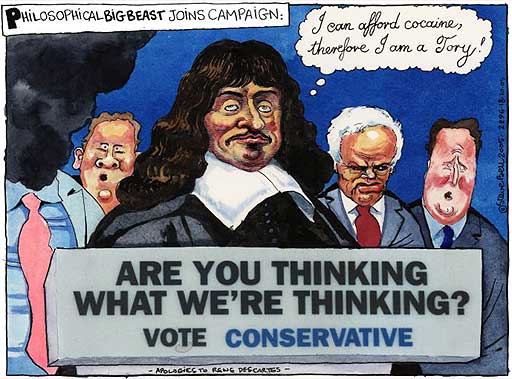
A neat way of linking philosophy and politics isn't it. A bit cheeky perhaps?
A philosophical big beast. Witty, don't you think?
There is a serious point though. The conservative Anglo-American guys are well known for their complacency about the process of elimination of individuality and particularity in modernity, and their comfort with the rationalization of reason, even if they do go on and on about values and morals.
October 18, 2005
analytic philosophy after Auschwitz
I've could not agree more with Dylan's this account of analytic philosophy. Dylan says it very well. Much better than I could in my current flu-ridden state of being. Do go and have a read. He is grappling with a serious issue.
Analytic philosophy in Australia in the second part of the 20th century has traditionally meant scientific materialism: a naturalist, systematic philosophy aligned with natural science, based on a mechanistic metaphysics of nature and science on the path to Truth. So you would not expect it to say much about the Holocaust. Society as such did not exist. Neither did social practice. That was the extent of the reduction undertaken by Anglo-American philosophy as it worshiped at the feet of science. The reduction was so severe that this philosophy did not recognize its own Enlightenment tradition of thinking for ourselves (instead of allowing the priests to do it for us) and its conception of the progressive mastery of nature through science as historical.
Analytic philosophy did eventually develop social, ethical and political philosophies; albeit one's that turned away from the historical. They were seduced by Rawls and a social contract tradition that stripped history away and ended up a bracketing of all the events, all the traumas, of our own history.
Yet philosophy does need to think about itself in the light of Auschwitz in the form of a critical reflection against iself; against its silence and indifference to the hell of Auschwitz. Analytic philosophy sidestepped, avoided or discounted trying to make sense of Auschwitz, even though some of its philosophy courses were about the problem of evil; and even though that form of human savagery---an administrative, industrially organized murder of millions---- could not fit into the caterories of an affirmative philosophy of attaining Truth through science.
Not only were millions murdered but before their extermination their humanity was systematically eradicated while their bodies were left alive. That treatment cannot be detached from the rational method and the industrial means employed. Yet analytic philosophy remains silent. It bracketed history altogether. As Derrida observes analytic philosophers philosophize as if nothing has happened. Derrida says that:
It must be emphasized that this philosophical disinterest or indifference (I do mean philosophical, in philosophical discourse, because some individuals may as individuals be interested in the Holocaust, but they do not integrate this interest in the Holocaust into their philosophical discourse. So, it must be emphasized that disinterest) in the Holocaust often co-habits in American academic culture, probably for reasons of a bad conscience, with a prosecutorial attitude towards the least offence committed by European intellectuals, as the de Man or the Heidegger affairs have revealed.
Or we can add the prosecutorial attitude towards "postmodernism", which is seen in terms of the suppression of reason and the denial of the possibility of truth in the name of philosophy. Derrida spells the ethos of this academic culture out:
That is to say that the Americans, who were basically strangers to what happened in Europe, well, far away, American intellectuals and professors are often de-politicized, unlike many European intellectuals, they are shut up in their academic institutions, and they don't have any space for political intervention, and very often, all too often they are not interested even in the politics of their own country. They concern themselves very little with racism in the United States, with economic deprivation, with the homeless, etc, but are in big rush to set up trials concerning literary fascism in France: the de Man affair, or Blanchot, etc. And I believe this should be seen as a sign of the bad conscience of abstract, powerless intellectuals who often, how should I say it, are not too active in their own country.
And we can add Australian analytic philosophers.
The conversation continues over at Pas Au-Dela
October 15, 2005
Deleuze & desire
If we take the idea of philosophical traditions seriously, then we would have to say that in Australia the original Freudian psychoanalysis did not move from the edge to the center of power, nor did it justify itself as a new structure of order. That may have happened in France in the 20 th century but it did not happen in Australia.
In Australia Freudian psychoanalysis has remained on the edge of medical power. It is psychiatry that stands in the centre of power, even though psychiatry failed to solve the notion of madness, and it stands accused of treating as insane certain people who are not exactly so, and of not seeing in time the madness of others who clearly are.
What we do have in Australia is a whole 'psychopathology of everyday life'. This is the world of neurotics in which psychoanalysis is involved. So we can implicitly align psychoanalysis along with psychiatry with a medical officialdom that psychiatry was striving to become. Both are part of modernity's discourses and institutions which repress desire.
What Deleuze argues is that this officialdom understands desire to be constituted as lack--"the holy castration, the split subject, the death drive, the strange culture of death." Desire from that perspective is a bridge between subject and object: "the subject of desire cannot but be split, and the object lost in advance."
Over against this psychoanalytic-official concept of desire, Deleuze places his idea that "desire is a process. On this account desire does not set up "lack" as its mode and does not seek an object to fill that lack. Deleuze characterize desire as you already have it, but you have to construct it. It is Nietzsche's "will to power."
October 12, 2005
Gilles Deleuze contra psychoanalysis #2
In Dialogues Gilles Dellueze makes a second criticism of psychoanalysis. This concerns the way in which psychoanalysis prevents the formation of utterances.The concept of assemblages is introduced:
Assemblages --in their content---are populated by becomings and intensities, by intensive circulation, by various multipliciities (packs, masses, species, races, popualtions , tribes...).... The collective machine assemlage is a material production of desire as well an expressive chain of expression whose contensts are reltaively the least formalized. Not representing a subject --for there is no subject of enunciation--but programming an asemblage. Not overcoding utterances but, on the contrary, preventing them from toppling under the tryanny of supposedly significant combinations. (p.79)
Understanding concepts in Delueze's philosophy (eg., faciality, virtuality, haecceity, types of becoming, and rhizome) is important as they provide to entry points into some of the issues under examination.
Assemblage is an important concept and it seems to describe multiplicities. Presumably we can have different kinds of assemblages or multiplicities, and we can have assemlages of bodies and matter and assemblages of enunciation or utterance. One conception of an assemblage is an arborescense, which is the model of the tree; which sprouts from a single seed, producing a trunk and continuously branching out, growing and spreading vertically. This kind of assemblage is representative of humanist thought and the belief that humans—through language, science, and art—can represent or reflect the world.
This assemblage is juxtaposed with an assemblage as the rhizome, or rootlike organism that spreads and grows horizontally (generally underground), such as couchgrass. Couchgrass or crabgrass continues to grow even if you pull up what you think is all of it, as it has no center, and just spreads continuously in a constant state of becoming..
Deleuze then says of Freud:
And again, there is what Freud does with little Hans: he takes no account of the assemblage (building-street-nextdoor-warehouse-omnibus-horse-a-horse-falls-a-horse-is-whipped!); he takes no account of the situation (the child has been forbidden to go into the street, etc); he takes no account of little Hans's endeavour (horse-becoming, because every other way has been blocked up; the childhood bloc; the bloc of Hans's animal-becoming , the infinite marker of a becoming , the line of flight or the movement of deterritorization). The only important thing for Freud is that the horse be the father--and that's the end of it.
The result?
All the real-desire has already disappearded: a code is put in its place, a symbolic overcoding of utterances, a fictitious subject of enunciation who doesn't give patients a chance.
October 10, 2005
Gilles Deleuze contra psychoanalysis
In Dialogues Gilles Deleuze makes several criticisms of the Freudian psychoanalysis' conception of the unconscious. The first of these criticisms is this one:
We say, on the contrary: you haven't got hold of the unconscious, you never get a hold of it, it is not an 'it was' in place of which the 'I' must come. The Freudian formula must be reversed. You have to produce the unconscious. It is not at all a matter of repressed memories or even of phantams. You don't reproduce childhood memories, you produce blocs of child-becoming with blocs of childhood which are always in the present...The unconscious is a substance to be manufactured, to get flowing---a social and political space to be conquered. here is no subject of desire any more than there is an object. There is no subject of enunciation. Fluxes are the only objectivity of desire itself. Desire is the system of a-signifying signs with which fluxes of the unconscious are produced in a social field.
I 've always been in favour of, and defended, the unconscious, especially in relation to American ego psychologists and their emphasis on the stability of the ego. I've always interpreted that as a betrayal of Freudian thought. The unconscious, along with desire, was one of the most important of the psychoanalytic concepts. What was needed was a transformative critique of psychoanalysis, not its betrayal; a critique that displaces the traditional idea of a subject (as an ego) and deconstructs the traditional Freudian idea of desire.
However, I've been uneasy with the conception of repressed memories of say sexual abuse that can be recovered in their raw form. It has always struck me that the memories and desires are constructed by us. We interpret what we remember.
October 9, 2005
politics of desire
The title of the post refers to Gilles Delueze and Felix Guattari, and it signifies their assault on the synthesis of Freudianism and Marxism in the 20th century. They see desire as being implicated in all social and political processes. So all social relations are desire relations as well as power relations. Presumably desire is inseperable from power.
That is a different and more fruitful way of looking at desire.
Deleuze+psychoanalysis
From Dialogues, a text in which Gilles Deluze is in conversation with Clair Parnett. In this text Delueze says:
We've only said two things against psychonalysis: that it breaks up all productions of desire and crushes all formation of utterances. In this way it wrecks both aspects of the assemblage: the machinic assemblage of desire and the collective assemblage of enunciation.The fact is that psychonalysis talks a lot about the unconscious--it even discovered it. But in practice, it always diminishes, destroys and exorcises it. The unconscious is understood as a negative it's the enemy. (p.76)
October 4, 2005
reason's death?
You rarely see this kind of stuff about reason in the corporate media, even from cartoonists:
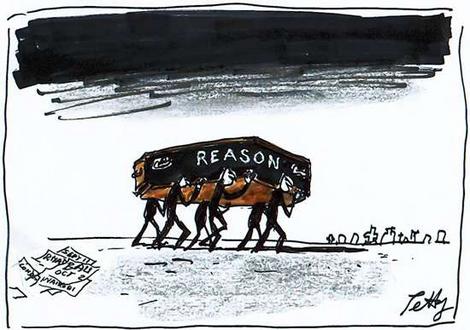
Reason has become historical and badly damaged. For Petty reason has died. KIlled by the Bali terrorist bombers.
That is a deathknell for the progressive narratives of progress through the use of reason. We have reached a turning point; a breach in history.
The Nazi genocide at Auschwitz was much much worse in terms of evil. There seems to be some historical forgetting going on.
October 3, 2005
popularising philosophy #2
I did not realize that Alan Saunder's interview with Christina Colegate on The Philosopher's Zone that I posted on here was continued. It can be found here. What I should say is that the text is less an interview and more a conversation about Colgate's new book, Just Between You and Me: The Art of Ethical Relationships.
In this second part of the conversation we move onto Merleau Ponty. Saunders introduces Merleau Ponty as a critic of Descartes' conception of the subject as a material object in the world:
Maurice Merleau-Ponty was a major opponent of Decartes’ views, and whose own view it was that the body is not an object in the world just like any other, as it is for Descartes: remember that Descartes thought you could as easily doubt the existence of your own arm, as doubt the existence of the table it was resting on. No, for Merleau-Ponty, my body is not an object of knowledge but a knowing subject, my point of view on the world.
The key concept is body image. Colgate says:
One of the central aims of the book [is] to introduce readers to new ideas, not just present philosophy as an old tradition, but also one as a progressing tradition. Bodies are becoming more and more central to the way we understand who we are, how we live, how we move through the world, how we manipulate spaces and leave our mark on it, but also how we are dependent on one another, in our understanding of who we are. So in that chapter my big question is, why are we so dependent on others in the creation of our own body image, to get a sense of what we actually look like?
This theme of not presenting philosophy as an old tradition, but as a progressing tradition challenges what I wrote in the earlier post when I said that Colgate was just populizing classic texts. That interpretation was clearly mistaken. What we have is the critical reflection upon the presuppositions of the Cartesian tradition and, at the same time, proposing new directions.
Do we have a progressing tradition or an alternative one that counters the mechanistic naturalist tradition? It depends whether you are thinking in terms of the French tradition of philosophy, or you think in terms of opposing traditions (eg., the mechanism and organic ones).
A little thought. Are we not Australians with our philosophical tradition? Why is that absent? Why do we not engage with what is our own?
October 2, 2005
interpreting Merleau Ponty
One interpretation of Merleau Ponty holds that he endeavoured to avoid the dualisms of the Western tradition. Whether that be in his affirmation of an embodied intelligence, or the transformational possibilities that perception has for him, Merleau-Ponty has consistently embarked upon the type of project that Kirby is now delineating in only slightly different terms. Rather than being able to separate perception from culture, Merleau-Ponty insists that perception “already stylises,”and in the The Visible and the Invisible he also suggests that what we have termed the object, always encroaches upon us, just as we encroach upon it. Rather than being brute facts in the world objects are capable of the same transformation that are commonly associated with out understanding of culture.
This is the interpretation of Jack Reynolds here in Contretemps.