January 26, 2006
questioning Bergson
These comments by John C Halasz on the post on the previous post were in the comments box. I've posted them here as a weblog post as they are much better than my fumbling post. John says:
'I suppose I should take some fundamental objection to all this. To start with, I don't think one should take objection to and arbitrarily reject the delimited projects of natural science per se, as opposed to taking objection to certain interpretations of natural science,- (regardless of whether those interpretations are held by practicing scientists or not),- specifically, those that operate along deterministic/reductionistic/instrumentalistic lines. And whereas I wouldn't want to assert the exclusive validity of natural science as a way of knowing the world,- (as opposed to its delimited validity, in a more-or-less Kantian/Wittgensteinian sense, that is, a validity founded on a specific awareness of its limits),- and I wouldn't want to revert to the attitude that Horkheimer famously dubbed as "traditional theory", (though especially with an eye toward social scientific theorizing, even if the Cartesian mindset as a whole was implicated), I would still hold to the case for the intrinsic value of natural scientific theory, as both a source of validity and an end-in-itself, for not only does it permit an understanding of the pre- and extra-human world, without any appeal to a transcendent deity or a destiny of Being, but it also serves to inform our understanding of the place of human beings and their societies and their role and effects within that world. (It is most especially the ecological awareness that derives from such research, especially now that we are faced with "global warming", and the rather terrifying potentials for "non-linearities" that might ensure, that needs urgently to be re-enforced.)
Bergson might have taken objection to what he understood of Darwinian theory, but it's worth pointing out that Darwinian theory, evolution by natural selection, was not really fully established at that time. It was only when not only Mendelian genetics was rediscovered, but also statistical population ecology was worked out that "Darwinism" successfully "won out" over potential competitor theories, as possessing superior explanatory resources for the productive pursuit of empirical research. But even the Neo-Darwinian synthesis of the 1930's, though a significant milestone, is hardly the last word, and, in fact, within the broad Darwinian paradigm, there is ample room for different and conflicting or competing interpretations and approaches, (which disputes, to my mind, at least, is a far more interesting set of issues than efforts to reject or "refute" evolutionary theory, such as ID, a ridiculous obfuscation/exploitation of human anxieties about "purpose" in the world, which advocates of Darwinian evolution are only remiss in not disentangling, while delimiting the specific bases of validity of their research.
Between the two bad alternatives of metaphysical/theological teleology and deterministic causal immanentism is the entirely viable option of teleonomic accounts, or neo-vitalist revivalism, which seems to derive from confusion about the stakes involved with respect to human freedom and its material substrates, since a causal explanation of a capacity is obviously not a causal determinism with respect to that capacity, while an explication of the constraints involved is not the erection of some sort of permanent barrier, but rather an explication of the pathways and real possibilities of their transformations or transcendence.)
Now, to be sure, there nowadays is a lot of hard-line Darwinian fundamentalism abroad, especially in popularizing writings, (which is only a particular instance of the general communicative problem of the relation between the currently established results of specialized scientific research and the formation of generalized cultural understandings). Most especially, there are efforts, along the axis of Richard Dawkins, Daniel Dennett, and Steven Pinker, to renew and extend the traditional,- (and, to my mind, largely discredited),- project of "ontological naturalism/epistemological representationalism". Dawkins, the only real biologist of the three, is known for his gene-selection theorem, which claims that genes,- rather than the phenotypes of whole organisms, as in traditional Darwinism,- are the actual objects of natural selection, as if genes would have, as it were, an independent conative drive.
However, even leaving aside the absurdly reductionist claims in his pop writings that whole organisms are the means for the reproduction of genes,- (rather than genes being the highly conserved "memory" of natural selective processes, else it would be rather like the CPU processing memory and the cold-storage disc drive memory of one's computer being all mixed up with one another, i.e. highly and destructively unstable),- and that the genome, since we have a clear analytic knowledge of its chemical units, their composition, structures and some of the resultant reactions, is thereby a digital code, as if per se non-intelligent chemical reactivities could be an instance of digital processing, whereas, in actual fact, the genome interacts with the cellular metabolism in multi-directional and highly context-dependent ways, in actual fact, further research has revealed that "transpositons", bits of DNA that implant themselves ad hoc onto other portions of the double helix are so common that the real question for research is now how does the genome suppress such effects and repair itself so as to effectively preserve its regulatory and reproductive effects.
Dennett, leaving aside that his book "Consciousness Explained", as several reviewers have noted, would better have been titled "Consciousness Explained Away", since its account is essentially epiphenomenalist and, while confusing the criticism of dualist accounts of consciousness as an epistemological foundation with the separate task of explaining consciousness as a real phenomenon, actually provides no account of the emergence of consciousness as an evolutionary real, that is, as something that emerged under specific selection pressures because of real, i.e. behavioral, effects and advantages, goes on to claim, as an extention of his account of consciousness, whereby he himself commits the fallacy of an inverted "sky-hook", i.e. projecting onto the world one's preferred account of "mind", that he reproves in others, that evolution is an "algorithmic processes", which is an awfully odd way to describe biological reproduction.
But that's not just odd, but exactly wrong, since an algorithmic process involves the reiteration of fixed rules, the reproduction of the same, whereas the whole point of natural selections is that there are no fixed pre-established rules and, further, that selection requires the maintenance of sufficient diversity/variation in a population to permit the continuation of selective effects,- (which is one of the reasons for the predominance of sexual modes of reproduction). Pinker, with his claims for a science of "evolutionary psychology", requires an account of "mind" in terms of strict strong modularity, in order for cognitive functions to be specifically selected for in unit-like fashion, which Jerry Fodor, the inventor of the notion of cognitive modularity, would reject, as without any empirical warrant. Further, he has to assume that cognition is strictly reducible to a set of functions and that those functions strictly subserve adaption. This ignores the fact that neural systems originally evolved for physical and physiological reasons that have nothing to do with so-called "mind" or cognition, that any emergent mental or cognitive capacities evolved in continous interaction with physiological and behavioral processes rather than as independent functions of adaption, and that the emergence of such features themselve bring about modal shifts in the environment being adapted to.
The upshot here is that these supposedly "hard" Darwinian accounts, reductionist, genetically determinist, strict adaptionist, cognitively functionalist, are not, in point of fact, Darwinian at all, since Darwinian accounts are selectionist, involving contigent selections among large and statistically variant populations to generate the information that allows for the co-variation between organisms and environments that otherwise does not exist. Rather these accounts are instructionalist, taking their cue from artificial digital-processing devices, which presume both a prior set of independently, externally defined functions and a "transparency" or pre-established harmony of environmental information as an "input".
The broader upshot here is that I think the worry about the broader Darwinian paradigm and its fields of application and research as mechanistic and reductionistic is misplaced, and, at least, something that can be contested within the Darwinian field. The supposed logical principle that from a suitably specified cause an effect necessarily follows can hardly disallow the fact that there are many emergent levels and types of causal processes, and that biological causality is circular or cyclical, intricate and complex, and multi-level and often non-linear, I think, is widely recognized by many practitioners in the field. Specifically, I think worries about genetic determinism are misplaced. As Ernst Mayer, one of the chief architects of the Neo-Darwinian synthesis, who was originally educated as a German vitalist, pointed out, it was pre-molecular Mendelian genetics that was wont to be strictly deterministic, since, lacking any actual knowledge of the genetic mechanism, all it could go by was unit-phenotypes traced to purely hypothetical genes.
But now, not only can we understand how multiple genes can contribute to a phenotype and how a single gene can have multiple phenotypic effects, but, aside from understanding the only direct effect that genes actually have, producing RNA sequences to manufacture various proteins, we can investigate the interaction between genetic regulations and metabolic processes at various levels, which are by no means a one-way street or conducive to unitary/reductionist explanations. In fact, the latest thing nowadays is "evo-devo", the program synthesizing evolutionary theory and molecular genetics with developmental biology, (i.e. embryology). Its adherents claim that evolutionary change results less from specific isomorphic chemical mutations in individual genes than from changes in the regulatory cycles that determine gene expression and the variable production of proteins in different regulatory regimes or cycles. (In fact, there is empircal evidence in specific instances for both kinds of changes.) At any rate, the reductionist notion of genes as a master blueprint determining all life processes is almost certainly mistaken. The central importance of genes, or, more generally, the DNA/RNA complex,- (and it seems that the RNA complex is the older and more original),- is the bald fact of template reproduction, as providing a basis for the metabolic cohesion of life processes.
But some further considerations of the explanatory resources of biological science within a broadly Darwinian framework, (though, obviously going beyond the original resources and vision of "The Origin of Species"), should rebut the charge that it can not account for the proliferation, diversity and differentiation of life processes, (leaving aside the dubious distinction between "external" and "internal" understanding- relative to what?) In the first place, the opposite of determinist explanation is stochastic processes, that is, explanation in terms of probability distributions, which extends well beyond the means that Darwin would have had at his disposal. (His nephew Francis Galton was to subsequently extend the development of statistical methods, though with a somewhat nefarious purpose in mind.) The upshot is that life processes are negentropic organizations, which "violate" the second law of thermodynamics, positive entropy or "heat death", the reversion to the lowest energy equilibrium possible. But that just means that an increase in the negentropic organization of organisms can only occur on the basis of an increase in the positive entropy of their environment, that is, through feeding off of energy sources in the environment. In fact, metabolism can best be described as the structured organisation of positive-entropic processes which release energy to build and reproduce negentropic structures that control the release of such energy. But, obviously, organisms tend to find and derive their energy resources by feeding off of other organisms in their environment.
The upshot here is two-fold: 1) organisms can only emerge and evolve in a more or less diversified bio-sphere, in which other organisms form a good part of the environment of any given organsim, for better or for worse; and 2) a biosphere can only emerge and develop under conditions of quasi-permanent thermo-dynamic disequilibrium. The upshot then is that the emergence and evolution of a biosphere as a whole not only permits the further emergence and evolution of more complex forms of life-processes provided only that large populations of less complex organizations persist, but precisely tends toward diversification and differentiation of organisms and their environmental niches, provided one takes into account three principles that supplement natural selection in the narrow sense: namely, symbiosis, co-evolution and self-organization. And self-organization is not especially a biotic or "vitalist" process. For example, drop some limpids into a container of water and they will form folded rounded shapes. Why? Because they revert to the lowest energy state with respect to their surface tension- standard thermodynamics. But limpids, of course, are the stuff of which cell membranes are made. In other words, biological or metabolic life-processes build over and chain into their organization the already self-organized and structured features of their physical environments, such that, not only are biological processes themselves not fully alive, but the self-organized features of their environments are already a statistical ground for their diversified and divergent evolution.
At any rate, though explanatory principles or, better, ground-rules are essential both to guiding empirical investigations and to developing a basic understanding of the nature of the fields or domains to which they are applied, I would strongly hesitate to hypostatize them ontologically, as if they could provide not just a distinctively limited basis of achievable intelligibility, but a source of vital or cosmic action itself. Still less do I think that they can be uncovered and deduced metaphysically from some buried ground, even if that ground is one of non-identity and unsupercedable difference. That still reeks too much of the fallacy of the Ontological Proof.'
John C Halasz
January 22, 2006
Bergson, evolution, critique
I think that Bergson's critique of Darwin's theory of natural selection is on the right track. It opens up a critical way of thinking about evolution in which we can locate the turn to vitalism. The creative agency of nature according to Darwin is natural selection and adaptation, with neo-Darwinism putting genetic mutation into the picture. Evolutionary theory is very gene-centered, as it is increasingly wedded to the notion that ‘life itself’ inheres in DNA, and that the range of possible genetic configurations represents the field of life’s possible forms.
Bergson had argued that natural election forms a purely external principle of difference capable of operating only on constituted forms. Such an external principle cannot by itself account for the proliferation of life. What is also required is an internal differentation within the organism that is a process of individuation that precedes, and gives rise to the constitution of individuals. Becoming is a key aspect of the critique and it challenges the mechanistic claim that becoming can be reduced to a series of states.
This review by Stephen Doughty of Gregory Dale Adamson's Philosophy in the Age of Science and Capital (2002) has a good quote from Adamson:
Metaphysics begins, Bergson argues, at the limits of science. From Newtonian dynamics to fractal geometry and chaos theory, matter is regarded as atomistic and change is conceived outside the subject. Although quantum mechanics, for example, suggests an indivisible continuity coexists the atomistic model, the wave function serves merely to bring 'unpredictability' into the 'discrete' realm of atomic positions. It is the external subject who renders continuity radically ulterior and all attempts to bring time into science, from Einstein to Prigogine, manage only to edge closer to the infinitive of experience. The metaphysics of time and change must begin from experience in order to determine that which can only be experienced. It is only within time that the duration of thought itself can be apprehended as well as expressed.
Doughty remarks that Bergson's insistence that science knows only time without change, or rather, time as space, was fundamental to his entire philosophical project.
Doughty then asks: 'But why does science spatialize time? Why does it reject that the continuity of lived time has any relevance for its own methods and procedures? '
He says that Bergson argument is that:
"...it is because the scientific pursuit is based on the principle of mechanism. From the scientific perspective the universe is a machine whose operations can be defined, quantified, and predicted. Thus science provides human beings a degree of control over the material world that pre-scientific societies could only dream of. However, for Bergson this doesn’t change the fact that the universe is not a mechanism, and that time is not space. And if the tremendous success of science culture has always been contingent on a willful refusal to acknowledge the unpredictable and unquantifiable force of time, that doesn’t mean that philosophy should play along, or that human beings insofar as we are born philosophers, creators and interrogators of concepts, should cede to science the exclusive claim of knowing the world. "
Hell, there's Deleuze's conception of philosophy.
So what we get is the view that challenges a mechanical conception of nature with a nature vitally alive with the forces of becoming.
Bergson, vitalism, Deleuze
Once again I've been having connectivity problems.
Deleuze's vitalism, or philosophy of life, has its roots in Bergson's metaphysics; or rather it is based on a critical engagement with evolutionary thinking that is rooted in Deleuze's rehabilitation of Henri Bergson's 1907 Creative Evolution and its conception of the élan vital.
On Deleuze's interpretation Bergson's ' élan vital ' introduces an explosive force internal to the process of evolution is internal difference. So differentiation as a process of actualization. Bergson is critical of natural selection, the core principle of Darwinism, which explains evolution in terms of an external principle of differentiation. Bergson's creative evolution furnishes an alternate understanding of differentiation: in which evolution follows an internal principle of differentation that explains genetic change .Life expresses itself as the play of a virtual creative evolution involving divergent lines of actualization.
Bergson's organic metaphysics or vitalism reworks Aristotle to hold that objects are composites, mixtures of a number of tendencies. Giovanna Borradori spells this out. She says that Bergson holds that things:
"... are not self-contained substances, independent of time and becoming, but "phases" of becoming itself. In other words, a thing is not the effect of a cause but the expression of a "tendency." A tendency is a phase of becoming. Is there a correspondence between a thing and a tendency? Not a one-to-one correspondence because things are composites (des mixtes) of at least two tendencies. A tendency can express itself only insofar as it is acted upon by another tendency and, therefore, tendencies never come isolated from one another but always in pairs."
According to Borradori Deleuze argues that Bergson encourages us to address not the presence of characters, but the tendency they have to develop them.
She says:
"When we describe a thing we usually group together set of properties. This is a mistake. We should focus on the emerging properties, or rather the tendency that a thing has to develop some properties or characters. It is these which differ in kind; their expressions, that is, the things and their properties, differ only in degree or intensity... Internal difference does not describe difference among things, but difference among the very tendencies that the individual thing brings to a certain degree of expression."
Hence the idea of internal difference :eparating out the tendencies means to intuit that at the bottom there is just difference and not identity. What Bergson showed, on Deleuze's interpretation is that internal difference does not need to get to contradiction, alterity or negation, because these three notions are either less deep than internal difference itself. Bergson's vitalism holds that things as composites of tendencies, qualitatively vary in time.
What Deleuze then does is rework Bergson's conception of objects. If for Bergson things were composites, mixtures of a number of tendencies, then in Deleuze's Nietzsche book they are expression of forces .Forces are antagonistic to each other, come in differentiated pairs, like tendencies, and form a multiplicity which is an irreducible plurality.
January 19, 2006
Deleuze on vitalism
As we know, the early Deleuze was sympathetic to Bergson's notion of the élan vital---Deleuze accepts this model of creative evolution as part of developing a metaphysics (for contemporary biological science?) The élan vital introduces an explosive force internal to the process of evolution (an internal difference?) .
I guess that what we have here is a biophilosophical model of the idea that development involves dynamical processes. It is an old (Hegelian) idea that seems to have been recovered. Only we have "internal difference" instead of contradiction as the dynamo, with Deleuze arguing that it is the subsumption of difference to negation which is the major mistake of the dialectical tradition.
In the Conclusion to his What is Philosophy? Gilles Deleuze addresses the issue of vitalism. He says:
Vitalism has always had two possible interpretations: that of an Idea that acts, but is not---that acts therefore only from the point of view of an external cerebral knowledge (from Kant to Claude Bernard); or that of a force that is but does not act--that is therefore a pure internal Awareness (from Leibniz to Ruyer). If the second interpretation appears to us to be imperative it is because the contradiction that preserves is always in a state of detachment in relation to action or even to movement and appears as a pure contemplation without knowledge. This can be seen even in the cerebral domain par excellence of apprenticeship or the formation of habits: although everything seems to take place by active connections and progressive integrations, from one test to another, the tests or cases, the occurrences, must as Hume showed, be contracted in a contemplating "imagination" while remaining distinct in relation to actions and to knowledge. (p.215)
I'm not sure what to make of that. It's left me non-plussed. I thought that Deleuze was more materialist than this, more Nietzschean than Humean, and more inclined to think in terms of a field of conflicting forces. I also presumed that he was more inclined to vitalism as "goal directed activity of organic life", rather than the romantic "mysterious vital force" and understood the former in terms of complexity theory's understanding of self-organizing material systems.
Maybe I miss what is meant by Idea --it sounds very Kantian and transcendental. Maybe it has to do with Deleuze's conception of philosophy as a problem solving activity that involves solutions to particular problems and and the act of thinking in the constitution of problems. This is beginning to sound like Hegel.
Hence vitalism is a problem that requires a solution involving the creation of concepts to make sense of 'vitalist life-forces, movementor flux, vigour, immediacy, connectedness, metamorphosis or change, and 'becoming' ie., the way we are immersed in country in the sense that bodies and landscape flow back and forth into one another.Vitalism has been recoded as flux and uncertainty and heterogeneity.It is a concept that refers to multiplicities subject to mutation and constant becomings.
January 17, 2006
Heidegger: world disclosure#2
I've had little connectivity these last few days.
So another quote from the paper by Nikolas Kompridis entitled Heidegger's Challenge and the Future of Critical Theory that I came across on the sidebar of Habermas Reflections. Kompridis says of Heidegger' s account of world disclosure:
In his later philosophy, Heidegger's account of world disclosure takes a "linguistic turn" -- or, rather, makes this turn in an ontological rather than in a semantic-logical direction. Breaking with the conception of language in Being and Time, where language (Rede) opens up or uncovers in a different light something which has already been disclosed independently of language (through concerned involvement with what we encounter in the world), the later Heidegger attributes to language a "primordial" (ürsprunglich) world-disclosing function. It is language which first discloses the horizons of meaning in terms of which we make sense of ourselves and the world. Although the notion of linguistic world disclosure has been traced back to Herder's and Humboldt's theories of language, and is certainly implicit in Nietzsche, the challenge contained in this notion is first formulated in its most original and radical terms by Heidegger. Heidegger not only lingustifies disclosure, he historicizes it as well, making possible accounts of the formation and transformation of historical epochs by tracking changes in ontologies (changes in the "understanding of being").
The idea that language discloses the horizons of meaning in terms of which we make sense of ourselves and the world is rather appealing and useful.
January 12, 2006
Heidegger: world disclosure
A quote from this paper by Nikolas Kompridis entitled Heidegger's Challenge and the Future of Critical Theory that I came across on the sidebar of Habermas Reflections.
Heidegger's various analyses of the phenomenon of world disclosure -- of In-der-Welt-Sein, Lichtung, Gestell, and Ereignis -- represent his central contribution to 20th century philosophy. Through these analyses Heidegger developed an original critique of, and an original alternative to, the representationalist epistemology and the naturalistic ontologies of modern philosophy. He marshalled important new arguments (both transcendental and hermeneutic) against mentalistic accounts of intentionality, against views of agency as disembodied and disengaged, and against "deworlded" conceptions of objectivity and truth. In Being and Time and in The Basic Problems of Phenomenology, Heidegger argued that prior to confronting the world as though it were first and foremost a physical object, or as though it were identical with nature, prior to establishing explicit epistemic relations to the world "out there," we always already operate with a pre-reflective, holistically structured, and grammatically regulated understanding of the world. (And so our theoretical understanding of the world always refers back to, as much as it draws upon, a concerned practical involvement with what we encounter in the world.) The notion of world disclosure refers, in part, to this ontological preunderstanding --- or understanding of "being." Heidegger's investigation of conditions of intelligibility -- of how something can show up "as something" in the first place -- took up the radical mode of questioning initiated by Kant's transcendental deduction, but cut much deeper than the epistemologically-curtailed and monologically-framed question of conditions of possible experience. One of the hugely important conclusions of his investigation is that if there is to be any understanding of something "as something" at all, "[u]nderstanding must itself somehow see as disclosed, that upon which it projects."
That strikes me as pretty right.judgement about Heidegger.
January 11, 2006
mechanism & vitalism
A nice quote from here about machine metaphysics in science:
Over the past decades, the machine metaphor has invaded the language of biologists. In the early times of molecular biology, such metaphors were exclusively used for DNA transcription and translation. Nowadays each entity active in the cell is described as a machine: ribosomes are assembly lines, ATP synthases are motors, polymerases are copy machines, proteases and proteosomes are bulldozers, membranes are electric fences, and so on ..... Although biologists generally agree that living systems are the product of evolution rather than of design, they describe them as devices designed for specific tasks. Indeed, if biology can teach us about engineering and manufacturing, it is because the living cell is now viewed as a factory crowded with numerous bionanomachines in action. At the same time, in chemistry and materials science, machine metaphors have also become prominent. One major objective of nanotechnology programs is to build nanomachines that will do a better job than conventional machines. As they seek to design functional materials, physicists and chemists readily redefine the product of their design as machines: wheelbarrow molecules, cantilever molecules, springs, and switches are specimens of the inventions commonly reported in materials journals.
Thus the languages of molecular biology and materials science converge in a stream of machine metaphors that indicate a common paradigm based on a mechanistic] view of nature. Some go so far as to argue that if you look inside cell machines you will find smaller machines that cause disease. Machines causing death? Where does that leave obesity, stress and lifestyle-related illness?
This mechanistic concept of life is held to refute vitalism because biology can give chemical and physical explanations for every aspect of living cells, and so vitalism is akin to superstitution or a metaphysical belief in a lifeforce. Welcome to the return of positivism. There is little acknowledgement that a machine understanding of nature is also a metaphysics:
[Eric] Drexler and his supporters have developed a concept of machine that combines an old mechanistic model inherited from Cartesian mechanics ---a passive matter moved by external agents---with a more recent computational model of machines inherited from cybernetics. Both the mechanistic model and the cybernetic one rest on the assumption of a blind mechanism operating without intentionality under the control of a program. Biological evolution itself is conceived of as a blind mechanism operated and controlled by an all-powerful algorithm.
These guys see themselves are doing hard science, not metaphysics; and a conception of a hard science that has its roots in quantum physics.
Though worlds collide we do not have to accept the reductionist construction of vitalist conception fo life as presupposing an occult force; or as a reworking of the Cartesian conception of non-physical substance. We can argue that a biological organism has inherent activity, an intrinsic dynamis allowing the construction of a variety of forms (or geometrical shapes such as helix, spiral, etc.). We can refuse the construction of vitalism as standing for an obscure and mysterious vital force, a breath, or animus that would come from the outside to give life to inanimate matter; argue that a machine metaphysics of science ignores inner dynamics and power at work in living organisms; argue that biological activity such as sentient life is intrinsically goal-directed that mechanism over looks this; and that the mechanization of life is inseparable from a project of instrumentalization of life and control over nature.
Mechanism assumes the conception of life of Cartesian mechanics --- passive matter moved by external agents---and suggests that vitalism requires extrinsic goals to explain sentient life. It interprets this by replacing the classic religious account of external agent and extrinsic goal as God with that of a mysterious vital force. That representation makes vitalism anti-evolutionary, as explanation in mechanism had replaced God with natural evolutionary processes.
What is overlooked by this account is the emphasis on intrinsic goal directed activity of organic life. This is what demarcates the living out from the non-living in biology as it became an autonomous discipline in the 19th century.
January 9, 2006
Blanchot:--Writing the Disaster
Maurice Blancht's The Writing of the Disaster is a philosophical inquiry into the Holocaust that seeks to understand the significance and meaning of the Holocaust independent from the empirical fact of its historical occurrence.
The holocaust, the absolute event of history---which is a date in history-- that utter-burn where all history took fire, where the movement of Meaning was swallowed up, where the gift, which knows nothing of forgiveness or of consent, shattered without giving place to any-thing that can be affirmed, that can be denied How can thought be made the keeper of the holocaust where all was lost, including guardian thought? (WD 47)
Jennifer Yusin says that Blanchot's claim that the movement of Meaning was swallowed up suggests the absence of meaning. What Blanchot suggests, however, is not that meaning was first present and then erased throughout the course of the Holocaust, but rather that meaning was absent, in the first place, from the event of the Holocaust.
January 8, 2006
art as disclosure
Some quotes from here which I am going to contrast with this kind of work and then leave you with a question.
First, these remarks made in an account of Timothy Clark's Martin Heidegger, a text in Routledge's Critical Thinkers series. The remarks below are on Heidegger's big thesis about the world picture of modernity, wherein contemporary life is caught within the instrumentalist/technological mode of being:
If Plato is the beginning of Western thought, then that beginning, Heidegger says, is still with us. Indeed it is "before us" like a predestined future. We still see the world as an object of knowledge to be understood, manipulated and utilised. It is an anthropocentric attitude that has profound consequences. Heidegger claims it set us on course toward nihilism. Eventually, everything is geared towards selfish aims with no regard for the earth or the people in it. This seems to contradict our faith in progress. As while we celebrate humankind's progress in science, medicine, technology, culture, we also lament the sublime disasters that have interrupted it. Yet "interrupted" is one of those evidences of "self-evident" truths we adopt to avoid the possibility that these disasters were a necessary part of "progress".
Some say that what stands against this technological mode of being is modern art. For Heidegger a great artwork gathers together an entire culture in affirmative celebration of its foundational 'truth', and that, by this criterion, art in modernity is 'dead'. The remarks e say that on Heidegger's account:
"art [has] shrunk to only a medium of aesthetic pleasure, a distraction from the Real World. Heidegger says art died (and turned into aesthetics and business) because it was unable to preserve its "world-soliciting force". This means the work NOT as a re-presentation of the world but as the revelation, the disclosure, of that world in the first place. Heidegger detects such a disclosing force of Greek temples (see his famous essay "The Origin of the Work of Art").
So Heidegger turned to the poets Holderlin, Stefan George, Rilke and Paul Celan because "poetry is itself a mode of language that engages [nihilism] by enacting the possibility of other, non-appropriative ways of knowing. Alas if these poets renewed art, then 'it is clear that it is, in its Lazarus state on the web and marketplace stall, still close to death. Literature has been appropriated by the very forces it should be resisting: technology and capital.'
Maybe. I've no way of judging. But Blanchot judges that even if art (literature presumably) is not be dead we are exiled from it. Only a violent misappropriation can bring it into the Real World.
My question is: why cannot we turn to the painters? For us in Australia it is the contemporary Aboriginal painters who make sense in terms of the Heideggerian problematic:
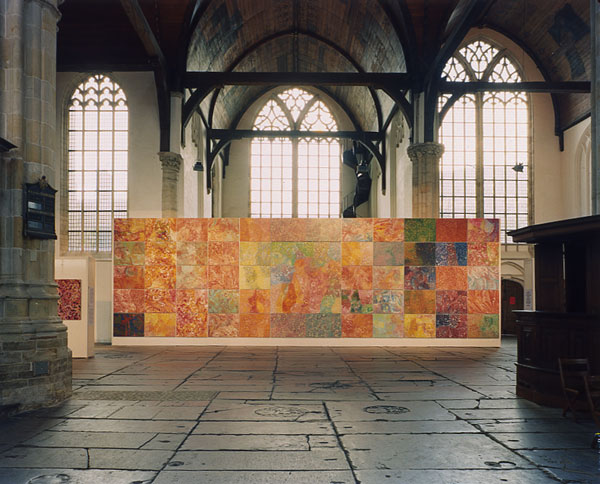
Emily Kame Kngwarreye, The Emily Wall: Oudkerk Exhibition, 1994, Acrylic on canvas
Is not this painting a mode of language that engages [nihilism] by enacting the possibility of other, non-appropriative ways of knowing to that of a technological mode of being? Should we not put into question Heidegger's notion that our alienation from nature is due to instrumental theoreticism, and that only poetry can redeem the situation?
We can ask: why only poetry? Is not this a very different representation of landscape as country?:
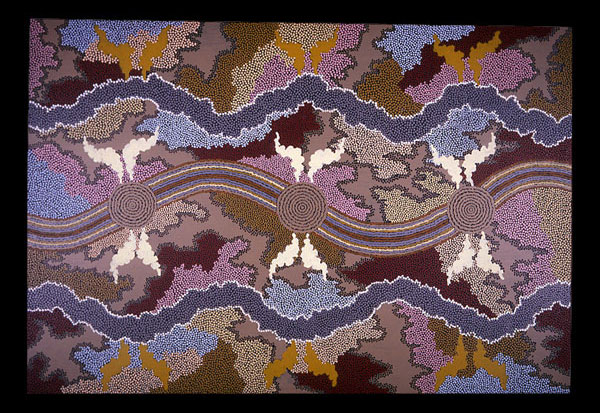
Clifford Possum Tjapaltjarri, Corkwood Dreaming, 1991, Acrylic on canvas
Is this not a "homecoming" to the earth as Heidegger saw it? Poetically man dwells upon this earth’, says Heidegger. Is that not Clifford Possum? Is not this painting of the earth? Is not Clifford Possum or Emily Kngwarreye dwelling poetically on their earth in a time of destitution? Existence for them means to dwell. Levinas says:
To dwell is not the simple fact of the anonymous reality of a being cast into existence as a stone one casts behind oneself; it is a recollection, a coming to oneself, a retreat home with oneself as in a land of refuge, which answers to a hospitality, an expectancy, a human welcome.
For Possum and Kngwarreye their country is their home.
living with Heidegger and dread
This description of Adelaide in the summertime heat indicates why I have an affinity with the Heidegger of dread, anxiety and existential crisis:
It was February and 40 degrees. I looked outside through the full-sized smokey balcony: an abandoned fruit market, scorching tarmac, not a soul in the street, empty vague buildings and above them, a mercilessly still sky, meltingly grey-blue. It took my breath away. I could not cope with this, this emptiness without a sense of time or a feeling of space to give a meaningful framework to what I saw. [...] There too it was Sunday afternoon, about four o'clock, and I thought that something would snap in my head and start bleeding and make me crazy forever, so confused and empty and without meaning did I feel.
Only a fool would go onto the streets in the searing heat of 40 degrees during a heat storm when the north wind is blowing hard down from the desert. if you you have a sense of nothing
And the houses are not much better----especially when the airconditioner has packed it in, like ours. Today is a scorcher. It is a bare life, period.
Nothing is what produces in us a feeling of dread (angst}. That this deep feeling of dread is a most fundamental human indication of human life isexperienced in Adelaide in summertime. It reminds us that we know that we will die (as many seniors do) , and so the concern with our annihilation (from fire or heat exhaustion) is an ever-present feature of human experience.
January 7, 2006
vitalism, healthcare, medicine
As I mentioned earlier chiropractic has been known as a vitalistic health care approach, as opposed to the mechanistic paradigm adopted by the medical profession. This is so even though, for many years, in an attempt to mimic the medical profession, some chiropractors have abandoned the vitalistic character of chiropractic in favor of one focused on musculoskeletal treatment only.This quote sums this situation up:
I find it interesting that chiropractic was developed on vitalistic principles, and somewhere along the way that principle was replaced by musculoskeletal therapy. As a result of this shift the public largely views chiropractic as offering musculoskeletal pain therapy only. At a grass-roots level, chiropractors like myself have to work our butts off re-educating the public of the true potential of chiropractic."
If vitalism is an integral part of chiropractic healthcare, then what is 'the vitalistic character' of chiropractic health care? What does vitalism mean? Is vitalism part of an old 19th century debate that has been left behind by recent developments in biology?
We know that vitalism means the mechanism vs. vitalism debate, and that mechanism meant that the universe was a giant machine, set into place by mere chance and sheer accident, and that there was no purpose in nature, and no design of nature by God. We know that vitalism is a response to the flaws of the mechanistic models of the body that have dominated medicine.
What then is vitalism?
One account---the romantic one-- holds that vitalism is the notion that living organisms possess some unique quality, an élan vital, that gives them that special quality we call life. Does it mean a teleologist position that posits a mystical entelechy or life-force possessed by living things that constrain the action of living entities? On this account the actions of an organic entity that constitute teleological causation are governed by laws that transcend the laws governing mechanical process -- those atomic, molecular, and cellular processes which can be described entirely in the mode of mechanical causation.
The "life force" or "spark of life" that is separate from its physical existence is what demarcates living from non-living being. Illness is caused by a disturbance to the body's vital energy and the cure is to restore balance to the flow of vital energy.
Often this romantic conception is a part of a pantheistic world-view (ie., where God is the universe rather than being separate from it). Then vital energy is thought of as a natural life force that pervades nature or the universe. pantheist assumptions the flow of energy from an externalized source, (Universal Intelligence or God) An eternal "metamerized" portion of that intelligence, referred to as Innate, is needed by each individualized being. Although Innate is not localized, its seat of control is the brain. From the brain, Innate’s intelligence travels down the spinal cord, and from the spinal cord outward to the periphery.
That 19th century account indicates we are dealing with the philosophy of biology that accounts for the unitary nature of a living organism the philsophy of
science, and the history and philosophy of medicine. We can interpret vitalism as a reworking of the tradition of an organic metaphysics that can be traced backed to Aristotle, his conception of a purposive natureand an integrated functioning organism. It also suggests that there may be alternatives to vitalism within organic philosophy; that vitalsim is just one current within the organic tradition, the philosophical criticism of mechanism, and the application of mechanism to the human body.
We can dig this out by this kind of questioning. In what sense exactly is the whole organism more than the sum of its parts? Vitalists assert that some non-physical entity, force or field, must be added to the laws of
physics and chemistry to understand life. Organismic biologists maintain that the additional ingredient is the understanding of ‘organization’, organizing relations, or self-organizing.
Another account, that of emergentism addresses the elimination of teleology by mechanism. It holds that the capacity of an organic entity act in a goal-directed way is not a mystical property, but an emergent property of matter -- a property of biological entities qua organic unities. It is a property possessed by the entity as a whole, but it is not a property had by any of the parts. This understanding of the emergent property of being-a-goal-directed-entity is a reworking of Aristotle. Goal-directedness is a capacity of a living organism as a whole, a capacity that emerges from a complex interdependency among its parts, and a particular goal-directed (life-sustaining) action or process is the realization of an entity's capacity for goal-directed action (sustaining its life).
Hence vitalism is just one stand within the organc philosophical tradition.
.
January 5, 2006
Heidegger's 'Plato's Sophist'
I pretty much agree with this statement made by Jasmin Chen in a review of Martin Heidegger's Plato's Sophist:
Yet it is this early section of the lecture course which has most immediately guaranteed the Plato's Sophist's relevance for Heideggarian scholarship. Indeed, it is generally accepted that Heidegger's theory resonates much more clearly with Aristotelian philosophy than with Platonic ideas....which is reinforced by the striking resemblance his preparatory reading of the Nichomachean Ethics bears to the fundamental structure of Being and Time, revealing the particularity of Heidegger's indebtedness to Aristotle. In this respect, Plato's Sophist has been taken up in support of the growing consensus that Heidegger is ultimately most influenced by Aristotle's "practical philosophy", to the extent that commentators such as Franco Volpi and Jacques Taminiaux argue that within Heidegge''s interpretation of Book Six, "what he takes to be Aristotle's ontology of Dasein .... indicate[s] the very structure of Heidegger's own analytic .... which is the first stage of his fundamental ontology."
Plato's Sophist is a reconstructed transcript of a course on Plato's Sophist offered in the Winter Semester of 1924-25 by Heidegger just prior to the publication of Being and Time. The text is in two parts; the first treats Book VI of Aristotle's Nicomachean Ethics, whilst the second Plato's Sophist where Plato is cioncerned with the whole--- the notion of being.--as the whole of things, what the world, the cosmos is, including non-being’as a form of Being.
Heidegger's concern is to discover a pre-philosophic way to understand the character and nature of Being through an hermeneutical examination of the western philosophic tradition on the question of Being. That involves a questioning of what the tradition of philosophic scholarship holds Aristotle and Plato to have taught. It indicates how philosophy for Heidegger was in its doing, that for him, philosophy belonged to those who questioned and who didn't write historiological tracts but engaged the material as matter to be thought. Hence the significance of this quote:
'For manifestly you have long been aware of what you mean when you use this expression "being." We, however, who used to think we understood it, have now become perplexed.'Plato, Sophist
Heidegger's way of reading the Western philosophical tradition is not in a spirit of reverence, nor does it have the aim of repetition; instead, it is an attempt to dismantle philosophical concepts, to loosen them from their sedimented and hypostatized strata so as to free them up for a radical kind of retrieval that rethinks their meaning within an ontological perspective that dispense with the whole notion of any subject-centered "perspective" and recovers a certain way of being-in-the-world. It is reading in a highly agonistic manner; a twisting, displacing, and reinterpreting the thought of Aristotle and Plato in ways designed to illuminate a range of exceedingly Heideggerian issues.
And so Heidegger approaches Plato through Aristotle. Though the pathway to Being is truth ---as a disclosing, a-forgetting, something that is revealed to the seeker---we approach this through phronesis, which deals with human choice and human action in relation to how one best lives one's life. It is in the question of living well that is the way into the hermeneutical circle of the various ways of understanding Being. Chen says:
Within the course of Heidegger's analysis, it has become quite clear that phronesis, or practical wisdom, rather than [Aristotles'] sophia, speculative wisdom, is the mode of uncovering proper to human Dasein, a point which has been taken up by many commentators seeking to reinvigorate Heidegger as ascribing to Aristotle's "practical philosophy."
That is how I approach Heidegger. He transforms Aristotelian phronesis from a branch of philosophy into an entire project of existence.
January 4, 2006
vitalism in medicine
One of the key themes of the Enlightenment was the search for universal laws and absolute truth that would help illuminate or reveal the inner workings of the universe. It is in such attitudes that we trace the origins of modern science and medicine. Conventional medicine follows conventional biology, conventional chemistry, and conventional physics in treating the material body-a complex, nonlinear system assembled from the same atoms and molecules that constitute nonliving objects such as computers and automobiles.The advocates of physicalism claimed there was no fundamental difference between living organisms and inanimate matter. Living phenomena could therefore be studied and explained with the methods and laws of physics.
Vitalists who postulated that living organisms had properties that could not be reduced to physics or chemistry and, therefore, biological phenomena could not be analysed with the concepts or methods of those sciences. Instead, vitalists claimed, to explain the nature of living phenomena one needed to apply such concepts as "vital force" and "vital fluids" to the analysis. Vitalism, as a response to the mechanistic models of the body that had dominated medicine, presupposed that organic beings (not machines) had self-organizing and transformational properties.
Not all eighteenth century scientists and physicians believed that such universal laws could be found, particularly in relation to the differences between living and inanimate matter. As Elizabeth Williams has shown :
From the 1740s physicians working in the University of Medicine of Montpellier began to contest Descartes's dualist concept of the body-machine that was being championed by leading Parisian medical 'mechanists'. In place of the body-machine perspective that sought laws universally valid for all phenomena, the vitalists postulated a distinction being living and other matter, offering a holistic understanding of the physical-moral relation in place of mind-body dualism. Their medicine was not based on mathematics and the unity of the sciences, but on observation of the individual patient and the harmonious activities of the 'body-economy'. Vitalists believed that Illness was a result of disharmony in this 'body-economy' which could only be remedied on an individual level depending on the patient's own 'natural' limitations.
Vitalism, according to the Merriam-Webster dictionary, is the doctrine that the processes of life are not explainable by the laws of physics and chemistry alone and that life is in some part self-determining. Vitalists contended that some vital factor, as distinct from physiochemical factors, was involved with "controlling" the body’s structure and function. Since the definition of vitalism emphasizes that its character is beyond the laws of physics (measurement), vitalistic mechanisms were outside of the defined parameters of modern science. In spite of its metaphysical nature, vitalism was still endorsed by many in romantic understanding of the healing power of nature in which the health prpofessional merely facilitates the innate healing power of the body.
Since vitalism is at the heart of alternative medical philosophy, and vitalism is perceived as metaphysics, the philosophy of chiropractic is not recognized by conventional medical science. So modern medicine considers alternative medicine as "unscientific" . Yet, in some ways, this debate has been superseded by the development of cellular and evolutionary theories, which indicated that living processes could not be satisfactorily explained either by Newtonian physics or by any non-material life forces. This fundamental metaphysical dispute in biology was eventually resolved with the conceptual development in biology of organicism, where life processes were explained by physiochemical and evolutionary instead of physical or teleological concepts
The ultimate explanation for human illness is now held to lie in the elementary cellular structures and their dysfunctions, as discoded amino acids in genetic processes. Conventional medical research has emphasized that genes are the responsible elements "controlling" health and disease. It is implied in the primacy of DNA theory that genes function as self-regulatory elements. Fundamental to this assumption is the requirement that genes must be capable of "controlling" their own activity. By definition, genes must be able to switch themselves on and off, as suggested in the concept of a cancer gene "turning itself on."
This conceptual change had a profound impact also on the development of medicine. The cellular theory of disease and its biochemical explanatory principle has displaced the physical and vitalistic approaches to human health and illness, and formed the knowledge base of 20th century medicine.
Where does that reductionism leave vitalism?
It becomes a part of the general critique of reductionism and the rejection of Enlightenment-style use of science as a knowledge/ power hegemony to assert a "single medical truth", or to elevate biomedicine in rank above any other medical modality. Pluralism has become accepted, and this change has seen a widening of medical theory from its current biological basis to include humanistic and social issues in medical thinking. Medicine is now oriented toward caring for human beings and it places medical consultation at the core of medicine. Medicine is seen as a form of interpersonal human activity taking place between a physician and her patient.
And yet, as this article shows, the decline of medical dominance has been associated with the rise of alternative and complimentary medicine. That opens up a space for vitalism. But what sort of vitalism?
January 2, 2006
man/machine and medicine
A quote from the dictionary of the history of ideas to establish the ground:
The term “man-machine” denotes the idea that the total psychic life of the individual can be properly described and explained as the product of his physical organization viewed as a mechanical system in structure and function
I've always understood the category of “machine,” as an equivalent of the living organism, as closely conforming
to its first thoroughly consistent exposition by La Mettrie in 1747 as developed by materialism based on the natural sciences that favoring naturalistic and physicalistic theories and explanations.
This presuppose a reductionism in which higher-level processes can generally be better understood by looking at their constituent lower-level processes., as understood by physics and chemistry. It rejects all forms of dualism, especially those who maintain that non-physical minds violate the laws of physics and chemistry in their interactions with bodies.
The strong conception of man/machine, which holds that animals and humans are 'nothing but' chemical or physical machines, stands in opposition to those who argue that in living organisms life cannot be explained solely by mechanism. The accounts of this 'cannot be explained' have varied, a key classical account centres around the scientific attempts to do away with teleology or goal directedness of organisms; ie., the idea of something's being directed towards an end.
In medicine this strong conception of man/machine in which the human is understood in terms of biochemical reactions . This model focuses on the physical processes, such as the pathology, the biochemistry and the physiology of a disease. This model is effective at diagnosing and treating most diseases, and it has been successful in establishing the reasons that a disease occurs, and in coming up with very effective treatment regimes.
It is limiting model as it reduces all illness to disease. We can explain illnesses without disease if we take into account the role of a person's mind or society in the cause and treatment of illhealth. By not taking into account society in general, the prevention of disease is omitted by the biomedical model. Many illnesses affecting such as heart disease, diabetes and obesity are very much dependent on a person's actions and beliefs, whilst environmental pollution in society causes many cancers. The latter is part of the social medicine model , which holds that diseases are due to the social conditions in which they develop.
This model believes that the origin of the great diseases in the 18th and 19th centuries was the social environment of developing capitalism. The social medicine model argues that that rather than examine the individual's body in search for bacteriological explanations of disease or search for new drugs in the laboratory, this model identifies the social environment as the source of sickness and ill health.
The strong conception of man/machine in medicine also stands in opposition to those whose account of why life in living organisms cannot be explained solely by mechanism.is along vitalist lines. Though has Western medicine has long abandoned vitalism with its embrace of the biomedical model, vitalism lives on in alterenative or complimentary medicine. This holds that the vital body is made up of a network of energy channels. Illness occurs due to disturbances, blockages, or congestion in this web of vital energy. Healing methods are directed at the restoring the flow vital energy.
January 1, 2006
vitalism
Postmodernity is usually characterised as a rebellion against the supposedly universalizing and even totalitarian hegemony of Enlightenment reason. Postmodernism is also characterised as a revolt against modernity and as a revolt against the Enlightenment. Revolt then leads to unreason, irrationality and the Counter Enlightenment.
Not exactly. Postmodernism is a reaction and critique of a particular conception of diverse national strands of the Enlightenment tradition: one that held that the language of science would one day approach perfection through knowledge of the truth and by a process of removing error, prejudice and superstitution. We can view this in terms of an underlying structures that organize these disciplines--as a regime, or what Foucault dubs an episteme; that is a deep cultural structure or a linguistic and epistemological domain that provides coherency to a particular mode of discourse.
Let me give an example.
The discursive category of science (the scientific )changed sometime between 1660 and 1730 into a universal mathematical science of nature that became a Newtonian instrumental mechanism. This was the basis of the hegemonic homogeneity of rational universalism upon the world and the critical reaction to the hegemony of Enlightenment rationality. That reaction did not start with postmodernism--it has its antecendents, especially if we think of vitalism as the notion of life that favour an idea of becoming over one of being, of movement over stasis, of action over structure, of flow and flux. Today this paradigm, as Thomas Kuhn would called it, is characterised by terms such as "self-organization," "emergent properties," "autopoesis" etc.
As Scott Lash rightly observes:
'Life', in this sense, can be understood in its opposition to mechanism. One could trace this opposition, and that between 'being' and 'becoming' back to that between Heraclitus's metaphysics of flux and Plato's predominance of form. ... There are especially important elements of vitalism in Aristotle. The primary distinction between mechanism and vitalism may be in terms of vitalism's self-organization. In mechanism, causation is external: the paths or movement or configuration of beings is determined. In vitalism causation is largely self-causation. And beings are largely indeterminate. In Aristotle there is a sort of hierarchy of self-organisation. Inorganic matter has the lowest level of self-organisation, though it also is partly self-organising. Organic matter in plants has higher levels of self-organisation; animals still higher; human beings still higher...
In late modernity you can trace vitalism as an organic philosophy of nature from the Aristotelian concepts of internal principles of change, through to Kant's distinctions between machines and organisms in the Critique of Judgement and his argument that an organized creature is more than a mere machine, because it has the power to form its parts and to transfer this formative power to the "materials," so that the parts can mutually bring one another forth. This leads to Hegel's philosophy of nature. And then Nietzsche, Bergson and Gilles Deleuze. I presume that contemporary neo-vitalism can, in many respects, be understood as Deleuzian and stands in opposition to that of Aristotle and Hegel.
But both organic strands stand in opposition to the mechanistic metaphysics of the scientific enlightenment 's mechanization of the world-picture that paraded as the Truth. It was argued that mechanistic causal explanations continued to seem unsatisfactory for understanding of purposelike things in the world, and for the forms of life that did not seem to be a mere assembly of parts. Above all the mechanistic seemed inappropriate to the investigation of organisms.
Part of the battle over mechanism has been over the legacy of Aristotle. Biology itself was founded on the classificatory insights of Aristotle, who established the distinction between form and matter and an understanding of nature based around purposiveness, or teleology, of ordered growth and development of organic form.
This kind of approach reads the philosophical tradition differently to those who argue that mechanism or physicalism defeated vitalism in the early to mid-19th century and, that with the organic banished, physicalism ruled uncontested as a scientific metaphysics. Thomas Kuhn is one who follows the latter interpretation: he assumes the vitalist demise and the physicalist victory without even mentioning them as illustrative cases of a revolution in scientific pardigms. Yet the structure of the modern scientific revolution became a physicalist one, and vitalism eventually became a term of contempt in the mind of the physicalists. It is still not credible or respectable to place physicalism into question in analytic philosophy.
Vitalism survived on the edges of philosophy and art as a minor tradition. Nietzsche is the central 19th century figure in the post- Darwinian world where no no species is immutable (including our own) and so pervasive change has replaced eternal fixity. That placed limits around the philosophy of nature in Plato and Aristotle and in Kant and Hegel. Nietzsche's turn to becoming, where objects are expression of forces, held that nature is essentially the will to power. Evolving life is not merely the Spencerian/Darwinian struggle for existence but, more importantly, it is the ongoing striving toward ever-greater complexity, diversity, multiplicity and creativity. Nietzsche's vitalism substitutes Darwin's adaptive fitness with creative power.