February 28, 2006
problem's with Adorno's ethics
As we know, Adorno claims that we have a kind of precognitive, intuitive sense of the awfulness of social reality evil of the world. This can take the form of a mood of despair at the greyness or the horror of the world. Or it can take the form of the ‘shudder’, a negative form the experience of wonder at the world, a kind of involuntary fright at the awfulness of reality. Adorno is of the view that we are living in a situation of moral emergency or of ongoing moral catastrophe. In that context, the single ideal of 'never again Auschwitz' stands as a kind of absolute moral minimum that must be striven for whatever else can or cannot be achieved .
Finlayson says that the problem with Adorno's ethics of resistance is that it:
....provides little or no practical orientation to the present, for it appears to ask us to resist everything at once. What can total resistance amount to, practically speaking, apart from total inactivity?... Adorno thought an ethics of resistance appropriate to the modern world precisely because it contained so many developments that were worth resisting....If we take Adorno’s own life as an example, we can see that in his view an ethics of resistance need not be an excuse for resignation and a recipe for quietism.
Adorno's own practice as a journalist, music critic, radio broadcaster, university lecturer and philosopher is one of resistance.
Finlayson goes on to argue that if this so then:
"...we have to modify our understanding of the second central thesis of Adorno’s negativism, that the social world is radically evil. There must be something positive, some reliable values in virtue of which these acts of resistance are to be performed. It would be self-defeating for Adorno to ground an ethics of resistance simply on the extant negative value of the social world. We have already seen that an ethics of resistance presupposes at least the virtues of Mündigkeit, modesty and affection. Adorno cannot claim that what makes these virtues, or their exercise, good or right, is merely that they somehow resist the extant evil of the social world, that they hinder the course of that world or prevent its reproduction. For that would imply that acts of Mündigkeit, modesty and affection, if they are good, are only good as means of resisting incorporation into the radically evil social world. But if such acts are only instrumentally valuable, they are part of the very context of universal fungibility they are supposed to resist; they are themselves radically evil."
Well, we would expect a dialectical account of Adorno’s negativism, that the social world is radically evil, from the practitioner of negative dialelctics wouldn't we; a tracing of ‘a real path of the positive in the negative’.
February 27, 2006
Adorno and the ethical
An article by James Gordon Finlayson on Adorno's ethics.It is entitled, 'Adorno On The Ethical and The Ineffable', and it argues that Adorno's ethics are problematic. We have meet Finalyson before.
Finlayson says that:
Adorno does have an ethics...In Minima Moralia and in the posthumously published lectures on The Problems of Moral Philosophy Adorno advances what we can best describe as an 'ethics of resistance'..The 'ethics of resistance' is a normative ethics. It is not just a vague gesture towards "the ethical", to use the meretricious facon de parler that has become the vogue: it is a normative moral theory which attempts to answer the questions of what one ought to do and why.
Finlayson goes on to say that:
The ethics of resistance is Adorno's response to the thesis of Minima Moralia, that there is no correct way of living a false life. It is, as we will see, a kind of practical counterpart to the aporetic and self-limiting techniques of conceptual thinking he develops in Negative Dialectics. Adorno's ethics consists in various strategies of self-conscious non-cooperation with institutionalized forms of social unfreedom and with prevailing norms and values. He maintains that practical resistance to the bad is possible even in the absence of any positive conception of the good.
An ethics of resistance is an ethics that is designed first and foremost to prevent the worst, where the worst is the 'repetition of Auschwitz' or of something similar.
This ethics is a virtue ethics based around the virtues of a refusal to capitulate or not cooperating or the power of self-determination, humility ( the refusal of self-assertion) and affection (sensitivity to and solidarity with others, vulnerability) in living a damaged ethical life. Finlayson says:
The exercise of these virtues is not constitutive of human flourishing, so they are really virtues in Aristotle's sense. They are at most prerequisites of the only good life available in a radically evil world. They are personal qualities that individuals must possess if they are to be in a position to perform ethical acts of resistance, and further, supposing there are enough people willing and able to exercise them, if they are to prevent the reoccurrence of Auschwitz or anything similar.
These considerations show that Adorno's ethics of resistance is a normative ethics. And a normative ethics presupposes the availability of some kind of normativity.
February 26, 2006
Delueze:undermining being as substance
This quote is courtesy of Enowning. It is from an essay entitled, 'The Transformation of the Sense of Dasein in Heidegger's Beiträge zur Philosophie (Vom Ereignis)', by Miguel Beistegui that was published in Research in Phenomenology Vol. 33 , no 1., 2003.
Beistegui says:
At the heart of being lies the following contradiction, which representational thought—metaphysics—has continuously and consistently overlooked: being “is” not; it is, literally, nothing. For “is” or “are” only those things—those beings—that can be represented, only those beings with a minimal structure of identity and permanence such that they can be identified and recognized by way of nouns, or substantives. In one way or another, beings are substances, or derived from substances, or attached and attributed to substances.
Isn't this questioning and displacing of being as substance what Deleuze is doing when he argues that difference and repetition have a reality that is independent of the concepts of sameness, identity, resemblance, similarity, or equivalence?
If becoming is the operation of self-differentiation, the elaboration of a difference within a thing, a quality or a system that emerges only in duration, then we still have the thing, don't we? Things, in their specificity and generality, are the effects of difference, but difference is not reducible to things insofar as it is the process that produces things and the reservoir from which they derive.
It is an undermining of the stability of fixed objects and states and his affirmation of the vibratory continuity of the material universe as a whole, that is, developing a philosophy of movement and change.
February 25, 2006
questioning science
This may explain the gap or divide between the analytic and continental schools around Nietzsche. The institutional division Richard Rorty sees between the two schools is one between the dominant "analytic" conception of philosophy as a kind of conceptual handmaiden to science, "getting things right," and the dominant "continental" conception of philosophy as cultural critique, or on some readings a philosophical therapy The analytic conception involves the return to systematic philosophy as solving problems about the world. Kant is the last historical figure in the canon of both analytics and continentals.
I would say that this kind of a division involves a problem of translation between conceptual schemes associated with valourizing science and 'putting science in question' : that is, to question and not assume the values of truth, rationality, and science.
This would be a philosophical critique of the modernist pro-science sensibility or ethos. The continuing and unchallenged status position of science, from its inception and throughout modern culture, as arbiter of truth and value-status is why Heideggerian interpretation of modernity is being tacitly written out. Anglo-American culture is not comfortable with the Heidegger, Nietzsche and Adorno philosophical critique of science in which science is part of the nihilism of modernity. It is seen as a form of irrationalism---as 'The Flight From Reason,'--- eg. in the l994 book Higher Superstition: The Academic Left and its Quarrels with Science by Paul Gross and Norman Levitt.
The basic fundamentalist science argument is that it is essentially and inevitably irrational to question the value of rationality, as science is the only episteme in town. Those continental philosophers make it their business to question science, reason, or truth are charged with irrationalism and recategorized as romantics, poets, or mystics. Philosophy has long defined itself as the discipline of the rational, (equated with science in modernity) and so you dump philosophy when you question science. So Nietzsche, Adorno, and Foucault are usually read on the Anglo-American side of the Atlantic---and in Australia--- as romantic crypto-reactionaries. They should be read as critiquing the Enlightenment from within.
I would guess that Heidegger is more radical as he stands more outside this Enlightenment tradition. Though his critique of Cartesian modernity works with a practical conception of rationality as a coping with the everyday that involves a tacit or embodied knowledge.
February 23, 2006
Deleuze and the body
Deleuze explains how at the moment of the completion of nihilism everything is ready for a creative transmutation that consists of an active becoming of forces, a triumph of affirmation (instead of negation) in the will to power. And what is affirmed is the earth, life in its multiplicity and becomings.
What is affirmed by Deleuze is the active forces of the body; those that reach out for power. By this is meant appropriating, possessing, subjugating, dominating by the body. Deleuze says, in paraphrasing Nietzsche in Nietzsche and Philosophy, that:
To appropriate means to to impose forms, to create forms by exploiting circumstances. Nietzsche criticizes Darwin for interpreting evolution and chance wuithin evolution in an entirely reactive way. He admires Lamarck because Lamarck foretold the existence of a truely active plastic force, primary in relation to adaptations:a force of metapmorphosis.For Nietzsche, as for energetics, energy which is capable of transforming itself is called "noble." (p.42)
February 22, 2006
Deleuze, the body, forces
In his Nietzsche & Philosophy Deleuze asks: 'What is the body?' He answers:
We do not define it by saying that it is field of forces, a nutrient medium fought over by a plurality of forces. For in fact there no "medium", no field of forces or battle. There is no quantity of reality, all reality is already quantity of force. There are nothing but quantities of force in mutual relations of tension. Every force is related to others and it obeys or commands. What defines a body is this relation betwen dominant and dominated forces.....every body is living, being the "arbitrary" product of the forces of which it is composed...In a body the superior or dominant forces are known as active and the inferior or dominated forces are known as reactive
Deleuze implicitly, and sometimes explicitly, produces philosophical concepts of his own. This work blurs the line between interpretation and creation.
The blurring involves a strong interpretation. Deleuze once described his method of interpreting philosophers as "buggery", as sneaking behind an author and producing an offspring which is recognizably his, yet also monstrous and different.
February 21, 2006
situating Nietzsche's biology
This excerpt is from the Introduction to Gregory Moore's Nietzsche, Biology and Metaphor, which is reviewed here by Iain Morrison. Moore's book explores the historical influences operative on Nietzsche--it is a historical approach that demands a command of both Nietzsche and the relevant portions of the history of philosophy, religion and science.
In the Introduction Moore says that:
It is my contention that Nietzsche’s recourse to biological and medical idiom is both a reflection and an ironic distortion of this pervasive biologism, and can only be truly appreciated once the contemporary force and significance of his metaphor is reconstructed.
Moore situates Nietzsche’s thoughts in the context of two dominant trends in late-nineteenth century European intellectual life – evolutionary biology and fin-de-siècle theories of degeneration. He says that:
Nietzsche’s own writings bear witness to the extraordinary cultural impact of the biological sciences in the late nineteenth century. His work demonstrates not only a life-long fascination with the mechanisms of progress and decline, but also, his attacks on Darwin notwithstanding, a profound interest in the far-reaching implications of the modern evolutionary world-view for the traditional areas of philosophical inquiry. Indeed, the central project of his later thought---the much-vaunted '‘transvaluation of all values' --- rests precisely upon an appeal to the explanatory power of a newly confident biology to demonstrate the inferiority of prevailing ideals and to overturn them.
Philosophy is both historical, in the sense of being conducted according to historically determined canons, and itextual, in the sense of being concerned with a body of written artifacts. Moore emphasizes the extent to which Nietzsche's philosophy was developed in active correspondence with the scientific literature and debates of his age and so it makes him more a nineteenth century figure. Moore understasnds that biology had become a central t discourse of the latter half of the nineteenth century; the language and concepts of evolutionary theory (and its counterpart, degeneration) were disseminated beyond the boundaries of the rapidly specializing biological disciplines and into the wider debates of politics, ethics, aesthetics and epistemology. Thus Nietzsche's entanglement in, and reinterpretation of, biology, evolution and degeneration.
Now I 've always read Nietzsche's biology as not a biologism, due to the importance he placed on culture, shaping the development of individuals, the character---or person-oriented-- focus of Nietzsche's affirmative ethics as an ethics of virtue, his conception of the cultural criticism task of the philosopher as a 'physician of culture', and Nietzsceh as a precursor to the "life-philosophy" school.
So what is Moore saying?
Iain Morrison, argues that Moore's biological Nietzsche is based around two central arguments:
first, he [Moore] contends that Nietzsche developed his own theory of evolution which was, like so many other nineteenth-century evolutionary theories, anti-Darwinian. Second, Moore concludes that Nietzsche goes beyond his age primarily by turning Christian concerns with degeneracy, decadence and mental illness back upon Christianity itself.
I hold that Nietzsche's anti-Darwinianism is a form of vitalism, which is opposed to mechanism and is based on the metaphysics of process and becoming.
Morrison says that Moore's first argument is that:
Nietzsche’s theory of evolution, according to which the driving force in evolution is not natural selection or the struggle for existence, but the will to power. Moore tells us that Nietzsche differentiates the evolution of the strong and the weak. The evolution of the strong is a matter of the springing forth of isolated cases of intense complexity and individuality. Evolution then is the "sudden eruption of life’s creative energies" (p. 54). The weak evolve by gathering in increasingly large groups and reaching higher and higher levels of adaptation. One of their adaptive strategies is morality. Thus, the morality of the majority is herd morality, which is a pattern of habitual and heritable behavior promoting the continued survival of the social organism.
So will to power as Nietzsche's metaphysics of life is associated with intense complexity and individuality and the "sudden eruption of life’s creative energies". How then is this to be interpreted?
Moore does acknowledge Heidegger's interpretation. He says that one notable figure to take issue with what he dismissed as Nietzsche’s ‘alleged biologism’ was Martin Heidegger. He then quotes
Evolutionism becomes be the 'new faith' ,which was nothing but the ‘old faith’ dressed up in the fashionable vocabulary of the biological sciences. That may well be the case, but what is displaced by Moore's theistic conception of metaphysics----eg., pseudo-religious sciences or pseudo-scientific religions---is the Hegelian/Heideggerian understanding of metaphysics as the theoretical presuppositions of bios eg., a differential economy, or play, of forces
Moore, as a historian, downplays the way that for both Heidegger and Nietzsche, metaphysical thinking is the fundamental basis of Western thinking.
February 20, 2006
Heidegger, Nietzsche, biology
Nietzsche has been read in vastly different and contradictory ways. He has been appropriated by both the right and the left; read as a fascist and a socialist, a conservative and a revolutionary, a religious thinker and an atheist. the post modern reading is that thesis that there is no single way of getting Nietzsche right because philosophy is an intertextual literary practice, then those with different backgrounds of texts would have different “readings” of a given text or group of texts.
Interpretations of Nietzsche continue to multiply around the biological, evolution and science. My understanding is that, despite his critique of Darwin, Nietzsche accepts the core of Darwin's theory, appropriates it for critical purposes of his own, and then builds on it in ways that continue to resonate today. Mine is a Heideggerian reading. My judgement of Heidegger's Nietzsche interpretation is not a negative one, and so it is different from most contemporary American Nietzsche interpretations, which tacitly holds that Heidegger's reading is wrong , incorrect, or in error.
Here's Heidegger on the biological in Nietzsche's texts:
To be sure, Nietzsche relates everything to 'life'----to the 'biological'. Yet does he still think life itself, the biological, 'biologically', in such a way that he explains the essence of life in terms of plant and animal phenomena? Nietzsche thinks the 'biological', the essence of what is alive, in the direction of commanding and poeticizing, of the perspectival and horizonal: in the direction of freedom. He does not think the biological, that is, the essence of what is alive, biologically at all. So little is Nietzsche's thinking in danger of biologism that on the contrary he rather tends to interpret what is biological in the true and strict sense --- the plant and animal ---nonbiologically, that is, humanly, pre-eminently in terms of the determinations of perspective, horizon, commanding and poeticizing--- in general, in terms of the representing of beings. ( Nietzsche, vol. 3 . p. 122.)
This disputes the traditional interpretation of Nietzsche's biologism, racism, and eugenics, in which the biologism commits Nietzsche to some form of determinism or fatalism.
Heidegger does not simply mean biology in terms of study of living organisms ---ie., zoology--- since bios means something closer to way of life, livelihood, etc, that is organized around will to power. What we find in Nietzsche on Heidegger's reading is a systematic (metaphysical) theory of being in which becoming, change and power is ontologically basic, and in light of which we ought to understand the rest of Nietzsche's ideas.
What we have with Deleuze's interpretation is a Nietzsche as a naturalistic thinker whose philosophy of life is based on an analysis of powers as forces (ie., forces that push or set something in motion; or forces as drives or plastic dispositions to behave in ways that aim at a particular goal or values?). Yet Deleuze doesn't engage with Heidegger's reading of Nietzsche.
The non-engagement is odd isn't it. Well, I find it odd.
February 16, 2006
a laughter moment
I'm going to be on the road over the weekend and it will be difficult for me to post over the next three days. Tis work commitments.
So some humour:
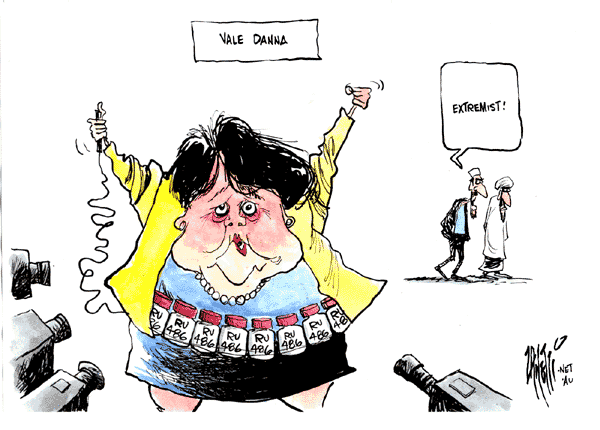
The political background.
We need laughter. The disorder of my laughter expresses the excess of raptures that shatter me ...As Bataille expressed it laughter is a way of spitting out language itself, the reassertion of the primal, organic mouth over the sense-making tool it becomes in socialization. After the decomposing laugh, I have to recompose myself, pull myself together.
Laugher is not just about dissipation: it is the inner experience as the leap into the abyss.
February 15, 2006
A question
If the being of simulacra is the being of difference itself; and the each simulacra is its own model then what provides the unity of the different? How can we talk about the being of something that is difference itself?
Deleuze's answer is that precisely there is no intrinsic ontological unity. He takes up here Nietzsche's idea that being is becoming: there is an internal self-differing within the different itself, the different differs from itself in each case. Everything that exists only becomes and never is.
February 13, 2006
Deleuze: understanding difference-in-itself
Deleuze is interesting is he not?
In Difference and Repetition he is engaged in a critique of the philosophical tradtion ---Plato, Aristotle, Leibniz, Hegel. From Plato to Heidegger Deleuze argues, difference has not been accepted on its own, but only after being understood with reference to self-identical objects, which makes difference a difference between. He attempts to reverse this situation and to understand difference-in-itself.
Deleuze unsettles and disturbs. Now I was comfortable with the way that difference was represented in terms of a conflict of opposites. I could even accept the lack of reconciliation or overcoming. He is interpretated by some in terms of the ruin of representation;
What does that mean? :
It is held that we
"...can understand Deleuze's argument by way of reference to his analysis of Plato's three-tiered system of idea, copy and simulacrum ...... In order to define something such as courage, we can have reference in the end only to the Idea of Courage, an identical-to-itself, this idea containing nothing else (DR 127). Courageous acts and people can be thus judged by analogy with this Idea. There are also, however, those who only imitate courageous acts, people who use courage as a front for personal gain, for example. These acts are not copies of the courageous ideal, but rather fakes, distortions of the idea. They are not related to the Idea by way of analogy, but by changing the idea itself, making it slip. Plato frequently makes arguments based on this system, Deleuze tells us, from the Statesman (God-shepherd, King-shepherd, charlatan) to the Sophist (wisdom, philosopher, sophist) (DR 60-1; 126-8).The philosophical tradition, beginning with Plato (although Deleuze detects some ambiguity here (eg. DR 59...)) and Aristotle, has sided with the model and the copy, and resolutely fought to exclude the simulacra from consideration......While difference is subordinated to the model/copy scheme, it can only be a consideration between elements, which gives to difference a wholly negative determination, as a not-this. However, Deleuze suggests, if we turn our attention to the simulacra, the reign of the identical and of analogy is destabilised. The simulacra exists in and of itself, iwithout grounding in or reference to a model: its existence is "unmediated" (DR 29), it is itself unmediated difference."
So you can see why Deleuze understands himself as an overcoming of Platonism.
February 12, 2006
Deleuze on difference
In Difference and Repetition Deleuze writes:
Hegelian contradiction appears to push difference to the limit, but this path is a dead end which brings it back to identity, making identity the sufficent condition for difference to exist and be thought. It is only in relation to the identical, as a function of the identical, that contradiction is the greatest difference. The intoxication and giddiness are feigned, the obscure is already clarified from the outset. Nothing shows this more than the insipid monocentrality of the circles in the Hegelian dialectic.(p.263)
Thus we have the dead end symbolized by the Hegelian circles. Hence the need to kiss Hegel goodbye Difference has not been accepted on its own, but only after being understood with reference to self-identical objects, which makes difference a difference between.
I have to admit that when I think of difference I do so in terms of identity, ie., in saying that "a is different from b" I tacitly assume "some a and b " with at least relatively stable identities--eg., man and woman are human. From what I can gather Deleuze argues that identities are effects of difference, that difference ontologically comes first and that difference goes all the way down. Consequently, the apparent identities such as "a" are composed of endless series of differences.
Quite a different ontology, radically different.Tis an ontology of particulars thought of in terms of process or becoming.
February 11, 2006
Agamben: man-animal, animal-man
Is this Agamben's story?
Western metaphysics has predicated what it is to be human through an oppositional distinction with animals.
Humanity is not animal. Animals are non-humans. You can be beastly to humans, and that is inhumane. The opposition has been part of a technological worldview wherein we should master nature, because nature otherwise dominates us. What is distinctively human is this mastery over nature. We should tend and keep animals, and when we have an animal side to ourselves, we should oppose that. Humanity, in this tradition, grows in controlling "the animal other" within ourselves and our world. Call this dimension of Western metaphysics, its mastery of animals.
In The Open Agamben says that this anthopological machine has a classic and modern variants. He says:
On the one hand, we have the anthropological machine of the moderns. As we have seen, it functions by excluding as not (yet) human an already human being from itself, that is by animalizing the human, by isolating the [In] nonhuman within the human: Homo alalus, or the ape-man ....... [In] The machine of earlier times .... the inside is obtained through the inclusion of an an outside, and the no-man is produced by the humanization of an anaimal: the man-ape, the enfant sauvage or Homo ferus, but also and above all the slave, the barbarian and the foreigner, as figures of an animal in human form. (p.37).
If we do away with the mastery of animals then what is it to open up our lives to animals? That means have a non-technological relationship to animals in the Heideggerian tradition to which Agamben belongs.
What does it mean to have a non-technological relationship to animals?
We could say that our sense of humanity is partly based on a deepening of our moral relations with animals in that being meaningfully human is enriched through relationships with animals based on a shared life with animals. That means animals (eg., dogs) eing integrated into the life of the household and communicated a great deal, in their own manner, with the family members. This is not to make animals human--it is respect the differences between dogs and humans difference between animal and human life and to form a richer and more meaningful world with animals and ourselves based on these differences.
Is this what the affirmative side of Agamben refers to ?
February 10, 2006
reworking Bergson
This review of the work of Keith Ansell-Pearson by Daniel W. Smith is interesting in the light of my concerns for vitalism, Bergson and Deleuze. Smith says:
The contemporary reception of Deleuze's own Bergsonism in turn has tended to be linked with two interrelated areas of contemporary scientific research. The first is complexity theory (theories of self-organization, dynamic systems theory, etc.), which deals with irreversible time sequences in physics and elsewhere. Writers such as Ilya Prigogine and Isabelle Stengers have seen Bergson's dynamic philosophy of change as a precursor to developments in "chaos" theory. The second is evolutionary biology, which deals with the question of "the time of life" (to use Ansell-Pearson’s subtitle), that is, the fact that Life itself entails a continual creation of unpredictable novelty (genetic differentiation).
I do recall reading Viroid Life: Perspectives on Nietzsche and the Transhuman (1997) but I have not read Germinal Life: The Difference and Repetition of Deleuze (1999). So I do not know the way that it attempts to interpret Deleuze's reworking of Bergson to think past the human condition to various forms of organic and non-organic life; or its interpretation of the way that Deleuze rehabilitates the category of the elan vital as internal difference.
Smith adds that:
Bergson wrote Creative Evolution long before [the modern synthesis in biology, which accounts for the production of the new in evolutionary terms]occurred, but with his notion of the élan vital, he was striving for a philosophical conceptualization of the new that could be derived from the phenomenon of “Life” itself. Earlier, in Time and Free Will, Bergson had attempted to do the same with the concept of durée. Ansell-Pearson marshals these Bergsonian concepts in an effort to rethink this primacy of the future, extracting the concept of the elan vital from its matrix of "vitalism” (at least as understood as a mysterious "life-force"; Deleuze preferred to maintain the concept of vitalism in a renewed form), and extracting the concept of duree from its matrix of psychologism.
The conception of the new that is rejected by Bergson is that of is modal logic, which Bergson argued, "sees in a new form or quality only a rearrangement of the old and nothing absolutely new" just as mathematics tends to reduce complexity to calculability.This is because we tend to think that a possibility logically "pre-exists" its reality, and that certain possibilities are excluded once one of them is realized. Deleuze argues that difference and divergence are needed to adequately think the new. Hence a metaphysics of the virtual.
February 9, 2006
philosophy as "destruktion"
Heidegger relates the concepts of "destruktion" (destruction or destructuring) and "Abbau" (deconstruction) in The Basic Problems in Phenomenology" as follows:
The store of basic philosophical concepts derived from the philosophical tradition is still so influential today that this effect of tradition can hardly be overestimated. It is for this reason that all philosophical discussion, even the most radical attempt to begin all over again, is pervaded by traditional concepts and thus by traditional horizons and traditional angles of approach, which we cannot assume with unquestionable certainty to have arisen originally and genuinely from the domain of being and the constitution of being they claim to comprehend. It is for this reason that there necessarily belongs to the conceptual interpretation of being and its structures, that is, to the reductive construction of being, a destruction - a critical process in which the traditional concepts, which at first must necessarily be employed, are de-constructed down to the sources from which they were drawn. Only by means of this destruction can ontology fully assure itself in a phenomenological way of the genuine character of its concepts.
The point is not to gain some knowledge about philosophy but to be able to philosophise---by using concepts against themselves. Tis a big difference.
So much for Richard Wolin's claim that Heidegger rejects reason. As I said Wolin writes books about philosophers he hasn't read. He's a historian of philosophy and so he reads the secondary literature.
two Agambens?
A quote from Aviva Shemesh's insightful post about Giorgio Agamben over at Forms of Life:
The ambivalence of Agamben's philosophy, which can be read as both a curse and a cure, may be attributed to the double strategy behind his publications in recent years. On the one hand, we have the celebrated Homo Sacer series, which, up to now, is comprised of three books: Homo Sacer: Sovereign Power and Bare Life, State of Exception, and Remnants of Auschwitz: the Witness and the Archive. These books analyze the darkness of our time, which Agamben calls "biopolitics", the political power over our naked life. However, in each of these three critiques, the attentive reader can also discern a certain light that shines in the darkness, which flashes up at the closing sections of each one of those "pessimistic" books. Because of the difficulty to recognize this light, Agamben offers a second set of investigations, those other books, which elaborate on his glad tidings: The Coming Community, The Open: Man and Animal, and the book that concerns us here, The Time That Remains.
My own relationship to Agamben's philosophy is to the political texts Homo Sacer: Sovereign Power and Bare Life, State of Exception, and Remnants of Auschwitz: the Witness and the Archive. I've explored these over at philosophy.com because they make sense of the new political realities of sovereignty, the law and biopolitics in liberal democracies. I find the thesis that the subject of sovereign power in modernity is not territory, but the mere fact of life, (a naked or bare life) to be a compelling one, as well as the centrality of the camp.
I do not know the other texts mentioned above. I only have The Open, which explores the way western philosophy has privileged the human through creating the great divide between human and animal based on language. From memory the classical understanding of human is animal rationale, the living being that has language or reason
I've only dipped into this text. I do not recall what I have read or what I have written So I do not know how Darwinism fits into Agamben's thesis about the ancient and modern anthropological machine. On my understanding the opposition between animal/human and human/inhuman evaporates with the abandonment of the old anthropolological perspective by the life sciences. I do recall thinking that Heideigger's Being and Time represents a backward step, as it dismisses the life sciences (ie., biology or ecology) in only a few lines in interpreting being-in-the-world. Are not animals, as distinct from stones, being-in-the-world? Should we not think beyond the human?
I'll pick The Open up again as I'm interested in biophilosophy.
February 8, 2006
academic trash
Richard Wolin says that Heidegger vilifies subjectivity and rejects reason. Vilifies and rejects? Why that rather than critiques? Wolin then adds that a:
philosophy like Heidegger's, which demands unquestioning obedience to nameless, higher powers such as Being, the gods, fate and so forth, is a warrant for human bondage. By preaching submission, it is latently authoritarian....By the late 1980s the moral vacuity of Heidegger's philosophy stood fully exposed. Above all, it lacked an ethics.
Ugh!. I cannot be bothered responding to junk such as this. Wolin hasn't even bothered to read Heidegger. Why bother to engage? This stuff is not philosophy.
More considered comments can be found at Before the law
February 5, 2006
about sexuality
A review of Regulating Sex: The Politics of Intimacy and Identity by Aagje Leven. The review say that there is a common theme which runs throughout the book.
Central to this theme is the observation that liberal states presuppose sexuality: they deem it a 'natural' thing and therefore relegate it to the presocial or private domain. Liberalism considers sex as neither a political subject, nor a public activity. The main line of argument in Regulating Sex, however,is that states consider sex as natural only when it is practiced in private, within the context of a heterosexual monogamous relationship between adults. It is observed that sexual expressions transgressing these implicit norms are controlled, suppressed or even criminalized. The various essays prove this normativity to be socially constructed through a complex interplay between family, social, criminal and other laws, on the one hand, and public discourses, institutions and social actors, on the other.
The book argues that sex is political and an important subject of public debate, and so it challenges the traditional private/public divide.I say traditional because the assumption here is that contemporary liberalisim is classical liberalism, when it is a neo-liberalsim.
Isn't sex just one market amongst others for neo-liberals? Do they not turn the family and the social into a market in which homo oeconomicus operates as an economic-rational individual sensitive to changes in the balance of profit and loss? Such an individual operates within the rules of the game of the market, which is made into the organizational principle for the state and society.The family and civil society are encoded as a form of the economic domain, where cost-benefit calculations and market criteria can be applied to decision-making processes
within the family, married life, sexuality, crime, professional life, etc.
February 4, 2006
back from holidays
The reason I haven't posted for a week or so is that I've been away on a much needed holidays in Tasmania for a week travelling in the west-central and south-west of the island----a place that some conservationists call wilderness that is contrasted with the technological mode of being in which we treat ourselves as resources (human capital) to be enhanced without appeal to subjectivity.
That conception of wilderness presupposes that we can reconnect with the beings around us. Wilderness is a discloses that not everything can be instrumentally reduced to the status of a human product, project or construct; wilderness is the 'other' that reminds humanity of its own dependency on the ecological life systems that underpin our society. It discloses that we can modify, in small ways, the current understanding of being in that human begins can become preservers, they can cherish things which gather and focus local practices whether such things be old stone bridges, restoring old buildings, or preserving old growth forests from logging or drowning from hydro dam building.
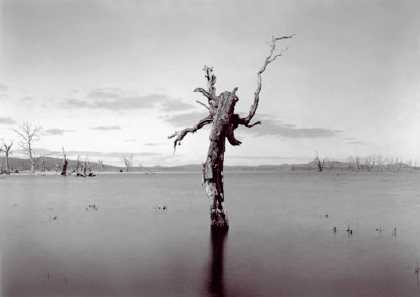
David Stephenson, Drowned, No. 176 (Arthurs Lake, Tasmania) 2002
Amidst the old resource economy (hydro, logging and farming) and its technological mode of being Tasmania is full of local practices based on preserving and a letting be that gather together.