March 31, 2006
time out
A moment out from the philosophy to laughter:

Tis a neat reworking of a Christian myth of the virgin birth is it not? Kinda brings it down to earth. Rather than choosing among the given possibilities, it is an inventing of other possibilities--as Bataille might say.
Laughter tends to go beyond the synthesis of the given possibilities. Laughter points to the unknowable, the unpredictable. It wants to obtain at the end of history the chance that subverts history.
March 29, 2006
Derrida on Bataille
Derrida says that in its striving for homogeneity, Hegel's discourse, unjustifiedly though necessarily, reduces the accidental, heterological elements such as restlessness, eroticism, anxiety, laughter, and the mystical. Bataille insists on these experiences, since they do not constitute a dialectical moment in the Phenomenology o0f Spirit. Hence, these resist the project says Bataille in Inner Experience ( p.323). But what does resistance to the project mean?
In his On the Sources and the Structure of Derrida's Radical Notion of Experience Zeynep Direk says:
According to Derrida, [in Writing and Difference] the attempts to stabilise the limit between philosophy and non-philosophy have always taken place through the concept of experience; and it is this attempt that determines its historical "specificity" within its dispersion throughout the tradition (, p.79). What Derrida says here is clearly the leading motivation in his reading of Bataille in "From Restricted to General Economy." The radical concept of experience, the experience of trace, becomes what it is in Derrida's work not simply because he makes an attempt to include what has so far been excluded from philosophy as "non-philosophical," but mainly because Derrida wants to underline the sacrificial logic underlying the inexhaustibility of experience. He shows in fact that the discourse of philosophy is sustained by a sacrificial logic. As Derrida's essay on Bataille makes clear, "experience" is not a term bound to a discourse that can be confined to a restricted economy, but exceeds it towards a general economy. In other words, the relation (or the non-relation) of rupture between these two different orders must be thought in terms of "experience." Perhaps, the elements of "radical experience" such as repetition, chance, play, risk, fear, untranslatability, resistance, forgetting, encounter of singularity, undecidability etc., must be conceived as the in-between of these two orders neither of which can be reduced to the other.
Bataille seeks to break out of the closure of knowledge in Hegel as interpreted by Kojeve. Radical experience is a transgression (the affirmation of play as a rule, the potlatch of signs, waste of words in the gay affirmation of death, i.e., sacrifice and challenge), of Hegel's conception of 'undergoing experience '. Bataille interprets this as being within "the circulation of prohibitions" and law and opposes it with the transgression of desire towards the non-meaning or the non-philosophical. This kind of radical experience is a "passage beyond the limits" or a "transgression", though the unlimited affirmation of singularity.
March 28, 2006
reworking 'experience'
When I was reading Bataille some time ago I couldn't really connect his work to the philosophical tradition, even though Derrida's Writing and Difference, had done so. I'd readDerrida's text many years ago, but it never occurrred to me to reconnect to Derrida's reading of Bataille when i was struggling with Bataille's text/.
In 'On the Sources and the Structure of Derrida's Radical Notion of Experience' Zeynep Direk helps us out by explicitly turning to Derrida's reading of Bataille. Direk says:
In "From Restricted to General Economy," Derrida interprets Bataille's relation to Hegel by putting the concept of experience at the center of his reading. He thereby articulates the difference between Hegel's concept of experience and Bataille's as the difference between a restricted economy and a general economy. In fact, Bataille can be said to follow a certain trend of Hegel criticism which asserts that "experience" is inexhaustible. The movement of experience in Hegel is the movement of Aufhebung: each "determination is negated and conserved in another determination which reveals the truth of the former" (WD, p. 275). Experience in Hegel's sense reveals itself in the final analysis as the "continuous linking up of the meaning to itself," the work of the constitution of meaning in which nothing is lost or wasted. Bataille detects here the reduction of experience to the "world of work"; the fundamental assumption of the exhaustibility of experience in absolute knowledge represents for him the victory of the slave. "The Aufhebung is included within the circle of absolute knowledge, never exceeds its closure, never suspends the totality of discourse, work, meaning, law, etc." (WD, p. 275). According to Eroticism, the world of work is a world of prohibitions. Hence the movement of Aufhebung is nothing else than "the circulation of prohibitions, history as the truth of prohibitions." As Bataille argues in Eroticism, desire would be unthinkable without law and prohibition (OC, VIII, p. 20). Derrida seems to argue that precisely because Bataille's concept of experience is a transgression (the affirmation of play as a rule, the potlatch of signs, waste of words in the gay affirmation of death, i.e., sacrifice and challenge), it is unthinkable without a fundamental relation to Hegel's concept of experience and hence to a restricted economy. Experience is transgressive when it is a linking of "the world of meaning to the meaning of non-meaning" (WD, p. 275). This transgression of desire towards the non-meaning or the non-philosophical implies not only that the Aufhebung remains prisoner to the restricted economy. If the circularity of absolute knowledge serves for the circuit of reproductive consumption, "we" in absolute knowledge still belong to natural, servile and vulgar consciousness. Nature remains in "us" as a second tissue, a second nature. The attempt to transgress this second nature, culture, is described by Derrida as an attempt at an opening – "the mortal opening of an eye" (WD, p. 276).
Tis a good way to reconnect Bataille to the philosophical tradition.
March 27, 2006
considering 'experience'
We have been here before, followed by this. It was suggested by this and this.
This quote from Zeynep Direk's On the Sources and the Structure of Derrida's Radical Notion of Experience sets the scene for another way to come at 'experience'. Direk says:
In the post-Second World War period in France there is a dissatisfaction with both "experience" in the Kantian sense and "experience" in the Hegelian sense. The questioning of Kant's, Hegel's, and Husserl's notion of experience is implicit in Blanchot, Bataille, Levinas and Derrida. Kant's notion of experience accounts for the experience of natural phenomena and is insufficient to take care of historical and social experiences of individuals insofar as it implies "the subsumption of the singularities under the categories of understanding." Kant's notion of experience deploys a "program" and desires mastery over the experienced. Hegel's concept of experience in the sense of "undergoing experiences" better accounts for what consciousness lives through; nevertheless, the mastery over the experienced through the mediation of absolute knowledge which is both at the end and at the beginning of the phenomenology indicates the same sense of "program." Thus, in both Hegel and Kant, experience refers to the unimpeded Greek Odyssey, a journey in which it is possible to return to the point from which one started, a return to the self.
And the reaction is this:
As a reaction to the conception of experience as a "program," a different conception of "radical experience" can be detected in Bataille, Blanchot, Levinas, and Derrida. These thinkers contribute to a re-thinking of the notion of experience. In order to make sense of this "tradition," one must go back to Hegel's concept of experience and to the reception of Hegel's philosophy in France as much as to the influence of Nietzsche's thought on these thinkers. "Radical experience" implies a journey that passes the limits, a bodily traversal which opens the space and goes to the world risking catastrophe and death. Although it fundamentally implies iterability it is not capable of being transferred and implies the loss of the possibility of deterministic decision. Its radicality has been conceived in terms of its "impossibility."
Deos raddcal experience work within, and revise, Hegel's concept of experience as "undergoing experiences" ?
March 26, 2006
difference and contradiction
In Difference and Repetition Deleuze says displaces Hegel's conception of difference as contradiction which treated identity as primary and difference as secondary. Deleuze says:
It is not difference which presupposes opposition but opposition which presupposes difference, and far from resolving difference by tracing it back to a foundation, opposition betrays and distorts it. Our claim is not only that difference in itself is not 'already contradiction ', but that it cannot be reduced or traced back to contradiction, since the latter is not more but less profound than difference. (p. 51)
So we have the primary field of differences as a point of departure for Deleuze's conception of difference. Presumably, Deleuze develops an ontology in which difference is the fundamental principle and the identity of objects is understood as something produced from the differences of which they are composed.
March 22, 2006
interpreting Deleuze
We have done enough digging around to appreciate that Deleuze has framed his account of individuation and agency through an evolving critical engagement with evolutionary thinking that is rooted in his early rehabilitation of Henri Bergson's 1907 Creative Evolution and which draws widely on the advances of recent biology. For all the connections with biological science Deleuze's work remains philosophical in terms of its metaphysics of vitalism and the virtual.
Mark Hansen says:
Only in Difference and Repetition does Deleuze fully articulate the transcendental principle of difference central to his important work of the late 60s. As I have suggested, this articulation involves a certain break with Bergson and also, it must be stressed, with the biological realism with which Bergson theorizes the elan vital. Intended as a means of reaching a properly philosophical realm of analysis and directed against Bergson's determination of the life force as a counterpoint to entropy (which Deleuze perceives to involve a potentially crippling reliance on a thermodynamic model), this break involves a key revision in Deleuze's previous understanding of vital difference. Rather than deriving vital difference from Bergson's two forms of difference, as he had in Bergsonism...Deleuze now finds it necessary to posit a fundamentally separate and primordial form of difference (intensity) from which both of Bergson's forms are derived.
March 21, 2006
about Nietzsche's legacy
A quote from a sample chapter of Raymond Geuss' Outside Ethics. In the introduction Guess addresses the significance of Nietzsche for us now. It is very much within Whiteheard's perspective of the European philosophical tradition as "a series of footnotes to Plato." Guess says:
One of Nietzsche's most important legacies to us....is his claim that it is desirable and possible to dismantle the Platonic apparatus of Forms, Absolute Truth, the Idea of the Good, etc. and its historical derivatives, such as Kant's transcendental philosophy, and that this can be done without fear of falling into "relativism." There is, however, a second and slightly different set of issues that also arises in part from the increasing implausibility of Platonist and Kantian approaches to philosophy, but more directly from the decline of traditional religions. The members of the Frankfurt School felt it important to deny that we had to choose between traditional transcendental religion and "positivism." There is no God and no God's-eye view, but this does not imply that we are trapped in the present, condemned merely to mirror the "facts" of the world that surrounds us, or to engage at best in merely piecemeal criticism of our social institutions, as, according to the members of the Frankfurt School, "positivists" would have it. Nietzsche seems sometimes to replace the "transcendence" which stands at the center of traditional accounts--the existence of a transcendent God, or, failing that, a transcendental viewpoint--with that of a continually transcending activity ("Überwindung" in one of the senses in which that term is used)....There is no single, final perspective, but given any one perspective, we can always go beyond it. I merely note that to take this as implying a guarantee that we will always (necessarily?) be able to go beyond any given position we might occupy, would be to fall back into a theological view. For Nietzsche, whether or not we will be able to "overcome" the one-sidedness of a perspective in which we find ourselves is an open question, for him a question of one's strength. One need not endorse Nietzsche's late-Romantic glorification of "strength" to accept his view that there are no guarantees of the requisite kind in the nature of things.
Overcoming the onesided perspectiveness. How appropriate. It's a good legacy.
March 20, 2006
interpreting Adorno
An excellent quote from this review of Raymond Geuss' Outside Ethics (Princeton University Press, 2005) by Alasdair MacIntyre. The essays are responses to concrete invitations to address a particular topic in a specific forum and they stand in the tradition of the early (i.e., pre-1970) Critical Theory of the Frankfurt School, although the specific version of the Critical Theory Guess favors contains a stronger Nietzschean component than most other versions. That is what captures my interest.
MacIntyre observes:
Adorno was as one with other early members of the Frankfurt School in holding that the kind of social order which they inhabited not only frustrates the satisfaction of human needs and oppressively distorts human relationships, but also inculcates illusions about its own character, illusions that inform not only many of our everyday beliefs, but the standard academic disciplines. We therefore have to learn how to outwit the social order in order to understand it, and we can begin to do so by identifying the significance of a variety of at first sight insignificant phenomena, to which we find ourselves responding as participants in the form of life to which they belong. In thinking about those phenomena and about the dominant social order we proceed dialectically through a series of denials, so that we arrive at a negative understanding, one that enables us to understand the social order that we inhabit from a point of view that is not its own, so escaping from the established consensus and becoming able to identify the radical defects and failures of the social order. Adorno believed that the interpretive knowledge thus gained had enabled him to recognize that the social order in which he found himself was one so evil that it was impossible to live rightly in it. Indeed he argued that the notion of a perfected human life is incoherent. Thus he found himself inescapably condemned to inhabit a culture in which the demands of spirit could no longer be met, so that in his time -- and surely he would have said also in ours -- the individual consciousness is doomed to be an unhappy consciousness.
That's pretty good. It captures the Hegelian dimension of the unhappy consciousness divided amongst itself. and aware of unhappiness.
To put it in more psychoanalytic language repressive norms do not stand outside repressed desire, but are exactly repressive in so far as they take part in that desire. It is exactly as a productive aspect of repression that desire, the body and pleasure impose themselves. Happiness can only be found in unhappiness.
Is not the theme of the experience of a self divided against itself a central one in French 20th century philosophy? A plausible account.
J.N .Findlay argues that Hegel’s three exemplary states of Stoicism, Scepticism, and the Unhappy Consciousness need not be given the philosophical or religious content that he gives them. He says:
One might, for instance, illustrate them by (a) the empty self-satisfaction of a mechanist who believes that all organic and psychic action can be mechanistically explained, without attempting to show how this is possible; (b) the equally empty self-satisfaction of a theoretical mechanist who also believes that it will never be actually possible to give an adequate explanation of organic and psychic action in mechanistic terms, or who thinks that a non-mechanistic explanation is equally feasible; (c) the tormented state of one who believes that a mechanistic explanation of life and consciousness is possible but despairs of ever finding it, who always dreams (Andacht) of an unattainable mechanistic explanation, who always treats non-mechanistic explanations as a pis aller for mechanistic ones (Freud), and who drags in the priestly scientist to validate his philosophical and moral opinions.)
That's bringing Hegel into the 20th century.
March 19, 2006
Deleuze:a non-essentialist vitalism?
How and in what sense can Bergson's "vitalism" be taken seriously given the developments in modern molecular biology? It's a good question for a contemporary "bio-philosophy" or philosophy of life is it not? Or for an interpretration of Deleuze's vitalist metaphysics, since Deleuze endorses Bergson’s ‘vitalism’, or the universal presence of dynamic forces in all living, and evolving, entities, including the human?
We know that Deleuze's vitalist philosophy belongs to a tradition of non-mechanistic, non-teleological, and non-reductionist thought about evolution running from Bergson to Gilbert Simonden through Jacob Von Uexkull and Raymond Ruyer. Deleuze's Difference and Repetitionis the most biological and ontological of his works, and is the text that constitutes the core of the Deleuzian metaphysics.
John Proteti argues in The Geophilosophies of Deleuze and Guattari, that Gilles Deleuze and Félix Guattari's A Thousand Plateaus constitutes a “geophilosophy,” a neo-materialism, which, in linking the philosophical materialisms of Marx, Nietzsche and Freud with contemporary science, avoids the traditional bogeys of materialism: determinism and vitalism. He says:
In this way transcendental geophilosophy can provide a consistent materialism without mechanistic reductionism or vitalist essentialism. We must first avoid attributing selfordering to the rule-bound interaction of elementary components of actual physical systems (mechanism). In Deleuze and Guattari’s insistence on maintaining a strict distinction between virtual singularities and the actual system, we see that the virtual is a way of talking about the emergent properties of systems, which are not reducible to the aggregated results of simple behaviors of elementary particles, but must be discussed in their own terms. On the other hand, Deleuze and Guattari avoid vitalism by avoiding any attribution of an essence to organic life; by insisting on the phenomenon of "non-organic life," that is, the appearance of phenomena of selforganization and novelty in physical, chemical, and geological processes, they disabuse us of any lingering humanist illusions and insert human affairs squarely in nature, parts of a creative "Earth." In other words, Deleuze and Guattari exorcize the ghost in the machine, but in so doing leave us with a different notion of machine, that of a concrete assemblage of heterogenous elements set to work by the potentials of selfordering and novelty inherent in the virtual singularities, the attractors and bifurcators, of the actual system.
It is in Difference and Repetition that Deleuze details the main characteristic of the virtual as self-differentiating, or “difference in itself.”
March 18, 2006
mapping the way we understand life
This article by J. Ronald Munson & Richard Charles York is quite good in mapping the ways in which life is understood philosophically--ie. , the metaphysics of life in the biological sciences.
They say that there are three basic ways regarding the biological nature of life: vitalism, mechanism, and organicism. They say that vitalism:
... holds that there exists in all living things an intrinsic factor - elusive, inestimable, and unmeasurable - that activates life. In its classic form, as espoused by many biologists at the turn of the 20th century - in particular, by Hans Driesch, a German biologist and philosopher - it has suffered severe criticism... And whereas most biologists concur in renouncing this so-called naïve vitalism, some continue to espouse a so-called critical vitalism, perhaps indistinguishable from organicism...
They say that mechanism, simply stated, is
the view of the mechanists is that organisms are no different from subtle machines: the whole is the sum of its parts, which are arranged in such a way that an internal energy source can move them in accordance with a built-in program of purposeful action. In the mechanist's view, advances in molecular biology corroborate this claim and demonstrate that in principle organisms are no more than complicated physical systems. This is, in essence, the reductionist position, which states that biological principles can be reduced to physical and chemical laws. Antireductionists, of course, contend that molecular biology cannot explain all aspects of living forms.
They say that basic claim of organicism:
...is that organisms must be interpreted as functioning wholes and cannot be understood by means of physics and chemistry alone. Few scientists today call themselves organismic biologists or endorse the doctrines put forward by such organismic theorists as Ludwig von Bertalanffy and Edward Stuart Russell. Nevertheless, most antireductionists subscribe at least to part of the organismic doctrine, in particular to its wholistic claim... In some special sense, then, an organism is regarded as being more than a simple sum of its parts; an additional “something” has accrued to it as a result of the unique arrangement of its components.
It is self-organising or self-directing. The holistic concept of an organism - i.e., the theory that the determining factors in biology are its irreducible wholes - owes much to a systems approach. It holds that the organic relationships between the different parts of an organism are wholly immanent in the physical structure of that
living organic system.
March 16, 2006
vitalism junked
This book review of Richard Doyle's (2003) Wetwares: Experiments in Postvital Living (2003) by Stephen Dougherty has some bearing on vitalism. Dougerty says that Doyle interested is in the emergence of the postvital body, that is the body that comes after the vital body, after 'life' in the sense of a mysterious life force (vitalism) has been evacuated from the organism.
He says:
As Michel Foucault explains in The Order of Things, nineteenth-century biology understood this life force as a 'sovereign vanishing point within the organism'(quoted in Doyle, 1997: 10), and as such, life could 'reveal' itself only insofar as it remained a mystery. It retreated, disappeared, into the depths of the body, and from there it exerted a strong shaping force on modern thought. From the nineteenth-century biological perspective, being was the epiphenomenon of life, a mysterious force beyond the powers of science (or other hermeneutical practices) to tease it out. But contemporary molecular biology does precisely that. It turns the organism into the output of the DNA code, eschewing in the process the binarisms that have helped to constitute modernity: surface and depth, being and living.
I interpret the 'mysterious life force' as referring to vitalism, understood as advocating a nonphysical force in order to distinguish animate from inanimate matter. This conception of vitalism---"life exceeds known physicochemical laws" ---- is conventionally regarded as an evolutionary has-been because of Darwinism. Vitalism is seen as the philosophical (metaphysical) baggage of science---whose ontological assumptions have been examined and found wanting.
Richard C. Lewontin states why vitalism has been eradicated from an analytic ontology of biological science.
He says:
Darwinism is a population-based theory consisting of three claims. First, there is variation in some characteristics among individuals in a population. Second, that variation is heritable. That is, offspring tend to resemble their biological parents more than they do unrelated individuals. In modern Darwinism the mechanism of that inheritance is information about development that is contained in the genes that are passed from parent to offspring. Third, there are different survival and reproduction rates among individuals carrying different variants of a characteristic, depending on the environment inhabited by the carriers. That is the principle of natural selection. The consequence of differential reproduction of individuals with different inherited variants is that the population becomes richer over generations in some forms and poorer in others. The population evolves.
Ever since the nature of DNA had been revealed, biomedical science has been grounded in the belief that the structure, function and health of an organism is directly or indirectly regulated by its genes. This has led to the concept of the primacy of DNA, the belief that our physical and behavioral traits are controlled by genes. It is molecular biology that undermines and displaces vitalism in biological science, since molecular biology turns cells into computers that store genetic memory and run programs---turning organisms, in other words, into informational processes, and bodies into transparent sites of coding.
So where does that leave Bergson and Deleuze? Rethinking vitalism and a philosophy of biology tha is distinct from current philosophies of science that are mainly oriented on modern physics.
March 15, 2006
doing away with ethics?
From an article in j_spot (Volume 1, Issue 3) entitled 'Beyond Economy, or the Infinite Debt to the Other: Caputo and Derrida on Obligation and Responsibility' by Chris Anderson-Irwin.
Ethics is a problem in postmodernity. Thinking along Heideggerian lines, one might argue this problem started with Nietzsche's proclamation of the death of God and his critique of all values hitherto. But even Nietzsche shuddered a little at the thought of losing morality; he felt the coldness of space encroaching as the light of religion and its absolute values dimmed in 19th century Europe ...Nietzsche is all too often understood as heralding a Dionysian modern era, but he was also a self acknowledged heir to "the ascetic" tradition of Western morality)... If even Nietzsche feared the repercussions of letting ethics go, what about the rest of us?Why let ethics---as distinct from morality---go, rather than place ethics into question, or question the assumption of modernist ethics? Did Nietzsche really let ethics go?
Anderson-Irwin continues:
But what else is to be done if the foundations of ethics have been swept away, if every cultural, historical, theological or metaphysical support has been called into question? What is to be done if there is no knowledge in ethics, no certainty, no absolutes, no saving laws or formulas which solve all problems before they begin?
Simple. Work with a non-foundational ethics. A postmodern ethics.
These questions are a rhetorical trick. Anderson-Irwin doen't mean to adress them. He's talking about a modernist ethics.
He says:
Perhaps the situation is not as dire as that. There is something suspicious about this assessment of the state of ethics. It seems too easy to say that ethics once dealt strictly with what could be "cognized" as objectively certain and universally true, whereas now, after Nietzsche, after Heidegger, after the end of Western metaphysics, we find ourselves in a precarious situation. ...The problem of ethics in postmodernity may have more to do with the way contemporary theorists tend to think of ethics. It has become common to connect ethics with cognition, designating it as a form of knowledge to be grasped by the cognitive subject. This view of ethics presupposes that there was once certainty, well-cleared ground, precise formulas and consensus regarding their legitimacy, but that since the cognitive subject has been knocked off its pedestal, a hole as been left at the centre of all of these schemes.
Sure, that's the argument of those working in the tradition of virtue ethics against a modern deontological and utiltiarian ethics. He says:
t has become common to connect ethics with cognition, designating it as a form of knowledge to be grasped by the cognitive subject. This view of ethics presupposes that there was once certainty, well-cleared ground, precise formulas and consensus regarding their legitimacy, but that since the cognitive subject has been knocked off its pedestal, a hole as been left at the centre of all of these schemes. On this view, the loss of certain knowledge leads to the destabilization of ethics, and to a certain amount of hand-wringing: How are ethics to be conceived if not as a matter of knowledge? Are we not lost on a sea of radical heteronomy where any number of approaches to ethics drift beside one another, sometimes colliding when the weather gets rough? This loss of a ballast seems to leave us with what Jameson calls a postmodern antinomy.... a situation where on the one hand there can be no ethical certainty while on the other we find ourselves treating ethics as an important question, and, even more significantly, relying on and presupposing at least a rudimentary or minimal set of ethical conditions that structure the relationships between persons.
Embrace an embodied ethics.
March 14, 2006
Anti-Oedipus as a work of ethics?
In this post I mentioned that one characteristic of the Anglo-American reception of French philosophy is that it interprets Deleuze and Guattari's Anti-Oedipus as a work of ethics.
The source for this interpretation is Foucaaut. In his 1977 introduction to the English translation of Deleuze and Guattari's Anti-Oedipus, Michel Foucault called the book a work of ethics, perhaps the first such (French?) reflection on ethics in a generation. Foucault went on to say that in his judgment Anti-Oedipus was a critique of the most insidious dimension of fascism: the way in which men and women willingly enslave themselves to fascist modes of being.
If I remember the context of this reception of the "philosophy of desire" is that it was seen as a superceding of Freudo-Marxism; as a going beyond the earlier efforts of the Frankfurt School (eg., Adorno) that had updated Marx with Freudian insights. Anti-Oedipus also launched a deep critique of many of the foundations of psychoanalysis. The reception of the "philosophy of desire" was linked to, and a part of, sexual counter-culture and the women and gay liberation movements. Desire was interpreted as a "flow" or flux a continuous, nonpersonal, and uninterrupted "flow . Into the flow come "machines." They interrupt the flow. Those "interruptions" "condition" and shape the flow, and are thus in fact part of the flow itself.
Is this a libertarian celebration of unfettered desire? A valorizing of desire's rebellion against conservative normative constraints (of the law and morality) in general? A celebration of subversive" pleasures in a 1970s Anglo-American culture whwose mode of being was still negatively Puritan? Is there more to the ethics than this liberrarian interpretation?
A suggestion.
There is a pragmatic, embodied ethics that focuses on particular bodily relations and their affects. A body' action can be thought of as becoming reactive (bad) or becoming active (good)–in relation to the specific assemblage or relationships it forms with other bodies and the specific affects it enables. The way to evaluate whether the becoming is bad or good is to judge whether a particular assemblage or moral code harms or enhances each body’s life force; in other words, whether it increases or reduces each body’s power to act and its potential to go on forming new relations, creating new flows of desire and new becomings.
An embodied ethics of this neo- Nietzschean sort aims to reduce life destroying assemblages and foster ethical, life-enhancing assemblages by opening up the flow life (desre) to difference (variation) and multiplicities.
March 13, 2006
the divided unity of modenity
A quote from this review of Peter Murphy and David Roberts Dialectic of Romanticism by Robert Savage in Colloquy:
The dialectics of enlightenment and romanticism were both triggered by the historicist self-understanding of modernity, with its chronic awareness of man's pre- or deformation through cultural factors over which he has no immediate control. Together,Together, enlightenment and romanticism makeup the divided unity of [European] modernism ... Whereas enlightenment rationalism has as its goal the liberation of man from the contingencies of birth and custom, romanticism responds by calling for a return to nature. Regardless of how such a return may be construed in individual cases as the descent to the chthonian realm of the Earth Mother (Bachofen, Baeumler), as the remembrance of nature in the subject (Horkheimer/Adorno), as the repetitive recuperation of the original event of Being(Heidegger) the split between nature and spirit is in each case to be overcome through their reunion in a new mythology founded upon the free interplay of the rational and creative faculties.
This conception of divided unity of modernity is very plausible and is something that I tacitly accept, even though I am uncomfortable with it.
Savage says that Murphy and Roberts maintain that this project:
...leads to consequences as invidious as those it was intended to counteract: Enlightenment autonomy is always threatened by the immanent contradiction of denaturalization: the reversal of freedom into unfreedom (the perpetuation of the blindnessof nature); romantic incarnation is always threatened by the immanent contradiction of renaturalization: the reversal of the spiritualization of natureinto the naturalization of spirit, of creative into destructive nature. Each bears witness to the failed internal dialogue of modernity.
I'm not sure what I make of that. I'm not even sure thatt I understand the argument.
March 11, 2006
Adorno, tacit knowing, virtues
Now to return to James Gordon Finlayson's interesting article on Adorno's ethical theory that we had been considering earlier.
Finlayson says:
Adorno and Horkheimer claim in the preface to the Dialectic of Enlightenment that even though Enlightenment is a form of domination in the interest of self-preservation, it is not only that, for ‘social freedom is inseparable from Enlightenment thinking’ (DA 3). This is the thought from which Adorno later weaves the fabric of Negative Dialectics. Even if concepts are instruments, they can and do point beyond themselves and thereby transcend their own instrumental value. .....but the value lies in experience of being shown something, of becoming self-consciously receptive to something that is more than can be put into words, a surplus, which Adorno takes as a promise that the realm of the possible outstrips the real and the conceptual (MM 253).
What is of interest is the way that Finlayson interprets this surplus as otherness ---it is almost in an Heideggerian way of tacit knowing based on a disposition to act.
Finlayson says:
The value of the experience of being shown something is inherently practical, for ineffable knowledge just is a disposition to act in certain ways. On this reading the three virtues, which I have argued are necessary conditions of an ethics of resistance, just are states of ineffable practical knowledge, competencies which enable subjects to bring about the goods of Mundigkeit, humility and love.
Is this nonconceptual knowing ---ineffable knowledge as a disposition to act in certain ways---an embodied form of knowing?
Finlayson does not explore this. But it is straight out of Aristotle, who says that the virtues of character are dispositions to act in certain ways in response to similar situations, the habits of behaving in a certain way. Thus, good conduct arises from habits that in turn can only be acquired by repeated action and correction, making ethics an intensely practical discipline. Virtues,are exercised within practices that are coherent, social forms of activity and seek to realize goods internal to the activity. The virtues enable us to achieve these goods.
Can we link this understanding of virtue ethics to an account ofAdorno's conception of mimesis as a positive experience that is true to what is there prior to conceptual identification --- the amorphous, the undifferentiated, the strange. The tacit assumption here is that mimesis is an impulsive bodily experience---disposition to act in certain ways"--- that momentarily registers the presence of what occasions it.
March 10, 2006
Uncritical reception of 'French Theory'
Another useful quote from this review of French Theory. It is stated that 'ethics is what comes after Nietzsche's death of God, and Foucault's "death of man." Ethics, in other words, is what comes with the end of morality, with the end in the belief in the transcendental categories of good and evil.' There is a turn to Deleuze and Guattari's Anti-Oedipus as a book of ethics.
What does that mean? Deleuze says:
...establishing ways of existing or styles of life isn't just an aesthetic matter, it's what's Foucault called ethics, as opposed to morality. The difference is that morality presents us with a set of constraining rules of a special sort, one that judge actions and intentions and considering them in relation to transcendental values (this is good, that's bad...); ethics is a set of optional rules that assess what we do, what we say, in relation to the ways of existing involved.(Deleuze, Negotiations, 1995, p. 100)
Why transcendental values rather than Hegel's conception ethical life? Why transcendental values when we live in particular way of life in consumer capitalism: one that Lyotard describes in the following terms:
Capitalism deculturalizes peoples, dehistoricizes their inscriptions, repeats them anywhere at all as long as they are marketable, recognizes no code marked by the libido but only exchange value: you can produce and consume everything, exchange, work, or inscribe anything you want if it comes through, if it flows, if it is metamorphosizable. (Lyotard, "Energumen Capitalism" in Sylvère Lotringer & Chris Kraus, eds., Hatred of Capitalism: A Semiotext(e) Reader New York, Semiotext(e) 200,1 pp. 229-241. p. 240).
What puzzles me is the way this discourse on ethics is accepted by those Anglo-Americans engaged int eh reception fo French Theory. Where is the critical thinking about framing ethics this way? Is it because the US is such a religious society in a fundamentalist sense?
March 9, 2006
Revisiting 'French Theory'
I concur with this quote by Sylvere Lotringer in Sylvere Lotringer and Sande Cohen, eds., French Theory in America, (New York/London: Routledge, 2001, p 125).
I knew about French theory before arriving in America in the late 1960s. It wasn't called that, in fact didn't yet exist as a distinct phenomenon, but it really is through America that I discovered theory, or rather realized its full potential...French theory is an American creation anyway. The French themselves never conceived it as such, although French philosophers obviously had something to do with it. In France, French theory was considered philosophy, or psychoanalysis or semiotics, or anthropology, in short any manner of thinking (pensee) but never referred to as theory.
I never really understood the American Theory thing. I always understood it as a construction from within literary departments in the US fashioned to enable a critique of their society; a critique that had little connection to the Frankfurt school 's critique. It really was French theory that galvanized the European side of American philosophy in an influential way--it had far more market penetration in academia than the Frankfurt School ever had. It became a sexy French commodity in the marketplace of ideas.
Why so? Was it all the stuff about the sexual desire and power? Or the need to find ways to navigate through the traps of identity and subjectivity in a world of confusion?
A point that is made is that whilst some academics were doing theory others were trying to figure out the theory from the outside, from their own lives and habits. I was in the latter camp. So I looked for tools to enable me to navigate my way.
What suprises me is that 40 years on we still hear the old criticisms about postructuralism: it continues to be routinely accused of destroying the humanities;t aking the "human" out of the humanities: by reducing everything in the world to texts and signifiers; erasing the subjectivity of the individual; reducing the world to language, to the relativity of linguistic signs--and making the world "meaningless," and so promoting nihilism.These are used as hammers and body blows. This conception of French Theory that laid waste to the humanities is called postmodernism (po mo) in Australia. It represents the 1990s backlash against 'French Theory'.
March 8, 2006
Deleuze's interpretation of Nietzsche
Deleuzes pushes Nietzsche to the limit and beyond. As I read Nietzsche and Philosophy I find myself initially agreeing, then several dense paragraphs latter I think--I don't remember saying things like that. Then I realize that this difference is Deleuze's voice.
A nice quote from here that gives us some insight into Deleuze's interpretation of Nietzsche:
Deleuze views the body, either the chemical, physical, political or social body, as composed of multiple irreducible forces and therefore the unity is a multiple phenomenon. In interpreting Nietzsche, Deleuze names the dominant forces in a body as active and the dominated as reactive (passive in Nietzsche's term). Active forces are spontaneous, aggressive, form-giving and often unconscious forces. "Appropriating, possessing, subjugating, dominating - these are the characteristics of active force. To appropriate means to impose forms, to create forms by exploiting circumstances." The reactive forces are those that rationally pursue utilitarian goals and mechanically react to surroundings. The essence of the concept of reaction is the mechanical and utilitarian accommodation. While reactive force is best marked by "adaptation", active force is characterized by its astonishing burst of creativity and powerful productive capability.
The article is by Xinmei Chein, and he suggests that Deleuze's interpretation of Nietzsche holds that consciousness is reactive force whilst the unconscious is an active force. Nietzsche criticizes modern thought for its satisfaction in understanding an organism only in terms of reactive (passive) forces and neglecting the spontaneous and active ones.
March 7, 2006
torn desires
Mimmo Rotella's collage work, which inspired by that of Kurt Schwitters, was created in Rome during the mid 50's. The image below is abstract expressionist in composition and appearance:
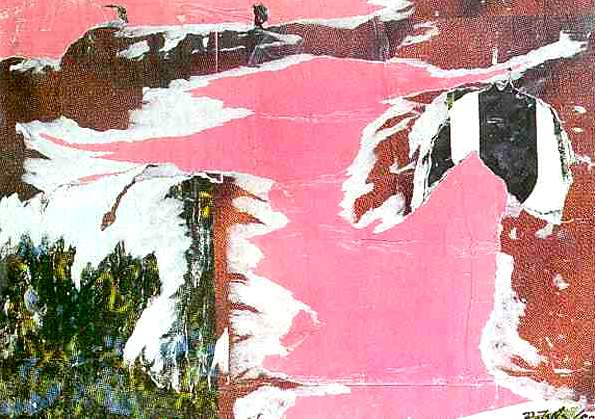
Mimmo Rotella, Untitled, decollage,
These evolved into 'torn poster' decollages constructed from urban walls covered by lacerated posters.
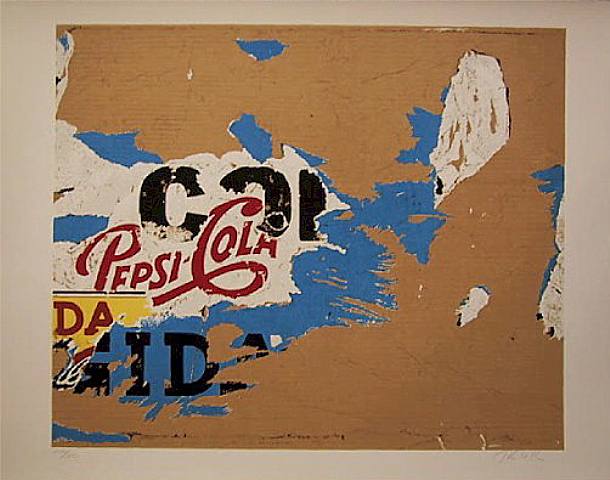
Mimmo Rotella, Pepsi, decollage, 1979
Many of the torn posters on the urban walls of our cities are historical pop cultural images of desire.

Mimmo Rotella, A Qualcuno Piace Caldo n'2, decollage 2004
Has not a lot of twentieth century continental philosophy been preoccupied with two desire as sex and desire as power? Though desire as sex/desire as power can form together overcome the other through desire but often they remain separated: Freud gives expression to the former, Hegel and Nietzsche to the latter. Bataille's erotic transgression reworks the Freudian model with the Hegelian dialectic as one between the socially accepted and the transgression of those norms by the erotic, orgasmic body.
March 6, 2006
Nietzsche:science as a reactive force
In his Nietzsche and Philosophy Gilles Deleuze says that for Nietzsche science is part of the nihilism of modern thought as its attempts to deny differences is a part of the more general enterprise of denying life, deprecating existence and promising it a death. he adds that we must look for the instrument of nihilistic thought in science:
The answer is that science, by inclination, understands phenomena in terms of reactive forces and interprets them from this standpoint. Physics is reactive in the same as biology: things are always seen from the ... side of reactions. (p.45)
I struggle with this. Science as a reactive force?
I can grasp the way that a positivist science is an expression of the ascetic ideal. The ascetic priest demands that we see a matter in one particular way. So does science when it values truth as being beyond criticism. Though science is commonly interpreted as being opposed to religion, it has merely replaced God with truth as an absolute, transcendent ground that justifies and explains existence. So Nietzsche attacks science on the ground that it relies too heavily on faith in unjustified fundamental beliefs. What it denies is interpretation; and more particularly interpretation developed by particular interests and with particular goals. That means that 'truth' is always partial and motivated. Fine.
So science, with its will to truth, is not the antithesis to the ascetic ideal. The opposing force is found in the self-overcoming of the ascetic ideal, when the meaning of the will to truth is called into question. Since reactive forces only have their existence through an opposition to another force which it rejects, so science is a reactive force.
That means what? Reactive forces, Nietzsche says, are always a no-saying, as active forces are self-affirming; Science is no saying to what? To Interpretation? Or would it be related to e unconscious processes that manifest themselves in ressentiment: a hatred first of all of life, of nature; that life itself can not be good enough, so that we have to invent a world beyond this world which is better, more perfect.
March 3, 2006
Deleuze, utilitarianism
I'm on the road to Sydney for a working weekend. I will post tomorrow, if I have time and access to the internet.
In Nietzsche and Philosophy Gilles Deleuze says that utilitarianism is an outmoded or outdated philosophy. He asks:
To whom is an action useful or harmful? Who considers action from the standpoint of its utility or harmfulness, its motives, and consequences..
Good questions. The answer is immediately forthcoming:
Not the one who acts: he does not "consider" action. It is rather the third party, the sufferer of the specator. He is the persosn who considers the actin he does not perform ---precisely because he does not perform it---as something to evaluate from the standpoint of the advantage which he draws or can draw from it....We can guies s the source of "utility": It is source of all passive concepts in general,ressentiment, nothing but the requirements of ressentiment.
March 2, 2006
Adorno ethics and virtue
A quote about an ethical virtue in Adorno. He says:
The single genuine power standing against the principle of Auschwitz is Mundigkeit, if I might use the Kantian expression: the power of self-determination, of not cooperating.’Adorno, 'Education after Auschwitz'
An example of why we need such a virtue
March 1, 2006
Adorno, the good, ethics of resistance
As we have seen in the previous post James Gordon Finlayson argues that Adorno has a problem providing a normative ground (the good) for his ethics of resistance. The problem arises because a cebntral thesis of Adorrno's philosophy is that that we can have no positive conception of the good. Adorno frequently claims that the good (or what he calls variously 'reconciliation', 'redemption', 'happiness' and 'utopia') cannot be thought. To conceive the good life is to falsify it in two ways. First, it is to misconstrue the good life by forming a general concept of it and thus losing sight of the particularity and uniqueness of every individual good life. Secondly, it is literally to make it bad, to transform it into evil by identifying it and making it the same as everything else.
Finlayson observes that there is a promising way in which Adorno attempts to solve the problem of the availability of the good.
In Negative Dialectics Adorno claims that philosophy is essentially concerned to think the ineffable. I use the unprejudicial term 'the ineffable' here to refer to the panoply of Adorno’s various locutions for what escapes conceptual thought: ‘'he other', 'otherness', 'the non-identical' 'the non-conceptual', 'the unrepresentable', 'the inexpressible', 'the unsayable' etc. Adorno hints that a potential for what he calls variously 'emancipation', 'redemption', 'utopia' and ‘reconciliation' --- a kind of hidden good ---resides in what is ineffable, i.e. in whatever cannot be thought by concepts. Philosophy, in aiming at the ineffable, aims at this hidden good. By attempting to think the ineffable, even in the self-conscious awareness of the paradoxical nature of that attempt, succeeds somehow in making available to philosophy a kind of goodness.
I've always puzzled over this aspect of Adorno and I've never been able to grasp it. It's struck me as theological even though I accept the non-conceptual as what escapes the concepts of instrumental reason. I do accept that, in some way, Adorno is obliged to seek a non-discursive or non-conceptual mode of access to the good.