April 30, 2006
Agamben: an ethics of witnessing
Catherine Mills in her review of Agamben's Remnants of Auschwitz: The Witness and the Archive in Borderlands says that:
....the ethics of witnessing that Agamben develops can be understood as an ethics of survival, insofar as the subject survives its radical and constitutive de-subjectification in testimony. As Agamben notes, the double movement of desubjectification and subjectification suggests that within humans, 'life bears with it a caesura that can transform all life into survival and all survival into life'
Mills says that the motivating aim of Agamben's elaboration of an ethics of witnessing is the specification of an ethical domain before the legal codification of judgment and culpability, since the law is only ever concerned with judgment and not with justice or truth.
April 29, 2006
Agamben: shame as desubjectification
We can now turn back to the way that Giorgio Agamben introduces shame Remnants of Auschwitz: The Witness and the Archive as desubjectivised experience. This account takes as its starting point Levinas' conception of shame in On Escape. Agamben says:
According to Levinas, shame does not derive, as the moral philosophers maintain, from the consciousness of an imperfection or a lack in our being from which we take distance. On the contrary, shame is grounded in our being's incapacity to move away and break from itself...in shame we are consigned to something from which we cannot in any way distance ourselves. (pp.104-105)
Agamben builds on this analysis of shame. He says that:
To be ashamed means to be consigned to something that cannot be assumed. But what cannot be assumed is not something external. Rather, it originates in our own intimacy; it is what is most intimate in us (for example, our own physiological life). Here the "I" is overcome by its own passivity, its own most sensibility; exappropriation and desubjectification is also an extreme and irreducible presence of the "I" to itself. It is as if our consciousness collapsed and, seeking to flee in all directions, were simultaneously summoned by an irrefutable order to be present at its own defacement, at the expropriation of what is most its own. (pp.105-106)
Agamben then says that in shame has no content other than its own desubjectification; it becomes witness to its own disorder, its own oblivion as subject.
Thus shame as a double movement, which is both subjectification and desubjectification, is Agamben's building block.
April 28, 2006
Levinas, il y a, bare being
In his review of Levinas' short essay 'On Escape,' (recently published with Jacques Rolland's introductory essay) Michael Purcell states that:
What Levinas undertakes in On Escape, then, is a phenomenological analysis of those existential experiences which can be interpreted as attempt to escape the burden of existence, experiences in which being, in its anonymity and indeterminacy, is recognized and determined. Levinas begins, like Heidegger, with an existential analytic of "the structure of this pure being"...But, unlike Heidegger, he asks how an excendence from it might be accomplished. In charting the escape from being to otherwise than being, Rolland draws attention to being as "there is" (il y a) in order to lay being bare. The il y a is bare being, but being which continues to bear upoupon an existent in its attempt to establish and position itself. Confronted with the there is, there is, as Rolland says, "the impossibility of being what one is".
Escape pertains to human existence, freedom, and Being. What does one wish to escape from? Where does one escape to? It is a getting out of being, as the reach for the infinite? The outward movement of the I challenges the original notion of the self-identical, self-sufficient ego presumed by previous philosophies.
The il y a as bare being? What does that mean? I find the concept of 'bare being' difficult to grasp.
One answer is that whereas Heidegger associates anxiety with death, Levinas interprets anxiety as the horror of Being. For him Being is a grim and menacing notion. Being-in-the-world is an experience of horror, fear and anxiety; a frightful occurrence of violent inhumanity; an anonymous and depersonalised existence. The phrase 'il y a', or there is, connotes an existence without existents, where existents is a personal subject who takes up a position towards there is. Existence without existents is consciousness stripped of subjectivity; or in more literary terms the dissolution of the subject in the darkness of the night. The implication of consciousness stripped of its subjectivity in a situation of horror is that there is no private existence. It is a terrifying state.
Does Levinas replace Heidegger's fundamental distinction between Being (Sein) and beings (Seindes) with there is (il y a) and existents?
April 26, 2006
philosophy & literary criticism
David McInerney, who runs Intervention has sent some interesting material. One article is Warren Montag's 'The Pressure of the Street: Habermas's Fear of the Masses'. It recalls my time in academia well.
Montag starts his article by acknowledging the effectiviness of Habermas's intervention in the field of contemporary philosophy that draw a line of demarcation separating philosophy from literary criticism. He says that this "genre distinction" was crucial, given the growing preeminence in the 1980s of works (usually in French) that, although written by individuals whose institutional training and function would appear to qualify them as philosophers, could be excluded from study on the grounds they were actually specimens of literary criticism and could not accurately be classified as philosophical. He adds:
Such works might take as their object philosophical concepts, just as they might advance analyses of philosophical texts. They did so, however, in the manner of literary criticism as Habermas conceives it: they not only concerned themselves with the history rather than the truth (and it is well known that the former can only "relativize" the latter) of concepts and the rhetoric rather than the logic of even the recognized texts of the philosophical canon, but themselves, as analyses, exhibited the primacy of rhetoric over rationality and therefore of ornament over argument. Authentic philosophy, in contrast, follows rational procedures in studying the logical structure of arguments rather than the rhetorical tropes in which they might be expressed.
Habermas's intervention had a liberating effect, especially on the English-speaking world as philosophers were relieved of any obligation to respond to or even read many of the works produced by their French counterparts, which now were reclassified as non-philosophy.
I remember it well. So began my disillusionment with academic philosophy. The boundary between literary criticism and philosophy should be undemined to open the way to the rigorous knowledge of history, including the historical circumstances that make possible a given philosophical text, and to grasp how philosophical text came to be what it is in its actuality and to explain what it presents to us, contradictions and all.
April 25, 2006
Levinas, 'On Escape'
Emmanuel Levinas' 'On Escape', which we have been referring to in earlier posts, is an early work published originally in 1935/36, prior to Levinas’ other phenomenological studies, Existence and Existents and Time and the Other, which were written after his return from the work camp where he was imprisoned as a French prisoner of war. This is a time marked by the simultaneous discovery of Hegel, Husserl, and Heidegger by the French philosophers. It was a time when the work of Levinas was known and appreciated by only a group of specialists; a work marked by a critical engagement and resistance to Heidegger.
The Levinas' text can be seen as an existential analyses of the human condition, pursued in a phenomenological manner; or rather an analyses of need, shame and nausea, undertaken against the backdrop of the question of being. Heidegger looms large and it is the Heidegger of Being and Time. What Levinas undertakes in 'On Escape', is a phenomenological analysis of those existential experiences which can be interpreted as attempt to escape the burden of existence.
I'm not sure that I understand what is meant the burden of existence? But we have been on this terrain before. I presume that existence as a burden (and not a gift) means that the self is bound to itself, constantly encumbered with and mired in itself. Existence imposes its terms with all the force of a contract etched in stone.
In Michael Purcell's review of 'On Escape,' Purcell states that for Levinas:
...the question is the question of being and the naive presumption that things are what "they are". "Being is: there is nothing to add to this assertion as long as we envision in a being only its existence".....Such a question has often been associated with the question of transcendence, which can be seen as attempt to "get out of being." However, with the "existential turn" which Heidegger inaugurated in phenomenology, the question of Being (Sein) is bound up with the one for whom his or her own being is a question. One feels oneself bound to being. The fact would seem to be that one cannot get out of it. One is "chained to it."
Purcell says that here one sees Levinas' insistence, which is developed in Existents and Existence, that human existence exhibits a type of duality:
Although being is thought to be ultimately at one with itself and intends an identity, human existence has a self-referentiality which is experienced less as being at one with oneself than as tension, effort, and burden. This experience needs to be phenomenologically exposed. Duality is the mark (stigmate) of existence.
How are we to understand this duality of human existence?
Purcell turns to extensive introductory essay by Jacques Rolland on "Getting out of Being by a new Path" ( the final sentence of 'On Escape') to the recently published 'On Escape'. Purcell says that Rolland notes that key to unlocking the problem of being which Levinas addresses:
.... is the Heideggerian "ontological difference" between Being (Sein) and beings (das Seiendes), which Levinas translate into the contract between existence and existent, a contract which is sustained through work and effort....To sustain one's contract with existence---to maintain one's possession of being---by which anonymous being is humanized in the "here" of consciousness is effort and struggle, which one both wants to evade and escape. Rolland notes that this points to "a deflect or taint inscribed in [the] very fact of existence" ....The emergence of the solitary "I" which is the result of a contract between existence and existent is a work to be achieved, and not without effort.
A contract between existence and existent? That is strange language is it not? Are we not thrown into existence? Does this mean the distinction between an existing human being who finds herself thrown among other beings and whose mode of being is at first determined from without and not properly her own (uneigentlich) towards a mode of being which becomes authentic by facing her finite and mortal temporality?
And that phrase, 'we are humanized by consciousness'. What's happened to embodied existence and bodily comportment?
April 24, 2006
Gayatri Spivak: value
I see that Long Sunday is having a symposium on Gayatri Spivak, with the primary text being Scattered Speculations on the Question of Value. Despite her work being at the intersection of marxism, feminism and deconstruction I haven't read many of her texts because she is primarily a literary theoriest.
We can see this in her opening remarks in the 'on the Question of Value' essay where she says that the issue of cvalue surfaces in literary criticism with reference to canon-formation with the question of why a canon? What is the ethico-political agenda that operates a canon? The desire is for an alternative canon formations. Hence the concern is with literary value in a world of domination not ethical value in the sense of easing the suffering of human beings.
Spivak's essay proper moves into a discussion of Marx's use and exchange value of commodities without her making any move to natural (ecological) or intrinsic value or the dialectic of economic categories that Marx modelled on Hegel. This whole question of the way that every science necessarily evolves through its own categories and that it is only through the development of such categories that thought is able to gain a more rigorous understanding of the objects and processes it is studying is sidestepped. At one point Spivak says that 'the self-determination fo the concept capital can be turned backward and forward and every which way' (p.5) Well, Hegel and Marx insisted on the objectivity of the basic categories of thought; argued that new concepts arise in science because, penetrating ever more deeply into the world of phenomena, reveals new aspects of these phenomena which simply cannot be fitted into the existing categories of thought; emphasised the logic in the development of the categores---an immanent progression of categories. Moreover, Marx tried to show the necessity of the categories of political economy as a reflection of the developing and unfolding social practice of human beings.
The text becomes more rigorous.
April 23, 2006
Levinas, need, shame
Levinas's basic point about shame in his early On Escape essay is this: in shame we are not shamed of the properties we have, or the qualities we possess, but of our very being itself. Of the pure and utterly inescapable fact that "the I is oneself". Levinas’ concern in 'On Escape' is 'getting out of being by a new path, at the risk of overturning certain notions that to common sense.... seemed the most evident.'
The question that drives Levinas’s phenomenological investigations in On Escape is a digging into why humans reach out and bond with others and objects, whether to grow or to stagnate. But Levinas asks, “what motivates these desires?” What is at the root of need?
If you recall, needs, for Levinas, points to something other than lack. Needs indicate the insufficiency of self-possession. The genuine significance of a human life is not found in the satisfaction of needs. Needs point to an original and incarnate concatenation, an embodied binding of the links of the self with itself, at the deepest level with its being. In its very incarnate existence, the self wants to escape. Levinas discovers not peace, but dissatisfaction, malaise, disquiet, at the heart of subjectivity. He writes, “Thus, escape is the need to get out of oneself, that is, to break that most radical and unalterably binding of chains, the fact that the I is oneself”. It is a desire to escape self-enclosure.
In making this case Levinas digs deeper into the self beneath its self-conscious theoretical constructions or its instrumental practical complexes. He argues though pleasure is meant to be, an abandonment, a loss of oneself, a getting out of oneself, the escape from self found in pleasure is not sustained: the self falls back into itself, returns to itself, remains attached to itself. Pleasure ends not in escape but in shame. Shame here is not meant in its directly moral sense of a guilt regarding one’s actions, but shame in the sense of the regret one feels regarding oneself. What is uncoverdby the latter sense of shame is the being who uncovers himself ” The embodied self is “riveted” to itself, as it were, bearing its own self like a double, incapable of getting away from itself.
April 22, 2006
medicine and philosophy
This review by Katerina Ierodiakonou of Philip J. van der Eijk's Medicine and Philosophy in Classical Antiquity: Doctors and Philosophers on Nature, Soul, Health and Disease is interesting. She says:
....as van der Eijk points out, what used to characterise the earlier study of ancient medicine, and in general the study of ancient thought, was some kind of teleological progressivism that paid particular attention to those aspects in which classical medicine was regarded as having managed to solve problems which modern medicine considers as central, or at least to suggest the beginnings of solutions to these problems. That is to say, it used to be the case that those who studied ancient medicine had the tendency to isolate from their ancient context those elements which they regarded interesting from their modern perspective, and to seek in the ancient texts possible answers to questions which arose out of the state of medicine or the culture of their times. It is as if they needed to appropriate the works of ancient medical doctors, in order to be able to learn something from them.
In contrast the new interpretation seeks to understand medical ideas and practices as products of the culture during a particular period in time and place. Thus:
Studying the ancient texts in their context helps us to make better sense of the theories found in them, theories which otherwise often sound naïve. We also avoid oversimplifications and become more sensitive to the subtle differences between ancient views....This, briefly, is the new approach to ancient medicine which van der Eijk advocates. And his inquiry into the interrelations between ancient medicine and philosophy comes to cover at least some of the gaps which were left by the earlier approach.
So what is achieved? What results from this interpretation? How did they understand medicine and philosophy? How is different from the philosophy underpinning the biomedicine of today? How is their understanding of health different from ours? What were the doctors and philosophers saying about health and disease in classical antiquity? Did they have a philosophy of medicine, narrowly defined as ontology and epistemology of medicine?What conception of healing fdo they have?
Alas we are not given much insight. Pity. Because it is here that we would find a conception of medicine and health as being embedded both in science and in the humanities. In treating disease and promoting health, medicine involves presuppositions about human goals and values, eg., those relating to wellbeing, treating patients as objects rather than subjects, or the criteria for health.
My understanding is that in classical Greece philosophy and medicine were closely linked as both professions continued to borrow ideas and methodology from each other. So there a reciprocal influence between philosophy and medicine. My memory of reading classic philsoophy is that naturalist philosophers like Anaxagoras and Protagoras questioned the role of the gods in the universe and that the doctors sought a rational rather than divine cause for disease.
This text examines a few of the early examples of Hippocratic writings, dating mostly from the end of the fifth century B.C. It says that their struggle:
... to apply or criticise philosophical concepts and methodology is typical of their rationalist understanding of human nature, whereby explanations of the cause of disease and health are given in non-theological terms as well as in a consistent, logical fashion. However, just as much as these works were influenced by philosophical thought, they to no less extent affected philosophical writers like Plato and Aristotle, as well as their more contemporaneous Sophists. Although some of the authors may have been disgruntled, the intertwining nexus between philosophical and medical writing was impossible to cut prior to modern times.
My point would be that philosophy always remains a part of medicine even when it becomes a science during the Enlightenment that eventually lead to the split between the sciences and humanities. However, systematic and critical philosophical reflection on medicine began only in the 19th century, rekindled in the middle of this century, and established as a distinct discipline within philosophy during the 1970's.in terms of concrete ethical questions involving new medical technology, such as euthanasia.
April 19, 2006
shame stigma, Levinas
I want to pick up the threads on the previous post.
Towards the end of her 'Danger to Human Dignity: the Revival of Disgust and Shame in the Law' article in the Chronicle of Higher Education's Chronicle Review, Nussbaum links fear and shame as stigma and connects them to how we perceive others. This linking of shame, stigma and discrimination is common in liberal societies --- we need to just think of mental lillness and our responses to it. Shame is a powerful emotion and the common understanding of this emotion links shame to guilt.
What Nussbaum says about shame as stigma is this:
Fear of a dissident minority often masquerades as moral disapproval. Societies frequently experience what social scientists call "moral panics," in which some "deviant" group is thought to be a threat to key moral values and is stigmatized in consequence. Often the danger posed by the group is purely imaginary, and the real issue is a desire to create a zone of safety and security by defining the dominant group as good and "normal," the outsider groups as the bearer of a disgraceful tainted identity. Our debates today over gay marriage contain much of this muddled thinking, whatever else they also contain. In general, a society based on the idea of equal human dignity must find ways to inhibit stigma and the aggression that are so often linked to the proclamation that "we" are the ones who are "normal." Such a society is difficult to achieve, because incompleteness is frightening, and grandiose fictions are comforting.
Muslims are currently seen this way after 9/11. We do so on this interpretation because we human beings cannot bear to live with the constant awareness of our mortality and our frail animal bodies. We human beings living in a modern liberal society that is. And we do so because of our desire for self-sufficiency that is expressed in our desire for control over objects and others.
Is shame always associated with stigma? Can we think of shame differently? Do we have to accept Nussbaum's approach to shame?
We can bring Levinas into the conversation at this point as he questions the perfectionist assumption in Nussbaum's approach. According to Toni Kannisto's interpretation of Levinas' 1935 essay "On Escape" (OE) at Beyond Appearances. Two reviews of 'On Escape' can found here and here.
Kannisto says that Levinas sees self-sufficiency as the "Bourgeois Spirit" that manifests itself as an attempt to be free by manipulating the surroundings: freedom is seen as a positive thing, as a freedom to do something, not as a freedom from something. According to Kannisto Levinas argues that there is a:
a fundamental error in the thinking of men in the Western tradition: it has always considered imperfection as a lack of being, as limited being. (OE, 56, 58.) As if there were some holes in an imperfect man's being that remain to be filled by some properties. This is most crucially evident in the Christian tradition as it is defined by St. Augustine: desire is a mark of the original sin, as it manifests the imperfection of our being - God as the ontologically perfect being does not lack anything, does not need anything.
This line of thinking does relate to Nussbaums. Kannisto says that ths imperfection relates to the Bourgeois Spirit in the following way:
man's pursuit of perfection has run along the course of making ourselves objectively more perfect, through pursuit of power. The freedom of man has been in the greatness of his being, in the god-likeness of him - God exemplifying the ultimate perfection that man so desperately longs for, ultimate power over all there is....We are bound to ourselves even more than we are bound to the world around us, and the freedom we truly seek, according to Levinas, lies not in power over objects, but in power over ourselves. It is said that the man with the greatest desire for power is the man with least confidence in himself. He tries to protect himself by manipulating the world outside, by building fences and erecting walls around himself, forming a buffer zone around himself. Yet in the end he has only accomplished total isolation: he is left alone with himself and all the demons he may carry. This man, instead of escaping the imprisonment he perceived in his inability to control the world, has truly and utterly chained himself.
Levinas then works through three central concepts: those of pleasure, malaise and shame. On shame Kannisto says that:
According to Levinas, shame is not a moral thing. Instead it arises when we are incapable of making others, and ourselves, "forget our basic nudity" (OE, 64.). As an example he gives poverty, which is not shameful because it would be morally wrong, but because, "like the beggar's rags, it shows up a nakedness of an existence incapable of hiding itself" (Ibid.). Levinas gives other examples to back up his thesis that shame is "existence that seeks excuses" (OE, 65.). It is about us being unable to hide the fact that we are ourselves, through and through incapable of evading that fact of self-identity. Shame is, in the final analysis, the exposure of the basic fact of our being to others.
This is quite different to Nussbaum's understanding of shame as stigma and is much closer to Agamren's understanding of shame in Remnants of Auschwitz. Like Agamben Levinas severs shame from more contractual or legalistic understandings of responsibility. Shame figured as a mode of the subject's relation to the world, and not in reference to others.
This is very different terrain to the one Nussbaum works on.
April 18, 2006
shame, ethics, Nussbaum
Martha C. Nussbaum is one of the few people in the world of Anglo-American academic philosophy writing on the connection between the emotions and ethics in a positive manner of philosophy as moral therapy. This presupposes that the emotions have an important cognitive element embodying "ways of interpreting the world". Nussbaum has recently written the Upheavals of Thought: The Intelligence of Emotions (Cambridge, England: The Cambridge University Press, 2001), and Hiding from Humanity: Disgust, Shame, and the Law (Princeton: Princeton University Press, 2004). So she is useful to bring into a conversation with Agamben's turn to shame as the new ethical terrain in his Remnants of Auschwitz.
According to this accountNussbaum insists that we accept and affirm our animality and (physical) humanity on the one hand, and yet she also condemns some emotions as morally deficient in themselves on the other. On her own account of the matter, nothing could be more natural, more firmly rooted in our nature as embodied beings, than disgust or shame. Yet she also insisis that we should brand these emotions as ethically bad. She argues that though emotions play a legitimate role in public affairs (as they are not intrinsically opposed to reason for they involve pictures of the world and evaluations), there are some emotions whose role in the law has always been more controversial. Disgust and shame are two of those.
I've read neither book so I'm having to rely on bits and pieces I've gleaned from the web. Is shame seen as a prejudice from which the law protects us? Or is it seen as a form of humilation as a punishment--a shaming penalty that stigmatizes a child molestor in a local communtiy -- for a crime? Or is shame simialr to disgust in that it is seen as a form of physical revulsion or as deeply bound up with modesty and part of a Christian ascetic ethic?
In the above linked article, 'Danger to Human Dignity: the Revival of Disgust and Shame in the Law' in the the Chronicle Review, Nussbaum argues that should we begin:
...with a deeper and more detailed understanding of the emotions of shame and disgust and their role in the narrative history of human life. If we draw on cognitive psychology and psychoanalysis for a richer view, we will see that there is something very problematic about these two emotions, something of which a liberal society should indeed be suspicious. They are linked to a general shrinking from the bodily nature of human life, and hence to various forms of prejudice, exclusion, and misogyny, as people project the discomfort they feel about mortality and decay onto vulnerable groups and individuals.
Nussbaum wants to privatize shame, as it were, to disenfranchise it from any role in public life. Shame is a feeling and so extra rational. Hence the appeal to shame as a moral aversion is questionable because our shame might be misplaced.
Nussbaum says that shame is connected to:
... deep human insecurities that similarly project themselves outward, via the stigmatization of vulnerable people and groups. As Erving Goffman showed in his classic sociological analysis, Stigma (Prentice-Hall, 1963), all societies contain a composite image of the "normal" person that is actually embodied, as a whole, by more or less nobody. (Goffman's account of the American norm is that of "a young, married, white, urban, northern, heterosexual Protestant father of college education, fully employed, of good complexion, weight and height, and a recent record in sports.") People who lack any of those desirable characteristics are made to feel shame; so more or less all of us feel shame about something. But some people's lives are more dominated by shame than others. Racial and sexual minorities, people with marked physical disabilities they, in particular, are ostracized and made to feel that they must hide themselves.
Shame is associated with inflicting stigma--we are ashamed of being overweight and obese. Why this connection? Why do all societies inflict stigma? Nussbaum gives a psychoanalytic interpretation:
I suggest that the desire to stigmatize others grows out of the insecurity that all human beings experience, being intelligent creatures who soon learn how weak and helpless they are in regard to things of the highest importance. The more our development encourages us to expect and seek control, the more likely we are, finding out that we can't really have it, to gain a substitute kind of safety by defining a dominant group as perfect, lacking in nothing, and projecting weakness and inadequacy onto an outside group. To the extent that societies can teach people that the desired condition is one of interdependence, rather than control and self-sufficiency, such pernicious tendencies can be minimized. But they are never likely to be completely eradicated, given that people really are weaker than they want to be and, as they grow older, are likely to have an increasing desire to conceal their weaknesses.
Note the 'eradicated' of pernicious tendencies. There's the strategy of philosophical stoicism for you. We don't have to buy into the Stoic eradiction of the passions. We can work with Aristotle's strategy of the moderation of the emotions.
April 16, 2006
The structure of Hegel's Logic
I have lifted this section from the first chapter of Tony Smith's The Logic of Marx's Capital, Replies to Hegelian Criticisms, (State University of New York Press, 1990.) I read the book in the mid 1990s and it gives a very clear account of the three levels of the structure of Hegel's Logic.
Smith says that within Hegel's logical realm there are three fundamental sorts of structures. The first is described with the category of being (Sein). This is a category of simple unity because the basic structure here is one of an aggregate of isolated and self-contained entities, each of which is treated as a simple unity in itself.

Hegel argues that this one-tiered ontology is quite impoverished. Each isolated entity is supposedly a complete unity in itself. But each is confronted with others "outside" it, and would not be what it is without those others. An adequate determination of an entity requires an acknowledgment of its necessary interconnection with other entities. It must be acknowledged that there are principles which underlie the different units, connecting them together. In this manner a two-tiered ontology is formed, a more complex ontological structure with two poles. The first is the pole of the different unities or beings. The second pole is that of the essence (Wesen) that subsumes those separate beings under common principles.
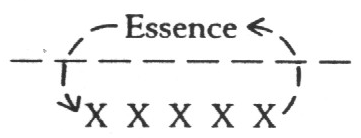
Although the essence pole does unite different unities under it, the dominant characteristic of this structure is the difference between the two poles. This difference can be expressed in a number of ways. The essence pole can claim a priority that reduces the realm of beings to its mere appearances. Or the essence pole, the moment of unity, could be relatively extrinsic to the beings, such that the unity tends to break down and fragment.
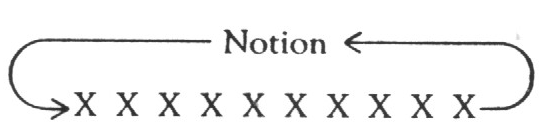
In the final section, the notion (Begriff), Hegel introduces categories that allow for a mediation between these two levels, a unity-in-difference in which each pole remains distinct from the other while being reconciled within a structured totality. Differences here are no longer "swallowed up" by the pole of unity, or unity is no longer unstable and constantly in danger of fragmenting, the twin dangers within essence structures. Instead different individuals retain their autonomy within a unity strong enough to maintain them. The categories on the level of Begriff thus allow us to describe a complex ontological structure characterised by a reciprocal affirmation of different individuals within a common unity. This unity is both distinct from and united with the individuals. A notion structure is characterised by a harmonious reconciliation between universal and individual.
A pretty good account eh.
April 15, 2006
Hegel: unity and difference
As we know, Hegel attempted to provide an immanent ordering of the basic categories. A category is. a principle (a universal) for unifying a manifold of some sort or other (different individuals, or particulars). A category thus articulates a structure with two poles, a pole of unity and a pole of differences. Hegel says that this sort of structure, captured in some category, can be described as a unity of identity in difference, or as a reconciliation of universal and individuals.
From this general notion of a category we can go on to derive three general types of categorial structures. In one the moment of unity is stressed, with the moment of differences implicit. In another the moment of difference is emphasised, with the moment of unity now being only implicit. In a third both unity and differences are made explicit together.
Hegel claims that there is a systematic order immanently connecting these three categorial structures. A structure of unity in which differences are merely implicit is simpler than one in which these differences are explicitly introduced; and one in which both unity and differences are explicit is yet more complex still. Similarly, the first sort of structure is the most abstract, while the other structures are successively more concrete.
April 14, 2006
contradictions
A good illustration of the contradictions between the unconscious and consciousness in everyday life:

It happens all the time doesn't it. The desires and fantasies of an individual are at odds with what consciousness says to others.
April 13, 2006
Agamben, shame, Abu Ghraib
Shame.and prisons: I've been thinking about this in terms fo an ethics of the emotions. It's a hard one. Consider the recent Abu Ghraib scandal. The Abu Ghraib photos made it clear how disturbing the psychological challenges of shame are.
Why did the soldiers in those photos flash the thumbs-up sign, and grin such simian grins, while they stood over the human pyramid of naked bodies that they had built? We all remember such scenes as the young American woman festively cocking her finger at the exposed genitals of the cowering prisoner, or the tableaux vivants of naked Iraqi men forced to kneel down and push their unseeing, hooded faces into other men’s penises, in a parody of fellatio. We also all know that Abu Ghraib raises troubling questions about domestic American prisons adn Guantamo Bay. There is disturbing evidence that similar sorts of brutal and degrading practices go on in ordinary American corrections facilities.
This complicates Agamben's argument that Auschwitz's open new ethical terrain marked by shame.
April 12, 2006
Agamben: shame
Auschwitz creates a whole new set of relationships between concepts and in doing so serves to disrupt the settled relations of the pre-Auschwitz world---and later the post-Auschwitz world.
For Agamben, in Remnants of Auschwitz, the new ethical terrain after Aschwitz is marked by shame, to making oneself passive and being consigned to passivity. We are the subjects of our desubjectification. Shame is what is produced in self-loss--to the subject becoming a witness to its oblivion as subject.
Some argue that shame (and disgust) offer an unreliable guide to ethical conduct behavior as it risk calling up mere prejudice and social stigma and signifies a desire to hide from our humanity. Martha C Nussbaum says:
My general thesis will be that shame and disgust are different from anger and fear, in the sense that they are especially likely to be normatively distorted, and thus unreliable as guides to public practice, because of features of their specific internal structure. Anger is a reasonable type of emotion to have, in a world where it is reasonable to care deeply about things that can be damaged by others. The question about any given instance of anger must then be, are the facts correct and are the values balanced?
She says that shame that there is much more to be said about shame's positive role in development and social life, in connection with valuable ideals and aspirations. Thus my story about shame will ultimately be quite complex, and will involve distinguishing different varieties of shame, some more and some less reliable.
I shall argue that what I shall call "primitive shame"--a shame closely connected to an infantile demand for omnipotence and the unwillingness to accept neediness--is, like disgust, a way of hiding from our humanity that is both irrational in the normative sense, embodying a wish to be a type of creature one is not, and unreliable in the practical sense, frequently bound up with narcissism and an unwillingness to recognize the rights and needs of others. Even though this sort of shame can be in many ways transcended, such favorable outcomes do not always take place. Moreover, all human beings very likely carry a good deal of primitive shame around with them, even after they in some ways transcend it. For this reason, and other reasons I shall offer, shame is likely to be normatively unreliable in public life, despite its potential for good. I shall then argue that a liberal society has particular reasons to inhibit shame and to protect its citizens from shaming.
April 10, 2006
Deleuze: process as actualisation
Back to metaphysics:--- to Deleuze on difference and unity that was approached in this post. In Difference and Repetition Deleuze says:
An organism is nothing if not the solution to a problem, as are each of its differenciated organs such as the eye which solves a light 'problem'; but nothing within the organism, no organ, would be differenciated without the internal mileu endowed with a general effectivity or integrating power of regulation. (Here again, in the case of living matter, the negative forms of opposition and contradiction, obstacle and need, are secondary and derivative in relation to the imperatives of an organism to be constructed or a problem to be solved.) (p. 211)
It's odd to see an organisim as a solution to a problem, but it makes sense if we think in evolutionary terms. How then does Deleuze understand the 'integrating power of regulation'? He says:
The only danger in all of this is that the virtual could be confused with the possible. The possible is opposed to the real; the process undergone by the possible is therefore a 'realisation'. By contrast the virtual is not opposed to the real; it possses a full reality by itself.The process it undergoes is that of actualisation. It would be wrong to see only a verbal dispute here: it is a question of existence. (p.211)
Hence the emphasis is on actualisation that takes place by difference, divergence or differeciation. In this sense actualization or differenciation is a genuine creation, as it does not result from any limitation fo a pre-exsiting possibility.
April 9, 2006
Agamben: Auschwitz as new ethical territory
In the previous post I asked what kind of ethics is Agamben pointing to in Remnants of Auschwitz? My reply was that this is where it gets fuzzy. Agamben does warn us about this. In the concluding sentence of his preface, Agamben declares:
For my own part, I will consider myself content with my work if, in attempting to locate the place and theme of testimony, I have erected some signposts allowing future cartographers of the new ethical territory to orient themselves. Indeed, I will be satisfied if this book succeeds in correcting some of the terms with which we register the decisive lesson of the century. . . .” (RA, p.14)
What are these signposts of the new ethical territory? We know that Agamben argues that 'ethics is the sphere that recognizes neither guilt nor responsibility; it is, as Spinoza knew, the doctrine of happy life'. (RA, p.24).
What we also know is that the figure of the Muselmann is regarded by Agamben as not only the symbol of the evil of Auschwitz but also the defining characteristic of a new, post-Auschwitz, paradigm of ethics. What Agamben does do in the text is unsettle and shake up our well-entrenched concepts and categories; our task is to resist cliches and our comfortable familiar ethical and political categories. For instance he rejects the tragic hero model of ethics based on the guilty-innocent person. Agamben says that:
The Greek hero model has left us forever; he can no longer bear witness for us in any way. After Auschwitz, it is not possible to use a tragic paradigm in ethics. (RA, p.99)
Agamben also rejects an ethics based on the guilt or shame at having survived the camps whilst others died; ashamed at having survived.
Agamben states that 20th century ethics opens with Nietzsche's critique of Judeo-Christianity, the overcoming of resentment, and Zarathustra's teaches us to will backwards. How promising is this as a mapping of the new ethical territory?
On Agamben's interpretation what Nietzsche offers us is conquering of the spirit of revenge in order to assume the past by willing its return for eternity--the doctrine of eternal return. Agamben acknowledges that Nietzsche's eternal return makes no sense of Auschwitz--who would wish that horror to be repeated for eternity or to love it as destiny?
Where does that leave us in terms of the new ethical territory ? With shame in terms of its ontological characteristics? Is this a signpost for this new ethical terrain?
April 8, 2006
Agamben: ethics & Auschwitz
Catherine Mills in a review essay of Giorgio Agamben's Remnants of Auschwitz: The Witness and the Archive, says that:
The ethical problematic presented by Auschwitz then is that of remaining human or not; however, in the biopolitical situation of the camps, remaining human takes on a particular cast that eludes and contradicts attempts to sanctify human life through moral categories such as dignity and respect. Agamben argues that neither the claim that the intolerable uniqueness of Auschwitz lies in the degradation of life nor, conversely, in the degradation of death, is sufficient to yield an understanding of the indistinction of the human and the inhuman and an ethics adequate to the challenge presented by the Muselmanner.
In Remnants of Auschwitz Agamben say that:
Auschwitz marks the end and ruin of every ethics of dignity and conformity to a norm. The bare life to which human beings were reduced neither demands nor confoirms to anything...the good that the survivors were abke to save from the camp--if there is any sense in speaking of a "good" here--is therefore not dignity ... The Muslemann..is the guard on the threshold of a new ethics, an ethics of a form of life that begins where dignity ends. (p.69)
This means that Agamben is critical of those like Bruno Bettleheim who interpret the limit experience of the Muselmann in moral terms.
Bettleheim tells us that once one passes beyond the point of no return, the Muselmann abdicates his inalienable freedom and loses all traces of affective life and humanity. He is no longer a creature about whom we can speak of his human dignity, a being who is capable of responsibility. Agamben argues that dignity and responsibility are originally legal (not moral) concepts, obscure the threshold reality of the Muselmann. In a manner similar to Nietzsche, Agamben also argues that our moral concepts have their genealogy in the history of the law. Our standard moral discourse fails to do justice to the fact that the Muselmann is "beyond" dignity and responsibility. Auschwitz shows us that it is possible to lose one’s dignity and decency but that there is still life in this most extreme degradation.
What kind of ethics is Agamben pointing to? That's where it gets fuzzy.
April 6, 2006
Agamben: Remnants of Auschwitz
I started reading Giorgio Agamben's Remnants of Auschwitz here then dropped it. Suprisingly, I did so, despite the text being an account of ethical response to biopolitical subjection in the concentration camp, which Agamben holds operate as 'the nomos of the earth', as the biopolitical space par excellence. Maybe I was reading the text politically rather than ethically? Agamben explicitly distinquishes between ethical categories and juridical categories (responsibility and guilt) to clear a space in which the problem of Auschwitz has not been overcome.
Remnants of Auschwitz is an interpretative account based on the writing of others, notably Primo Levi's The Drowned and the Saved. In this text Agamben takes the condition of the camps as a starting point. He says that in ' the camp, one of the reasons that can drive a prisoner to survive is the idea of becoming a witness.' He grounds his witnessing of the horror of Auschwitz on those 'who have experienced an event from beginning to end and can therefore bear witness to it'--a camp prisoner.
The figure who witnesses is the living dead, the Muselmann, the shell man who marks the threshold between life and death ; it is limbo in which human passes into non-human. The threshold or non-place is the world of the half living. The Muselmann are immobile skeletons who do not speak and who had touched bottom. Agamben says that:
Auschwitz is precisely the place in which the state of exception coincides perfectly with the rule and the extreme situation becomes the very paradigm of daily life. But it is this paradoxical tendency of the limit situation to turn over into its opposite that makes it interesting. As long as the state of exception and the normal situaion are kept separate in space and time, as is usually the case, both remain opaque though they secretly institute each other. But as soon as they show their complicitly, which happens more and more today, they illuninate each other, so to speak, from the inside.
Agamben says that before Auschwitz became an extermination or death camp it was a concentration camp in which the Jew is transformed into a Muselmann, and the human being into a non-human.
Agamben says that what is at stake in the extreme situation of Auschwitz is remaining human or not, becoming a Muselmann or not. Agamben aims to show us that the Muselmann raises the most profound questions about the basis of dignity, morality, and politics--indeed about our very understanding of humanity. Is he right about this?
April 5, 2006
Foucault+Heidegger
In this article in Contretemps Timothy Rayner argues that it is possible to discern at least three lines of continuity between Foucault's biopolitical government and Heidegger's technological enframing as accounts of modernity. Rayner says:
First, we have a substantive continuity. Both biopower and technology address reality understood as a field of resource. In this respect, the difference between Foucault and Heidegger's accounts is merely a matter of scope. Whereas the viewpoint of technological enframing encompasses reality as such, biopolitical government is concerned with a limited field of reality-resource: the state population. Second, we have an instrumental continuity. In both these critiques, the process of objectification-commodification of the real is thoroughly mediated by technology, being inseparable from the deployment of technical concepts, structures, practices, and procedures, and governed by an overarching perspective on the world that would situate all forms of life within a domain of technical manipulation. Third, we have a strategical continuity. Both biopower and technology pursue the overall management of life. Reducing the forces of nature to raw material, both seek to set this material in order---implementing mechanisms to establish regular patterns of cause and effect, checks and balances to ensure the flow of energies into productive, self-enhancing systems, thus to achieve a heightened measure of mastery and control over this object-domain.
I've pretty much operated with the view that Heidegger provides the ontology of biopower. I enfold biopower into technological enframing as it were and leave it at that. But that's too crude and misleading.
Rayner is more sophisticated. He talks in terms of problematize the relationship between technology and biopower and figuring out how we might advance beyond these simple continuities:
To understand Foucault's critique of biopolitical government along the lines of a Heideggerian way of thinking, we first need to sharpen-up our conception of the interiority that we have associated with it. We have previously defined this interiority in its substantive, instrumental, and strategical dimensions. Let us now incorporate into this conception the specific forms of knowledge (connaisance) that Foucault has associated with biopolitical government..
Why so? Rayner argues that Foucault's critique of the present is particularistic. Rather than attempt to provide a general account of the 'essence’' of modern technology, Foucault 'simply identifies particular practices in the
present...and traces their lines of descent in a Nietzschean fashion'. Such questioning is not tantamount to prescribing an ontology,either anti-humanist or humanist.
Well now, there are such things aas ontological commitments or presupposition. Heideigger makes explicit Foucault's onolotcal presuppositions.
April 4, 2006
Heidegger: the world as picture
Technological enframing is a 'way of revealing', or mode of world-disclosure that tHeidegger argues defines the ethos, or way of being, that characterizes the modern age.
According to Heidegger in "The Age of the World Picture," essay in The Question Concerning Technology and Other Essays (trs. William Lovitt, Harper and Row, New York, 1977) there is a specific is a relationship between technological enframing and the objectification of the real in modernity. We see the first signs of the emergence of this way of beginng the mid-seventeenth century, when the real as such was first defined as something essentially amenable to the representation of human beings.
With Descartes, Heidegger argues '[w]hat is, in its entirety, is...taken in such a way that it first is in being and onlyis in being to the extent that it is set up by man, who represents and sets forth'. This does not mean that in modernity the world becomes 'subjective'. Far from it. Modernity, Heidegger claims, does usher in a new 'subjectivism', but also an unprecedented 'objectivism'. This subjectivism and objectivism condition one another in a reciprocal interplay.
In order to posit something as a determinate object, the modern subject of representation must first project a 'groundplan' of what is to count as an element within the governing sphere of objectivity. Precisely how a thing is understood in its objectivity will depend on the groundplan thus projected. But for there to be a subject at all, the subject of representation must also be 'set up' relative to a sphere of objectivity.
So the subject of modernity not only re-presents the world as picture----that is to say, as an objective realm set out before him, but he simultaneously 'puts himself into the picture'...puts himself into the scene, i.e., into the open sphere of that which is generally and publicly represented.
What then is the content of this picture? What is the mode of being that is disclosed?
It is a technological one; one in which the world is ceaselessly objectified, qualified, quantified, and systematized-- and reduced to the level of stock, or resource. What cannot be objectified cannot be put to use, and what cannot be put to use is useless, and thus redundant. The human being is no exception.
a primordial sense of being
Robert Pierchy in The Spinoza-intoxicated man: Deleuze on expressionsays that Deleuze’s ontology is based on a tripartite distinction among Being, the virtual, and the actual is synonymous with the Event or the good repetition.
On Being he says:
Claims about Being are not to be confounded with claims about entities, whether actual (material objects) or virtual (such as Ideas). As I suggested above, Deleuze understands Being in the pronominal mode. He views it as something like expressive agency, something like movement or force. More specifically, he views it as the activity of differentiation---a destabilizing or decentring force which shatters fixed identities. One might think of this by analogy with Heraclitus’s primordial fire. In both cases, Being is seen as an incendiary force, a force which makes different and makes difference.
That's about right. Doesn't Heidegger seeks to recover a primordial sense of being that he believes has been lost
through the history of the West. Is this not one such conception?
Could we say that a Heideggerian way of thinking is implicit in Deleuze? Could we say that Deleuze appropriates Heidegger’s philosophical practice, just as Foucault did?
April 1, 2006
Deleuze: difference & unity
I want to turn back to this post----to Deleuze's concept of difference as difference in itself and his conception of difference as the ground of being.
The new concept of difference relies upon other concepts such as those of multiplicity and virtuality and this gives us a conception of things as the expression of virtual multiplicities.
A question. Does Deleuze simply posit a world of pure difference in which unities are explained as secondary phenomena?
Virtual multiplicities are structures in the sense that these are composed of purely formal elements defined by the reciprocal relations between their component elements. Hence we have a system of multiple non-localised connections between differential elements that are embodied in relations and terms. In Diifference and Repetition Deleuze says:
The reality of the virtual consists of the differential elements and relations along with the singular points which correspond to them. The reality of the virtual is structure. We must avoid giving the elements and relations which form a structure an actuality which they do not have, and withdrawing from them a reality which they have. (p. 209)
Hell, Deleuze is a structuralist.