October 29, 2009
art, photography, Flickr
There appears to be an emerging debate around the art institution, photography and Flickr arising out of the discovery of Vivian Maier. The heading of the debate is elites, flickr and chipmunks, and one undercurrent is that Flickr is not being taken seriously by the art world, and that it is stereotyped as nothing but kittens, sunsets, and chipmunks.
Jin at Shooting Wide Open says:
I really think there’s no reason not to embrace the net. In class, I’m reading about Stieglitz and his distinction between the professional photographers who are just out to make money and the true artists, about museum curators as elite taste makers, and about photography’s slow acceptance into the art world. One thing that occurs to me is that if we aren’t interested in how the general public uses and perceives photography, if we keep putting down supposedly low brow incarnations of photography, how can we possibly expect the majority of the public to look at the art photography that we find interesting or to increase funding for the arts? Why is it that arts funding is not a priority in this country? What do the arts offer the average person by his own reckoning, rather than what an artist, curator or critic tells him he should get out of it?
This position defends Flickr in terms of helping to raise visual literacy and in helping us to start somewhere with lots of photos of kittens, babies, sunsets or flowers. Jim Colberg's response at his Conscientious Redux highlights the importance of good art, acquiring an appreciation for, cultural elitism and the role of role of art not necessarily being entertaining but is transformative.
By transformative Colberg means when art:
does something to you, when, after being subjected to it, you’re a different person - regardless of whether you smiled or laughed about what you saw or not. That, I believe, is the true essence of art, and that’s something we should aim for.The role of curators or critics is to point this out - that’s what they’re being paid for. Of course, there’s the lingo, the “art speak”, but it’s easy to ignore that (just don’t read the press releases).
Fair enough. He then turns to Flickr.
So back to Flickr...there are two major problems with the usual complaints about it not being taken seriously by the art world. First of all, it’s not true. There are lots of people who use the site to find “vernacular photography”, say, or to collect images and transform them (for example Penelope Umbrico; also Joachim Schmid, etc.). Second, one of the reasons why so many critics or curators don’t consider Flickr is simply because they are looking for something else.
Well, there is a divide between the art institution and Flickr and it's the old fault line of high culture versus mass culture; art v kitsch, professional v. propfessional.
hyperallergic--(Hrag Vartanian is an art critic who writes about photography and Flickr (here and here) responds by saying that art is also experimental and that:
the main thing that makes Flickr unattractive is that it is dominated by ad-educated aesthetic, by which I mean, sleek, surface-based, and impressionable with little beyond that point. That’s not to say that much of the “art” being produced today isn’t informed by that aesthetic, just that most of the best art gives you more than just that.
Vartanian's interpretation of Flickr's aesthetic is a reasonable one.Such an aesthetic has emerged on Flickr aesthetic, but there is also a lot of work on Flick that is in opposition to this aesthetic.
Vartanian's response is questioned by La Pura Vida's Bryan Formhals on his Tumblr:
It’s futile to attempt to stereotype a community as large as Flickr. There are thousands of photographers that are working in the fine art and documentary genres. It’s not all ‘vernacular’ or “sleek, surface-based” photography. I’m constantly amazed that intelligent people make such flippant comments without really understanding the variety of communities that are using Flickr.
He adds that Flickr is simply one channel that photographers can use to distribute and broadcast their work. Most serious photographers are intelligent enough to distribute their work through various channels. Flickr, for the most part, is more geared toward networking and meeting other like minded artists. But it’s also a great place to find new work from photographers who maybe just finding their voice.
Colberg's reply is that one of the reason why people ignore Flickr--or don't take it seriously-- is the poor quality of the discussions both on Flickr and about Flickr. It is poor quality because:
it’s not so much about discussing Flickr, it’s about denouncing those people who dare to question Flickr as elitist or, in this case (a variant), as people who just don’t (what is really meant is: don’t want to) understand it. This is not much different from how people like Bill O’Reilly, Shaun Hannity, or Keith Olberman operate: Instead of engaging with a debate, carefully push those buttons that you know will make your real audience react.
This is a red herring in that Formhals at La Pura Vida was making the reasonable point that the tendency to stereotype Flickr as nothing but kittens, sunsets, and chipmunks is mostly made by people who haven’t invested the time to explore (and so don't know) the various groups and communities that have developed on Flickr.
However, discussions around Flickr, aesthetics and photography are pretty poor and often dogmatic. Most are better at image production that cultural or aesthetic criticism.
October 26, 2009
Australia Council + contemporary culture
Since I've given greater space and time to photography I've occasionally wandered over to the Australia Council for the Arts to see how my work connects with what they are doing. After all Australia has become a more visual culture in the last decade and the Council's brief or priority is on nurturing artists rather than on building grand arts centres, impressive museums and large-scale galleries.
I was curious. To be honest I haven't seen much in the way of photography, digital media or innovating with digital technology there. I haven't thought much about that tardiness towards engaging with contemporary culture --even when I stumbled upon Revealing the Arts, which will be webcast live by ABC arts. The theme is "creative conversations and solutions for the digital era."
Marcus Westbury has given this issue some thought. In an op-ed in The Age he says:
the Australia Council sits on narrow terrain that has seismically shifted. The entire world of professional and amateur creation, of ad hoc exhibitions and global audiences opened up by the internet, has been ignored. Changing forms have clashed with archaic art-form definitions. The result is that proportionally less and less Australian art and culture has anything to do with the Australia Council...The reality is that culture is evolving at rapid pace. Artists increasingly work in ways that the Australia Council has little understanding of or interest in. By default, the Australia Council has decided its role lies with protecting and defending the heritage arts and not with being an active participant in an evolving culture.
The Australia Council has retreated to a heritage rump and acted defensively towards the changes wrought by digital technology.
Westbury says that the Council's basic assumptions are rarely questioned:
that the culture, the cultural organisations that deliver it, the cultural needs and infrastructure of Australia will remain more or less fixed. Technology is merely about the marketing, the branding, the language, the revenue and the education programs. The idea that the culture itself is changing and evolving is rarely considered. Technology merely changes the hype and the pitch to keep the kids interested.
The Council thinks in terms of the art forms it wishes to reward or ignore rather than the plurality of http://www.marcuswestbury.net/2009/09/15/niche-cultures-or-why-opera-is-like-comic-books/">niche cultures. From the latter perspective there is a need to rethink the way cultural diversity can be guaranteed in a climate where everyone seems more interested in building a creative industry than a creative culture.
October 22, 2009
in memoriam
The Grateful Dead perform Dylan's Forever Young with Neil Young on vocals and guitar at the Bill Graham Memorial Concert "Laughter, Love, and Music" in the Polo Fields, San Francisco, CA 1991.
An estimated 300,000 people attended to view and listen to many of the entertainment acts Graham had supported through his musical promotions.
October 21, 2009
nostalgia
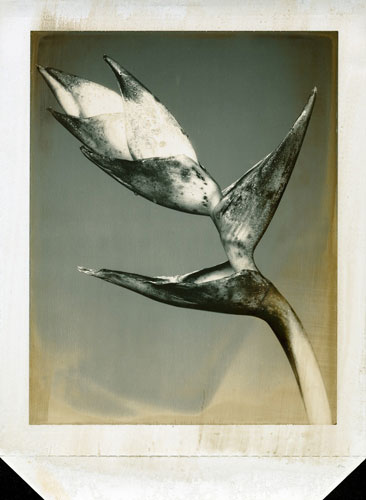
Polaroid Corpoation has gone. It had withdrawn from analog instant film products completely in 2008. The SX-70/600 film system is now history. There is the Polanoir Gallery first ever Polaroid-only art gallery in Vienna and Polanoid.net the biggest Polaroid gallery on the web.
What is left is nostalgia for what once was. People like the look and feel of Polaroid analog photography. They have a retro look with lovely colors.
 David Bailey, Swinger, 2008, Unique Polaroid
This image is from an exhibition at Atlas Gallery. The expiration date of the last batch of manufactured Polaroid film - the 9th October 2009 - marked the opening of the Polaroid Exhibition at Atlas Gallery in London. It is the passing of an era.
For many people, Polaroid film was reminiscent of a simpler form of instant photography --a mass product during the 70's/80's. Polaroid hopes to reposition itself in the digital-imaging environment with the PoGo, an instant photo printer producing 2 × 3 inch (5 × 7.5 cm) prints, whilst building on its brand-name recognition and long history in the medium.
In contrast, we have the revival of polaroid film and cameras by Florian Kaps', a leading manager of the Lomographic society and founded Polanoid.net, a site dedicated to the art of Polaroid photography, with his Impossible Project. This project aims to produce film of two exposure types, each compatible with both the classic SX-70 cameras popular with artists and the more modern 600 series. The team in the Netherlands has had to start from scratch as many of these components don't exist anymore. The aim is not to rebuild the Polaroid format but create a new system complete with characteristics of its own.
Will the same problem that plagued the original Polaroid stock — the increasing popularity of digital photography — befall the fate of the film produced by The Impossible Project? Or will it become a niche or micro-market that treats photography as a craft that keeps a picture-making technology alive when a major manufacturer can no longer justify keeping it in the product line. The faux-Polaroid “Polaroid look” will doubtless endure in our lens culture.
October 11, 2009
automobile heaven
Edward Burtynsky's photographs of industrial landscapes are well known.These are manufactured landscapes that stand in contrast the majesty of the unspoiled wilderness.
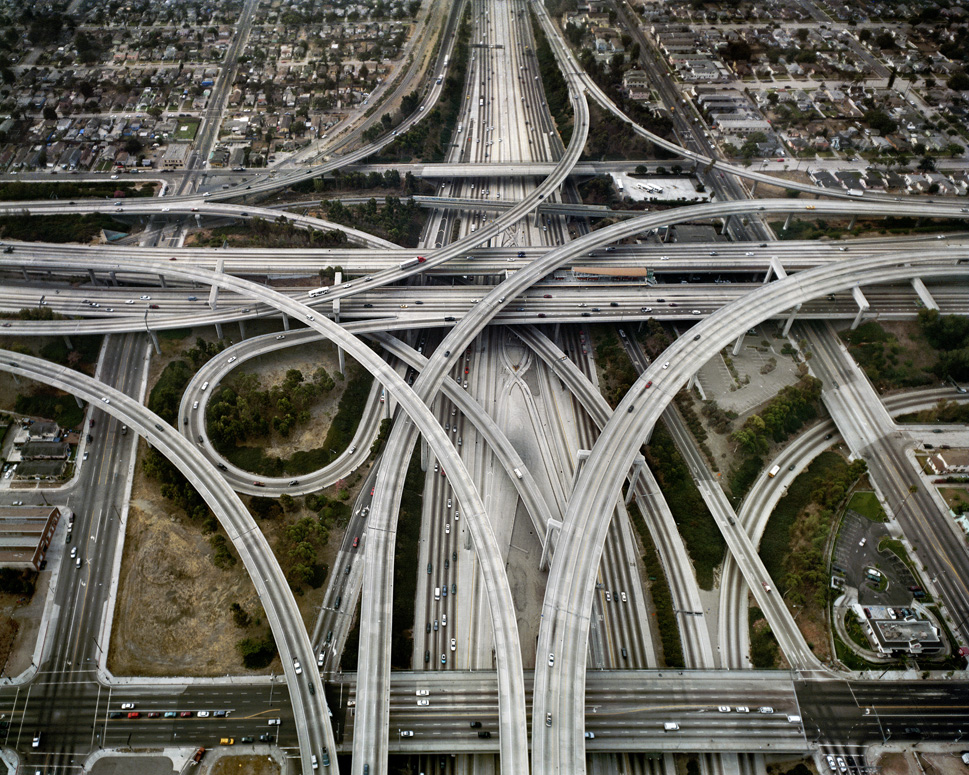 Edward Burtynsky, Highway #1, Intersection 105 & 110, Los Angeles, California, USA, 2003, Chromogenic color print.
Human activity within industrial capitalism has so altered nature and transformed the atmosphere over the entire planet, there is no longer a nature outside of culture. For the last 25 years, Edward Burtynsky has photographed the results of the ways that human beings have dominated ecological systems.
The results are photographs of devastated places----the industrial sublime.They are shot with a view camera, largely in diffused light, and present in rich detail the scale of the change wrought upon the earth.
 Edward Burtynsky, Alberta Oil Sands #6, Fort McMurray, Alberta, Canada, 2007, Chromogenic color print.
The criticism is that though ostensibly the photos promote awareness of the issues at hand, they are equally open to criticism for aestheticizing environmental atrocity.
October 10, 2009
Benjamin's relevance
Transformations Issue 15 (Nov 2007) is concerned with the influence that Walter Benjamin continues to have on contemporary thought. It seeks to create a dialogue between contemporary scholars, theorists, and writers from a range of disciplines and practices with Benjamin’s ideas on politics, art, and representation in the context of a shift from mass to global culture.
In From Flâneur to Web Surfer: Videoblogging, Photo Sharing and Walter Benjamin @ the Web 2.0 Simon Lindgren says that
One of Walter Benjamin’s main points in the introductory parts of The Arcades Project was that technology and techniques contribute to a restructuring of the human sensory system.... He wanted to put forth that the forms of mediated reproduction which were emerging in the era of modern industrialism had an impact on the ways in which people organise their perception of the world around them. Benjamin illustrated his point by discussing how cars, trains and aeroplanes transform relations to physical space, as well as how new media such as photography and cinema reformulate previous conceptions of time and space.
This latter area of focus makes it particularly tempting to try to apply his analytical concepts on today’s intensified developments within the sphere of digital media such as Flickr. Here we have “the culture of real virtuality” in which “timeless time” and “the space of flows” have annihilated traditional time and place.
October 1, 2009
a critical architecture?
a.aaaarg.org is a conversation platform - at different times it performs as a school, or a reading group, or a journal and it was created with the intention of developing critical discourse outside of an institutional framework. Just what I need. I dig around and uncover “Criticality” and Its Discontents by George Baird from the Harvard Design Magazine (No 21, 2004-5.) He says:
The matter now coming into question is the concept of a “critical architecture”....Today “criticality” is under attack, seen by its critics as obsolete, as irrelevant, and/or as inhibiting design creativity..the lineage of “criticality”...has consistently focused intellectually on concepts of “resistance” and “negation.”
I have no idea what a critical architecture would be. Critical of what? Consumer society? The names Peter Eisenman, Michael Hays, Manfredo Tafuri, Kenneth Frampton, and Elizabeth Diller and Ricardo Scofidio mean nothing to me.
Michael Hays “Critical Architecture: Between Culture and Form,” published in Perspecta (No 21 1984) is the place to start. Hays says:
In this essay I shall examine a critical architecture, one resistant to the selfconfirming, conciliatory operations of a dominant culture and yet irreducible to a purely formal structure disengaged from the contingencies of place and time. A reinterpretation of a few projects by Mies van der Rohe will provide examples of a critical architecture that claims for itself a place between the efficient representation of preexisting cultural values and the wholly detached autonomy of an abstract formal system. The proposition of a critical realm between culture and form is not so much an extension of received views of interpretation as it is a challenge to those views that claim to exhaust architectural meaning in considerations of only one side or the other.
The two positions sketched are symptomatic of a pervasive dichotomy in architectural theory and criticism. One side describes artifacts as instruments of the self-justifying, self-perpetuating hegemony of culture; the other side treats architectural objects in their most disinfected, pristine state, as containers of a privileged principle of internal coherence.
Hays examines some works by Mies van der Rohe that he describes as critical in the sense of being resistant and oppositional; ie an an architecture that cannot be reduced either to a conciliatory representation of external forces or to a dogmatic, reproducible formal system.