September 29, 2009
Freud in America
In his When Freud Came to America in The Chronicle Review Russell Jacoby says that:
Yet the clamorous effort to rid the world of Freud is misguided. Psychology departments may relegate psychoanalysis to phrenology and other quackeries as they seek testable results, but Freud's thought lives on in the humanities—or wherever scholars and students contemplate the vagaries of desire, morality, and religion. In the name of reason, Freud challenged the veneer of reason. He dug to uncover the forces that make us not only loving but also odd, hateful, and violent. Even when he was wrong, a boldness infused his thinking. He remains a tonic for a cautious age. The epigram that Freud chose for The Interpretation of Dreams—a line from Virgil—has not lost its appeal: "If I cannot bend the higher powers, I shall stir up hell."
Though Freud uncovered the unconscious dimension of individual reason, this hasn't really been accepted in the social sciences, especially in economics despite the rationality principle being a fundamental principle of economics in that it is premised on individual agents choosing rationally. What does that mean?
It is the principle according to which people act rationally in the sense that they tend to adopt means which, according to them, are oriented towards the satisfaction of their goals which are understood in terms of utility, profit or wealth maximization. The equation of human rational behavior with instrumentalist, especially economic, rationality represents the hallmark of the economic or rational choice approach. Here the optimizing substantively rational actor faces the problem of maximizing utility subject to a budget constraint.
Duncan K. Foley states that:
The concept of rationality connects economics firmly to the Hobbesian-Lockean tradition of political philosophy, which purports to explain the political and economic organization of modern society as the necessary outcome of the interaction of naturally constituted rational individuals confronting each other as competitors for scarce resources. To avoid the terrible consequences of anarchic struggle, these rational individual actors are supposed, according to this "just so" story, to agree to the institutions of property and political authority that constitute the framework of modern society.
The theme of rational-actor theory is that "naturally" constituted individuals facing existential conflicts over scarce resources would rationally impose on themselves the institutional structures of modern capitalist society, or something approximating them.The world as it presents itself to us is to a better or worse approximation, the world we would have constructed freely if we had the chance. This way of looking at matters systematically neglects the ways in which modern capitalist society and its social relations constitute the "rational," calculating individual.
The strong versions of substantive rationality are at odds with observable individual behavior. People are routinely inconsistent in making choices and processing information. They act from multiple motives without having resolved the conflicts inherent in them, and these motives often include aspirations, identity issues, and unconscious values that are impossible to reduce to material consumption.
What has happened is that economics functions as if psychoanalysis, a logic of the unconscious, never happened; that it no longer has a place in the history of reason; and that we can return to the Enlightenment, to Hobbes and Locke, and to the philosophy of the ego without paradox. Economics represents a restoration that places the unconscious outside reason.
September 24, 2009
fractured online identities
In Time to get used to our fragmented identities Bronwen Clune says:
blogs have just become part of the constant fractured stream/identities that we create. I guess they are no longer our central destination site.....Blogs still have an important role, but I think they are just now part of the fragmented identities that so many of us have across a number of networks. ....I guess wanting to hold on to our online identities in one place is an old-way of looking at things Growing your profile in future might mean more fragmentation
I guess that I have a fractured online identity-- they are decentralized in the sense of I have multiple digital identities in multiple networks eg., (FaceBook, Flickr, home page, blogs, twitter) ---and I try to more actively adopt some centering strategies in thoughtfactory. This homepage attempts to 'consolidate' the various masks of my network presence.
Though masks are not necessary for online interaction we are required by some networks (eg.,Flickr, Twitter) to adopt them.
September 23, 2009
fundamentalism explored
Justin Clemens argues in The science of fundamentalism that fundamentalism is more than a stupid hick religiosity or a dot-point religion as the problem of fundamentalism is integrally bound up with the problem of science and technology.
He says that fundamentalism is a (biopolitical) technological response to modern science:
Fundamentalism shouldn’t be opposed to relativism (or secularisation), despite appearances. Its real bond is with modern science, off which it feeds in an antagonistic complicity. Therefore it will never be eradicated as long as our civilisation remains what Neil Postman calls a “technopoly,” that is, as long as we continue to take our socio-political directives from technology.
Fundamentalism’s refusal of science is directed at technoscience which is technological innovation that is now so bound to capitalist investment.
Clemens says that we need to affirm that fundamentalism is a very reasonable and viable response to a serious epistemo-political paradox of modern life:
fundamentalism isn’t merely ignorant, stupid or prejudiced; rather, it very quickly recognised how science short-circuits the Enlightenment gap between belief and reason in a radical new way. Because only a tiny section of the population has any understanding of, or access to, the grounding processes of scientific experts, the latter’s pronouncements can appear substantially identical to the pronouncements of traditional religious figures. More fundamentally, the grounds available for non-experts to adjudge the claims of experts isn’t and cannot be given scientifically – and there are presently no other commonly accepted rational grounds for making such judgements. What rushes in to fill the void is typically a devil’s cocktail of heterogeneous discourses – nationalism, racism, sexism, etc. – the political correlates of the most primitive psychosexual fantasies. Fundamentalism works here because it at least tries to provide a central text to which all can equally refer and defer, and which often repudiates the contemptible socio-biological traits beloved of neo-fascist movements.
This contestation of the perceived social dominance of scientific research by fundamentalists makes sense. But their enemy is broader than modern science, as it is also Enlightenment values, secular liberal humanist virtues, relativism and the Socratic problem of the education of youth.
September 21, 2009
digital media: it's the social use
Eric Harvey in his The Social History of the MP at Pitchfork makes some good points in his analysis of the way that the network – not just the digital – has transformed the way we listen to music. He says that capitalism hasn't gone away but mp3s have severely threatened its habits and rituals within music culture in that the circulation of mp3s through unsanctioned networks reaffirms music as a social process driven by passion, not market logic or copyright. Then we have this:
These changes are part of a social and economic shift that is both revolutionary in scope and potential but also reliant on very traditional ideas of interaction and production. In the 19th century, the Industrial Revolution upended Western societies from their agrarian ways of life, distancing the average person from the means of production, and introduced what would later be called "modernity."In the late 20th century, the Internet quickly made this phase of communication and economics look quaint and distant. This latest shift-- you can tell your grandkids you lived through it-- opens the possibility to freely create and distribute culture, with the idea of reaching a global audience. Compared to the one-to-many model of last century, the current one, which is still coming into shape, gives us the capacity-- maybe even necessity-- to cheaply and easily collaborate, create, organize, and speak truth to power. Technologically, it's futuristic. In terms of what it might hold for social organization, the roots are pre-modern, even ancient.
He warns us to not get carried away with this emergence of the future of a "convergence culture" from the old industrial music-making though. A lot of forces would have to coalesce for any sort of revolution to happen:
More likely, it will take a while, as it did with radio and the phonograph, for mp3s to stabilize and reach a point where the old ways of doing things learn from the new tools. The mess left by free digital music-- a collapsed industry, a rising generation of kids with a vastly different notion of musical "value" than their parents, a subset of that set with more eclectic tastes than a teenager should be capable of, and a wave of lawsuits that are going to appear increasingly surreal and ridiculous as they fall into history-- is going to take a while to sort out and clean up.Is this a suggestive map of the way that the publishing industry and photography books is attempting to transform itself in the face of the digital? Harvey's argument is that the social use of digital media is more transformative than the move to the digital itself.
September 16, 2009
the e-book
Susan Hayes, the director of literature at the Australia Council for the Arts, has an op-ed in The Australian entitled Books will survive, but not on paper arguing that the paper book, as we know it, will gradually disappear from our shelves over the next 10 years with the emergence of e-books and e-reader's such as the Kindle-2 all its e-ink cousins, future ebook tablets from Apple and other phone makers that are all designed to emulate the experience of reading printed material.
Hayes' duality is a bit stark as the paper book will survive in a niche market. However, her concern is with the effects of this transition to digital on the publishing industry:
While the multinationals are already taking advantage of both the publishing and global marketing opportunities offered by the new technologies, small independent publishers are struggling. Operating on low staffing levels and even lower profit margins, they do not have the necessary in-house expertise or the IT equipment capable of taking on this new level of sophistication.Paradoxically, I believe that those who have already gone to an all digital output, investing in skills and technology rather than paper, have more chance of keeping pace with their more powerful rivals. It's the cost of putting out simultaneous online and paper versions of a book that will put some companies out of business.
The publishing industry is attempting to transform itself in the face of the digital, but it is probably the social use of digital media that is more transformative than the move to the digital itself. To understand what the social use or digital media might mean in this content we need to turn to if:book, the blog of The Institute for the Future of the Book, which chronicles the shift from the printed page to the networked screen.
The book's reinvention in a networked environment means that it becomes an evolving entity within an ecology of readers, authors and texts. Unlike the printed book, the networked book is never finished: it is always a work in progress. Don Stein says that it is a continuously evolving text, as the authors add new findings in their work and engage in back and forth with "readers" who have begun to learn history by "doing history", and have begun both to question the authors' conclusions and to suggest new sources and alternative syntheses:
On the surface that sounds a lot like a Wikipedia article, in the sense that it's always in process and consideration of the the back and forth is crucial to making sense of the whole. However it's also different, because a defining aspect of the Wikipedia is that once an article is started, there is no special, ongoing role accorded to the the person who initiated it or tends it over time. And that's definitely not what I'm talking about here. Locating discourse in a dynamic network doesn't erase the distinction between authors and readers, but it significantly flattens the traditional perceived hierarchy.
The key element is the author's commitment to engage directly with readers. If the print author's commitment has been to engage with a particular subject matter on behalf of her readers, in the era of the network that shifts to a commitment to engage with readers in the context of a particular subject.
September 15, 2009
the tricks of philosophy?
anotherheideggerblog has an interview with Ian Bogost.
Bogost says about deconstruction that:
Derrida opened my eyes in ways I will always be grateful for (as I will for the influential American deconstructionists I had the benefit of studying under), but once my eyes were opened, I didn't know what I saw. Nothing. A blank vista. A desert.
Why not possibilities to step outside entrenched dualities? Why not a different perspective on inherited traditions? Or a middle path between dualities? Bogost addresses this:
Why? Deconstruction is superb at setting things in eternal motion, like some wild steampunk apparatus fastened with magnets of opposing poles. And that apparatus is mesmerizing. But beyond enchantment, it offers little direction on what practical steps to take. It is a paperweight. Once things are destabilized, then what? It is poetic and moving to assert, like Samuel Beckett, "I can't go on, I'll go on," but what sort of coward or psychopath would leave his companions stranded there, in the desert, with this useless joke of a compass? Go where, exactly? To do what, precisely? What's the third term, the structure that offers alternative to the aporia without reconciling it? Deconstruction can never answer this question, by definition, yet it is where the real work resides.
September 11, 2009
a Flickr aesthetic
In Digital Images, Photo-Sharing, and Our Shifting Notions of Everyday Aesthetics in the Journal of Visual Culture (August 2008) Susan Murray says that:
The move to the digital alters many of the basics of photographic practice –whether practical or theoretical – for users and scholars alike. While theorists grapple with the meaning of photography without film, consumers have had to learn new practices and protocols and many have found new ways to use their cameras in their everyday lives. The relationship between photographer, camera, spectator, and the image changes in some fairly significant ways and yet... there is also much continuity between the practice ofdigital photography and what came before.
Murray says that whether professional or amateur, photography has traditionally been discussed in relation to history, memory, absence, and loss. However, the introduction of digital photography and accompanying websites such as Flickr have created an additional function to photography that has much more to do with transience than with loss.
The content of some of themost popular pages[on Flickr] has little relation to traditional snapshot photographyand is, in many ways, the opposite of pictorialist amateur photography (with its focus on realism, urbanization, and the small objects in life that often go noticed). It also has little to do with studio photography. It seems to speakto a new aesthetic and function – one dedicated to the exploration of the urban eye and its relation to decay, alienation, kitsch, and its ability to locate beauty in themundane
Instead, it is understood that an everyday aesthetic –whether present in digital photography, the internet, television, or in the life of the city streets – is fleeting, malleable, immediate, and contains a type of liveness in its initial appearance that is lost once it is placed under glass or replaced by an even more recent image.
September 7, 2009
Apple: iPhone
I'm slowly shifting away from the Microsoft PC world to an Apple one because of my photography. Apple is better for graphics and colour. It's operating system also work smoothly in contrast to Microsoft's bigger, slower and more bloated. But the shift to Apple is being taken slowly ---I have yet to switch to going mobile with an iPhone. The main reason is that the telcom companies in Australia allow very limited data download.
The problem here is spelt out here in The Atlantic by Daniel Indiviglio. He quotes from this article in The New York Times:
It’s a data guzzler. Owners use them like minicomputers, which they are, and use them a lot. Not only do iPhone owners download applications, stream music and videos and browse the Web at higher rates than the average smartphone user, but the average iPhone owner can also use 10 times the network capacity used by the average smartphone user.
Owners of the iPhone 3GS, the newest model, have probably increased their usage by about 100 percent. It’s faster so they are using it more on a daily basis.
That usage places strain on the wireless network. It slows the network down especially in the US, were AT&T is the exclusive carrier for the iPhone. In Australia, where the iPhone is spread across different telecoms the date caps are so severe that the iPhone capabilities are limited g., multimedia messaging, or text messages containing pictures, audio or video. That requires additional capacity and coverage and upgrading of the network infrastructure.
So I am holding off on buying an iPhone.
September 6, 2009
Art and Mass Culture
Les Grands Spectacles: 120 Years of Art and Mass Culture is the title of an exhibition that was held at the Museum of Modern Art Salzburg in 2005 as well as of the extensively illustrated accompanying catalogue. According to this review by Julia Pine in the Journal of Visual Culture (2006, Volume 5, No. 3 ) the catalogue contains 15 essays, all published in both English and German, by the curators of the show, Margrit Brehm, an associate curator of the museum, and Roberto Ohrt, a freelance writer on the arts, and a specialist on the Situationists.
According to the curators:
The aim of the exhibition is to examine the relationship between art and spectacle; to inquire about the significance of art in a culture that s increasingly geared to sensations, illusions, spotlights and cameras;to ask which current artistic strategies are responding to this; to sketch out a historical panorama extending back to the 19th century in order to examine the different kinds of public space and media, ideas and fictions over the last 120 years. (p. 27)
The unstated dialectic of the Grands Spectacles project, what is known as the ‘high/low’ debate in English-based art theory in the context of the traditional divide between popular culture and what has been
called ‘autonomous’ art.
This is articulated by Margrit Brehm in an essay entitled ‘The Age of Pigs’:
The borderline between high and low began to blur when images reproduced in the media – indicators of mass culture and consumerism – found their way onto the canvas. Reality was traded, spectacular situations staged in real time, and the remnants of industrial society were integrated into art’s store of materials. Assemblage, environment, body art, performance and action were means of artistic expression that mirrored the changed idiom and demanded a new form of reception from the viewer. (p. 219)
This is prior to the shift in emphasis ‘from art to the visual and from history to culture’ and the excess of the visual or hypervisuality that is a characteristic of postmodern culture. Art history is the establishment position put into question by visual culture.
September 5, 2009
creative class + urban growth
There is a post on Richard Florida’s The Rise of the Creative Class at Scribbling on Bricks, which is part of Russell Degnan's Civil Pandemonium.
The post by Long Nguyen is a reading based on a E. Glaeser's analysis on Florida’s work. Florida argues that creativity can result in the growth and development of the city. If cities want to succeed they need to think about providing lifestyle, or consumption, advantages to their residents. Glaeser says that:
Florida’s basic thesis is that the economy is transforming, and creativity is to the 21st century what the ability to push a plow was to the 18th century. Creative occupations are growing and firms now orient themselves to attract the creative. Employers now prod their hires onto greater bursts of inspiration. The urban lesson of Florida’s book is that cities that want to succeed must aim at attracting the creative types who are, Florida argues, the wave of the future.large industries have tried to adapt to the rising importance of idea-creation.
Large industries have tried to adapt to the rising importance of idea-creation---the creative industries.
The first of criticism is Florida's reduction of creativity to boheminism:
Florida makes the reasonable argument that as cities hinge on creative people, they need to attract creative people. So far, so good. Then he argues that this means attracting bohemian types who like funky, socially free areas with cool downtowns and lots of density. Wait a minute. Where does that come from? I know a lot of creative people. I’ve studied a lot of creative people. Most of them like what most well-off people like—big suburban lots with easy commutes by automobile and safe streets and good schools and low taxes. After all, there is plenty of evidence linking low taxes, sprawl and safety with growth. Plano, Texas was the most successful skilled city in the country in the 1990s (measured by population growth)—it’s not exactly a Bohemian paradise.
Glaeser's argument is that it is that human capital (that is creative human capital) generates the growth within the city as opposed to Florida’s argument that a creative capital generates the growth (to have a creative capital, not only do we need the creative people, we need the contents of the city to promote creative people and activities).
There is a truth content in Florida's claim --eg., the recent rejuvenation of the inner CBD of Melbourne with its laneways, bars and restaurants which developed from the artists, designers (fashion, web), writers etc who had moved into the older buildings with their cheap rents. They created a particular place that was valued for the diversity of its inner city urban life in opposition to the windswept streets of the commercial district. It's a good example of Florida's thesis.
September 3, 2009
The Band: great disappointment, but...
The background to this kind of contemporary music in Australia is the body of work produced by Dylan, The Byrds, Gram Parsons, The Grateful Dead, Neil Young and The Band in the late 60s and early 1970s. There was a lot of musical interweaving in this alt-country and country-rock, and the interpretations and interesting reworkings that emerged from this period were more than nostalgia of the classic album period of what is now called Americana-- an amalgam of Rock, Country, Folk, Blues, Soul, and R & B.
After enjoying watching The Band is Back some time ago, I took a punt on The Band, Live At Loreley. This was from a concert and the line-up featured 3 original members in Levon Helm (percussion / vocals / bass), Garth Hudson (keyboards / saxophone) and Rick Danko (bass / vocals), plus new additions Jim Weider (lead Guitar), Richard Bell (piano) and Randy Ciarlante (percussion / vocals). Danko died in 1999.
What a shock. The legacy of The Band is a long one, and after Robbie Robertson left The Band hasn't aged well like old red wine. That is the impression given here at the Bobfest---Dylan's 30th Anniversary Concert in 1992.
They are but a shadow of their former selves. The creative juices had gone in the 80s and 90s. The musicians had retreated to poor covers and an old-timey good time version of the folky and country music side of The Band. The new material from High on the Hog is weak, the musical interplay is limited, and the energy has gone. Disappointment.
Levon Helm is the last of the Band to be still creating music and he is better on his own doing his earthy, homespun country music. There is a rejuvenation and freshness here, even after recovering from throat cancer in 1998:
"Poor old Dirt Farmer' is a song about the trials and tribulations of the sharecropper is honest and it has its roots in the soil of rural America today. The voice is weaker, but his conviction is strong in that it matters what happens to the dirt farmer.
The song is from his comeback album Dirt Farmer (2007), which is a look back at Helm's roots as the son of a farm family in the rural South (Turkey Scratch, Arkansas). It works within the acoustic music in the Appalachian tradition and is the work of an old man, with the embedded salt-of-the-earth wisdom and the weariness of a long life. Dirt Farmer earned Helm a 2007 Grammy for best Traditional Folk Album.
If Electric Dirt is an addendum to the critically acclaimed Dirt Farmer, it re-approaches the style of his work with the Band, going electric and upping the energy. It starts with an boogie interpretation of the Grateful Dead's "Tennessee Jed" and so we have come full circle.
September 2, 2009
the online academic journal
John Hartley in his Lament for a Lost Running Order? Obsolescence and Academic Journals in M/C Journal says:
The academic journal is obsolete. In a world where there are more titles than ever, this is a comment on their form – especially the print journal – rather than their quantity. Now that you can get everything online, it doesn’t really matter what journal a paper appears in; certainly it doesn’t matter what’s in the same issue. The experience of a journal is rapidly obsolescing, for both editors and readers.
Hartly is the editor of the International Journal of Cultural Studies, which is one of the few academic journals that is online and open access. The obsolete features are the cover, the running order of articles, referees, the ‘population-gathering’ aspects of print journals.
I can attest to one aspect of these changes. I just scan the International Journal of Cultural Studies for articles that are of interest to me. I have no real interest in the Journal per se-- the cover, the running order of articles, or the ‘population-gathering’ aspects. Just the particular article.
Thus in the March 2000 issue I'm interested in a review of John Hartley's Television Truths because I want to understand how television has changed. This section is what I want:
John Hartley has been writing about television for many years, during which time he has witnessed radical shifts in media technology, programme content and the social and political roles of media. When he began, television was the main source and the locus of debates as to whether mass media had the potential for enhancing social cohesion around the idea of the nation state and engaging the public in democracy, or whether it was a powerful vehicle for ideological state control. Things have moved on, and television is now part of a global convergent media system apparently more focused on entertaining media consumers than on educating and informing citizens.
And that's it. I'm not really interested in Hartley's recognition that the case for the importance of television and
for the viability of television studies needs to be remade. Or even his exploration of key theoretical issues in the study of television – such as the mediation of personal and national identity, the reasons for the appeal of Reality TV, ideas about the way that television is changing in a convergent global media environment, and whether TV studies is a viable and distinct area of study. I've got what I need.I move on to look for material on way that television is changing in a convergent global media environment.
Hartley's argument is that now that television has escaped the box and the national framework, it has become the paradigm of a new model of global, digital consumer-citizen engagement. This conception trans-forms the couch potato of classical mass communication theory into a digitally enhanced content navigator-creator engaged in what Hartley terms “a process of redaction” or recombinant editing. Hartley goes on to say that in the knowledge economy the arts and humanities need to be repurposed for use by people who will spend their lives working in the converged “creative industries.”
The arts, computers, entertainment media, and telecommunications were no longer separate industries but aspects of the same emergent phenomenon in a post-broadcast era...It was no longer viable to think of infrastructure (IT), connectivity (telecoms), and content (media) as separate disciplines, and to keep all of these away from ‘culture’ and the creative and performing arts. Furthermore, if the new economy was to be based on consumer action not behaviour, and on innovation in the services sector, there was a need
to get beyond behaviourist models of the consumer and marketing models of society. Graduates needed capabilities that would enable them to act with confidence both as consumers and as citizens, and to create
affluence both economic and symbolic out of their own talents and actions.” (p. 250)
In the knowledge economy, the key word in a digitally networked world for Hartley's is “innova-tion” and universities should be restructured to enable “project management,” “entrepreneurship,” and “life design.”
September 1, 2009
Cabinets of curiosities
I'd always thought that Wunderkammer or Cabinets of curiosities were an historical relic of early modernity, replaced by, or emerged into, natural history museums.
The cabinets were basically collections of natural specimens, fossils, artifacts, and oddities. The seventeenth-century cabinets were encyclopedic collections usually filled with preserved animals, horns, tusks, skeletons, minerals, as well as other types of equally fascinating man-made objects: sculptures wondrously old, wondrously fine or wondrously small; clockwork automata; ethnographic specimens from exotic locations.
Then I chanced or stumbled upon the work or box assemblages created from found objects produced by Joseph Cornell and I began to wonder. These works relied on irrational juxtaposition (Surrealism) and nostalgia for old objects.
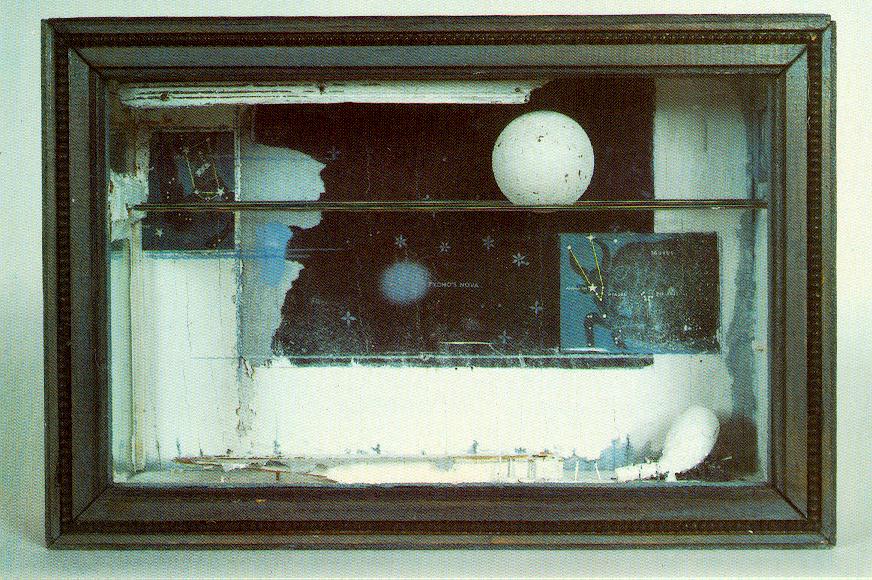 Joseph Cornell, Cassiopeai 1, 1960
Then we have The Collectors on ABC Television which I struggle within terms of the populism ( anything goes) and the oddity of objects collected. Collecting is big.
What then of the art world? Well, we have an online Curiosity Cabinet, which reaches back to the original cabinets of curiosities. I find it fascinating.
The most popular digital Wunderkammer today is YouTube is an archive awaiting curators; a ‘closet of wonders’ where many of the artifacts of digital empire sit on shelves, waiting either to overwhelm a visitor or to be utilized by savvy new entrepreneurs. The media objects in YouTube are often separated from their original uses awaiting reassembly into something new by bloggers, entrepreneurs and large media companies. These are curators of display and exhibition.