August 30, 2009
Minnie Pwerle: Bush Melon
Minnie Pwerle (1910 - 2006) is from the Utopia region approximately 300km north east of Alice Springs. NT Utopia artists have been at the forefront of the contemporary Aboriginal art movement since Emily Kngwarreye came to the attention of collectors and institutions in the 1990s. Since then, distinguished artists such as Gloria Petyarre, Kathleen Petyarre, and Barbara Weir (Pwerle’s daughter) have risen to prominence.
Minnie Pwerle’s first solo exhibition was held at Flinders Lane Gallery in 2000, her second in 2004, and her final exhibition in 2006.
 Minnie Pwerle, Bush Melon (body paint design) 2005, Acrylic on linen.
Pwerle's work is focussed on womens’ body design (awelye-atnwengerrp) or sometimes bush melon designs and she is well known for her loose, free-flowing and repetitious patterning evocative of finger painting.
August 27, 2009
learning to use media technology
some thoughts on technophilia is danah boyd 's contribution to a Symposium for the Future hosted by The New Media Consortium. Boyd says something that resonates with me after my experience of participation in this media forum:
Technology does not determine practice. How people embrace technology has less to do with the technology itself than with the social setting in which they are embedded. Those who are immersed in a techno-savvy, technophilic community are far more likely to embrace technology than those whose social world is shaped by other patterns of consumption and communication. People's practices are also shaped by those around them. There are cluster effects to socio-technical engagement. In other words, people do what their friends do. Rejecting technological determinism should be a mantra in our professional conversations.
Boyd says that what distinguishes the groups in the use of new media technology is not just a question of access, although that is an issue; it's also a question of community and education and opportunities for exploration:
Youth learn through active participation, but phrases like "digital natives" obscure the considerable learning that occurs to enable some youth to be technologically fluent while others fail to engage...We each approach technology based on our own needs and desires and we leverage it to do our bidding. In this way, we actively repurpose technology as a part of engagement such that rarely does one technology fit all.
So we need to learn how to use social media so that it will be advantageous us.
August 26, 2009
Genevieve Maynard and The Tallboys
I've signed up to Twitter, initially to promote Thoughtfactory.com. Then I discovered this post on Johnny's in the Basement from Tim Dunlop's twittering about his interview with Genevieve Maynard, an independent Australian musician, who owns and operates Revolution Studios in Alexandria, Sydney.
The Albatross song is from Genevieve Maynard and The Tallboys' album 'The Hollow Way' --- an alt.country blend with good songwriting and expressionist vocals. I haven't heard the album--only the songs that are on YouTube--but it does refer to Neil Young, Lucinda Williams and Gillian Welch.
Genevieve Maynard had been a solo artist who had released a solo CD entitled 'Ghost Notes', was her debut album. She talks about it in this interview in 2002.
August 24, 2009
Encyclopedia of Life
The Encylopedia of Life is a freely accessible online database of every known species, to give scientists the tools that they need to inspire preservation of Earth's biodiversity.It's an excellent example of the emerging world of free.The archive or data base has grown rapidly---to date there are pages for more than 150,000 species, with contributions from 250 specialists and 1,200 "citizen scientists".
The Encyclopedia is intended to document all of the 1.8 million living species known to science and it has an excellent Flickr group.
The Atlas of Living Australia is more modest in that it has no Flickr group.
August 23, 2009
perfectibility + pluralism
As is well known the Enlightenment assumed in its confidence that only error and prejudice--above all religious superstition--block the path to the perfect society, where the timeless values of human existence will all be realized. Condorcet expressed this vision thus: "Nature binds by an unbreakable chain truth, happiness, and virtue." Condorcet's idea was that knowledge of the truth or the scientific study of man's place in nature and the workings of society provides the key to a world where virtue and happiness will thrive together. Ignorance, so he and other 18th-century thinkers supposed, is the great enemy of man's perfectibility.
Perfectibility implies the notion of the perfect whole the ultimate good, in which all good things coexist. As Charles Lamore says in his review of Isaiah Berlin's The Sense of Reality: Studies in Ideas and Their History Western philosophy has been predominately monist in character:
Since Plato, most philosophers have supposed that the proper ends of life all express or promote a single ultimate value, though naturally they have disagreed about what it is: rational thought, pleasure, perhaps freedom. None has denied, of course, that there are many different activities, traits of character, and states of mind that we rightly prize. But this multiplicity has not been thought to extend to the nature of goodness itself. Instead, the assumption has been that all these things are good because they draw in various ways upon a single source, a single ultimate good that defines what is of supreme moment in our humanity.
Lamore adds that though few today would put their faith in the identity of scientific and moral progress--because the discoveries of modern science have been readily enlisted in the service of evil---many in Western liberal democracy have so often invoked the Enlightenment creed against those who question the Enlightenment narrative or neo-liberal economics. What undercuts the Enlightenment's perfectibility is the recognition of the pluralism of values:
Pluralism for Berlin is the view that the ends which reasonable people may pursue are ultimately not one, but many. The forms of human good do not have a common source; indeed, they prove so divergent in their tendency that they defy unification within a single life--they may even prove irreconcilable within any given culture.
If the good is ultimately diverse in character, then there is no final destination at which all the ways of living well are (or could be) struggling to arrive. Consequently, the just society aims not at perfection, but at striking a balance among the different, conflicting goods which human beings espouse.
August 21, 2009
W. J.T. Mitchell on Visual Studies
W. J.T. Mitchell in his Showing seeing: a critique of visual culture in the Journal of Visual Culture, August, 2002 says that visual studies emerged from the critique of the natural attitude, namely, that vision and visual images, things that are apparently automatic, transparent, and natural, are actually symbolic constructions,like a language to be learned, a system of codes that interposes an ideological veil. He adds that it is not just that we see the way we do because we are social animals, but also that our social arrangements take the forms they do because we are seeing animals.
Mitchell says that the disciplinary anxiety provoked by visual studies is a classic instance of what Jacques Derrida called the ‘dangerous supplement’:
Visual studies stands in an ambiguous relation to art history and aesthetics. On the one hand, it functions as an internal complement to these fields, a way of filling in a gap. If art history is about visual images, and aesthetics about the senses, what could be more natural than a subdiscipline that would focus of visuality as such, linking aesthetics and art history around the problems of light, optics, visual apparatuses and experience, the eye as a perceptual organ, the scopic drive, etc.? But this complementary function of visual studies threatens to become supplementary as well: first, in that it indicates an incompleteness in the internal coherence of aesthetics and art history, as if these disciplines had somehow failed to pay attention to what was most central in their own domains; and second, in that it opens both disciplines to outside issues that threaten their boundaries. Visual studies threatens to make art history and aesthetics into subdisciplines within some expanded field of inquiry whose boundaries are anything but clear.
What, after all, can fit inside the domain of visual studies? Not just art history and aesthetics, but scientific and technical imaging, film, television, and digital media, as well as philosophical inquiries into the epistemology of vision, semiotic studies of images and visual signs, psychoanalytic investigation of the scopic drive, pheno- menological, physiological, and cognitive studies of the visual process, sociological studies of spectatorship and display, visual anthropology, physical optics and animal vision, and so forth and so on. If the object of visual studies is what Hal Foster (1987) calls visuality, it is a capacious topic indeed, one that may be impossible to delimit in a systematic way.
I accept the idea of the field of visual culture in which art history, media studies and aesthetics are subdisciplines and acknowledge that this creates defensive postures and territorial anxieties in academic institutions. Maybe, as Mitchell suggests visual studies belongs in the first year in university, in the introduction to graduate studies in the humanities, and in the graduate workshop or seminar.
Mitchell usefully outlines ten myths about how visual culture is understood--these are a whole set of related assumptions and commonplaces that have become the common currency of both those who defend and attack visual studies as a dangerous supplement to art history and aesthetics.
1. Visual culture entails the liquidation of art as we have known it.
2. Visual culture accepts without question the view that art is to be defined by its working exclusively through the optical faculties.
3. Visual culture transforms the history of art into a history of images.
4. Visual culture implies that the difference between a literary text and a painting is a non-problem. Words and images dissolve into undifferentiated representation.
5. Visual culture implies a predilection for the disembodied, dematerialized image.
6. We live in a predominantly visual era. Modernity entails the hegemony of vision and visual media.
7. There is a coherent class of things called visual media.
8. Visual culture is fundamentally about the social construction of the visual field. What we see, and the manner in which we come to see it, is not simply part of a natural ability.
9. Visual culture entails an anthropological, and therefore unhistorical, approach to vision.
10. Visual culture consists of scopic regimes and mystifying images to be overthrown by political critique.
He then goes through and criticizes these assumptions. I will refer to the second of these to indicate how Mitchell approaches these myths. He says that this myth refers to the pictorial turn that acknowledge the perception of a turn to the visual or to the image as a commonplace, a thing that is said casually and unreflectively about our time. The pictorial or visual turn, then, is not unique to our time. It is a repeated narrative figure that takes on a very specific form in our time, but which seems to be available in its schematic form in an innumerable variety of circumstances. He adds:
The mistake is to construct a grand binary model of history centered on just one of these turning points, and to declare a single great divide between the age of literacy (for instance) and the age of visuality. These kinds of narratives are beguiling, handy for the purposes of presentist polemics, and useless for the purposes of genuine historical criticism.
He adds that we need to learn to get away from the notion that visual culture is covered by the materials or
methods of art history, aesthetics, and media studies. Visual culture starts out in an area beneath the notice of these disciplines the realm of non-artistic, non-aesthetic, and unmediated or immediate visual images and experiences. It comprises a larger field of what I would call vernacular visuality or everyday seeing that is bracketed out by the disciplines addressed to visual arts and media.
It looks at the strange things we do while looking, gazing, showing and showing off such as hiding, dissembling, and refusing to look. In particular, it helps us to see that even something as broad as the image does not exhaust the field of visuality; that visual studies is not the same thing as image studies, and that the study of the visual image is just one component of the larger field. Visual studies is not merely a dangerous
supplement to the traditional vision-oriented disciplines, but an interdiscipline that draws on their resources and those of other disciplines to construct a new and distinctive object of research. Visual culture is, then, a specific domain of research, one whose fundamental principles and problems are being articulated freshly in our time.
August 20, 2009
Tony Fry: sustainment, design
Tony Fry, a Director of Team D/E/S and founder of the EcoDesign Foundation, argues for the idea of 'sustainment', rather than the older idea of 'sustainable development' that was popular in th 1980s
In this Introducing the Sustainment, a plenary paper for the 2050 ‘Building the Future’, conference at RMIT, Melbourne 2006 Fry says that:
Our starting point is to recognise that an the idea of sustainability is lodged in a limited and now largely debased agenda. It’s about propping up the status quo rather than making the means of redirection towards viable futures. De facto, much ‘sustainable architecture’ and many ‘sustainable products’ are implicated in sustaining the unsustainable. Equally, ‘sustainable development’ is bonded to ‘development logic’ – the ‘logic’ of continual economic growth – rather than the development of sustainment. It does not add up to the fundamental directional changes essential if the human race is to stay around. Likewise, so much of the rhetoric of sustainability avoids speaking the horror of the unsustainable. Of course, bad news is a turn-off, however, false optimism is dishonest, it’s a lie. A precondition for solving a problem is to confront it, to know it, to face it square on. The rhetoric and practices of sustainability do not do this.
The argument is that too much of what has been promoted as 'green' in the last decades has involved "sustaining the unsustainable", making fundamentally unsustainable activities moderately less ecologically impacting. Less worse is not necessarily better.
The core of the unsustainable is not just the historical catalogue of our acts of destruction, but us. This means that the problem cannot be fixed unless we change. It certainly cannot be solved just technologically.
Fry illustrates this with the issue of the anthropogenic nature of global warming.
Dominantly, thecurrent debate is preoccupied with the question of emissions reduction and low or zeroemissions technologies. This is based on the assumption of life going on as usual while making changes to how and what kind of energy will service this way of life. Whereas, the first and immediate action should be demand reduction, which is in large part a question of cultural and economic conduct, i.e., changes in ways of life. Technological means to reduce emissions come next. Next, socio-cultural and technological changes converge on adaptive action – at best we have a problem that will be around at a significant level for several centuries (the atmospheric life of CO2 being over 200 years); at worst climate chaos will be triggered when a critical, andas yet unidentified, threshhold is crossed.
August 19, 2009
Lessig on Google's Book Search Settlement
Lawrence Lessig, the author of Free Culture, gave a talk at the Berkman workshop on the Google book search settlement at the Berkman Centre for Internet and Society at Stanford University:
The proposed Google Book Search settlement creates the opportunity for unprecedented access by the public, scholars, libraries and others to a digital library containing millions of books assembled by major research libraries. But the settlement is controversial, in large part because this access is limited in major ways.
Instead of being truly open, this new digital library will be controlled by a single company, Google, and a newly created Book Rights Registry consisting of representatives of authors and publishers; it will include millions of so-called “orphan works” that cannot legally be included in any competing digitization and access effort, and it will be available to readers only in the United States.
So we have an example of Lessig's thesis of the tension in intellectual property law between it having been captured in most nations by multinational corporations that are interested in the accumulation of capital versus the free exchange of ideas in the public domain and an innovation commons. The Internet’s very design built a neutral platform upon which the widest range of creators could experiment. The legal architecture surrounding it protected this free space so that culture and information–the ideas of our era–could flow freely and inspire an unprecedented breadth of expression.
But this structural design is changing–both legally and technically as corporations have established themselves as virtual gatekeepers of the Net while Congress and parliaments in the pockets of media magnates, have rewritten copyright and patent laws to stifle creativity and progress. In his -The Vision for the Creative Commons: What are We and Where are We Headed? Free Culture contribution to the Open Content Licensing: Cultivating the Creative Commons, a conference on the internet, law and the importance of open content licensing in the digital age, Lessig said that there are two general principles that Creative Commons stands for.
The first is that we want to find a way to lower the cost of the law, not eliminate the law, but lower the costs associated with the law in making creativity possible. Second, we want to enable ‘commonses’ wherever they might help innovation, not in contrast to property, but complementing property, recognising that the complement of commons and property is what makes the greatest creativity possible.
Freedom here is not ‘free’ in the sense of ‘free beer’ but ‘free’ in the sense of ‘freedom’, express freedom associated with content, to encourage the extraordinary range of creativity that could be realised.
August 18, 2009
Radiohead's new single
"These Are My Twisted Words" is a new Radiohead song. According to Jonny Greenwood on Dead Air Space, the groups blog, it is one they've officially released themselves as a free download.
The internet has placed an emphasis on singles and so returns us to the way things used to be with the music industry in the ’50s when radio singles were what defined artists. Now we have online stores such as Boomkat and free streaming from Wolfgang's Vault.
August 16, 2009
urban futurity
In The Future Gaze: City Panoramas as Politico-Emotive Geographies in The Journal of Visual Culture (April 2009, Volume 8, No. 1) André Jansson and Amanda Lagerkvist draw attention to the dreams and visions about the future associated with cities. They say:
Debates on ‘the city of the future’ or ‘the future of the city’ have recurred within urban theory, planning and geography for decades ..... Our argument is that neither the mediation of urban spaces, nor the ‘urban spectacle’ can be fully grasped without paying close attention to the role of affect and fantasies.... and to their importance for political and commercial interests in developing the city into a ‘world centre’ and a space of the future – a space of futurity...This perspective transcends notions of abstract space and spectacle, and allows for a more dynamic understanding of the interrelationships between the social appropriation of city space and the abstraction and mediation of the city into a visual sign or commodity.
In modern society, the gazes of people admiring a city skyline are mediatized, that is, scripted through public discourse (e.g. TV programmes) as well as more private media channels (e.g. holiday photos).
They say that in his Iis book The Capsular Civilization: On the City in the Age of Fear (2004), De Cauter provides an explicit elaboration of Debord’s theory, arguing that while cities have always operated as scenes, stages or theatres (of memory, power, everyday life and so on), what is peculiar about the neo-theatrical city is that the dividing line between spectacle and everyday life is sharpened. Contemporary urbanism, according to De Cauter, celebrates sealed, controlled spaces-as-images, and this social division threatens the city. The logical counterpart to the spectacular ecology of fantasy, or Disneyfication, is the ecology of fear, nurtured by surveillance technologies. The two logics support one another, reproducing an ideology of capsularization.
August 13, 2009
ocularcentric culture
In her Sight Unseen Anne Marie Willis from Team Des argues that truth as correctness of the gaze became the basis of Cartesian rationalism --and we can add British empiricism and scientific positivism. She says that:
Vision was the model of knowledge for Descartes, and the theory of consciousness his thinking inaugurated was one in which there is a clear divide between observer and the observed, ‘a disembodied observer seeing with his mind’s eye’ as Jay puts it. ‘The look that sunders and compartmentalises’ became normative and integral to the development of Western culture (as cause and effect) — the foundation of science, exploration, art, technology and much else. Framed by modes of representation, correctness became a question of correspondence between sign and referent, and was codified into realist representational practices from classical sculpture, then later, with the invention of perspective, through to painting, photography, then moving image, then moving image plus sound …. and so on.
Willis adds that the drive was towards ever more ‘accurate’ techniques of the real which reached their apotheosis in analogue systems of representation, but which today have mutated into digitised simulations of
themselves. (Images generated by binary code no longer have any ‘organic’ link to their referents, unlike photographic images which are ‘caused by’ light bouncing off things and registering via chemical processes on film — today correctness of appearance still rules, but no longer with any contiguity between image and referent.)
Coupled to this mode of seeing is the rise of the sign-driven economy with its creation of desire through the look, the image, style, brand identity; here too is the dominance of the televisual, of spectacle, of the hyper-real.
critical theory + the camera
Scott McQuire in Visions of modernity: Representation, Memory, Time and Space in the Age of the Camera, says that critical theory has rarely treated the camera adequate to the complexity of the questions it raises:
Despite the early example of those such as Siegfried Kracauer and Walter Benjamin, analysis has frequently suffered by hastily assembling an overly unified concept of 'the image' , or buy arbitrarily isolating the domains of photography, cinema,television in order to define 'proper' objects of study. Cutting across these categories is the silent paralysis caused by the split between analysis of cultural-aesthetic formations on the one hand and scientific-industrial applications on the other. The fact that camera technologies have been an integral part of the process of industrialization has been much neglected in social theory as the camera's dependence on a whole network of industrial practices and production techniques has been excluded from art history. This concatenation of absences skews our perceptions of history , and limits out ability to respond to changes in the present.
Remaining blind to the exclusions promoted by rigid disciplinary boundaries risks allowing the camera to ground its own history as the uninterrupted history of technological progress.
August 11, 2009
time, photography, Flickr
In Digital Images, Photo-Sharing and Everyday Aesthetics in the Journal of Visual Culture (August 2008, Volume 7, No. 2) Susan Murray argues:
argues that the social use of digital photography, as represented on Flickr, signals a shift in the engagement with the everyday image, as it has become less about the special or rarefied moments of domestic living and more about an immediate, rather fleeting, display and collection of one’s discovery and framing of the small and mundane. In this way, photography is no longer just the embalmer of time that André Bazin once spoke of, but rather a more alive, immediate, and often transitory practice/form. In addition, the everyday image becomes something that even the amateur can create and comment on with relative authority and ease, which works to break down the traditional bifurcation of amateur versus professional categories in image-making.
Murray says that Flickr has become a collaborative experience: a shared display of memory, taste, history, signifiers of identity, collection, daily life and judgement through which amateur and professional photographers collectively articulate a novel, digitized (and decentralized) aesthetics of the everyday. Flickr has become so popular, and the images it contains so well distributed and displayed, that it has become one of the most active social networks around. It is also one of the rare sites centered more on image than on text.
Photo-sharing sites such as Flick represent a shift in production, representation, and sociality. A user’s Flickr page works as autobiography or diary by layering an ever changing or growing stream of photos on their page thereby moving the focus away from the single image. The pages that are the most subscribed to are those at the center of a community of photographers, such as those by Heather Powazek Champ. The content of some of the most popular pages are:
dedicated to the exploration of the urban eye and its relation to decay, alienation, kitsch, and its ability to locate beauty in the mundane. Some have claimed that it is indeed a new category of photography, called ‘ephemera’. It is, perhaps, the confluence of digital image technology along with socia network software that has brought about this new aesthetic....It is now possible to affordably and reasonably incorporate the taking of photos into your everyday life rather than saving film for ‘special’ moments.
While there is a preference for a certain type of everyday aesthetic, the hierarchal relationship between hobbyist, serious amateur, and professional does not really exist on these sites. Murray adds that the sadness and a longing in the relationship to memory and history that theorists such as Barthes ascribe to traditional photography that is not altogether present in the social construction of popular digital photography and its communities.
Instead of evoking loss, preservation, and death, users and viewers are encouraged to establish a connection with the image that is simultaneously fleeting and a building block of a biographical or social narrative. While these sites build a collection, they also privilege the immediacy of the image and acknowledge the inability of photography to hold onto time even as it provides avenues for nostalgia and memory.
An everyday aesthetic –whether present in digital photography, the internet, television, or in the life of the city streets – is fleeting, malleable, immediate, and contains a type of liveness.
August 9, 2009
Arthur C. Danto on The Transfiguration of the Commonplace
Arthur C. Danto says in an article in Comntemporary Aesthetics that The Transfiguration of the Commonplace was essentially a contribution to the ontology of art in which two necessary conditions emerge as essential to a real definition of the art work: that an artwork must (a) have meaning and (b) must embody its meaning. This strikes a blow against formalism and the intentionalist fallacy that underpinned it.
Danto says that the need for such a definition was inspired by George Dickie, who really advanced the first definition of art that responded to the changes in the art world in his Institutional approach to art. Danto felt that this was philosophically unacceptable, and set out to find some necessary conditions for something being an art work in the face of the possibility that something might look exactly – or exactly enough like a commonplace object without being one.
 James Harvey, Brillo Box
The key question the text addressed was:
If a work of art is an object plus x, the problem was to solve for x, just as, if a basic action is a bodily movement plus y, the task was to solve for y. ...Given two perceptually indiscernible objects, one an art work, the other not, what accounts for the difference?
There was not a lot of difference between seeing Brillo Box by Warhol and the Brillo boxes designed by James Harvey for the Brillo people to move their products about in. So: why weren't they art works if Andy's factory-produced boxes were?
 Andy Warhol, Brillo Box, 1965
Brillo Box's status as a work of art could not be attributed to its possession of the very properties that it shares with those more mundane cartons of James Harvey --the cardboard cartons in which boxes of Brillo pads were shipped to grocery stores in the early 1960s. Danto's book brings to the surface what amounts to two necessary conditions — meaning and embodiment — that led to the definition that something is an artwork only if it embodies its meaning. So we have the content (meaning) and the mode in which it is presented.
Danto's argument is that whether something that looks like a box is a work of art depends on whether it embodies a meaning and not on quality based on the taste (an aesthetic preference) of someone who had spent a lot of time looking at abstract painting was qualified to pronounce on its possession of quality.However, James Harvey's Brillo Box was not a just a material thing--- a "mere" artifact --as it also embodied meaning.--a things that embody meanings without obviously being works of art. Secondly, James Harvey's Brillo Box was more than a commercial object, as it was commercial art---ie., design that is employed for a commercial purpose. Presumably, Harvey's Brillo Box had the wrong kind of meaning? Or would Danto say that this box has a use, rather than a meaning?
Danto's text was basically a denial that possessing aesthetic interest (beauty) constituted a third necessary condition. The grounds for denying its necessity was based on the observation that much of the world’s art is prized not for its beauty, since there is none, but for other reasons altogether.The aesthetics is already in the work, (internal to the meaning of the works that embody them) as its “aesthetic” qualities, which may or may not compass “beauty.” It is interpretation that is crucial for to see something as art is to be ready to interpret it in terms of what and how it means.
August 7, 2009
the ghostly presence of art criticism
We know that newspaper art criticism has gone into a steep decline, and that is in line with the absence of art criticism from contemporary cultural programming on television and in radio. Signs of art criticism slipping off the face of the cultural world as it goes from cultural critique into the safer domains of localized description, careful evocation and "restaurant review" style criticism.
In his What happened to art criticism? James Elkins presents a wide array of evidence suggesting that art criticism has little use in the world today and that almost no one really reads it. It is not read much by ordinary folks, nor is it catalogued and used in research by art historians. As for artists and galleries or museums, they treat the critics who write extended catalog essays as hired workers whose products are only acceptable if they serve the purpose of promotion. This means critics are regarded as waiters asked to bring in a different dish if what comes out of the kitchen does not satisfy them.
The first paragraph of the text states:
Art criticism is in worldwide crisis. Its voice has become very weak, and it is dissolving into the background clutter of ephemeral cultural criticism. But its decay is not the ordinary last faint push of a practice that has run its course, because at the very same time, art criticism is also healthier than ever. Its business is booming: it attracts an enormous number of writers, and often benefits from high-quality color printing and worldwide distribution. In that sense art criticism is flourishing, but invisibly, out of sight of contemporary intellectual debates. So it’s dying, but it’s everywhere. It’s ignored, and yet it has the market behind it.
Art criticism is very nearly dead, if health is measured by the number of people who take it seriously, or by its interaction with neighboring kinds of writing such as art history, art education, or aesthetics. If art criticism is massively produced by the art institution, then it is also massively ignored. No one reads it.
August 6, 2009
shifting to electronic publishing
I've just stumbled upon Doug Brent's Steven Harnad's Subversive Proposal: Kick-Starting Electronic Scholarship, in EJournal. This article picks up on Harnad's argument that much or all of the future of scholarly publishing lies in transferring scholarly research from behind the for-profit publishing industry's toll-gate and firewall (the market's version of a trade in knowledge) to the internet. This work indicates that the case for the open access to knowledge was being argued for a decade ago, and I've stumbled into the archives. It is the archives since the EJournal itself stopped publication in 2004.
Brent says that Harnad argued that internet publication not only eliminates much of the cost of publishing, but also allows for an extremely quick turnaround of articles and responses to them. This quick turnaround is, of course, especially important in the sciences, where ideas become stale within weeks or even days. Brent adds that Harnad argued for more than timely presentation of ideas:
He argues that in the electronic world, *presentation* of ideas as lapidary product of thought can be replaced by in-process texts that participate in the *development* of thought. The process is more akin to oral dialogue than to electronic representations of finished texts.
Scholars have consented to having their works published and sold in trade format of the publishing industry simply because there was no other way to get their ideas, texts or images in circulation. Harnad called this arrangement a "Faustian bargain."
Harnard argument is that scholars working in what he calls the 'esoteric' fields of narrow specialisms (particularly the sciences) do not need to publish on paper; they merely wish to be read by their peers. And since they don't expect to be paid for what they make public, why shouldn't they put their work straight onto the Net in preprint form. They can invite comment, make whatever revisions they feel warranted, then archive the finished article in digital form. By following this procedure, peer review is maintained, but the system works more rapidly and less expensively.
That does away with the 'tradition' and 'authority' of the refereed and printed journal to concentrate on electronic communication between peers. Hanard says that his toll-free access proposal applies only to the refereed journal literature, not to books, textbooks, magazine articles, best-sellers, films, etc. Brent comments that though electronic publication obviously provides an alternative to the Faustian bargain:
Yet electronic publication has been slow in coming and slower in meeting acceptance. Many on-line journals are nothing more than mirrors of paper journals, which continue to be the main conduits for academic knowledge and associated academic rewards. Trade publishers are obviously in no hurry to move to electronic publishing because it is difficult to see how to make any money at it. Harnad's "subversive proposal" suggests that scholars not wait for the publishing industry to ooze slowly onto the net. Harnad recommends that we leave the publishing industry behind and take to the skies ourselves
Though others have been championing electronic publication for years Harnad's proposal is his recommendation of direct action on the part of the scholarly community, action that would end the hegemony of the publishing industry.
Sadly, few academics are making available on the Net, in publicly accessible archives on the World Wide Web, the texts of their current papers or even the past ones that still sitting on the computers hard drive. Though academic researchers have taken full advantage of email, online discussion groups, online storage and exchange of data and even online refereeing of papers for their journals they have not embraced the free, open, global access to their work that the internet provides. As Harnard points out the major exception is the centralized Los Alamos Physics Archive --it is the exemplar of Give-Away research literature.
The Universities, in spite of the serials budget crunch, have not taken steps to help disseminating research by installing open archives and providing their authors with the technical proxies to self-archive their papers for them where needed. Is this because of copyright restrictions? As has been pointed put author self-archiving can legally get round any copyright restrictions in the following manner:
First the author publicly archives a preprint of the paper on the web. Then they submit the paper to a refereed journal. The author makes amendments in light of referees' and editors' comments, then signs the publisher's copyright agreement The author then posts a note onto the web pre-print, pointing out where areas of correction might need to be made, in effect turning the pre-print into a version of the draft refereed paper.
Is the next barrier to self-archiving the embargo policies of academic journals? Some journals state that they will not referee (let alone publish) papers that have previously been "made public" in any way, whether through conferences, press releases, or on-line self-archiving. However, the Ingelfinger Rule, apart from being directly at odds with the interests of research and researchers and has no intrinsic justification whatsoever -- other than as a way of protecting journals' current revenue streams. It is not a legal matter and, as it is unenforceable, so researchers can ignore it completely.
August 4, 2009
Pamphlet Architecture
I've just stumbled upon Pamphlet Architecture an alternative to mainstream architectural publishing that encourages architects and writers to put forth their ideas, theories, and designs in modest, affordable booklets.
No 13 in the series, Edge of a City by Steven Holl is an attempt to intensify the metropolitan landscape and counter urban sprawl in six cities. In each scheme, living, working, recreational, and cultural facilities are juxtaposed in new pedestrian sectors to promote new communities.
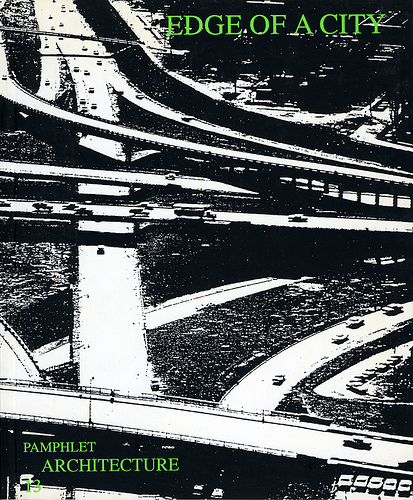
One of the utopian projects/ideas called Parallax Skyscrapers, is a series of towers linked by skybridges. These modernist visionary projects of the 1970-80s are becoming realizable, in that China is now the testing ground for the heroic super-modernism of the 1970s, in that the quest to add a horizontal dimension to the skyscraper has moved to Beijing. It is an architectural language we can trace back to Fritz Lang's Metropolis.
branding Melbourne
Lord Mayor Robert Doyle unveiled a new identity that will represent the City of Melbourne old logo and he provided a rationale behind the new identity replacing a logo that was designed in the early 1990s. Doyle says that the new icon for Melbourne, which was designed by the Sydney office of Landor, is synonymous with the modern, vibrant, cool city that Melbourne is today:

The new logo is an interesting design. There is a tension created by the detail and overlay on the left side of the M and the way it resolves into something more simple on the right side. The gradients help add a sense of depth and breadth. It is much more sophisticated and interesting than the logo of the 1990s.
August 3, 2009
intertexuality
Saussurean semiotics is based on a linguistic model but not everyone agrees that it is productive to treat photography and film, for instance, as 'languages'. However, it suggests that we need to learn to 'read' (interpret) the formal codes of photographic and audio-visual media as well as the resemblance of their images to observable reality which is not merely a matter of cultural convention.
It introduces the idea that we can interpret pictures in terms of two axes: a horizontal axis connecting the author and reader of a picture, and a vertical axis, which connects the picture to other pictures. This counters the deeply entrenched view in literary and aesthetic thought which emphasized the uniqueness of both texts/art works and authors. The ideology of individualism (with its associated concepts of authorial 'originality', 'creativity' and 'expressiveness') reached its peak in Romanticism but it still dominates popular discourse.
The flaw here from the perspective of structuralists and poststructuralists alike is that we are ('always already' positioned by semiotic systems - and most clearly by language and the world of visual signs.To communicate or express ourselves as photographers or writers we must utilize existing concepts and literary or visual conventions. Consequently, whilst our intention to communicate and what we intend to communicate are both important to us as individuals, meaning cannot be reduced to authorial 'intention'.
Writing or photography does not involve an instrumental process of recording pre-formed thoughts and feelings (working from signified to signifier) but is a matter of working with the signifiers ; working, as it were, to mix photos or to counter the ones with the others. Texts and photos come before us as the always-already-read; we apprehend them through the sedimented layers of previous interpretations, or - if the text or photo is brand-new - through the sedimented reading habits and categories developed by those inherited interpretive traditions.
August 2, 2009
conserving heritage places
I've just come across the Productivity Commission's Conservation of Australia’s Historic Heritage Places (2006) and it aroused my interest in the light of my brief photography trip to Broken Hill. This city is well known for mining by BHP, and the city is beginning to consider how to best conserve its heritage places to attract tourists.
The Commission's Report strikes the right notes. It says that:
Historic heritage places are important, providing a sense of identity and a connection to our past and to our nation. For the purposes of this inquiry, they include: built structures, such as houses, factories, commercial buildings, places of worship, cemeteries, monuments and built infrastructure such as roads, railways and bridges; physically created places and landscapes, such as gardens, stock routes and mining sites; and other places of historic significance, such as archaeological sites and the landing place of Captain Cook at Botany Bay.
It adds that the benefits of historic heritage places include the nature and extent of the cultural values they provide to different individuals and groups in the community. These are in addition to the use and enjoyment benefits provided to their owners. Some historic heritage places have significance only locally, or for a particular group, while for other places the scope of their significance is more general and extends to a State or Territory.The Commission adds that:
The cultural significance of historic heritage places can change over time as community values evolve. Nonetheless, the cultural values provided by an individual place depend on properly maintaining the features of the property that provide them. In addition to normal maintenance, such conservation includes preservation, restoration, reconstruction, adaptation and interpretation.
'Tis hard to disagree with any of that, or with the cost benefit analysis framework adopted by the Commission----for government intervention to be warranted, the extra benefits to the community need to be greater than the added costs of that intervention.
No problems for Broken Hill, as its economy increasingly depends on tourism as the mining comes to an end.
The Commission goes on to say that government intervention to achieve extra conservation of privately-owned historic heritage places should be targeted to where the intervention is likely to result in net benefits for their community. Such targeting would involve considering the added costs of conservation and assessment of net community benefit after assessment of heritage significance and before regulatory controls are applied through statutory listing. To encourage such considerations, private owners should be given the right to appeal listing on the grounds of ‘unreasonable costs’.
August 1, 2009
Bill Jay: on fine art photography
Bill Jay in his Artists: Rebels without a Cause argues that there is no difference between fine-art and commercialism – and there never has been. He says that:
The invention and early history of photography is rooted in economics. Without the newly wealthy middle class in the aftermath of the Industrial Revolution there would be no need for a substitute for oil paintings. Photography was invented, developed, made by and sold to those with surplus wealth, the nouveau riche of the Victorian Age....Only when there is enough surplus wealth in a culture (such as our own) can it afford to siphon off otherwise productive citizens and allow them to become fine artists in order to promote their own or someone else’s egos.
He adds that o ne of the biggest myths of contemporary photography is that of the solitary, wayward, individualistic, non-commercial, art-for-art’s-sake spiritually minded genius who is in opposition to corporate money-grubbing.Rebelliousness is not anti-establishment; it is the sales pitch of the corporations.Art and advertising are not as dissimilar as usually assumed.