July 31, 2009
hegemonic imagination
In "Time is on Our Side: Rewriting the Space of Imagination" in Situations (Vol 3, No 1 (2009)) Eric J. Weiner states:
The hegemonic imagination’s power to condition our waking dreams, while making a claim to limitless freedom, lays in the celebration of its perceived ability to produce an infinite variety of thoughts, ideas, dreams, and visions. Just as neoliberal discourses position “choice” and “opportunity” as correlates to freedom without examining the social, cultural, and political conditions that a priori regulate (i.e., normalize) the choices that can be made or the opportunities that can be had, imagination is too often conceptualized as the key to possibility, opening an infinite number of doors, all of which promise either (and most often) an escape from reality or a different perspective on it.
Weiner says that because the regulatory process does not determine imagi nation and its output, but rather suggests a field of infinitely structured and structuring structures, Bourdieu’s conception of habitus is a vital, if insufficient concept, in understanding how the process of social imagining takes shape.
July 29, 2009
Grateful Dead: Franklins Tower
Grateful Dead, Franklins Tower, Radio City, 31 10 1980. This song is from the Blues for Allah album, which was informed by the Miles Davis of ESP.
On this album the band further developed the jazz-oriented framework that it had been exploring, however tentatively, on Wake of the Flood. It did so by appropriating Miles Davis’ fusion experiments over several years. In 1975 the band was at one of its high points, and the music on the record brings together long-form compositions, complicated harmonies, carefully chosen rhythms and some of the Dead's best melodies.
July 25, 2009
forms of textuality and writing
Larval Subjects writes about the Luddite attitudes among many of academics with respect to the new media and technologies:
I have encountered this lament quite often among my colleagues as well, especially those who come from a background informed by Gadamerian hermeneutics and who practice philosophy through the analysis of the history of philosophy. It appears that something similar goes on in literary studies, where texts and a particular way of reading texts is privileged above all else. Faced with forms of textuality, writing, and communication that have come into prominence with the new internet technologies, it cannot but appear, from within this way of thinking, that we have fallen into states of decline. Rather than discerning the emergence of new ways of thinking, communicating, producing, feeling, and interacting, these new forms of textuality are instead seen as forms of decay and decline. We thus get a sort of Adornoesque Luddite narrative about how modern technology has led to a cultural decline that enslaves us all.
Rather than seeing the new technology and media as an opening for new cultural possibilities these kind of academics engage in the gesture of attempting to maintain a particular form of cultural practice that is doomed to eventually die out.
July 22, 2009
Brian Eno and Will Wright
Brian Eno and Will Wright in conversation about generated systems in music and computer games (eg., Spore ) at The Long Now Foundation via Fora tv.
Fora tv. runs a website that gathers the web's largest collection of unmediated video drawn from live events, lectures, and debates at universities, think tanks and conferences. It provides a digital forum where people can get and discuss information on public affairs, politics and culture, as well as see historic speeches and other events.
July 21, 2009
primacy of everyday life
Henri Lefebvre argued in his Critique of Everyday Life that everyday life constituted the fundamental layer of social existence and, in the contemporary world superceded the economic and political:
… daily life cannot be defined as a “sub-system” within a larger system. On the contrary: it is the “base” from which the mode of production endeavors to constitute itself as a system, by programming this base. Thus, we are not dealing with the self-regulatio of a closed totality. The programming of daily life has powerful means at its disposal: it contains an element of luck, but it also holds the initiative, has the impetus at the ‘base’ that makes the edifice totter. Whatever happens, alterations in daily life will remain the criterion of change.” (Critique, vol. 3, p.41).
For Lefebvre, everyday life is the site of and the crucial condition for the “reproduction of the relations of production.” Lefebvre’s central argument is that state and economy are outcomes of the everyday, and that state and the economy attempt to dominate and to assert their primacy over social life with the massive urbanization and modernization which transformed industries and urban environments. The technological culture and industrial capitalism transformed social life into economic life, everyday life became saturated with commodity logistics, and corporate logos became the semiotics of daily life.
In late modernity exchange value and equivalence come to dominate and constrain the singularity of our everyday lived experience whilst capitalism achieves growth through producing space.
July 15, 2009
Cory Doctorow on DRM
Cory Doctorow argued in a talk given to Microsoft's Research Group at their Redmond offices on June 17, 2004 on copyright, technology and DRM that copyright laws should be liberalized to allow for free sharing of all digital media . He also argues that DRM, claiming that it limits the free sharing of digital media and frequently causes problems for legitimate users (including registration problems that lock users out of their own purchases and prevent them from being able to move their media to other devices and platforms.
July 14, 2009
Theory's Empire?
Harry Harootunian, in Theory’s Empire: Reflections on a Vocation for Critical Inquiry, reflects on the Critical Inquiry journal that is published by the University of Chicago. The text is from 2004 and Harootunian says that Critical Inquiry may well be one of the few forums left that still allow us to imagine alternatives to the graying and increasingly managerialized and instrumentalized world of universities and colleges, progressively being emptied of any respect for the intellectual life and its social necessity.
Harootunian adds:
Critical Inquiry faces a perilous future precisely because it still constitutes one of the few reliable guideposts enabling us to navigate through this ruined and now unfamiliar landscape, marking the immense transformation of educational institutions into administered knowledge factories that have already eviscerated the humanities, making them into service centers. We in the humanities are caught in the vise of two noncommunicating cultures in the university....an academic capitalism that insists on linking research, usually R and D, to the recruitment of funds from outside sources, diminishing those disciplines not in a position to attract financing for the kind of research they do, and a growing critique by humanist scholars that is totally oblivious of the “entrepreneurial university.”
Even more troubling is the eagerness and enthusiasm of university administrators (whose existence is the best argument yet against cloning) who demand that departments find their own funds—every boat on its own bottom, as it is called.
Harootunian adds that we have no doubt reached the juncture where theory and its offspring cultural studies are under siege and, in some advanced places, in full rout. Oneof the many uses (and thus abuses) of 9/11 has been that it has permitted a wholesale rejection of theory, which was already underway before the big
push, and widespread denunciation of cultural studies and multiculturalism as symptoms of loosening standards and the corrosive curse of uncheckedrelativism. But these charges are simply steroid-induced manifestations of earlier claims that sought to persuade the public that universities had fallen into the dirty hands of 1960s radicals.
What I’m suggesting is that the apparent collapse of theory and the distrust of cultural studies was already prefigured by endorsements that sought to place it within the system and make it a part of normal professionalization that had, and would have, no relationship to the world outside of the academy. In this regard, theory was transmuted into a functional prerequisite of professionalization. The functionalism that had once dominated the social sciences had metastasized and spread into the humanities,notably in the field of literary studies. Hence the folding of Empire had as much to do with this historical conjuncture as the “eventfulness” of 9/11.
consumer city
I have just come across the Cultural Studies e-archive, which is a supplement to the Culture Machine e-journal.
Stumbling around I uncover Frederic Jameson in Future City in New Left Review; a review of two texts from Rem Koolhaas' Project of the City, which reaches beyond architecture’s traditional definition of ‘making buildings’ to the mutations of the contemporary city. Project of the City is a research programme conducted by thesis students ‘to document and understand the mutations of urban culture . . . that can no longer be described within the traditional categories of architecture, landscape and urban planning’.
Jameson asks: After the dilapidation of urban modernism, what kinds of city and what forms of architecture await us? Is it the city as a shopping mall? Post-industrial consumption is transforming the city almost as much as industrial production did. Does this mean that ‘In the end, there will be little else for us to do but shop’. He adds:
The world in which we were trapped is in fact a shopping mall; the windless closure is the underground network of tunnels hollowed out for the display of images. The virus ascribed to junkspace is in fact the virus of shopping itself; which, like Disneyfication, gradually spreads like a toxic moss across the known universe.
Airports have become shopping malls; shopping malls have become parts of museums, and so the city, not only by housing huge new malls within itself, but by becoming a virtual mall in its own right. A mall constitutes itself as a modern-day Main Street, and they are the temples of capitalist consumerism’. The commodification process is now a whole new life style, which we call consumerism in which we shop for images rather than objects per se.
Shopping is so successful that it has become the:
the last remaining form of public activity. Through a battery of increasingly predatory forms, shopping has been able to colonise – even replace – almost every aspect of urban life. Historical town centres, suburbs, streets, and now train stations, museums, hospitals, schools, the Internet, and even the military, are increasingly shaped by the mechanisms and spaces of shopping. Churches are mimicking shopping malls to attract followers. Airports have become wildly profitable by converting travellers into consumers. Museums are turning to shopping to survive. The traditional European city once tried to resist shopping, but is now a vehicle for American-style consumerism. ‘High’ architects disdain the world of retailing yet use shopping configurations to design museums and universities. Ailing cities are revitalised by being planned more like malls.
In this analysis, as mega-stores increasingly govern movement through cities, architecture and urbanism are more and more exposed as the mere co-ordination of flow.The preservation of city centres produce a non-urban (suburban) space given over to malling. A Junkspace’.
‘In the end, there will be little else for us to do but shop’. So dam depressing. In despair to turn to photography as a way out.
July 13, 2009
Lauren E. Simonutti
Lauren E. Simonutti is known as lauren.rabbit on Fickr. She is an old school photographer --in that she works with large format cameras, darkroom, contact prints, black and white film, toned prints.
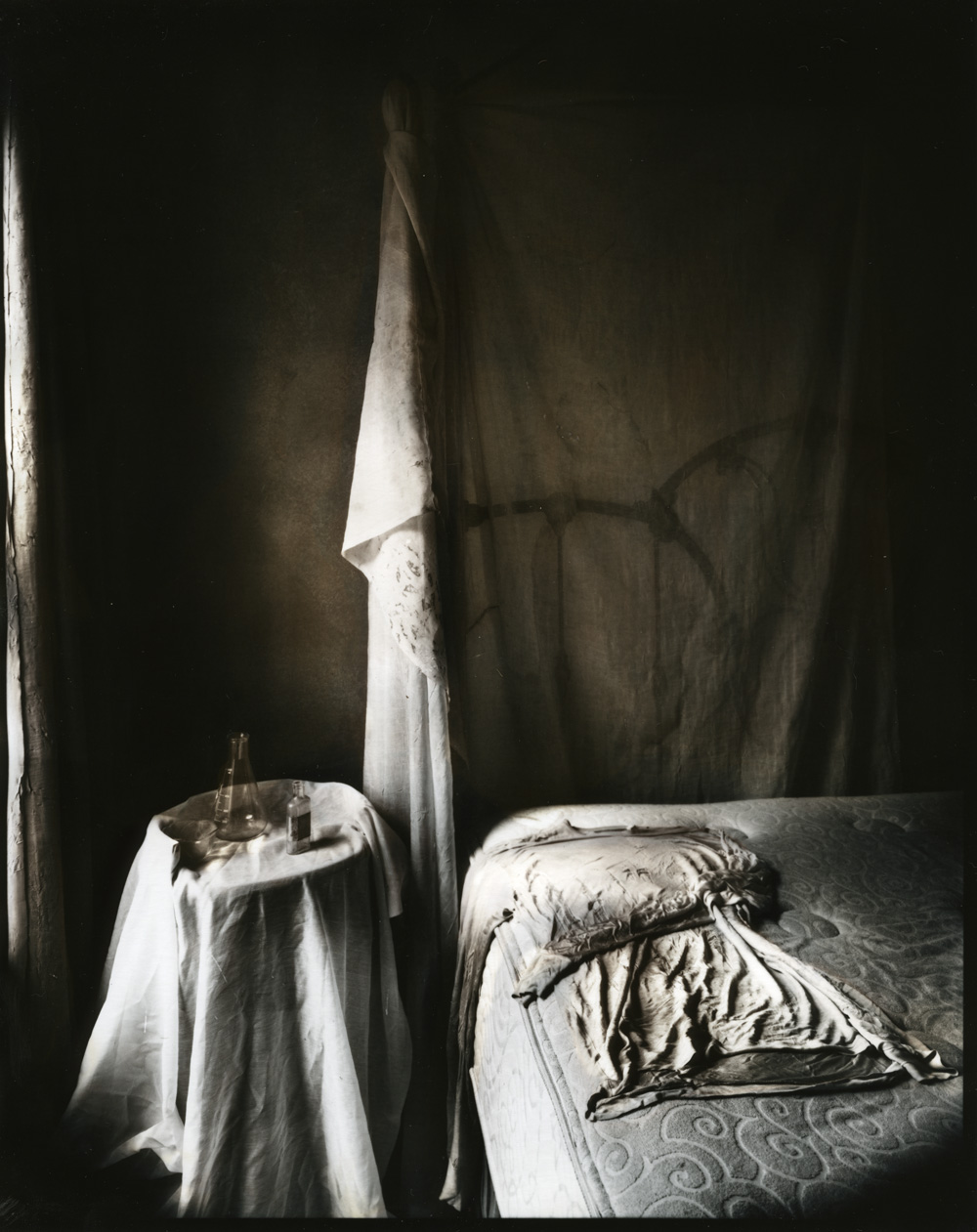 Lauren E Simonutti, hospice, 2008, gelatin silver print
She is exhibiting at the Ballarat International Foto Biennale and has a portfolio at Lens Culture. Her work is a visual narrative of an unexpected & devastating situation in which she finds herself--mental illness. She is sequestered in the house only leaving to see the doctor or for food.
July 8, 2009
Aral Sea
The Aral Sea lies between Uzbekistan (to the south) and Kazakhstan (to the north). Once the fourth largest lake in the world, the Aral Sea is now less than half of its original size. The Aral Sea is a terminal, or endorheic, sea (meaning no water flows out of it). It is fed by the Syr Darya and the Amu Darya Rivers, but Soviet river diversions for irrigation made over 40 years ago have starved the Aral Sea of water.
The Aral Sea has shrunk dramatically over the past few decades as the primary rivers that fed the Sea were almost completely diverted for cotton farming and other agriculture.
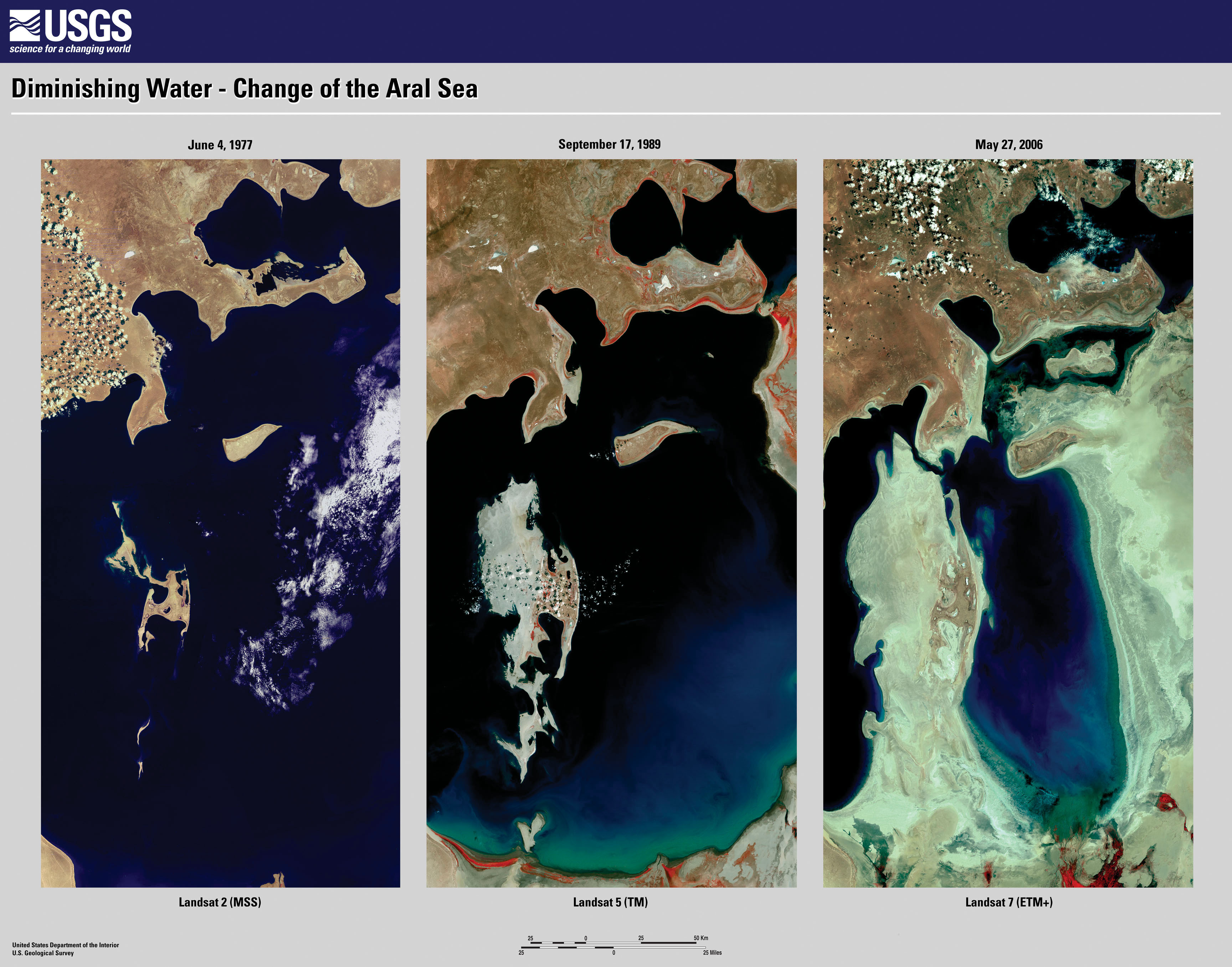
n 2001, the World Bank funded the construction of an 8-mile dam to separate the North and South Aral, and thereby save the smaller and less polluted North Aral Sea. The North Aral has been growing since completion of the Kok-Aral Dam in the summer of 2005. Repairs and updates to the inefficient Soviet-era canals have also played a role in the rejuvenation of the North Aral.
July 4, 2009
Gene Clarke
Gene Clarke and Carla Olson----Gypsy Rider from the 1986 album "So Rebellious a Lover".
I'm interested in hearing Clarke's 1974 album No Other ---- one of the great lost albums of the decade.