October 20, 2010
the collapse of the humanities
Stanley Fish in The Crisis of the Humanities Officially Arrives in the New York Times argues that the collapse of the humanities has happened in the US. The example is SUNY Albany announcing that the French, Italian, classics, Russian and theater programs were getting the axe, and Fish adds:
For someone of my vintage the elimination of French was the shocker. In the 1960s and ’70s, French departments were the location of much of the intellectual energy. Faculty and students in other disciplines looked to French philosophers and critics for inspiration; the latest thing from Paris was instantly devoured and made the subject of conferences. Spanish was then the outlier, a discipline considered stodgy and uninteresting. Now Spanish is the only safe department to be in
Fish goes on to say that:
if your criteria are productivity, efficiency and consumer satisfaction, it makes perfect sense to withdraw funds and material support from the humanities — which do not earn their keep and often draw the ire of a public suspicious of what humanities teachers do in the classroom — and leave standing programs that have a more obvious relationship to a state’s economic prosperity and produce results the man or woman in the street can recognize and appreciate.
In a latter column Fish says that a central reason is the withdrawal by the states from the funding of higher education.
Because the shrinking pool of state dollars does not cover salaries and other instructional costs and because the humanities “cannot count on heavy infusions of federal research dollars” as the sciences can (anywhere from $100 million to a billion), there is a shortfall the humanities have no way of making up:
the elephant in the room..[is] the shrinking of public support of (supposedly) public higher education. Posters who wondered why the corporate model, along with the vocabulary of the university as a business, has become so entrenched need only look to the inexorable economics of the situation. Starved for cash and inundated by students, what are universities to do?
In the absence of restoration of strong public funding he says there seem to be only two courses of action, aggressive fundraising (once rare in the public university sector, now required), and a cost/benefit analysis that substitutes bottom line questions for questions about intellectual and disciplinary value.
October 18, 2010
Quarantine
An interesting interview with Krista Maglen on the issue of quarantine at BLDG Blog. Maglen's research explores the nature of infectious disease prevention, including quarantine, during the latter part of the 19th century and beginning of the 20th century in the USA, Australia and Britain. I'm interested because my Port Adelaide photographic project could well incorporate the disused quarantine station at Torrens Island.
The Australian mode is a system where people get their health checks done at the point of departure. In Australia, the quarantining of the entire continent came to be important in terms of keeping diseases out, but it was also symbolically incredibly important as part of the project of producing White Australia. Maglan says:
Quarantine differs very much depending on where a country is in relation to a disease source or perceived disease source. Australia, for example, has actually historically had one of the strictest quarantine policies, even though it’s so far away. Quarantine became a very big deal there. First of all, there’s a perceived proximity to Asia, which in the West has traditionally been seen as this great source of disease—the “Yellow Peril.” Quarantine is also a way to draw a line around White Australia, racially, just as much as it is to draw a line around the notion of a virgin territory that doesn’t have the diseases of the rest of the world.
Quarantine borders—just like national borders—are seeking to draw a line between us and them, inside and outside, desirable and undesirable, and so on. She adds:
Quarantine is a word that’s used quite freely. The way it’s used quite often now is to refer to the isolation of sick and infected people. But quarantine more accurately refers to the isolation of anyone who’s deemed to be a risk. That means that you can have perfectly healthy people in quarantine—and being held in quarantine for quite a long time. One difference is that, in Australia, the quarantine facilities are designed to house all quarantined people—people who are sick and people who are healthy, but have either been in contact with an infected person or have come from somewhere that’s perceived to be an infected place. Australian quarantine stations have an isolation hospital—which is separated, but still part of the main facility—and then they have a big dormitory for all the healthy people who are having to be quarantined as well.
The only design philosophy that exists for quarantine is keeping people away. It i isn’t designed to function; it’s simply designed to contain. It’s a place that’s not designed as a place. It’s designed as a non-place. It’s designed as somewhere to deposit people temporarily—although, in some cases, that meant several months–but that’s about it. We just shut the doors and leave.
By virtue of being a practice of detention, quarantine can be misused very easily. Maglen says:
It’s not just because it’s a practice of detention, but because quarantine, unlike isolation, is about keeping people who are deemed to pose a risk to public health separate. They’re not known to be a danger, but they’re judged to be a risk—and it’s that idea of risk that can be very easily manipulated. Risk could mean that they’re carrying a pathogen, or it could be that the place that person has come from is deemed to be diseased. It’s a very loose and dangerous term.
Quarantine stations as a place simply to dump people are similar to refugee camps or detention centers for asylum seekers in Australia. The policy of mandatory detention for asylum seekers who arrived in Australia is to put them in horrible camps out in the middle of the desert until they could be processed.
October 14, 2010
representing the US economic crisis
Todd Hido's foreclosed homes series is seen as a part of the picturing the foreclosure crisis taking place across the US even though they made in Los Angeles in the 1990s.
This body of Hido's work is of interiors of vacant, foreclosed homes is a timely series that captures the insides of houses devoid of people and furniture. The traces of habitation are evident:
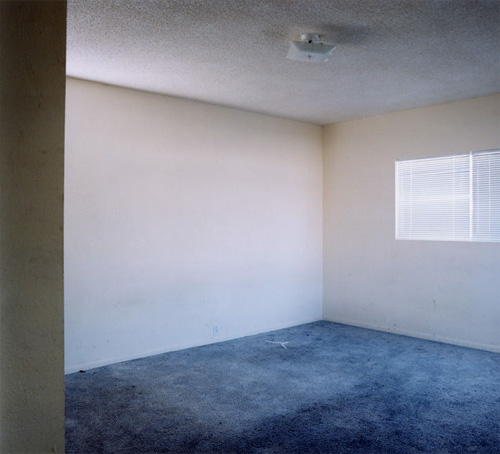 Todd Hido from foreclosed homes’ series
The blue carpeting above signals the presence of what is probably a bed located above the light blue rectangle against the wall at left. The series is mostly of t rooms cleaned entirely, save for a lamp left in a corner or a plastic coat hanger atop plush blue carpet. Though the rooms aren’t exactly clean, they’ve mostly been cleared of anything significant that isn’t bolted down.
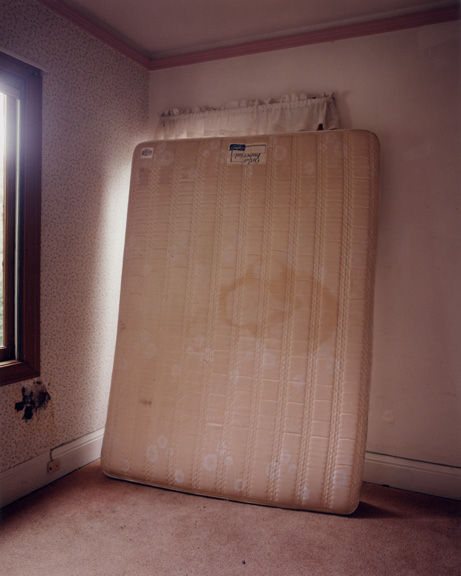 Todd Hido from foreclosed homes’ series
In this interview Hido says:
it is a very sad situation, when people have to give up their homes, but I am not making any judgment. I feel there is pathos to the images that the aesthetical method suggests. In these particular cases the way, I try to photograph in a way, that is suitable for that kind of situation. These are rooms, which are charged, and something has happened there. If you just make a document of that it wouldn’t do justice to what occurred in that place. By bringing in the mood and the darkness in my pictures, I think I can bring something more to the table.
He adds that it is very important to create this atmosphere. It brings out stories just as the beauty brings people into the photographs. I
October 13, 2010
Australia’s art history + Aboriginal art.
Susan Lowish in European Vision and Aboriginal Art: Blindness and Insight in the Work of Bernard Smith Thesis Eleven August 2005 argues that Bernard Smith is unable to engage with indigenous/ aboriginal art in an art historical context. Smith barely mentions Aboriginal art. The reason, according to Lowish:
The logic of the argument in Place, Taste and Tradition and in Australian Painting excludes art by Indigenous Australians by virtue of the fact that it is constructed around the model of centre/periphery. As Bernard writes in Place, Taste and Tradition, ‘this study is largely concerned with the mutations which have occurred in styles and fashions originating overseas as they have been assimilated into conditions . . . existing in Australia’ (Smith, 1945: 21). Smith is not concerned with Aboriginal art because it is outside the margins. His ‘marginalised other’ already exists as Australian painting itself.
Smith accentuate Aboriginal art’s difference from Australian art as the reason for its exclusion instead, of points to an inability on the part of settler and modernist Australians to recognize Aboriginal art as art. Australia’s art history as characterized by the non-recognition and non-acceptance of Aboriginal art.
Lowish says:
Without resorting to creating further divisions within art, what is required is a broadening of perspectives. In Place, Taste, and Tradition, Smith writes of ‘the habit of vision’ by which early colonists viewed the Australian landscape; these colonists had a distinctly European vision of Aboriginal art. Smith also writes of distortion of vision, ‘found most strongly in the depiction of objects about which visual habits or mental preconcep- tions had established an image that possessed considerable resistance to change’ (Smith, 1945: 19–20). Is not a similar distortion possible in the perception of Aboriginal art?
She says that Smith’s works European Vision and the South Pacific (1960) and Imagining the Pacific (1992) demonstrate his skill at producing a critique of the established norms of art history and the use of art by scientists and explorers. In both these works, Smith identifies different aesthetic tastes that dominated European perceptions in different epochs. He uses them to define the limits and constraints of European understanding of other lands, peoples and cultures. How disappointing then that Smith’s insight does not extend to his perception of Aboriginal art.
Smith's great insight lies in recognizing that aesthetic conventions shape perception and it it is only a small step further to apply this logic to the reception of Aboriginal art.
October 12, 2010
Australia as a hydraulic society?
One way to understand water in Australian society is to turn to Karl Wittfogel’s essay ‘The Theory of Oriental Society’ as this is where Wittfogel develops his ideas of hydraulic civilizations. According to Kirsten Henderson in 'Review Essay: Water and Culture in Australia: Some Alternative Perspectives' in Thesis Eleven August 2010:
Hydraulic civilizations are societies where the ever increasing drive to control water through the development of technology leads to an ever increasing concentration of power in the hands of an elite. Under such regimes, according to Wittfogel, these elite are usually bureaucrats. They are tasked with the job of providing the expert knowledge on hydrological conditions and devising the organizational procedures required for the mobilization of the labour needed to build dams, irrigation channels, locks and weirs for the control of water. Wittfogel was therefore disputing the orthodox Marxist idea that the ruling class within a society are necessarily those with capital and that the driving force for change in society is always the relationship between labour and capital. According to Wittfogel the ruling class of a hydraulic society are those who control the ‘hydraulic means of production’ and the driving force for change is increasing technological control of water.
In semi-arid or arid conditions it is not only the presence or absence of water that has a bearing on the development of irrigated agriculture and the subsequent social formation of a hydraulic society.
Henderson says:
Three requirements must be met: the development and building of water controlling technology, the social organization of labour to carry out the water- works, and the development of what Wittfogel calls a ‘time-keeping’ ability or, in other words, the development of a calendar (usually based on understandings of astronomy) able to predict the availability of water (p. 143).In a hydraulic society it is the state, argues Wittfogel, that is the only entity capable of meeting all three of these requirements simultaneously.The state, therefore, is directly involved in the economy. For Wittfogel this is the key to understanding hydraulic societies.
Wittfogel’s analysis, says Henderson, is a starting point for a way to think about nature and society together because Wittfogel foregrounds the role of nature in history in a manner that his contemporaries failed to take up:
In so doing he also incorporated the notion of power, particularly bureaucratic state power, into the nature-culture relationship in a form that other Marxist scholars of his time were unwilling to examine.... Wittfogel’s insights are important today because they ask the question: how in the remaking of nature do we re-make ourselves? (Worster, 1985: 30). In other words, what role do decisions taken by societies as they encounter their environment have in the formation of that society? And, more specifically, what is the role of water in that process?
These are important questions for an Australia struggling to make the Murray-Darling Basin more sustainable.
October 8, 2010
aesthetics: a note
A note aesthetics at Design Observer that gives an excerpt from Which "Aesthetics" Do You Mean?: Ten Definitions by Leonard Koren. Koren says that a search through my favorite dictionaries indicated that aesthetics means a philosophical discipline, concerned mainly with art and beauty This wasn’t the useful, “natural” meaning I had hoped to find, but curious, I waded into the literature to get a better idea of what philosophical aesthetics is all about. He comments:
After perusing the classical Greeks, Kant and his contemporaries and finally the arguments of modern-day thinkers, I concluded that academic aesthetics [in the meaning of “a branch of Western philosophy concerned primarily with the nature of art and related phenomena; the philosophy of art”] has little relevance for the artists and designers drawn to my books. Nevertheless, a passage from a volume by the philosopher–art critic Arthur Danto echoed in my brain: “…without theories of art, black paint is just black paint and nothing more.” Danto pithily noted an obvious reality: in practice many artists do use the equivalent of aesthetic [philosophy of art] theories and arguments to establish, justify, and bolster the meaning of their artwork. Indeed, how and what artists say — or don’t say — about their work is often an integral part of the art-making process itself.
Koren adds that he was no longer enamored of academic philosophical aesthetics; its focus and preoccupations now seemed too narrow. He desired to construct a more comprehensive vision of aesthetics [appearance, style, taste, philosophy of art, artistic, beauty, cognitive mode, a language] which would more accurately reflect our visceral/cerebral engagements with the world.
October 7, 2010
Eugene Atget: a photography of resistance?
As is well known Eugene Atget’s archive is of the premodern city of Paris both its places and its people. He photographed old streets, old courtyards, the interiors of shops, bars, markets, junk shops, horse-drawn tramways, carriages and wagons, fountains, bridges, barges, churches, doorknobs.
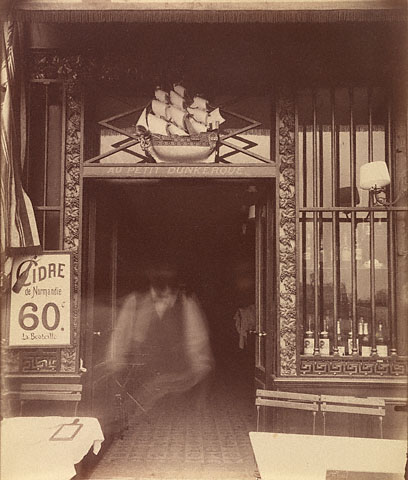 Eugene Atget, Quai, Conti 3 Paris, 1900 Albumen
Atget also photographed the street commerce that was archaic: flower-sellers, rag-pickers, street musicians, garbage collectors, prostitutes, beggars and tramps. He turned the artefactual remains of the Ancien Régime into a vast photographic archive.
In How Modernity Forgets Paul Connerton says that Atget’s photography represented a counter movement to the transformation of Paris by Baron von Haussmann.
He says:
Between 1900 and 1920 Atget assembled an enormous photo- graphic archive of Parisian artefacts dating from the Ancien Régime to the mid nineteenth century. He was reacting to the enormous topographical transformation of Paris since the mid nineteenth century, which had proceeded in two phases. In the first phase, under Haussmann, twenty-two new boulevards were begun, avenues such as Lafayette, Rivoli and Kléber were constructed, and the Solferino, Alma and Change bridges were built across the Seine. These vast new designs required the destruction of many existing structures, particularly in the Latin Quarter and the Île de la Cité. Then, in a second phase, between 1892 and 1902, 171 new streets were constructed; the western extension to the Rue Réaumur on the Right Bank from Saint-Denis to Notre-Dame-des-Victoires was established in 1895–6; the Rue du Louvre was linked at its northern end with the Rue Montmartre in 1906; and the Boulevard Raspail was joined to the Rue Montparnasse in 1890. These changes, once again, meant the sacrifice of existing structures, as when sections of the 1st arrondissement, especially the Rue des Deux-Écus, were demolished in 1907.
He adds that these vast transformations provoked a counter-movement to resist the persistent destruction and that Atget was a part of this countermovement.
Between 1890 and 1895, de Champeaux produced a detailed series of illustrated articles on the decorative ornamentation of old Parisian architecture in the Gazette des Beaux-Arts; in 1903 the Marquis de Rochegude’s Guide à travers le vieux Paris appeared; and in November 1897 an official body, the Commission municipale du vieux Paris, was established to resist the persistent destructions. Atget’s photo- graphic archive is situated within this movement of resistance to the new place-world of Paris at the opening of the twentieth century. The invention of photography formed a cultural counter-weight to the invention of railways; the latter produced speed, the former created stillness; the latter unsettled remembering, the former gave it a new sedimentation. But it was not so much the production of speed as rather the repeated destruction and restructuring of the built environment that most preoccupied Atget, and against which he fought a kind of rearguard cultural campaign for twenty years.
A photography of cultural memory. Eugène Atget never called himself a photographer; instead he preferred "author-producer."
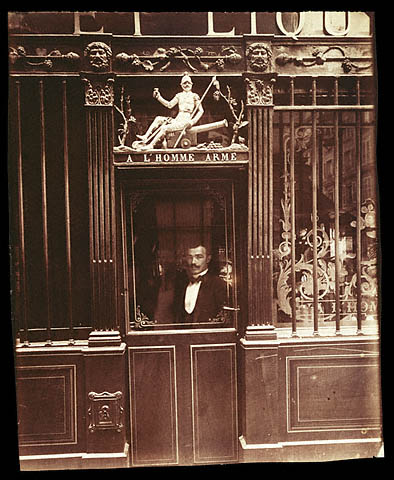 Eugene Atget, Restaurant, rue des Blancs Manteaux, Paris, 1900, Albumen print
Atget carried a large-format view camera, an outdated, cumbersome outfit, through the streets and gardens of Paris, usually photographing around dawn; many of these areas--storefronts and public spaces in nineteenth-century Paris and Versailles--were demolished soon afterward to make way for rapid urbanization.
October 3, 2010
Jason Wilson says that he is quitting Twitter. Unlike me he has been a heavy user in Australia. I've been very careful in my use of Twitter, mostly using it to publicise my blog posts and photography uploads, to make comments during Question Time and to draw attention to, and share, certain events or articles that I find of interest. I'm conscious of the weak ties.
Wilson's reasons are different from the more common ones of protecting a certain kind of reading and writing and engagement that seems to be threatened by the attention overload and surface concerns of online skimming. He states that his reason has to do with online identity and the private/public distinctions:
The timing is no accident. The Grog'sgate fiasco is not a catalyst for this decision, but you might see it as the straw that broke the camel's back. It was the final confirmation for me that after three-and-a-half years using the service, the Summer of Love on Twitter has come to an end for this particular user...We've known since the start that life online does funny things with identity. Others might have it that it just makes certain things about contemporary human identity more obvious. Always on, real-time social media like Twitter don't always allow clear distinctions to be made between professional and private selves, and between the public and private spheres. No-one knows when you've clocked on, or clocked off.
His concern is to protect the distinction between his professional and private selves more carefully, which he explains as follows:
Twitter encourages one (or me, at least) to vent immediate replies, which may not match, may even contradict a more disinterested evaluation. I'm not paid or qualified for minute-by-minute commentary, but for analysis and research. My personal opinions are my own, and they're quite distinct from, and often incompatible with any professional conclusions I might draw. But I need to make that clearer by not issuing professional and personal messages from the same space. Since I've ruled out separate accounts, the whole thing needs to come to a halt.
Twitter has changed. The Grog'sgate fiasco indicates that journalists from the mainstream media go to Twitter looking for stories and are looking for a story, revenge and roadkill. This is kind of behaviour is one reason why people are losing their trust in journalists.