November 24, 2010
integrated urban design
South Australia has a Commissioner for Integrated Design ---currently Tim Horton. It sounds good as Adelaide has lacked a genuine commitment to design in the city’s public realm for some time, even though Adelaide is based on the grid-like urban design of Colonel Light. Currently it has a culture of risk aversion.
The position arose out of Laura Lee's 2009 residency at South Australia's thinkers in resident that was concerned with the new urban form’ for Adelaide City and sustainable futures. Her residence focused on the value of design and the impact of the built environment on the quality of life for SA residents and was supported by the Institute of Architects. Her report is not online.
However, It is hard to figure out what the Commissioner for Integrated Design does. The brief says:
Integrated Design recognises that the nature of our challenges has shifted with increasing interdependence on component parts. Cities are just one example of a complex system that crosses traditional boundaries of responsibility including transport, planning, health and education, sustainability and finance. Multi-disciplinary perspectives are required to respond to global and local challenges....The key objective of the Integrated Design Commission (IDC) South Australia is to advocate the value of design and assume a whole of government (local and state) approach in advocating for, and advising on, ways to achieve excellence in the designed environment through an intelligent investment approach.
I'm really none the wiser apart from planning urban development in a holistic and sustainable way., reather than an approach to the built environment design being based on conception and delivery of projects in isolation.
We have the usual rhetoric of eveloping strategies that will improve the city character, making Adelaide more appealing, vibrant and desirable as a place to visit, live and work. Fair enough. What are these strategies? What sort of city is being envisioned?
November 23, 2010
Walter Benjamin + the autonomy art
In 'Benjamin’s Critique of Aesthetic Autonomy' George Markus in Walter Benjamin and the Architecture of Modernity, edited by Andrew Benjamin & Charles Rice, (its an open access publication) says that both Adorno and Benjamin:
combined some fundamental elements of the Marxist idea of socialism with the Romantic conception of an ultimate reconciliation between man and nature beyond all utilitarian practices. No collective home for men if their world is treated as the mere collection of manipulable objects; no liquidation of the exploitation of human beings by other humans without over- coming the exploitation of nature by men.
Markus says that Benjamin’s rejection of the claim to the autonomy of art orients his whole approach to culture, the grounds for this attitude are less clear, at least in the sense that the considerations invoked by him do not seem to be easily reconcilable.
November 22, 2010
dogs are not silent
Alice A. Kuzniar's Melancholia's Dog: Reflections on Our Animal Kinship is a book about dogs and people. Dogs eclipse all other species when it comes to reading the body language of people and Kuzniar inquires into 'how the literary and visual arts explore shifting, unsure divisions and alliances between man and beast and how they do so based on the uniqueness of each animal life’.
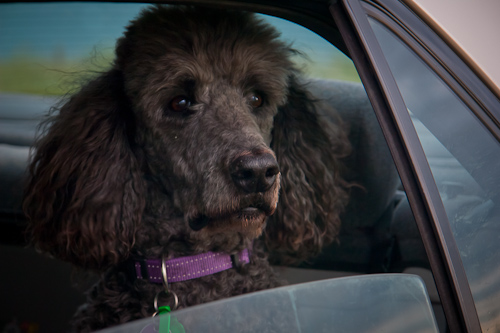 Gary Sauer-Thompson, Atget, Victor Harbor, 2010
After setting out the context in an introduction, Kuzniar presents four chapters: "Muteness," "Shame," "Intimacy," and "Mourning." Her basic idea is that these are dimensions of our interactions with canids (mostly domestic ones), the outcomes of which are melancholy for us, and perhaps for the dogs.
Because they are "beings that lack the word," in Derrida's phrase, we feel isolated from them and filled with sadness. We fall back on our projection and our anthropomorphism (some of us more than others), but ultimately we don't know what they are feeling. Kuzniar believes this must sadden us, whether because of their deficiencies or our own.
Animals may lack the word but they are not silent. Dylan Trigg says that the animal’s body is full of pathos and expression, its eyes and ears caught up in the texture of the world, yet its voice is mute. There is a silence that takes place with the animal, but a silence through which communication is dependent. He adds:
Heidegger will speak of this silence in terms of poverty, an inability to see the world as world. A line is drawn in Heidegger’s analysis, a refusal to meet the animal face-to-face. For him, the silence of animal is an opportunity for Dasein to define its ontology, a model that is created from the inverse ontology of the animal. The animal’s silence is worldless, a life with no no existence, a pure facticity.
Animals may lack the word but they are not silent. They bark and communicate with their bodies. Nor is it the case that we don't know what they are feeling. We can tell when they are happy or are in pain.
November 21, 2010
Eric de Maré: the Functional Tradition of achitecture
Eric de Maré was a British architectural photographer who worked in the mid-20th century and specialised in the qualities of early and late industrial structures.
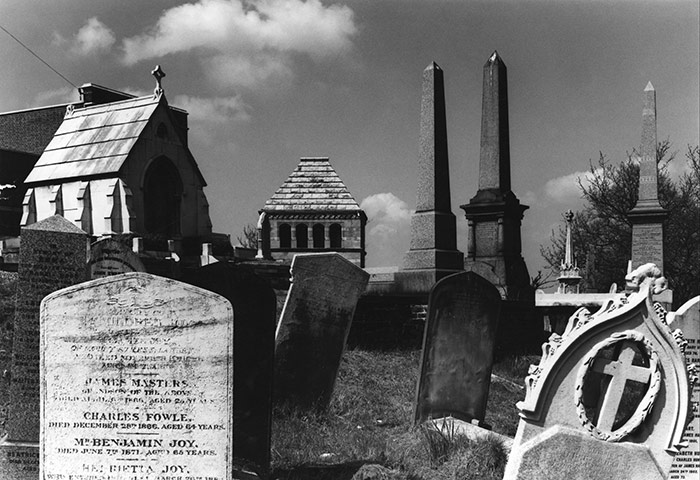 Eric de Maré, West Norwood cemetery, London 1968.
In The Canals of England (1950), de Maré celebrated the unselfconscious "functional tradition" of canalside buildings, bridges and bollards, offering the canals as a model of combined beauty and efficiency, eloquently supported by photographs.
The "Functional Tradition" was manifested in brick warehouses and engineering structures which de Maré photographed with a Linhof Super Technika.
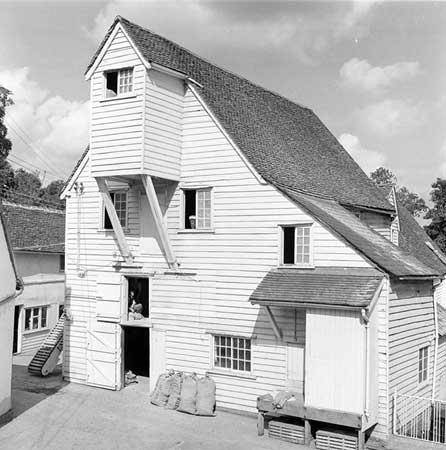 Eric de Maré, Bradford Mill on the River Plant at Bocking, Essex, circa 1945 - 1958
His work at the Architectural Review consisted of a series of special issues that celebrated canals, the Thames and, most importantly, the buildings of the Industrial Revolution, which were then ignored or being destroyed as a reaction to the horrors of the nineteenth-century transformation of society.
I haven't seen de Maré's 1975 text Architectural Photography.
November 19, 2010
Leonard Cohen: Live in Adelaide
I saw Leonard Cohen last night at the Adelaide Entertainment Centre. We travelled to and from the Entertainment Centre by tram from the city pad. I took a camera but I was too far away to take any photos or to record a video.
The first set was a kind of jazz fusion cabaret. This track, Tower of Song, is from Live in London (recorded at London's O2 Arena on July 17, 2008)
This track was in the second set, which was much better than the first. You could hear the rich downbeat imagery, the power of his writing, and his near-monotone gravel delivery has become an expressive deep baritone. Cohen, who is in his mid 70's, is a compelling and absorbing performer who brings his soul into every verse he sings, and his band is superb. His gifts as a performer nearly match his abilities as a writer.
An spoken poem that was part of the second set in which his performance is genuinely engrossing.
Cohen is touched by the affectionate reception he receives from his audience and the show is emotionally resonant. He has kept his orginal audience and added to it across generations.
November 13, 2010
Gene Clark: No Other
This song, 'Refuse From a Silver Phial', is from Gene Clark's long forgotten 1974 album No Other.
This background to the album says that No Other was dismissed as being bloated and pretentious by critics. Clark had hoped to release the set as a double album but Asylum Records refused. It moves beyond the stripped down, passionate country-rock on the earlier "White Light" and Roadmaster albums.
This is the title song, 'No Other', which some see as overproduced.
Clark died in 1991, of complications related to his lifelong battle with alcoholism. No Other was reissued on CD with bonus tracks in the early 2000s.
November 12, 2010
Robert Plant: 'Band of Joy'
This bluesy track, Silver Rider, is from Robert Plant's new album entitled Band of Joy:
The album is an outgrowth of Raising Sand, Plant’s striking duet album with Alison Krauss.
Plant and Krauss take turns singing lead on some of the songs: This is Krauss on Sam Phillips' "Sister Rosetta Goes Before Us" is from the Raising Sand Album
Both Plant and Krauss are known for being envelope-pushing innovators in their respective fields. Both records indicate that Robert Plant has escaped the long shadow of Led Zeppelin and stadium rock. Plant’s roots are as much in country, blues, and folk as they are in rock and roll and heavy metal.
November 8, 2010
the future of the fourth estate
Alan Rusbridger has a long blog on the future of the fourth estate at The Guardian. He divides the fourth estate into three:
There is the press, mostly still privately owned and lightly regulated, which was all we had until the dawn of broadcasting. Then there are public service broadcasters – publicly owned and, in return, pretty stringently regulated in terms of content, balance, impartiality and so on. Finally, there is the new public sphere opened up by digital technologies. (I need a catchier term for this. "Social media" I find a bit deadening.) Without getting into the debates about net neutrality, one might say that no one (yet?) "owns" or regulates this new third division of the fourth estate.
Anthony Barnett in his response The Web Estate: a response to Alan Rusbridger at Open Democracy rejects this division:
What Alan calls the press I see as the MSM, the main-stream media...The MSM includes the BBC...A subsection of the MSM is public service broadcasting or PSB..In the UK, public broadcasting of this kind is now almost monopolised by the BBC. Alan concedes this by heading his section on PSB simply ‘The BBC’. But they are not the same...e badly need more PSB, I agree. But it is a colossal mistake to put it into the hands of a single institution as this exposes the idea to continuous attack, thanks to the distortions of it being monopolised.
Barnett says that the digital sphere or the digital public is called the web, adding that:
in the next fifteen to twenty years the web will become the publishing medium of everything. Everything: news, magazines, books, advertising, articles, video, music, movies, TV, shopping, education, diaries, maps, thoughts, votes, prayers, branding and ‘facetime’. You name it, the web will publish, broadcast or deliver it and in the process mash it, creating new combinations. The web will deliver to the flat screen you roll up and put in your backpack, back pocket or purse, to the watch on your wrist, to your phone, television, radio, tablet and computer.
He says that the question is: what forms will be developed within the web? Will the MSM be able to find some that can reassert their domination online? Will new web corporations like Google gain irreversible full-spectrum dominance? Will its revenues, this is the killer question, be shared or oligopolised?
I would add that the digital public is becoming an important voice within the fourth estate; a voice that is a gain for journalism. This new digital public already enriches traditional journalism, but it isn't replacing it.
November 3, 2010
damaged landscapes
An interesting weblog by Dalton Rooney an American landscape photographer, whose latest project is Outer Lands. This survey of the landscape of Long Island is about the contemporary landscape with its diverse human traces. it marks a break with unspoiled wilderness.
November 2, 2010
Michael Wolf: architecture of density
German-born, but now Hong Kong based, photographer Michael Wolf, photographs the extreme densities of Hong Kong. In a diverse array of photographic projects Michael Wolf explores the complex cultural identities of China and Hong Kong, where he has lived since 1995.
His series ‘Architecture of Density’ rarely contain images of people, instead letting the extreme scale of the buildings remain the focus.
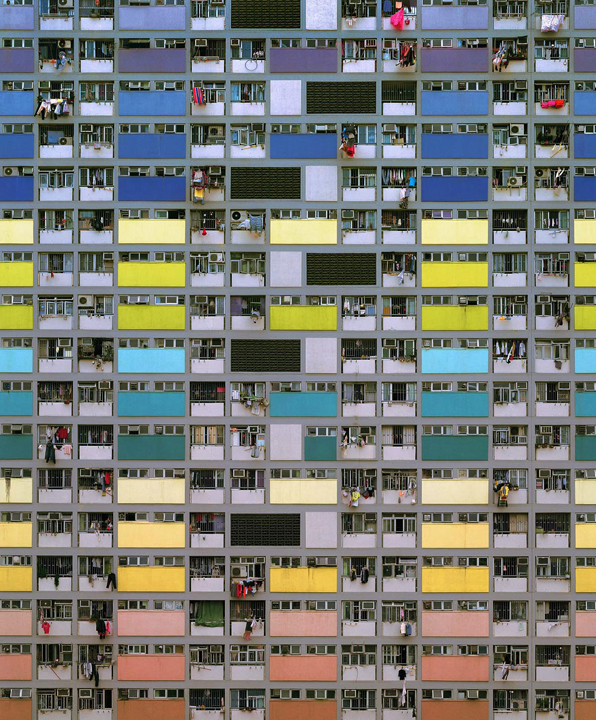 Michael Wolf,Architecture of Density #75, 2003, chromogenic Print
These are these huge apartment blocks (80 floors or so) in which everyone lives right on top of each other in this urban hyper-density. There is a historical aspect to Hong Kong’s hyperdensity. It is a culmination of a small geographic space (only 85 developable square miles), a rapid postwar economy, a politically and economically situated location, a boom in immigration influx in the 1960s, and a hands off government. Everything sort of just happened all at once, within the span of 40 or so years, starting in the 1960s.
The hyperdensity of Hong Kong is what makes it one of the most accessible, convenient, and vibrant cities on earth. The notion of overcrowded is a term used to denote places that due to its overpopulation, is unable to sustain itself in terms of living space, food, sustenance, and so on. There is a difference between overcrowded and high population density, the latter actually being a phenomenom that has many benefits economically, socially, and environmentally.
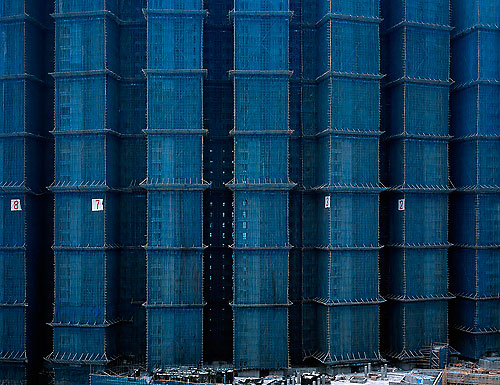 Michael Wolf,Architecture of Density #19, 2003, chromogenic Print
This high rise urban living is such a contrast to the Australian suburbia with its huge backyards, wide highways and car dependent lifestyle. From this perspective the early high rise attempts in the inner urban areas of Melbourne for post war migrants who worked in the factories were seen as a social disaster. It is otherwise in Hong Kong.
November 1, 2010
Nadav Kander: Yangtze River project
Nadav Kander’s Yangtze River project explores the banks and waterways of The Yangtze River that provide home and livelihood for hundreds of millions of Chinese. Taken along the river from its source in remote western China to its mouth just off the shores of Shanghai, these photographs, shown here for the very first time, depict the human footprint of habitat and industry that can be seen along the shores of China’s longest river.
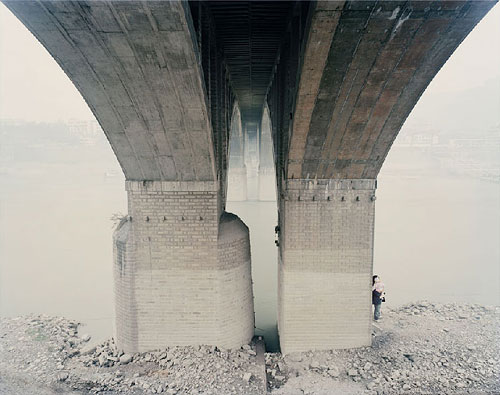 Nadav Kander, Woman & Child Under Bridge, Yibin, Sichuan, from Yangtze, The Long River
From 2006 to 2008 Kander travelled along the Yangtze's banks from its mouth to its source – a distance of 4,100 miles that took him from the modernised city of Shanghai to the rural Qinghai province in the west of the country.