September 28, 2010
signs proliferating; referents retreating
In The Future is an Open Future: Cultural Studies a the End of the 'Long Twentieth Century' and the Beginning of the 'Chinese Century' in Cultural Science John Hartley says that cultural studies was caught up in a crisis not so much of knowledge as of representation, which was also entering the period of ‘creative destruction’ known as postmodernism.
Here the legitimacy of both political and semiotic representation, as inherited from nineteenth century philosophy, was challenged. Commentators became interested in the productivity of signs, and in particular the excess of mediation in contemporary societies, whereby signs – often entirely detached from any plausible referent – suffused the public and private domains. Although they were often criticised for turning the world into a text, the postmodernists were among the first to see clearly, right across the domains of politics, culture and the economy, that representation had been emancipated from reality, and that the process of abstracting textuality, signification, meaning and value from situated context or referential causation was a phenomenon of the system, not of their own fantasies. Everywhere, signs were proliferating; referents retreating. Excessive media signification, in movies, advertisements, TV and the arts, was only the most visible form. Easily observed and readily taught, media studies ‘caught’ postmodernism early and popularised it widely, to the dismay of the nineteenth-century disciplines.
He adds that abstraction and the detachment of the sign characterised even economics, where capital itself was ‘textualised’ in the form of financial markets, releasing unprecedented energy into the global financial system. Work was abstracted from the labourer in automated factory systems. The wide distribution of personal computers detached words from pages, allowing ‘text’ to become mobile in ways that would have astonished typewriter-bashing journalists of the modern era, but they too were busy textualising the world in order to know it.
Recipes were abstracted from food, allowing celebrity chefs to prosper even as cooking declined as a social practice. In short, ‘the economy’ shifted decisively from manufacturing to information. Politics shifted from representative to mediated forms, in which class, party or ethno-territorial loyalty gave way to a system where politicians auctioned promises for votes and events mattered in direct proportion to their visibility on network TV. Culture became the site for the tensions, struggles and ‘affordances’ associated with these changes to be worked through at the local, contextual and experiential levels.
September 26, 2010
the urban sublime
I'm picking up on this earlier post on Shane Gunster's 'Second Nature': Advertising, Metaphor and the Production of Space in Fast Capitalism. In this post I am interested in the transformation of the sublime from nature to the urban.
Gunster says that in the early twentieth century:
attempts to describe the metropolis itself as a coherent totality and, above all, to register how such a complex, multi-faceted and 'monumental' environment was experienced by individuals defied conventional, realist modes of description and explanation..... romantic metaphors and allegories were used to construct the 'urban sublime', a series of interlocking rhetorical tropes that both signify the impossibility of grasping the totality of metropolitan existence and turn such recognition into an occasion for wonder and delight at the marvellous spectacle in which (some) city dwellers find themselves.
He adds that Christophe Den Tandt in The Urban Sublime in American Literary Naturalism (1998) locates the origin of sublime experience in a state of perceptual confusion motivated by a sudden surplus of signifiers, as when immersed in an environment with a surplus of sensory stimulation: the semiotic flood simply overflows our capacity to give it meaning. Resolution of this crisis is achieved through the use of metaphor by which the experience of confusion and disorientation is given meaning as expressive of transcendent forces beyond human ken.
Gunster adds that images of nature become, then, not the cause of sublime experience, but rather a metaphorical response to it, the origins of which lie in an urban environment that simultaneously overwhelms the senses and seemingly defies comprehension. In the face of a reified world that appears to lie beyond human understanding and control, spatial agency retreats to the fortification of domestic enclaves on the one hand, and the episodic pursuit of mystical rejuvenation through different forms of spectacular experience on the other.
Images of nature as sublime offer a compelling metaphor through which to recognize (and misrecognize) what it feels like to live within the petrified urban and suburban landscapes of postmodern capital. Yet the ideological significance of these images does not only lie in a literal naturalization of social space, but, more importantly, in how they invite us to actively embrace and even celebrate this fate.
September 24, 2010
Radiohead: "From The Basement" set
Radiohead's "From The Basement" set, recorded for Nigel Godrich's interesting web series, is now on YouTube.
Track listing:
Weird Fishes/Arpeggi
15 Step
Bodysnatchers
Nude
The Gloaming
Myxomatosis
House Of Cards
Bangers and Mash
Optimistic
Reckoner
Videotape
Where I End And You Begin
All I Need
Go Slowly
Godrich's web series focuses on intimate, live performances by musicians without a host or an audience.
September 15, 2010
The Situationist International
The Situationist International was created in 1957, in large part out of the ruins of the less well known Letterist movement, as well as several other fledgling European avant-garde groups. Though international in scope with active sections all over Europe, the Paris branch of the S.I. remained the most important, exerting a great deal of often irksome authority over the other factions. The Letterists had been active in Paris throughout the 1950s, carrying on both the best and worst traditions of Dada and Surrealist art, criticism and activism. Led by former Letterist Guy Debord, members of the S.I. created various works of art, books, periodicals, posters, and graffiti. However, they differed from other avant-garde movements in their development of a critique of everyday life that went beyond and ultimately turned against the production and politics of art, focusing instead on city planning and the critique of mass communications
In The most radical gesture The Situationist International in a postmodern age Sadie Plant says that:
The situationists characterised modern capitalist society as an organisation of spectacles: a frozen moment of history in which it is impossible to experience real life or actively participate in the construction of the lived world. They argued that the alienation fundamental to class society and capitalist production has permeated all areas of social life, knowledge, and culture, with the consequence that people are removed and alienated not only from the goods they produce and consume, but also from their own experiences, emotions, creativity, and desires. People are spectators of their own lives, and even the most personal gestures are experienced at one remove.
Even though the ability to control one’s own life is lost in the midst of all-pervasive capitalist relations, the demand to do so continues to assert itself, and the situationists were convinced that this demand is encouraged by the increasingly obvious discrepancy between the possibilities awoken by capitalist development and the poverty of their actual use.
They drew on Dada and Surrealism to explore the role of the imagination, creativity, desire, and pleasure in the transformation of everyday life from a realm of bland consumption to free creation.
Plant says:
Dada and surrealism had interrupted and subverted the language and images with which they worked, invoking a wider world of meanings which challenged conventional arrangements of reality. And in their challenges to the inevitability and immutability of the spectacle, the situationists pursued this same attempt to conjure a totality of possible social relations which exceeds and opposes the totality of spectacular relations. They took the words, meanings, theories, and experiences of the spectacle, and placed them in an opposing context; a perspective from which the world was given a fluidity and motion with which the static mediocrity of the spectacle could be negated. Introducing a sense of historical continuity by showing that the spectacle, in spite of its seamless appearance, carries the seeds of an emancipated and pleasure-filled world, the situationists showed that what could become real is more meaningful and desirable than that which is in being. The spectacle circumscribes the reality it presents, but it does not preclude the possibility of identifying a bigger and better world of chosen relations and experiences beyond its constraints.
The situationists’ attempt to transform everyday life has been defeated after the troubles of 1968 which is remembered for the irruption of play, festivity, spontaneity, and the imagination into the political realm. However, the avant-garde had failed to deliver the transformation of everyday reality it promised, so had the city planners.
We are left with their image or picture: modern society is a spectacle, modern individuals are spectators: observers seduced by the glamorous representations of their own lives, bound up in the mediations of images, signs, and commodities, and intolerably constrained by the necessity of living solely in relation to spectacular categories and alienated relations. The response, they argued was to cultivate an awareness of the ways in which everyday life is presently conditioned and controlled, the ways in which this manipulation can be exposed and subverted.
Everyday life is the very realm over which we should have control, yet it is experienced as mundane and dull in its ubiquity. In our escape from the fragmentation and mediocrity of our own experience, we run blindly towards the promises of wholeness, fulfilment, and unity implicit in the world of the abundant commodity.
September 14, 2010
the moral economy of waste
Maree Pardy, a social anthropologist at the University of Melbourne, says in A Waste of Space: Bodies, Time and Urban Renewal in the M/C Journal that:
Neoliberalism as the ideology of a radically free market that institutes economic deregulation, tariff reduction, public financial support for business and its shareholders, and the reduced role of government in areas of welfare and social expenditure, the effects of which are discernable at the urban scale. For Neil Brenner and Nik Theodore [“Cities and the Geographies of ‘Actually Existing Neoliberalism’.” Antipode 34.3 (July 2002): 349-79], “actually existing neoliberalism” is witnessed in what they call the “creative destruction” that inheres in the urbanisation of neoliberalism. In this materialisation of neoliberal time, modernity and progress continue to be driven visually. Thus this neoliberal/urban nexus depends on further sub-units of time, nominated by Brenner and Theodore as moments of (visual) “destruction and creation.” A series of examples of such creative destruction are offered by Brenner and Theodore and include the destruction of rights through the creation policing and social exclusion agendas. They argue that the mechanism of “re-regulating urban civility” entails moments of destroying notions of the liberal city in which all inhabitants are entitled to social services and political rights, and moments of creating zero tolerance policing, new forms of social surveillance and new policies to prevent social exclusion. The destructive moment of “re-representing the city” recasts the postwar image of the working class through visions of urban disorder, dangerous classes of people and of economic decline, involves the creative moment of entrepreneurial discourses about the need for revitalisation, renewal and reinvestment in urban areas (372).
The ‘proper use’ of neoliberal urban space depends on the dynamic of destruction/creation through a new consumer-driven urban entrepreneurialism. Urban renewal as proper neoliberal usage is a re-ordering of space to make it fit for purpose. Proper use here follows the Lockean impulse of human intervention through planning, design and redevelopment, is now apprehended not as service to God, but capitulation to the dictates of the neoliberal agendas implemented by the combined forces of the state and capital. The moral economy of waste is at work in the moral economy of urban renewal.
She adds that contemporary urban renewal and regeneration programs in places like the UK, Europe, North America and Australia are inspired to use space more productively, and to design and develop urban space in ways that enable the production of vibrant, clean, safer places where cultural diversity might be experienced as cosmopolitan chic. Tethering modern urban design to property development and the trend to ‘lifestyle’ based local economies, urban renewal is a strategy sweeping most postindustrial economies.
September 12, 2010
Charles Bayliss + the Australian landscape
Charles Bayliss was an important nineteenth century photographer in settler Australia whose photographic heyday was the 1870s and 1880s.
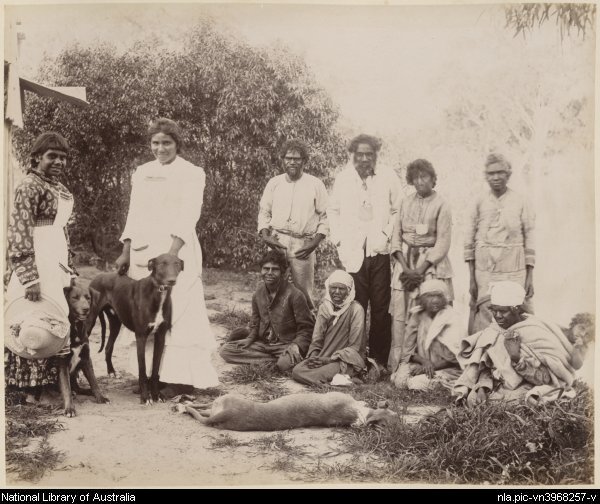 Charles Bayliss, Group of Aboriginals at Dunlop Station homestead, Darling River, New South Wales
1886, (NLA)
Charles Bayliss, Group of Aboriginals at Dunlop Station homestead, Darling River, New South Wales
1886, (NLA)
His specialisation involved two main areas: photography of the natural and of the built environments. These conformed to the standard fare of the view trade, which underpinned Bayliss’s livelihood for the next 20 years.
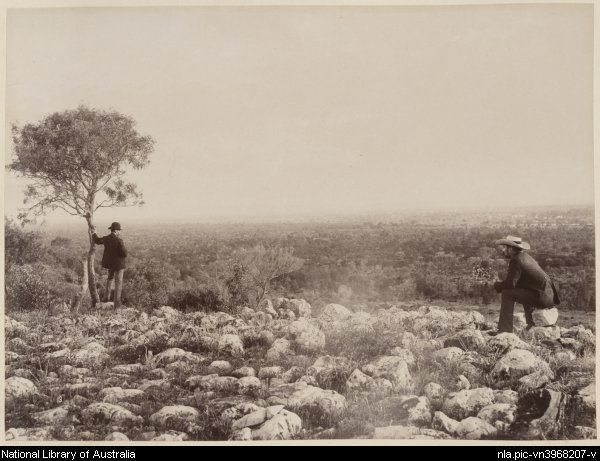 Charles Bayliss, Looking south from Dunlop Range overlooking Louth, Darling River, New South Wales 1886, (NLA)
Helen Ennis in A Modern Vision: Charles Bayliss, Photographer, 1850–1897 says that the image Looking South from Dunlop Range, Overlooking Louth, Darling River
deploys some of his trademark visual devices, with two men positioned strategically at either side of the image (surely the man at the left was instructed to lean against the tree to reinforce the vertical axis and to provide a counterpoint to his seated companion). Each man looks in a different direction, leading the viewer’s eye both ways across the composition. This is a strategy Bayliss used well, making us aware simultaneously of the act of looking at the landscape and of constructing it as an image.
Ennis says that in his landscapes from the late 1870s onwards, Bayliss employed a range of approaches that demonstrated his mastery of the dominant aesthetic conventions of the picturesque and the sublime:
The views that exemplify the sublime are relatively few: the unpeopled vistas of the Blue Mountains with their endlessly rolling hills, or scenes of the Grose Valley in which small figures perch on rocks in the foreground to provide a measure of scale and drama. Variations on the sublime include highly analytical, impersonal images of rock faces and natural features that are unyielding and implacable. In them, Bayliss uses an indeterminate vantage point that blocks any possibility of entry; there is no rock to step on to in the foreground, no pathway for the viewer to take through the scene.Generally, however, he was attracted to less dramatic but no less beautiful scenery. Some of Bayliss’s quietest images are the most enduring; they still operate within a romantic framework and draw from a deep appreciation of nature. They are not, however, concerned with evoking a sense of awe so much as a particular mood.
In the1880s, this mood is private and intensely solitary: a single person—sometimes in a boat—is held completely within the scene. Beyond the frame there is no other world. Such images address the viewer in a highly individual fashion, inviting a contemplative state, a state of reverie.
September 1, 2010
Edward Burtynsky: early landscape studies
Edward Burtynsky's large-scale colour photographs, which are taken with large format field cameras, explore the way that nature has been transformed through industrial work and manufacturing--eg., railway cutting, mine tailings, quarries, scrap piles and the oil industry.
Burtynsky's toxic sublime work lacks the raw anger and the muckraking impulse of the documentary photographer, as it recognises a strange beauty in the destruction of nature. It has its roots in the Romantics' realization that the coming industrial revolution threatened a pristine nature.
 Edward Burtynsky, Landscape Study #4, Ontario, 1981, colour photograph
The early landscape work in the 1980s has largely been forgotten. It is comprised of modest studies of pristine landscapes in Canada and the United States and it lead to a desire to probe much deeper, into the nature and visual result of impact of human beings on the planet.
 Edward Burtynsky, Landscape Study #7, West Virginia, 1985, colour photograph
These modest studies are something that I can do around the Fleurieu Peninsula in South Australia now that my 8x10 camera is operational.