November 28, 2007
from porn culture to AI
Courtesy of Radar.com the photograph below is excerpted from Naked Ambition: An R-Rated Look at an X-Rated Industry by Michael Grecco. He tries to photograph porn stars and show who they are without shooting porn. Isn't porn theater?

Michael Grecco, Control Box, from Naked Ambition, 2007
Grecco says that it is a photo of a Control Box to the Tender Lover, which is a sex machine designed by two Taiwanese engineers from the military. I've always been puzzled by mechanical sex and people building sex machines. Why bother?
Maybe its sex and innovation?
An active community of sex toy hobbyists----a kind of folk art sculpted from the Home Depot palette--in which some inventors have expanded their hobby into thriving cottage industries, selling their creations on eBay and adult stores online.
Or is it about having sex with robots---sex-bots. The argument here is that robot-human sex is the next step in a sexual “evolution” that began with vibrators and inflatable datables. Robot love will have special appeal to those who find it difficult to locate a sex partner – because they are disabled, say, or profoundly married. In presupposing that the robots of the future will, at least in some sense, be alive we have left the world of porn culture for that of artificial intelligence.
David Levy, author of Robots Unlimited (Life In A Virtual Age), says in this interview that:
robot sex will become the only sexual outlet for a few sectors of the population: the misfits, the very shy, the sexually inadequate and uneducable, . . .; and that for different sectors of the population robot sex will vary between something to be indulged in occasionally, and only when one's partner is away from home on a long trip, to an activity that supplements one's regular sex life, perhaps when one's partner is not feeling well, or not feeling like sex for some other reason.
November 26, 2007
Abstract Expressionism as action painting
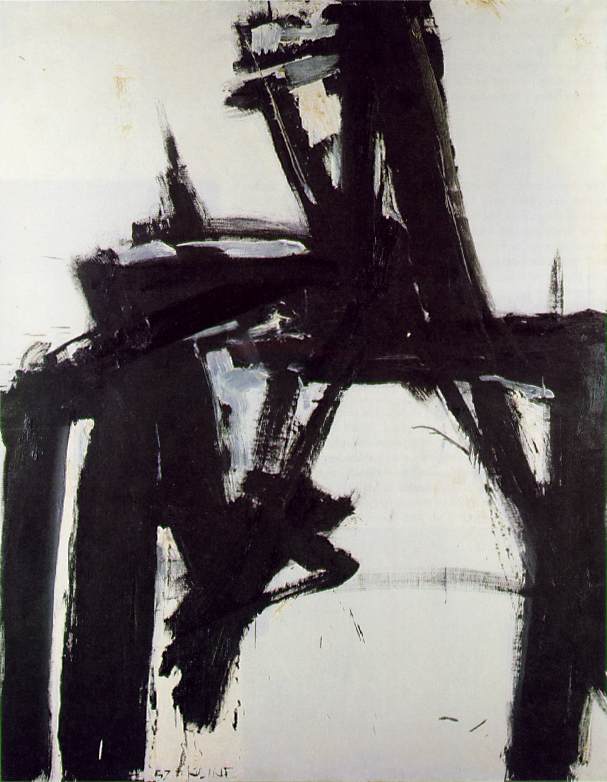
Franz Kline's work is deemed to be a response to a distinctively urban, specifically New York sensibility and to the life of metropolis. It is deemed to a gritty honesty by the deliberate, blatant roughness of its execution and the poverty of materials: cheap, commercial house paint slathered on a flimsy sheet of paperboard. Kline insisted his most successful paintings were visual responses to a specific emotional state in that his images were "painting experiences," in the sense that it is the act of painting that becomes a genuine experience for the artist

Franz Kline, Orange Outline, 1955, Oil on paperboard, mounted on canvas,
But he would have found similar images on the walls and streets of New York. Kline claimed to paint "not what I see but the feelings aroused in me by that looking." However, we are a along way from the 1950s and what we have is the image before us as a self continued object. The experience of painting has disappeared into history.
November 24, 2007
Lefebvre, everyday life
In this review of Michael E. Gardiner's recent Critiques of Everyday Life at Culture Machine by Liam McNamara we find a section on the work of Henri Lefebvre and the Situationists. McNamara says:
Lefebvre’s main tool of analysis is gained via his critical reading of Marx, and has similarities to the Surrealists and the Situationists. Gardiner points out how Lefebvre rejects a ‘metaphysics of labour’ in favour of a critical praxis that operates through poesis rather than work. However, Lefebvre also criticizes the tendency for Surrealism to strive for an escape from everyday life via the marvellous, rather than enabling its dialectical supersession. Many of these ideas are integrated into a critical theory of leisure, opposing an affective leisure to an instrumental, egocentric variant.
McNamara adds that the theory emerging from Lefebvre’s later career takes a linguistic turn, but the focus remains on everyday life as an unfulfilled realm of human potentialities:
Modernity is categorized as an impoverished realm where the affective powers of the symbol have been substituted by the ‘signal’ (sign) and metalanguage. This process of cybernetization vitiates everyday life, and the technocracy it helps usher in shows a total absence of Utopian vision. The most alarming development is the loss of referential meaning in language; meaning is decontextualized by the split of the signifier and signified, leading to their hasty fusion.
Lefebvre, sees everyday life everyday life as an unfulfilled realm of human potentialities as increasingly detached from science and leisure and understands emancipatory acts to be the sublime rather than the more prosaic activities such as eating and drinking.
November 22, 2007
another kind of critique
It is possible to have a project as an artist plays out a Deleuzian strategy of functioning inside the ceaselessly productive and destructive operations of late capitalist culture, but doing so in such a way as to expose certain differences or heterogeneities that these processes create but cannot fully accommodate.
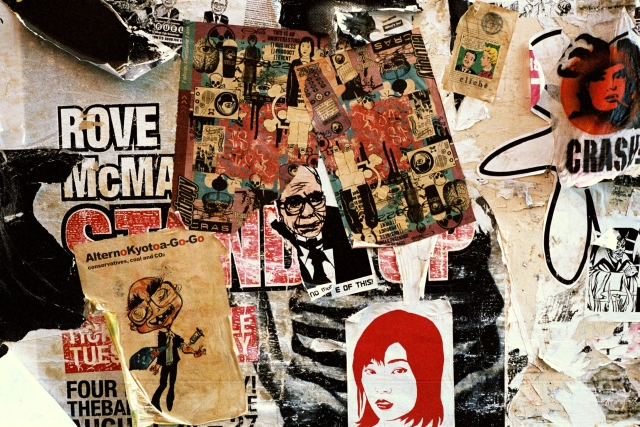
Gary Sauer-Thompson, collage, Adelaide CBD, 2007
The moment is not of opposition or critique or outright refusal in a political sense but of attempted evasion of the procedures governing the production and consumption of things and spectacles in late-modern or postmodern society.
November 21, 2007
Rauschenberg: visual compositional structure
According to Alex Potts in Random Order: Robert Rauschenberg and the Neo-Avant-Garde in the Art Bulletin critical commentary on Rauschenberg, since John Cage's classic 1961 essay "On Robert Rauschenberg," has emphasized the distinctive combinatorial logic or illogic of his so-called combine paintings. Rauschenberg himself designated these as combines rather than assemblages or collages, doing so possibly to fend off associations with modernist ideas of compositional structure or calculated disjuncture.
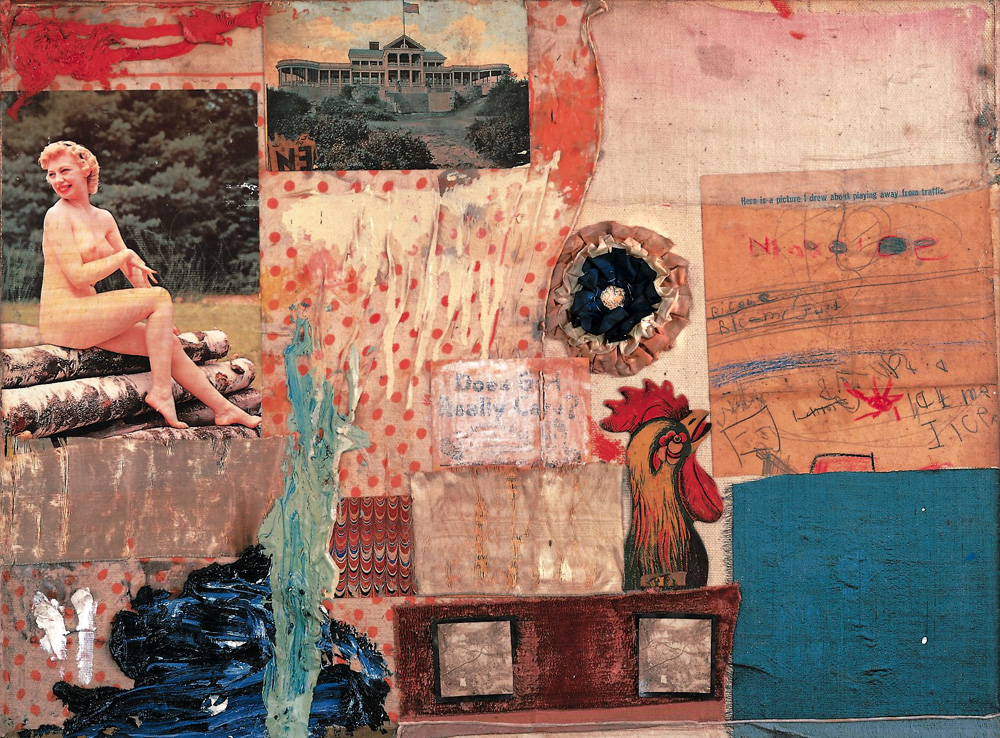
Robert Rauschenberg, Untitled, Combine painting, 1955.
It dispenses with the traditional compositional effects and realizes a bringing together of parts that preserved their separate identity. Rauschenberg's approach did not conceive of the overall format of a work as a relatively empty framing that simply made the constituent elements simultaneously present. He considered the combining of parts as itself a significant phenomenon, producing new results and effects not present in the elements that were being brought together. He was also attentive to the image quality of the entities with which he was working; for him they were not just constructs or prosaically factual entities.
November 18, 2007
Reith lectures 2001: Living longer
I ve been dipping into the Reith Lectures and came across one on the ageing process delivered in 2001 by Tom Kirkwood, Professor of Medicine and head of the Department of Gerontology at the University of Newcastle, in the UK. In the first lecture Kirkwood says:
The paradox about the longevity revolution, and its greatest inherent danger, is that we find ourselves in the present situation without having thought very much, until recently, about the kind of world we are creating. It is easy to win support for saving lives. Davy's safety lamp, Jenner's triumph of inoculation against smallpox, Fleming's discovery of penicillin - these are unquestionable gains. It is easy to win support for the fight against a killing or disabling disease, as can be seen from the generous public support for so many disease-focussed medical research charities.
He adds:
It is surely time that we took a new look at our changing world and the forces that are shaping it. The declines in mortality rates of older people are forcing the forecasts of future life expectancy to be revised upwards. Should we be pleased or depressed? ....One cannot pretend for a moment that there is not a lot that is disagreeable about getting older. This is all the more reason why we should direct unprecedented attention to ensuring that all reasonable effort be directed at removing the obstacles to enjoyment of the later years of life.
November 14, 2007
Robert Rauschenberg
I've become interested in the early work of Robert Rauschenberg--the combine paintings and the distinctive flattening produced by Rauschenberg's approach to assemblage. This work almost seems to suspend articulation of meaning:
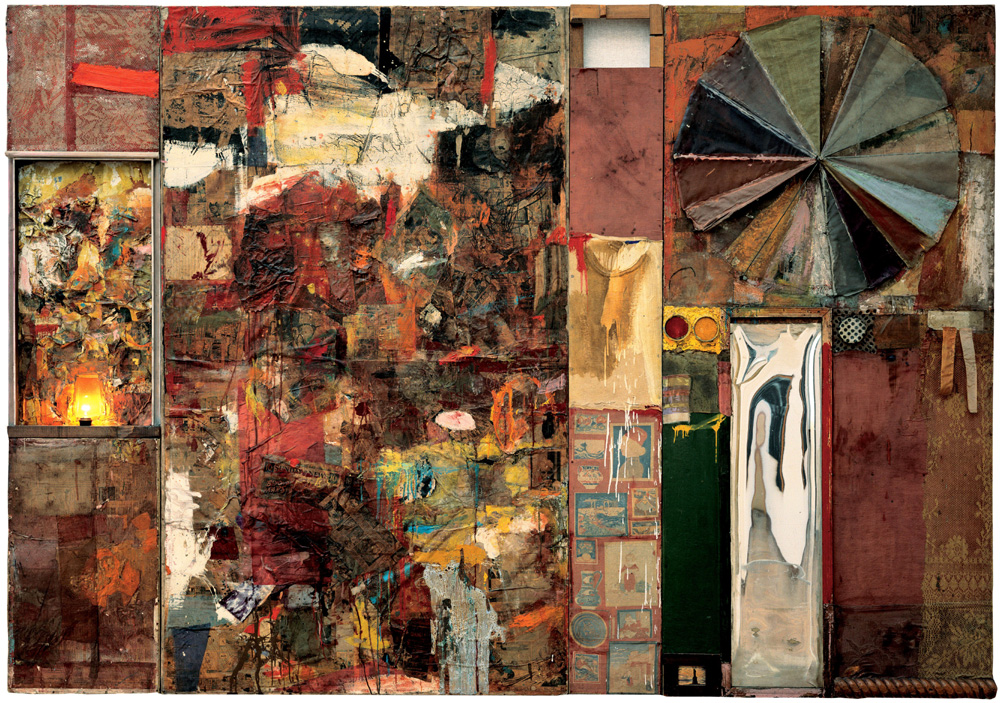
Robert Rauschenberg, Charlene, 1954, Combine painting.
He turned collage into assemblage. I feel compelled to “read” it from left to right, then wander around it, not sure what is going on.
November 11, 2007
Bacon, bodies, fragmentation
The reclaiming the body and repositioning its locus and identity in philosophy can be connected to the work of Francis Bacon who sees bodies as a series of fragments and the fragmented experience of self
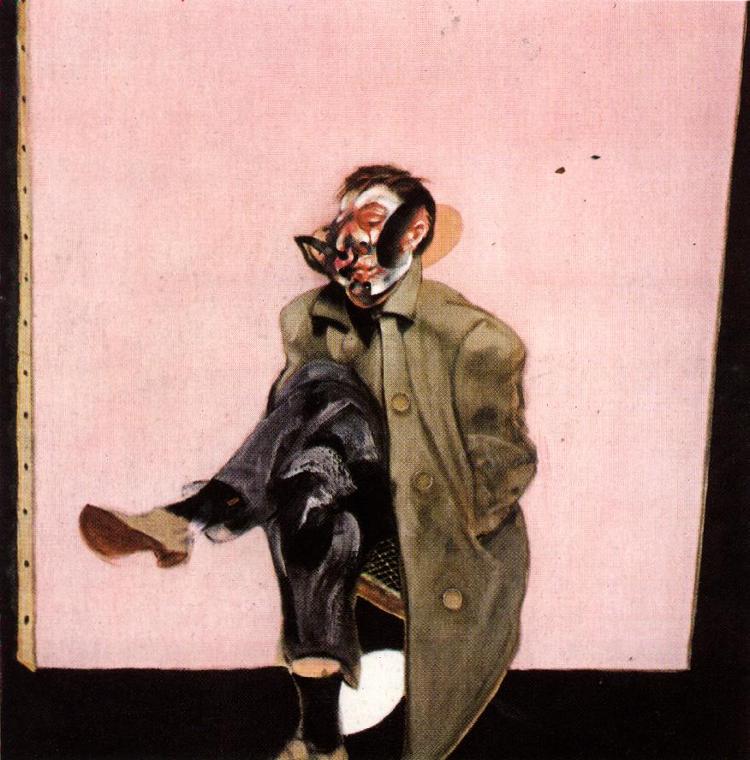
Francis Bacon, Self, 1970
The theme of Bacon's figures is the "shattering of the subject" or the replacement of a unified self by a fragmented self, which has been read as "loss of self" with psychoanalytic implications. The bodies of his figures always merge and hardly differentiate from one another.
November 10, 2007
November 9, 2007
secularity: a note
Robert Bellah in a post at Immanent Flame says that that Taylor is doing something different from what others writing about secularization have achieved, because he distinguishes three senses of secularity. Almost all the literature on secularization falls under Taylor’s first two categories of secularity:
• Secularity 1: the expulsion of religion from sphere after sphere of public life.
• Secularity 2: the decline of religious belief and practice.
But Taylor’s focus in this book is on what he calls Secularity 3: “the conditions of experience of and search for the spiritual” that make it possible to speak of ours as a “secular age.” Bellah says that he doubts that many people have even perceived this third dimension, and Taylor’s book should be as much a revelation to them as it has been to me.
November 8, 2007
Charles Taylor's A Secular Age
I've just come across the Immanent Frame weblog hosted by the Social Sciences Research Council. The blog is on secularism, religion, and the public sphere and there is a conversation about Charles Taylor's recently published A Secular Age, which I have yet to read.
The Secular Age text explores what it means to live in a secular age. In this excerpt--How Has the Moral Landscape Changed? Taylor says:
The generations that have been formed in the cultural revolution of the 1960s are in some respects deeply alienated from a strong traditional model of Christian faith in the West. They are refractory to the sexual disciplines which were part of the good Christian life as understood, for instance, in the nineteenth-century Evangelical revivals in English-speaking countries. Indeed, the contemporary swing goes beyond just repudiating these very high standards.... Not only do people experiment widely before settling down as a stable couple, but they also form couples without ever marrying. In addition, they form, then break, then reform these relationships. There is something here deeply at odds with all forms of sexual ethic----be it folk tradition or Christian doctrine----that saw the stability of marriage as essential to social order.
There can be stability of relationships outside marriage--it's not an either marriage or a free for all. However, the ethical questioning of Christianity goes deeper than marriage, as Taylor acknowledges, and then explores.
He says that the:
combination of clerical reform from the top, moralism, and repression of sexual life would come into conflict with developing modernity. The emphasis on individual responsibility and freedom would eventually run athwart the claims of clerical control. And the post-Romantic reactions against the disciplines of modernity, the attempts to rehabilitate the body and the life of feeling, would eventually fuel a reaction against sexual repression.
He says the ethical strands of this revolution are fourfold:
(1) the rehabilitation, continued from the 1920s, of sensuality as a good in itself; (2) the continued affirmation of the equality of the sexes, and in particular the expression of a new ideal in which men and women come together as partners freed of their gender roles; (3) a widespread sense of Dionysian, even “transgressive” sex as liberating; and (4) a new conception of one’s sexuality as an essential part of one’s identity, which not only gave an additional meaning to sexual liberation, but also became the basis for gay liberation and the emancipation of a whole host of previously condemned forms of sexual life.
On Taylor's interpretation the sexual revolution was moved by a complex of moral ideas in which discovering one’s authentic identity and demanding that it be recognized was connected to the goal of equality, the rehabilitation of the body and sensuality, and the overcoming of the divisions between mind and body, reason and feeling.
It is not an outbreak of hedonism as many conservatives currently claim. The moral landscape has changed.
November 7, 2007
Heidegger’s critique of modernity’s technological worldview
Dale Allen Wilkerson in The Root of Heidegger's Concern for the Earth at the Consummation of Metaphysics: The Nietzsche Lectures in Cosmos and History attempts to situate Heidegger’s critique of modernity’s technological worldview within the conceptual context and time frame of his Nietzsche lectures of the 1930’s.
Heidegger discovers in Nietzsche’s thought the “consummation of metaphysics” and in Nietzsche’s concept of “will to power” an articulation of the world dominating principle reflecting modernity’s comportment with beings as mere resources for consumption.
Wilkinson says that Heidegger in a section entitled, “Nietzsche as Metaphysical Thinker,” of the Summer 1936 lecture advanced an argument that will be sustained throughout his confrontation with Nietzsche as “the last Metaphysician:”
This argument holds that the will to power is Nietzsche’s name for the basic character of all beings, a name that answers philosophy’s guiding question in a way that is decisive for all of Western metaphysics. Why is Nietzsche’s place in the past, present and future of Western metaphysics so decisive? How is this meditation on Nietzsche situated within the development of Heidegger’s thought concerning the Western world’s technological domination of the earth?
Modernity“completes itself” in the consummation of all metaphysics, expressed in Nietzsche’s “thought-path leading to the will to power,” an expression of “the unimpeded development of all the essential powers of beings.” Moreover, modernity is that age when the human being has developed its powers for thinking in such a way that beings are thought now to have taken complete “priority over Being.”
November 5, 2007
Rancière: politics+aesthetics
Robert Palmer, in Distribution of the Sensible, a review in Variant, of Jacques Rancière's 'The Future of the Image', says that in recent books such as The Flesh of Words, The Politics of Aesthetics and Film Fables, Rancière time and again implicitly and explicitly builds on one of the basic insights from his earlier text Disagreement. Palmer says that:
politics involves a ‘distribution of the sensible’, where this can be understood as a legitimization of certain ways of seeing, feeling, acting, speaking, being in the world with one another... Put bluntly, Rancière suggests that art or aesthetic practices (for example, the novel, photography, film, painting...) can be political to the extent that they play a key function in this ‘distribution of the sensible’. So if, as Rancière wants to argue, politics revolves around “what is seen and what can be said about it, around who has the ability to see and the talent to speak” around “ways of doing and making” a shared sense of what we have in common, then ‘artistic practices’ are always-already political: that is, “aesthetics is at the core of politics”.
In Disagreement politics, emerges through the formation of a mode of subjectivity that begins to speak for itself, through a call to be heard and seen in public space.
Politics, then, is antagonism, the disruption of the hitherto constituted political order (Rancière pointedly refers to this as the order of police, an order of administration, the politics of maintaining order…) by a subject who emerges and demands a role and a part to play in a reconfigured public sphere (Rancière often talks about this emergent mode of subjectivity as a ‘part with no part’ in the given, as that part of society with as yet no properly defined place…). So we can begin to see that the term ‘politics’ can come to signify a double meaning and significance from a Rancièrian perspective. There is the politics of maintaining order (politics as police) and a politics of disruption (‘political subjectivization’), the instrumentality of administration and its destabilization. Key here, for Rancière, is the ability to see how politics as police precipitates a depoliticization of the public sphere and to understand how such a depoliticization can be concretely challenged in public space by those hitherto excluded or marginalized
November 1, 2007
reconnecting to Charles Taylor
Over the course of the last several years, there has been a renewal of attention to religion’s public significance. Religion has become a more important dimension of national and international politics, an increasingly contentious cultural force, and the subject of sustained debate within multiple public spheres.
This is explored in this SSRC Roundtable with Charles Taylor. Taylor's early texts helped me to overcome my adherence to positivism, whilst his early book on Hegel enabled me to make the transition to continental philosophy and Hegel. I later read Sources of Self, which explored the modern turn to subjectivity, with its attendant rejection of an objective order of reason.
Conservatives interpret this strand modernity in terms of a mere subjectivism that leds to nihilism. These critics argue that the modern order has no moral backbone and has proved corrosive to all that might foster human good. Taylor rejects this argument, as he argues that, properly understood, our modern notion of the self provides a framework that more than compensates for the abandonment of substantive notions of rationality.
Taylor's argument is modern subjectivity has its roots in ideas of human good--- the modern turn inward is not disastrous but is in fact the result of our long efforts to define and reach the good. At the heart of this definition he finds what he calls the affirmation of ordinary life, a value which has decisively if not completely replaced an older conception of reason as connected to a hierarchy based on birth and wealth.