December 31, 2007
Rancière on the politics of aesthetics
In this interview in Eurozine Jacques Rancière says in reference to his book The Politics of Aesthetics, that:
What I meant is that aesthetics is not a discipline dealing with art and artworks, but a kind of, what I call, distribution of the sensible. I mean a way of mapping the visible, a cartography of the visible, the intelligible and also of the possible. Aesthetics was a kind of redistribution of experience, the idea that there was a sphere of experience that didn't feed the traditional distribution, because the traditional distribution adds that people have different senses according to their position in society. Those who were destined to rule and those who were destined to be ruled didn't have the same sensory equipment, not the same eyes and ears, not the same intelligence. Aesthetics means precisely the break with that traditional way of embodying inequality in the very constitution of the sensible world.
He adds that:
Aesthetic has to be rethought precisely in its political meaning. What "aesthetics" meant when it was created at the end of the eighteenth century was something very different from beauty or a philosophy of art. It was a new status of experience. Aesthetics meant that for the first time, artworks were not defined according to the rules of their production or their destinations in a hierarchical system, but taken for a kind of specific sensation. So artworks were no longer addressing a specific audience or social hierarchy. This was conceptualized at the time by philosophers like Kant and poets like Schiller, who thought there was something specific, a new kind of equality, involved in the aesthetic experience. At this time, the idea was born that in aesthetic experience and in aesthetic community there is a possibility for another kind of revolution.
December 30, 2007
FiberCulture
Andrew Murphy, the editor of the early issues of the Fibreculture Journal, makes some interesting remarks in introducing the first issue of the journal.
There are many who say that publishing today - especially the publishing of new ideas - is in trouble. In many ways, this is hard to argue with, especially as regards commercial academic publishing. At the same time it is, in fact, a very exciting time for publishing. Just as a revolution in music publishing and online distribution has changed the nature of music, new technologies have meant new modes of delivery and new forms of distribution are currently changing the way we engage with ideas. Perhaps most exciting is that it is suddenly much easier for new voices to find publication outside of the established academic presses, and to find new communities that are prepared to give these voices a context.
True, so very true. No doubt many would be aware of this in relation to publishing ideas,and would know all about Fibreculture, but I've just stumbled upon it. This is an indication that things are changing.
December 29, 2007
new media, Deleuze, virtual
There is a lot of talk about the 'new media.' It's unclear what it means. I decode it to mean digital media--eg., digital photography. I understand this kind of photography to be a part of the discursive practice of photography as understood in the sense of Geoffrey Batchen's work on photography his essay "In Desiring Production Itself: Notes on the Invention of Photography' in R. Diprose + R. Ferrell (eds.) Cartographies: Postructuralism and the Mapping of Bodies in Space.
The broad tradition of photography as a visual practice is understood thus: it was not a bastard left by science on the doorstep of art, but a legitimate child of the Western pictorial tradition"; a practice that is brought into being by the desire to make pictures. This discursive practice allows us to step outside the boundaries of modernist aesthetics of photography: sharp focus, a full range of tones, clarity of detail, no darkroom trickery -- based on the fundamental principle of formalist criticism, namely, that each medium had its own unique properties and should be judged according to its fidelity to internally specific criteria. The logic of photographic exceptionalism used the art historical concepts (artist, style, oeuvre, masterpiece) to think in terms of photography as art (as an art institution object).
What does 'new' mean in new media? We need to understand 'new' differently, once we have stepped away from a modernist aesthetic---and the traditional conservatism that surrounds art gallery culture and its transhistorical, transcendental aesthetic assumptions of its trustee- and audience-derived power base; and stepped toward an open consideration of photographs as historically and culturally begotten artifacts.
December 28, 2007
ontology of photography
Some interesting questions about photography are raised by Christopher Bedford at Words without Pictures in an article entitled Qualifying Photography as Art, or, Is Photography All It Can Be? Bedford says:
the status of photography as art is rarely drawn into question, and the market currency of the medium is beyond dispute. But does it necessarily follow that the fundamental ontology of photography as a practice has been fully interrogated, understood, and integrated into the discourse of contemporary art, assuming its rightful place alongside traditional media like painting, sculpture, and drawing, as well as new media such as installation and video? In other words, does photography exist as photography in art history and criticism today? And if not, why not? Is photography—and by derivation photography criticism—all it can be?
Bedford talks in terms of a dialectic:
December 27, 2007
Wakartu Cory Surprise
Mangkaja Arts is located at Fitzroy Crossing, on the banks of the Fitzroy River, 400kms from Broome. Within the region there are four main language groups Gooniyandi, Bunuba, Walmajarri, Wangkajugka. The Art Centre was developed in the early 1980s and artists include Pijaju Peter Skipper, Mawukura Jimmy Nerrimah, Jukuja Dolly Snell, Tarku Rosie Tarco, Wakartu Cory Surprise, Nyilpirr Ngalyaku Spider Snell, Nyuju Stumpy Brown and others. "The main role of Mangkaja Arts Resource Agency Aboriginal Association is to relieve poverty, helplessness, distress, suffering and cultural loss."
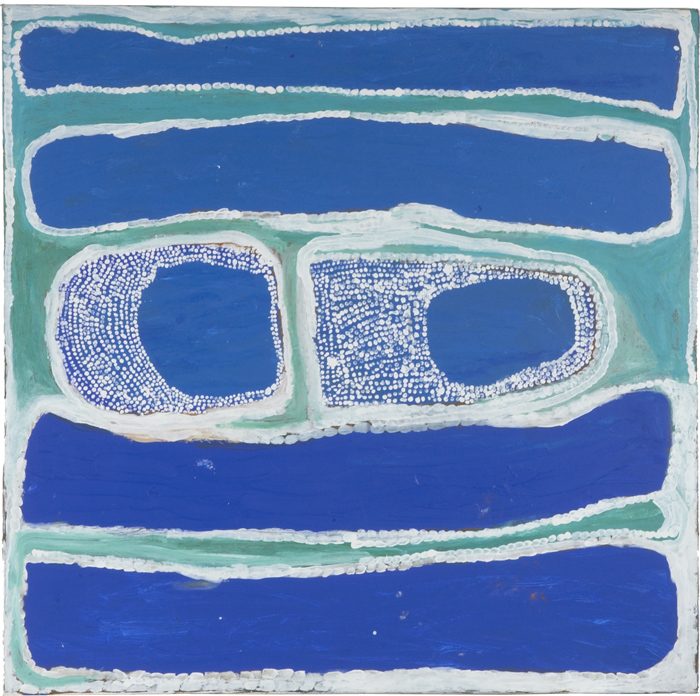
Wakartu Cory Surprise
Following their initial migration during the first half of last century, from their desert lands to the station country in the north, the desert people moved again in the late 1960s. The introduction of equal pay laws brought about movement away from pastoral stations and into town.
December 26, 2007
Nihil Unbound: Enlightenment and Extinction
Much contemporary philosophy seeks to stave off the 'threat' of nihilism by safeguarding the experience of meaning - characterized as the defining feature of human existence - from the Enlightenment logic of disenchantment. In the first chapter of his Nihil Unbound Enlightenment and Extinction Ray Brassier, explores this dialectic in terms of Wilfred Sellars manifest and scientific image, as we saw in this earlier post Brassier says that:
It should come as no surprise then that the manifest image continues to provide the fundamental framework within which much contemporary philosophizing is carried out. It encompasses not only ‘the major schools of contemporary Continental thought’ – by which Sellars, writing at the beginning of the 1960s, presumably meant phenomenology and existentialism, to which we should add critical theory, hermeneutics, and post-structuralism – but also ‘the trends of contemporary British and American philosophy which emphasize the analysis of “common sense” and “ordinary usage” For all these philosophies can be fruitfully construed as more or less adequate accounts of the manifest image of man-in-the-world, which accounts are then taken to be an adequate and full description in general terms of what man and the world really are’ (Sellars 1963a: 8). Despite their otherwise intractable differences, what all these philosophies share is a more or ess profound hostility to the idea that the scientific image describes 'what there really is’
Well, that is how I've always understood it. I've stood on the ground of the manifest image against scientific reductionism and eliminative materialism. Brassier says that nihilism is ... the unavoidable corollary of the realist conviction that there is a mind-independent reality which ... is indifferent to our existence and oblivious to the ‘values’ and ‘meanings’ which we would drape over it in order to make it more hospitable.”By “nihilism” Brassier means a reality shorn of sentimental opiates. For him, healthy philosophy must confront the fact of an oblivious universe without blinking.
Brassier observes:
Thus, although they are the totems of two otherwise divergent philosophical traditions, the two ‘canonical’ twentieth-century philosophers, Heidegger and Wittgenstein, share the conviction that the manifest image enjoys a philosophical privilege vis-à-vis the scientific image, and that the sorts of entities and processes postulated by scientific theory are in some way founded upon, or derivative of, our more ‘originary’, pre-scientific understanding, whether this be construed in terms of our ‘being-in-the-world’, or our practical engagement in ‘language-games’.
Rightly so. Brassier says that the manifest image crowd view the scientific image in terms of the instrumentalization of the scientific image. Heidegger? I thought that he would have argued an ontological thesis, not an instrumental one. I would argue the ontological thesis. Brassier says that:
Sellars adamantly refused this instrumentalization of the scientific image...even if the scientific image remains methodologically dependent upon the manifest image, this in no way undermines its substantive autonomy vis-à-vis the latter....Sellars [insisted] that philosophy should resist attempts to subsume the scientific image within the manifest image. At the same time, Sellars enjoined philosophers to abstain from the opposite temptation, which would consist in trying to supplant the manifest image with the scientific one. For Sellars, this cannot be an option, since it would entail depriving ourselves of what makes us human.
So we have two competing ontologtical images.
December 25, 2007
Xmas Day
An Xmas post:
 Gary Sauer-Thompson, Stain glass window, Block Arcade, Melbourne, 2007
Enjoy.
December 24, 2007
Minnie Pwerle: Awelye Atnwengerrp series
MInnie Pwerle's Awelye-Atnwengerrp paintings developed from her experience as a ritual body-painter, resembling as they do the patterns and designs used in these ceremonies, which vary depending on their subject and the season, and the seniority of the women.
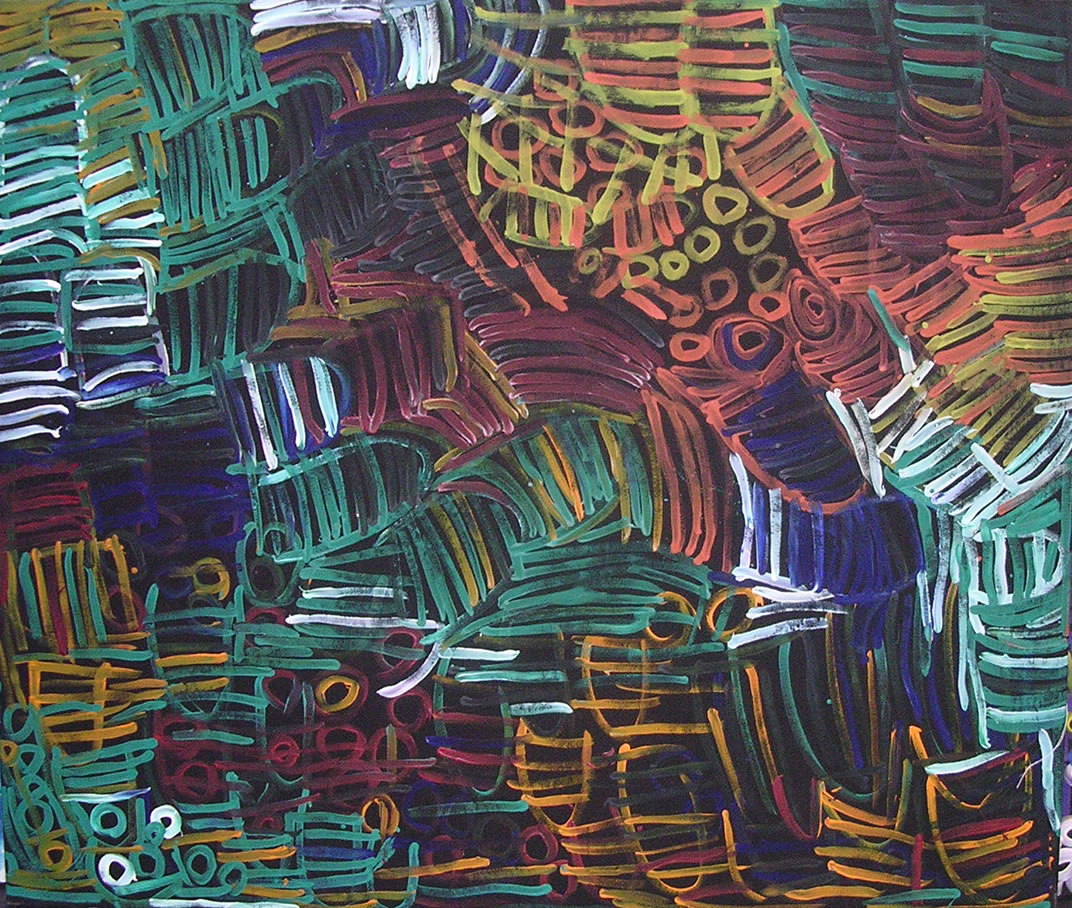 MInnie Pwerle, Untitled, Awelye Atnwengerrp series
In the ceremonial designs a variety of powders ground from charcoal and yellow and red ochres are finger-painted on the breasts and upper bodies of the singers and dancers. The paintings show lines of varying lengths and widths, and a variety of colours is used to build up these Dreamings.
Pwerle's’ more recent works have drawn comparisons to Emily Knwarreye’s "Wild Yam Stories" painted in the mid 1990’s. Eclectic in nature, her work seems to combine modernism, contemporary theory, impressionism and Aboriginality while also expressing a story of her own sacred dreamings. Her combination of historical visual styles and spiritual content promote a sense of unity amongst two vary different spheres of influence.
December 23, 2007
Sellar's manifest image
I was going through my files the other day and I cam across a reference to Wilfred Sellars ‘Philosophy and the Scientific Image of Man’, where he proposes compelling diagnosis of the predicament of contemporary philosophy that made a lot of sense to me. It is described thus by Ray Brassier in Nihil Unbound: Enlightenment and Extinction:
The contemporary philosopher is confronted by two competing ‘images’ of man in the world: on the one hand, the manifest image of man as he has conceived of himself up until now with the aid of philosophical eflection; on the other, the relatively recent but continually expanding scientific image of man as a ‘complex physical system’... one which is conspicuously unlike the manifest image, but which can
be distilled from various scientific discourses, including physics, neurophysiology, evolutionary biology, and, more recently, cognitive science. But for Sellars, the contrast between the manifest and the scientific image is not to be construed in terms of a conflict between naive common sense and sophisticated theoretical reason. The manifest image is not the domain of pre-theoretical immediacy. On the contrary, it is itself a subtle theoretical construct, a disciplined and critical ‘refinement or sophistication’ of the originary framework in terms of which man first encountered himself as a being capable of conceptual thought, in contradistinction to creatures who lack this capacity.
for Sellars, the fundamental import of the manifest image is not so much ontological as normative. The manifest image does not so much catalogue a set of indispensable ontological items which we should strive to preserve from scientific reduction; rather, it indexes the community of rational agents.Sellars maintains, the manifest image provides the ineluctable prerequisite for our capacity to identify ourselves as human, which is to say, as persons.
December 20, 2007
An Xmas card
This was the image that I used for my electronic Xmas card:

Gary Sauer-Thompson, Block Arcade, Melbourne, 2007
Seasons greetings everyone.
December 19, 2007
self -transformation
This review by Ladelle McWhorter of Cressida J. Heyes' Self-Transformations: Foucault, Ethics, and Normalized Bodies, is interesting in the way that it addresses the set of bodily practices that are increasingly common in North America: sex reassignment surgeries and related sex-transformational regimes, dieting for the purpose of weight-loss, and cosmetic surgeries such as face-lift, liposuction, gastric bypass, and rhinoplasty. Ladelle McWhorter says that the central issue of Heyes' text:
is not whether these various techniques for altering the human body are repressive or, on the contrary, self-expressive; the central issue is not whether feminists should endorse these practices or condemn them and have them outlawed. In this book, detached moral judgment is displaced, and a different kind of ethical discourse comes to the fore. Heyes is concerned about normalization and the foreclosure of freedom it portends, and she is clear and adamant that these practices are normalizing, sometimes in the extreme. But as a student of Foucault she rejects both a sovereign account of selfhood and the notion that power is external to selves and primarily prohibitive, and thus she resists the feminist temptation to see trans men and women, recidivist dieters, and candidates for cosmetic surgery as mere dupes or victims of the normalizing sexist ideologies and institutions that they at times recite and inhabit.
Heyes argues that if we set those two pictures----ie., a sovereign account of selfhood and the notion that power is external to selves and primarily prohibitive aside- ---it becomes possible to see occurrences of freedom and possibilities for imaginative alternatives even within very rigid regimes of gender normalization.
Heyes thinks that Foucault's genealogical work helps us to do this. According to McWhorter's interpretation:
Normalizing power produces, as Foucault tells us; it produces capacities as well as timidity and obedience. Thus the subjects of normalizing disciplinary practices really are empowered at the same time that they are disempowered. They become subjects, and agents, within these practices, and the failures they may well lament are also moments of excess in relation to the norms and rules that feminist critics of those practices might find lamentable. The self caught up in networks of gender normalization is not, or at least not merely, a victim without hope of extrication.
December 18, 2007
dialectics of enlightenment and romanticism
Peter Murphy and David Roberts' Dialectic of Romanticism both refer to Horkheimer and Adorno's Dialectic of Enlightenment, and challenge stheir vision of the trajectory of the West from Greek beginnings to totalitarian conclusions and what they see as a one-dimensional equation of enlightenment and myth. In contrast, they argue that romanticism and enlightenment have proved fatal genies in modernity during the Long 19th Century from the French Revolution to the Nazis.
In this review of Dialectic of Romanticism in Continuum Robert Savage says:
The dialectics of enlightenment and romanticism were both triggered by the historicist self-understanding of modernity, with its chronic awareness of man's pre- or deformation through cultural factors over which he has no immediate control. Together, enlightenment and romanticism make up the divided unity of [European] modernism (a modernism which, in this account, extends to its various postmodern recensions). Whereas enlightenment rationalism has as its goal the liberation of man from the contingencies of birth and custom, romanticism responds by calling for a return to nature. Regardless of how such a return may be construed in individual cases as the descent to the chthonian realm of the Earth Mother (Bachofen, Baeumler), as the remembrance of nature in the subject (Horkheimer/ Adorno), as the repetitive recuperation of the original event of Being (Heidegger) the split between nature and spirit is in each case to be overcome through their reunion in a new mythology founded upon the free interplay of the rational and creative faculties.
Murphy and Roberts are critical of this project. Fair enough. I'm troubled by it myself.
They say:
Enlightenment autonomy is always threatened by the immanent contradiction of denaturalization: the reversal of freedom into unfreedom (the perpetuation of the blindness of nature); romantic incarnation is always threatened by the immanent contradiction of renaturalization: the reversal of the spiritualization of nature into the naturalization of spirit, of creative into destructive nature. Each bears witness to the failed internal dialogue of modernity
A difficult and turgid passage for sure.
December 17, 2007
artificial intelligence + everyday life
A good question about the effects of technology on our everyday life is raised by Cory Silverberg in this interview with David Levy, author of Robots Unlimited (Life In A Virtual Age), an accessible history of artificial intelligence (AI). Silverberg says:
.....rather than enhancing a social experience (such as sex), technology will allow us as humans to avoid evolving socially by using technology to mimic social interaction rather than add to it. Currently the biggest problem for people who are socially marginalized (which is what I’m assuming you meant by “misfit”) is not that they aren’t able to have sex, or make meaningful connections with others, it’s that our society functions in a way to systemically keep them isolated. As the disability activist and academic Tom Shakespeare says "the trouble is not how can we have sex, it's who can we have sex with". And while there is no doubt that people who are socially marginalized want to have casual rollicking sex, just as often they report that what they long for is the intimacy, human contact, and human connections, that come with sexual intimacy and exploration. If these robots are intended in any way to increase the opportunity and potential of human sexuality, using them in this way would be seriously counterproductive.
I'm not sure that it is as black and white as Silverberg makes out. The prospect of human-robot love is certainly not implausible. But Silverberg does express the way in which many people are threatened by the possibilities of human robot sexual interactions.
Levy's response opens up the conversation into interesting areas:
If you mean that providing robots to satisfy needs that the socially marginalized would prefer to be satisfied by humans, will make it less likely that the socially marginalized will want or be able to find suitable human partners, then you might be right, but I would still argue that the benefits to the socially marginalized far outweigh the negatives. Tom Shakespeare's words ring true - the socially marginalized do experience much more difficulty than others in finding human contact, intimacy and sex.... I feel that the validity of your "counterproductive" argument, if I understand it correctly, assumes that the socially marginalized can indeed find intimacy and sex when they need it, in which case they will not need to employ robots for these purposes. If that is so, then all well and good. But my point is simply that there are groups in society who do find it extremely difficult, almost impossible, to mate with partners who will love them and satisfy their emotional and sexual needs on a long-term basis. In many ways robots represent a very good way out of this problem, just as the Japanese and American governments are now looking at the possibility of using robots as carers for the elderly.
December 15, 2007
The Atrocity Exhibition
In the entry on J.G. Ballard's in The Atrocity Exhibition in The Literary Encyclopedia Jeanne Baxter says that the text is littered with images from the media and consumer culture of the 1960s. We are overloaded with images of atrocity.
The link between Ballard and contemporary fashipon photography is made by K-Punk in this guest post at Ballardian.com that grew out of the now defunct Sleepy Brain Magazine. Both are the work of Simon Sellars.

Steven Meisel, State of Emergency, 2006
The setting is unmistakably an airport customs station. Two officers flank the glamorous model, doing more than usual their surveillance. An everyday banal scene except for the public strip.

Steven Meisel, State of Emergency, 2006
We watch them strip searching her. Security is dominant, the model submissive. Fashion’s surface obsession with beauty and glamour is simultaneously a form of cultural critique.

Steven Meisel, State of Emergency, 2006
December 14, 2007
transgression
The Cold War period in Australian history was an age of taboo and trans-gression. The transgressive individual became equated with the communist who threatened to destroy Australia from within and bring about the destruction of the planet through nuclear war.
The McCarthyist witch-hunt for communists in the US encompassed those "suspected of violating mainstream sex or gender roles". Transgression itself, and specifically sexual transgression, became linked with communism in popular perceptions and hence became conjoined with the threat of apocalypse. As taboos were emphasized more and more in 1950s America, the allure of transgression was heightened. The horror film expressed the interplay between taboo and transgression.
Bataille's understanding of taboo and transgression does not posit transgression as an act that undermines taboo.--transgression never represents a simple subversion of the dominant order. Transgression does not 'subvert' the taboo: it completes and reinforces it.
December 13, 2007
Returning to Franz Kline
I just love the simplicity of Franz Kline. It reminds me so much of marks on walls of our cities. I can now see why Aaron Siskind responded so strongly to Klines work when he pointed out that the world was filled with ordinary materials and shapes that could be artistically rendered.
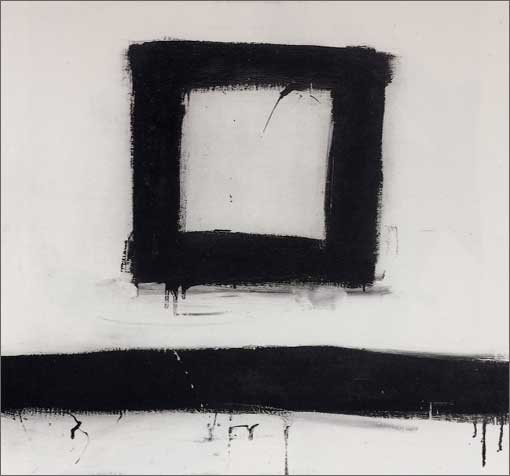
Franz Kline, Suspended, 1953, Oil on canvas \
His was a unique style, using large brushstrokes to create bold black and white patterned paintings. He did not begin using color in his paintings until late in his life but always preferred black and white.