October 27, 2008
public spaces
In New Urban topologies: The Desire for Public Place in the Age of Virtual Geography in Drain Michael Jenson says that in the history of urban center in the west, the public "square" and "street" have been the predominant locations of participation in the life of the polis. Historically, this has been where political debates and conversations have taken place, domestic turmoil and celebrations have emerged, as well as the expression of unity that comes about when differing individuals begin to develop a common identity often reinforced by the aesthetic qualities and meaning associated with certain places, architecture, or urban forms.
A public space is often described in architecturally descriptive terms of an urban square where significant historical events might emerge:
"A similar idea is sometimes expressed with the more concrete phrase, Public Square, the place according to Bakhtin, where history is enacted. It stands in contrast to private spaces such as rooms, houses, and gardens, which are settings for the enactment of individual lives. The public square is a site of conflict, a heteroglossia where ‘the Nietzschean, the peasant or the student speak publicly as such.' This conjures up a useful image. Picture an open plaza overlooked by a regal balcony. In the plaza stand the people, for the moment listening; on the balcony stands the ruler, for the moment pronouncing. The people assembled in the square become public once they are able to debate among themselves and respond to the pronouncements of the state with rational protests and formal petitions."
There is a direct connection between public space and the formulation of civic life. Public spaces then, are settings for individuals to congregate and formulate civil organizations. They are places where people can meet to discuss their respective cultural merits and faults, pasts and futures as equal participants in the societal realm.
October 25, 2008
junkspace
Ian Buchanan in his Space in the Age of Non–place at Drain says that Marc Augé in La Traversée du Luxembourg makes the point that:
that jet travel has lightened our step on earth, we no longer dwell as heavily as we once did. We swim through places more than we dwell there and consequently a new type of social space has emerged whose precise purpose is to facilitate a frictionless passage - airports, train stations, bus terminals, fast food outlets, supermarkets and hotels. Because they do not confer a sense of place, Augé calls these places non-places.
The new space, which Rem Koolhaas aptly terms 'junk space' (the residue of capitalism), does not confer on us any sense of 'place'. It is space as mass-manufactured good:
"If space junk is the human debris that litters the universe, junkspace is the residue mankind leaves on the planet. The built (more about that later) product of modernization is not modern architecture but junkspace. Junkspace is what remains after modernization has run its course, or more precisely, what coagulates while modernization is in progress, its fallout. Modernization had a rational program: to share the blessings of science, universally. Junkspace is its apotheosis, or meltdown. ... Although its individual parts are the outcome of brilliant inventions, hypertechnical, lucidly planned by human intelligence, imagination, and infinite computation, their sum spells the end of Enlightenment, its resurrection as farce, a low-grade purgatory.
Junkspace is the logical result of a culture in which ‘shopping’ is the last public activity. All public institutions churches, museums, the internet, hospitals, universities and airports increasingly are drawn into this framework. He recognised economic and modernist-Utopian exhaustion as a condition of his own practice.
October 21, 2008
Benjamin today
One of Walter Benjamin’s main points in the introductory parts of The Arcades Project was that technology and techniques contribute to a restructuring of the human sensory system. He wanted to put forth that the forms of mediated reproduction which were emerging in the era of modern industrialism had an impact on the ways in which people organise their perception of the world around them. Benjamin illustrated his point by discussing how cars, trains and aeroplanes transform relations to physical space, as well as how new media such as photography and cinema reformulate previous conceptions of time and space.
Can we apply his concepts to an analysis of contemporary new media? Simon Lindgren in From Flâneur to Web Surfer: Videoblogging, Photo Sharing and Walter Benjamin @ the Web 2.0 in <Transformations explores how Benjamin’s analysis of the nineteenth century culture of consumption might contribute to an understanding of the new communal formations and self-reflexive subjectivities of the internet in the twenty-first century
October 20, 2008
Artifice and simulation
From Gilles Deleuze in The Logic of Sense:
The artificial is always a copy of a copy, which should be pushed to the point where it changes its nature and is reversed into the simulacrum (the moment of Pop Art). Artifice and simulation are opposed at the heart of modernity, at the point where modernity settles all its accounts, as two modes of destruction: the two nihilisms. For there is a vast difference between destroying in order to conserve and perpetuate the established order of representations, models, and copies, and destroying the models and copies in order to institute the chaos which creates, making the simulacra function and raising a phantasm - the most innocent of all destructions, the destruction of Platonism."
October 15, 2008
Benjamin, dreaming
Walter Benjamin argued that capitalism endowed objects with the means to express collective dreams. This drew him to particular urban architectural forms such as arcades, railway stations, department stores, and wax museums, which he called "dream houses of the collective." Whilst these structures embodied a world of mystifying enchantment, the historian could discern the unfulfilled hopes and desires of the collective. For Benjamin, the nineteenth century resulted in a sleep induced by capitalism, which, by implication, had led to the rise of fascism: "Capitalism was a natural phenomenon with which a new dream-filled sleep came over Europe, and, through it, a reactivation of mythical forces."
A work of history was vital in order to slay capitalism by waking the slumbering collective from its from its nineteenth-century dream The task of the historian thus became to use history as a "technique of awakening,"and this project, he wrote, "deals with awakening from the nineteenth century. Benjamin's project of awakening involved the "unconscious world of remembrance" in the form of dream experience.
October 14, 2008
Australian romanticism revisited
An earlier stab at defining Australian Romanticism, which I had previously explored here and here on junk for code. The assumption in our artistic culture is that Romanticism has been superseded by modernism and that Australian modernity has transcended Romanticism.
What then of place? The environment, the natural world, the landscape or even the flora and fauna peculiar to this continent feature prominently among the subjects of Australian romanticism in our visual culture. The argument here is that the emphasis on themes of 'landscape', 'environment' and ‘place’, is part of the inheritance of Australian artists that has been handed down from their romantic forebears in Europe; an emphasis that rejects nature as framed by utility and the technological domination of nature.
This mode of thinking has been deemed to be inadequate for several reasons: romanticism does not simply involve a veneration of nature; nor does it necessarily privilege the natural world as a subject for artistic inquiry; and, finally, the influence of romanticism on Australian visual culture is far from clear-cut. It could be argued that ‘romanticism’ failed to take root in Australia because of the perceived hostility of the natural environment in the antipodes.
So argues Andrew Johnson here. He adds:
Romanticism is not a singular phenomenon. The word ‘nature’ can also be understood in many different ways: is ‘nature’ the animals, trees and plants (including human beings) or, more widely, the totality of animate and inanimate things, or is it just that which is opposite to ‘culture’ and all that humankind has made?
True, the influence of romanticism in Australia is neither direct nor simple as there is a history of alienation from the natural world felt by the colonists when they were establishing settler capitalism by dispossessing the indigenous people in the name of utility.
Johnson says that Paul Kane in Australian Poetry: Romanticism and Negativity, (Cambridge University Press, Cambridge 1996) argues that the problematic experience of nature in Australia could as easily have increased the need for a romantic ‘transvaluation’ of nature: an act of imagination powerful enough to overcome the alienation from the natural world felt by the colonists and first poets, hence a native romanticism. The fact that no such transvaluation occurred, in turn, should not be blamed on the supposed ‘failure of nature’ but on a ‘failure of imagination’. Johnson says that is is necessary to clarify this point.
It is not to say that the relationship between humans and nature in Australia has not been a troubled one — one in which nature has come off second best due to human failures to respect or even recognise what is distinctive about the environment of the continent. Salinity and the continuing destruction of native habitat and species are potent reminders of that fact. Neither is it to say that the country’s poets have struggled to respond adequately to the Australian environment because they do not have any examples of a response to nature or, specifically, the manifestation of ‘nature’ peculiar to the Australian continent to follow, and therefore have no ‘language’ in which to respond to it themselves. What it does suggest is that both past and contemporary poets have had, first and foremost, to deal with the fact that they do not have a native, original tradition of poetry against which to set themselves or test their strength. In this way, the original absence of romanticism, or the failure of imaginative strength in Australian poetry, has nevertheless determined the way poets in Australia have written about nature. While the perceived otherness of nature, the sense of alienation from nature experienced by the first Europeans in Australia, did not of itself necessarily hinder the development of a romantic tradition of poetry in Australia, the absence of such a tradition has certainly influenced the way nature appears, and has been figured in Australian poetry.
Romanticism did not take place in Australia-- it is absent-- and this absence magnified its effects ideologically (and hence aesthetically) appears to be the argument. The tradition is appears to be one that holds that Romanticism failed to appear in Australia during the ‘Romantic period’, precisely because the nation was founded largely as a capitalist enterprise: there never was a completely pre-modern Australian ‘folk’ . Not did Australia have a delayed romanticism, as in the late efflorescence of Transcendentalism in the United States from the 1830s into the 1850s ... In Australia, romanticism simply did not happen.
What then of the emphasis on the development of Australian culture in the Australian radical nationalist tradition, with its sense of Australia’s unique history and culture, and the 1960's concern to conserve the environment from economic development? Doesn't a romantic current run through here? What of romanticism as a critical philosophy: a critique of a damaging instrumental rationality and a narrow conception of ‘reason’ based upon the natural sciences was an urgent task? This is an alternative conception to Romanticism as a historical period in which the longing that "haunted” the Romantic “critique of the world” was “for the lost unity of man [sic] and nature,a yearning for the middle ages, primitive man (or, what could amount to the same thing the ‘folk’), and the French Revolution.This conception of romanticism is a rejection of an enlightened capitalist modernity, rather than an anti-capitalist protest within liberal capitalist modernity.
Johnson accepts Kane's argument and goes on to say that the argument reveals at least one major reason for the perpetual habit that Australian poets and critics have of orienting their work in relation to the environment. In Australia the romantic tendency to confuse nature and imagination has manifested itself as conflation of issues of national and cultural identity and issues of environment.
When a poet writes about the unique qualities of the natural world in Australia, it may be that they have in mind quite a different project than discovering an authentic response to the Australian environment or of finding a more natural and sustainable way to live in this part of the world.Instead, their project is to establish an original Australian poetics, or to distinguish their own work from the rest of the poetry written in English in the past and in the rest of the world. Australian flora, fauna and landscape have thus frequently been employed as figures in the search for imaginative originality
Australian flora, fauna and landscape have thus frequently been employed as figures in the search for imaginative originality--and this confuses questions of poetry and cultural identity with questions of nature and environment.
Maybe. But the alternative interpretation as a critique of instrumental rationality and its linear conception of progress would recover the surrealist emphasis on the dream as the ‘royal road to the unconscious’ and not as a ‘one-way street’ back to the archaic mists of time that had been radically displaced. As Michael Calderbank argues our reality is suffused by a dream----eg., the Paris arcades as a dream-world of banal and outmoded forms of capitalist consumption--in which we are fully immersed. The ‘dream’ is both a historically specific modality of experience on the one hand, and on the other, the ‘dream’ can conceived of on the hermeneutic level as textual object, a critical resource waiting to be interpreted as a guide to future experience.
The dream for Walter Benjamin discloses powerful utopian desires and wish images of mass culture. The dream was only interpretable, only capable of sundering its meaning, if its façade of unity was broken down into discrete fragments. The interpreter of the dream can make a meaningful reconstruction of the fragments at that moment when the consciousness is shocked into the recognition of possible forms of cognitive experience from which it is excluded in reality. The assumption here is that progress is not a gradual, seamless, linear continuum, but instead proceeds unevenly in jolts, leaps and unexpected reversals.
October 10, 2008
Henry Jenkins on Web 2.0
In this Media Report on ABC Radio National Henry Jenkins, the Director of the Comparative Media Studies Program at MIT, the Massachusetts Institute of Technology, says that the fact that web 2.0 has taken office quickly as it has, is a product of the fact that there are a large number of communities aren't in place that have been fighting for a long time to get to this point. They are part of a much larger history of people's desire to take media in their own hands and to produce content that reflect their own perspective, their own experience.
He adds about YouTube:
what's striking about YouTube is that it is a shared portal where all of these groups come together. Even as recently as a decade ago, people were predicting that online video would result in millions of individualised networks, small networks where people distributed video. No-one predicted I think that it would be the shared portal, that all these groups would come together. And as they come together, they're learning from each other: ideas cross pollinate across these various sub-cultures, educational groups, activist groups, citizen journalist, governmental groups are all learning from each other, they're beginning to collaborate with each other, and the result is a much more integrated public sphere through the communication and video than I think we saw before. But any given group has its own history leading up to that, and many of those groups have had to make conscious decisions about whether they want to use YouTube as a platform or not. And that's not an easy decision for some of these groups, given their histories.
So groups are consciously deciding to go to YouTube or not, whereas from the outside it looks like YouTube is just spontaneously creating all of this amateur content that came from no place. So we lose track of the history and the decisions and the struggles and the debates people are having right now about whether that platform is one that they want to use for their community or not.
October 8, 2008
photography + modernism
In On the Museum's Ruins Douglas Crimp argues that that the acceptance of photography as a significant expressive medium in art "foreclosed" or at least disrupted the discourse of modernism in the art world. "Art world" is used in the sense of Arthur C. Danto: the network of artists, collectors, dealers, curators, historians, foundation officers, and critics which constitutes the material and intellectual circuit of art valuation, exchange, interpretation, and patronage. The modernist fetishism of art had to a large extent, transformed photography from a subversive element within modernism to yet another avant-garde stage in modernism's progress.
However, the appearance of photographs and photomechanically-produced media in the art world interrupted modernism's discourse on originality and the irreducibility--the aura--of the unique object, forming a fault line along which the sensibility called postmodernism began to coalesce. One site of this rupture is Robert Rauschenberg's photographic reproductions Jeffrey Abt paraphrasing Crimp's argument says:
By juxtaposing those flat, monochrome photomechanical images alongside, covered by, or printed over vividly expressionistic brush strokes of paint, Rauschenberg intensified awareness of what, in the discourse of modernism, constituted the essence of art as high culture: the texture and mass of paint deposited by the brush stroke, material evidence of the artist's hand--the artist's signature--in a work's creation. The tactile, worked media of art had become not only the preeminent signifier of the artist's presence in late nineteenth and twentieth century art theory, but also a foundation upon which the modernist epistemology of aura was in part erected. Moreover, by joining the photomechanical image and brush stroke on the same surface, Rauschenberg augured the use of photography as a counter-discourse to modernism. When the art world found in the photograph an artistic "there" there, despite the absence of the artist's hand-wrought mark, the discourse of modernism was breached.
The art world's, and specifically the museum's, valuation system, based as it is on a currency of aura, was suddenly destabilized.
Douglas Crimp argues with reference to Walter Benjamin: that:
Through reproductive technology, postmodernist art dispenses with the aura. The fiction of the creating subject gives way to the frank confiscation, quotation, excerptation, accumulation and repetition of already existing images. Notions of originality, authenticity and presence, essential to the ordered discourse of the museum, are undermined.
The new techniques of artistic production dissolve the museum's conceptual frameworks—constructed as they are on the fiction of subjective, individual creativity—bringing them into disarray through their re-productive practice and ultimately leading to the museum's ruin.
In his essay The Museum’s Old / The Library’s New Subject Crimp says:
For at a certain moment photography enters the practice of art in such a way that it contaminates the purity of modernism's separate categories, the categories of painting and sculpture. These categories are subsequently divested of their fictive autonomy, their idealism, and thus their power. The first positive instances of this contamination occurred in the early 1960s, when Rauschenberg and Warhol began to silkscreen photographic images onto their canvases.17 From that moment forward, the guarded autonomy of modernist art was under constant threat from the incursions of the real world that photography has read¬mitted to the purview of art. After over a century of art's imprisonment in the discourse of modernism and the institution of the museum, hermetically sealed off from the rest of culture and society, the art of postmodernism begins to make inroads back into the world. It is photography, in part, that makes this possible, while still guaranteeing against the compromising atavism of traditional realism.
Reproductive technologies allow post-modern art to dispense with the ‘aura’ of the artwork altogether, and so undermine values such as originality, authenticity and presence that are essential to the modernist discourse of the museum.
October 6, 2008
history as a collection of images
In the Pinnochio Theory Steven Shapiro says that:
In the Age of Aesthetics, when we say that something is “history,” we mean not to honor it (as might have been the case in other times and places) but to dismiss it as obsolete and irrelevant. We collect mementos of the past, but we do not take History seriously as a process, or a force, or a source of meaning. It is nothing more than a collection of arbitrary styles. This is the situation that Jameson decries when he describes our world as “a society bereft of all historicity,” in which the collective past has become nothing more than “a vast collection of images, a multitudinous photographic simulacrum.”
We understand history as a vast database of “information.” We haven’t lost the past, so much as we have discarded a particular way of contextualizing and narrating it:
We have replaced the old-style, Hegelian logic of history with the (idealized) logic of the market, celebrated by Hayek as a superhuman, cybernetic information-processing mechanism. The past is available to us as a conglomeration of items among which we can pick and choose, and buy, according to our individual “preferences.” The market mechanism defines our possibilities in the present, and colonizes our hopes and dreams for the future; so it’s scarcely surprising that it remakes the past in its own image as well.
We view history in a flattened, reified way, as a collection of images-as-commodities.
Bill Henson, teenage sexuality and representation
In Innocence defiled, again? The art of Bill Henson and the welfare of children in the Australian Review of Public Affairs Kylie Valentine says that the debate over Bill Henson's photography and child sexuality has largely been cast as a debate about whether Henson produced art or pornography.
Aside from a brief interview with Henson himself, published on the day of the police raid ... there has been very little discussion about adolescent sexuality, about the representation of sexuality, and about the agency of children and young people in negotiating both sexuality and representation. The welfare of children is either defended by those decrying the Henson exhibition, or dismissed as irrelevant to the issue. The debate has largely been between adults over the values that adults should hold in protecting children and viewing art. Children and young people themselves have been almost entirely absent.
She says that this exclusion of children and young people from the Henson debate is not really surprising: there is a tradition of treating children as both incapable of contributing to the public arena and in need of protection from its dangers. Yet there is also an emerging body of work that argues children are both more capable and more rational than is often assumed. Many also argue that children are entitled to greater participation than they are currently allowed in decisions that affect them.
October 2, 2008
Emily Kame Kngwarreye
There is an exhibition of Emily Kame Kngwarreye's work (from 1988 until her death in late 1996) at the National Museum in Canberra. it was shown at The National Art Center, Tokyo in May/July 2008
Kngwarreye lacked any training or exposure to Western art yet her paintings transcend the categorization of 'ethnic' or primitive art. Art critics have identified similarities between Kngwarreye's works--her fields of dots, undulating stripes and multi-hued slabs of color--and those of major late 20th-century Western abstract expressionist artists such as Jackson Pollock, Mark Rothko and Willem de Kooning.
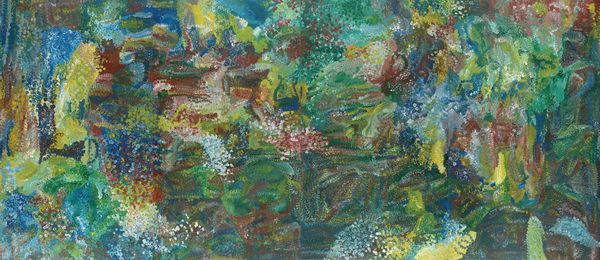 Emily Kame Kngwarreye, Earth's Creation,1994, synthetic polymer paint on canvas. 4 panels,
Earth's Creation measures g 2.7 metres high and 6.3 metres wide in total. The profuse dotting, linear patterns and swirls of colour are a celebration of her Country, Alhalkere. The work was created in the 'green time' that occurs after the rains: the verdant green of fresh, thick vegetation, making the earth seem to surge with life.