September 30, 2008
the baroque as an aesthetics
Monika Kaup in her The Neobaroque in Djuna Barnes in Modernism/Modernity says that Michel Foucault argued in The Order of Things, that the episteme of modernity was first articulated in the seventeenth-century baroque. Foucault writes:
At the beginning of the seventeenth century during the period that has been termed, rightly or wrongly, the baroque, thought ceases to move in the element of resemblance.
Kaup says that according to Foucault, the Baroque was a transitional period, which saw the first articulation of modernity, and contained the emergent elements of what would become Enlightenment rationalism as well as the residual, premodern knowledge that was losing authority. If placed under the optic of Foucault's theory of the baroque as the expression of an epochal and epistemic threshold, the characteristic disharmonies of baroque representation enumerated in formalist morphologies of the baroque such as Woelfflin's are historicized and validated at the same time.
The twentieth-century recuperation of baroque representation, therefore, is not a nostalgic gesture towards lost premodern unities and beliefs, but the opposite, a critical genealogy of modernity whereby the very principles of modern knowledge and representation are subjected to a deconstructive transformation.
Well-known topoi of baroque theorizing, such as the yoking of opposites within fragmented, unbalanced, and open wholes (coincidentia oppositorum); movement; and the impulse to break up static forms and transgress boundaries, all resonate with the epistemic break posited by Foucault. The content of baroque form grapples with the crisis of modernity in an ambivalent way, which can be characterized by the inclusive logic of both/and, rather than the dualistic logic of either/or.
Kaup says that Foucault's case for the baroque as an alternate modernity is stated even more urgently by Gilles Deleuze in his 1988 study of seventeenth-century philosopher Gottfried Leibniz. For Deleuze, the baroque offers a unique response to the modern problem of the loss of traditional principles and beliefs. According to Deleuze, Leibniz's philosophy represents an alternate rationality because his thinking enacts the multiplication, rather than the reduction, of principles—in contrast to systematic Enlightenment rationality.
September 29, 2008
Adorno's turn to aesthetics
Adorno's turn to aesthetics has been criticized for appealing to aesthetics rather than politics for an emancipatory model. Adorno argued that modern art emphasizes difference and intimates a possible future based on non-instrumental rationality. It emphasizes difference in its refusal to subsume the particular under the universal, and it intimates an emancipatory future insofar as it "speaks a language of insubordination" in the face of the hegemony of enlightenment rationality.
In order to explore the emancipatory potential of modern art, Adorno turns to Kant, whose Critique of Judgment provides him with critical tools for exploring aesthetic rationality.The text states that:
What Adorno finds most appealing about Kant is that his aesthetics insists upon reflective judgment, which, as opposed to determinant judgment, does not give a universal under which a particular might fall. Instead, the universal arises out of the particulars, which proclaim the truth of universality of the bureaucratized world. Art, when it gets to this universal moment, tells the truth about society. The best works bring to light the hidden irrationality of a seemingly rational world.
This provides Adorno with a way to explore and challenge the dominant forms of rationality in modernity.
September 20, 2008
Lessig's The Future of Ideas
Lawrence Lessig's The Future of Ideas. In the Preface Lessig argues that we are far enough along to see:
the future we have chosen with respect to the Internet. In that future, the counterrevolution prevails. The forces that the original Internet threatened to transform are well on their way to transforming the Internet. Through changes in the architecture that defined the original network, as well as changes in the legal environment within which that network lives, the future that promised great freedom and innovation will not be ours. The future that threatened the reemergence of almost perfect control will.
He adds that he doesn't mean the control of George Orwell’s 1984 --the struggle is not between free speech and censorship, or between democracy and totalitarianism.
The freedom that is my focus here is the creativity and innovation that marked the early Internet. This is the freedom that fueled the greatest technological revolution that our culture has seen since the Industrial Revolution. This is the freedom that promised a world of creativity different from the past.This freedom has been lost. With scarcely anyone even noticing, the network that gave birth to the innovation of the 1990s has been remade from under us; the legal environment surrounding that network has been importantlychanged, too. And the result of these two changes together will be an environment of innovation fundamentally different from what it was, or promised to be.
The story he tells is about how an environment designed to enable the new is being transformed to protect the old The new is the way that Digital technology enables an extraordinary range of ordinary people to become part of a creative process. The new is moving from the life of a “consumer” (passive, couch potato, fed) of music film, and art, and commerce to a life where one can individually and collectively participate in making something new. It's a world of rip, mix, burn.
The old is the future we are currently taking .
Take the Net, mixit with the fanciest TV, add a simple way to buy things, and that’s pretty much it. It is a future much like the present... the forging of an estate of large-scale networks with power over users to an estate dedicated to almost perfect control over content. That content will not be “broadcast” to millions at the same time; it will be fed to users as users demand it, packaged in advertising precisely tailored to the user. But the freedom to feed back, to feed creativity to others, will be just about as constrained as it is today. These constraints are not the constraints of economics as it exists today—not the high costs of production or the extraordinarily high costs of distribution. These constraints instead will be burdens created by law—by intellectual property as well as other government-granted exclusive rights.
The promise of many-to-many communication that defined the early Internet will be replaced by a reality of many, many ways to buy things and many, many ways to select among what is offered. What gets offered
will be just what fits within the current model of the concentrated systems of distribution: cable television on speed, addicting a much more manageable,malleable, and sellable public.
September 17, 2008
Joel Sternfeld: American Prospect
From American Prospect by Joel Sternfeld:
 Joel Sternfeld, Phoenix Arizona, from American Prospect, Digital C Print colour negative
The landmark book was first published in 1987 and it was a photographic tour of America made by large format color "street" work. Sternfeld’s text represented a break with painterly notions of the Picturesque and the Sublime; his image is flat, average and are not meant to be metaphoric equivalents of anything else. Nor are they mirrors on reality as the presence of the author is strong, as is the interpretation of the landscape.
September 15, 2008
produsage
A lot of the commentary on blogging and its forms ignores the reality of Web 2.0 and the emergence of produsers. The commentary is bounded by the old industrial forms of production and consumption.
Axel Bruns in his paper The Future Is User-Led: The Path towards Widespread Produsage explores the shift signified by Web 2.0 and produser. He says that:
In the emerging social software, ‘Web2.0’ environment, the production of ideas takes place in a collaborative, participatory mode which breaks down the boundaries between producers and consumers and instead enables all participants to be users as much as producers of information and knowledge, or what can be described as produsers. These produsers engage not in a traditional form of content production, but are instead involved in produsage – the collaborative and continuous building and extending of existing content in pursuit of further improvement. abilities, and above all the interest and enthusiasm to use them.
Web2.0 describes the technological framework for a notable shift from static to dynamic content, from hierarchically managed to collaboratively and continuously developed material, and from user-as-consumer to user-as-contributor.
Bruns illustrates withe example of Wikipedia:
In this model, control over content rests squarely with the producers: they decide upon the nature of the content itself, including any changes or updates from previous versions of the encyclopaedia, and upon its packaging as a complete product – that is, the definition of discrete (annual, full, condensed) versions of the product, the timing of version releases, and the nature of the content creation model of Wikipedia differs in a number of significant areas from the traditional, industrial-age model of production and distribution adhered to by traditional encyclopaedias. To begin with, the role of the distributor has disappeared altogether – the Web and its underlying carrier medium, the Internet, perform this function now. But more importantly, the producer as a distinct category and agent in the value chain has also been transformed – users themselves are now also potentially producers of content in this encyclopaedia (which is why we will soon describe this as a hybrid produser role), and the value chain as experienced by each user has been condensed to a single point ...which connects with the experiences of the other participants in the Wikipedia to form a network of collaborative content creation.
September 13, 2008
Damien Hirst
Hirst makes art exciting.
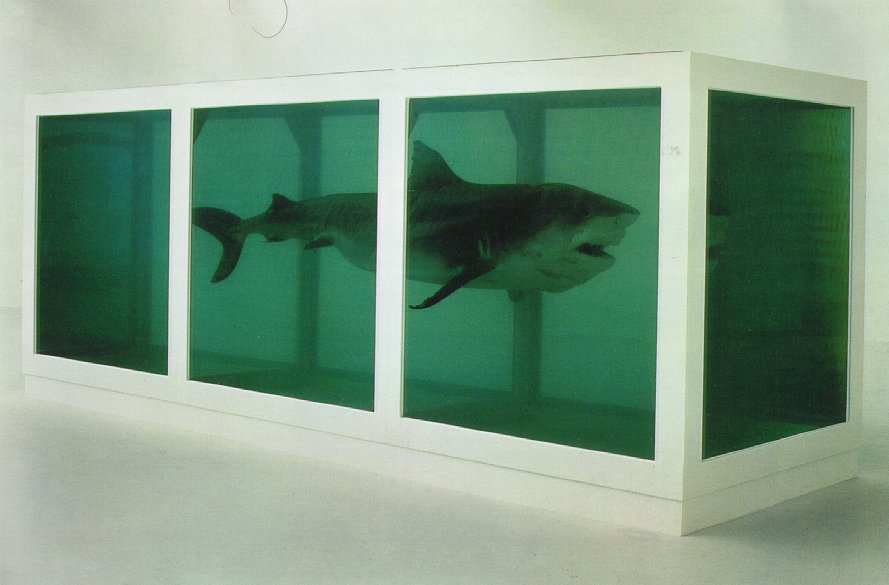 Damien Hirst, The Physical Impossibility of Death in the Mind of Someone Living, 1991, Tiger shark, glass, steel, 5% formaldehyde solution
September 11, 2008
Bernard Smith on modernism
In The Formalesque: A Guide to Modern Art and its History, Bernard Smith coins 'the Formalesque' for what is still described as 'Modernism'. Smith wrote that the history of 20th-century visual arts could no longer be written as a succession of avant-garde movements. Modern art was no longer modern. It was old. Smith argued that a return to the concept of period style was inevitable. Modernism - the dominant 'style' of art that emerged between the end of the 19th century and which continued until the 1960s should be recognised as a period style, like 'romanesque' or 'arabesque'. Smith says:
I have written this book as a critical introduction to the study of 20th-century art which is still described as 'Modernism'. But the word cannot be used to describe the art of the 20th century forever, for it is now a part of the past. So, is it not better to agree that it is now part of our past, wiser to take a distanced view rather than see it as continuous with the art of our own time? If we do that it should be possible to view it as a period style emerging around 1890 which dominated art in its practice, theory and history, until the 1970s. As the dominance of what we still call Modernism began to decline over thirty years ago, isn't it a bit absurd to persist in calling it Modernism? So I have coined the word Formalesque as a better name for it, as one might refer to the Gothic or the Baroque.
Smith stresses that it was the dominance of the Formalesque that declined in the 1970s, not the style itself, as artists continue to work within its ambience today. Smith proposed that "modernism" (the formalesque) began its life between 1890 and the First World War, was nourished between the wars, and consolidated itself between 1945 and 1960.
September 10, 2008
Cunningham on the humanities + Innovation
Stuart Cunningham's The humanities, creative arts and the innovation agenda is about the place of the humanities in the innovation regime of the knowledge economy. That regime is one where research turns money into ideas, and innovation turns ideas back into money. In the equation of a Canberra bureaucracy and politicians, if you didn't have enough of the money coming back, you couldn't be expecting more and more money to be going into the research.
Cunningham says that:
the broad context is the relation of the humanities and creative arts to the innovation agenda and the knowledge economy. It is about the humanities and the creative arts, a crucial but little thought-through connection that is assuming centre stage for reasons that are the burden of this paper but also, and relatedly, because of the growth and integration of creative arts courses and staff into the university system over the last decade...
The new macro-focus on the knowledge-based economy and innovation policies has been around in some form or other for a long time, certainly since the information society discussions of the 1950s ...But the shorter term influence is raceable to new growth theory in economics which has pointed to the limitations for wealth creation of only micro-economic efficiency gains and liberalisation strategies.
Governments are now attempting to advance knowledge-based economy models, which imply a renewed interventionary role for the state after decades of neo-liberal small government, prioritisation of innovation and R&D-driven industries, intensive reskilling and education of the population, and a focus on universalising the benefits of connectivity through mass ICT literacy upgrades.The humanities have been excluded from this regime since the importance of knowledge and creativity and the application of creativity are exclusively limited to the science-engineering-technology set. In contrast to this Cunningham focuses, not on the way humanities, creative arts and social sciences analyse and manage the knowledge-based economy, but on their central role in it.
Creative production and cultural consumption are an integral part of the new economy, as are the disciplines that educate, train and research these activities. Worldwide, the creative industries sector has been among the fastest growing sectors of the global economy...Entertainment has displaced defence in the US as the driver of new technology take-up, and has overtaken defence and aerospace as the biggest sector of the Southern Californian economyHe says that we can no longer afford to understand the social and creative disciplines as commercially irrelevant, merely ‘civilising’ activities. Instead they must be recognised as one of the vanguards of the new economy. he crucial point here that establishes the indivisibility of the humanities and creative arts is that the new economy requires both R and D, and that the contexts, meanings and effects of cultural consumption could be as important for these purposes as creative production.