August 13, 2008
a neo-liberal university
Since Australian society has gone through a number of wrenching changes since the early 1970s associated with “neo-liberalism”, there has been a tendency to see the university as having some kind of higher and protected status in a golden age.
Since American society has gone through a number of wrenching changes since the early 1970s associated with “neo-liberalism”, there is a tendency to see the university as having some kind of higher and protected status in a golden age.Frank Donoghue's The Last Professors: The Corporate University and the Fate of the Humanities,explores the state of the American university in terms of the disappearance of tenured professors, and the cultural change evident as universities change their operational according to a business oriented model. Though Donoghue's work only addresses American professors and American universities, the story he tells of their strategic realignment towards the job-market seems a little too close for home.
Donoghue sees universities driven now by market forces, focused on results, performance and the desperate quest for prestige. What this means is that the humanities are suffering as the sky-rocketing expense of a college education, and the need for students to be job-ready upon graduation, lead them away from liberal arts courses. Also suffering as a result this lack of interest in humanities are the humanities professors - their tenured positions disappearing in favour of adjuncts and graduate students used to fill casual teaching positions. This outcome is due to the streamlined approach universities are adopting in order to react, change and evolve with the ebb and flow of market demand.
August 8, 2008
Publius Project
The Publius Project is interesting. It's roots are in the US constitutional moment when Alexander Hamilton, James Madison, and John Jay wrote a series of essays advocating the ratification of the US Constitution that are known as The Federalist Papers. The project reworks this historic “constitutional moment” in terms of the intenet and a networked world.
The core insight of the Publius Project is that:
The Net is in the midst of a constitutional moment that’s unusual, if not unique in world history. Our argument is that we are together participating in a series of constitutional moments, taking place all the time, all around the world. And unlike previous constitutional moments, such as the late eighteenth century in the United States, many more people have a means of shaping the outcome.
Consequently, the Publius project intends to draw out and record for posterity the diverse voices of those participating in these rolling constitutional moments.
We are publishing the arguments of those who are exploring these many processes of decision-making and governance online. Our goal is to illuminate our collective experience and to provide a forum for strong points of view to emerge. We want to shine light on the nuances at the margins of decision-making online. We mean to encourage the Internet community to provoke one another, to inform ourselves, and to listen to others with different experiences.
It works by structuring the Publius forum around about a dozen topics and asking authors to contribute short (500-1000 words) op-ed style pieces:
One essay will touch off a discussion of the various forces, actors, and activities that link to form the “rule-making” architecture of the net. Additional authors will then be asked to contribute companion pieces that may respond to, refute, or develop the central themes or questions raised by the first author.
The aim is to foster an on-going public dialogue, and to create a durable record of how the rules of cyberspace are being formed.
August 2, 2008
surrealism In Australia
Surrealist photography has, as its core figures, Man Ray and Hans Bellmer. So what has happened since? Is there a modern surrealist sensibility.
If photography continues to provide contemporary art with some of its most astonishing moments, then women are at the forefront of photographic practice in Australia. Patricia Piccinini, Tracey Moffatt and Rosemary Laing and Pat Brassington are seen, and interpreted, as important artists.
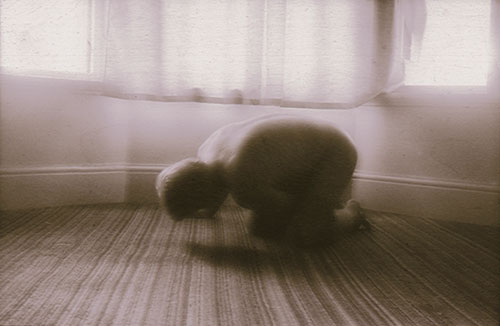 Pat Brassington, untitled, from In marble halls series, 2003
Brassington has stated that she is drawn to surrealism--to the uncanny in the normal.
August 1, 2008
placeblogging
Daisy Pignetti makes a good point in this piece on blogging in relation to New Orleans and Katrina:
They say people make the place.....Key to the mission of this Placeblogging Project is the idea that such bloggers offer “the lived experience of a place” and a “personality” ....The fact that hundreds of locals have chosen to turn to an online medium to share their unfinished stories of Katrina recovery fascinates me insomuch as their writing to represent and persuade can continue to improve outsiders’ understanding of “what it means to miss New Orleans.”
That essay calls attention to the value of local voices when representing the lived experience of a particular place. Pignetti argued that after witnessing the breakdown of communications on local, state, and federal government levels, not to mention the loss of composure on the part of the news anchors and talking heads, there was no better way to raise awareness of the reality of post-Katrina New Orleans than through alternative media genres.
Local communities can use digital media technologies to define themselves in that bloggers can speak more freely, with greater urgency, and their writing expresses a range of opinions that might otherwise go unnoticed. They then form part of a democratized media on the edges of main networks. This democratized media is built on an educated populace and critical thinking about public issues.