July 30, 2008
death
Death and the Maiden is a common motif in Renaissance art, especially in painting. It was developed from the Dance of Death.
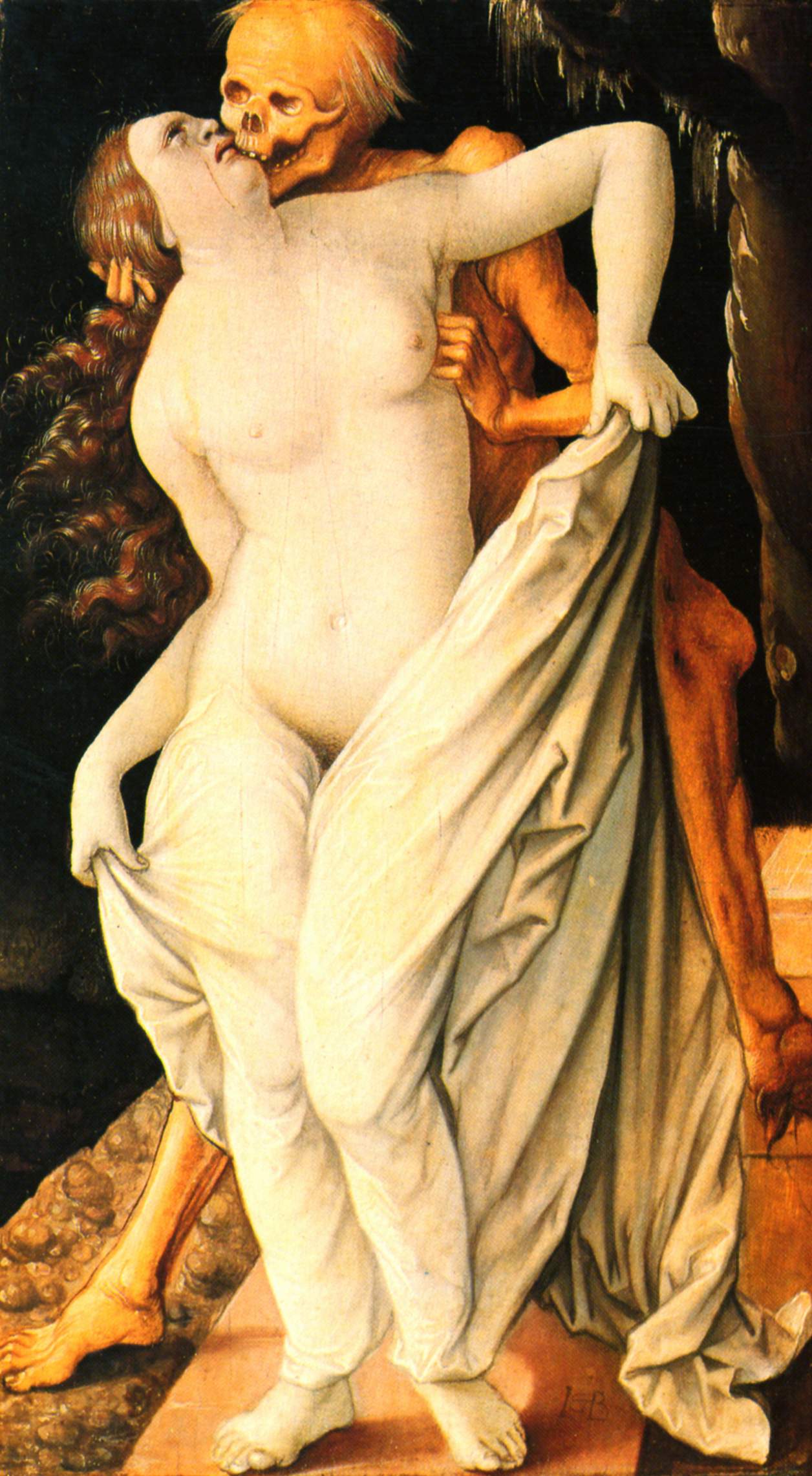 Hans Baldung, Death of a Maiden, 1580-1520, oil on canvas
The Grim Reaper is the obvious descendant of Death incarnate in that he plays the same role. As far as appearances go Death contributed much to the horror flick zombie. Death is the physical prototype upon which Hollywood’s living dead have been molded.
July 29, 2008
after modernism
K-Punk says on the concept of hauntology that it must be understood in relation to postmodernity. Postmodernism, in turn, has to be understood – as Jameson has taught us – as ‘the logic of late capitalism’. K-Punk adds:
Jameson’s great contribution was to have grasped was to have grasped the way in which, far from leading to an efflorescence of cultural innovation, the unprecedented dominion of capitalism over the globe and the unconscious would lead only to cultural situation given over to previously inconceivable levels of stagnation and inertia. Shorn of the confidence that an elite modernism could provide a revolutionary alternative to pacifying entertainment, no longer capable of believing that there was any form of detournement which could not in turn be re-incorporated and commodified, Jameson is the successor to both the Frankfurt School and the Situationists.Maybe we need to think of photography as a darker art than most people routinely practice.
Jameson and Baudrillard understood that the user-generated content, together with the concomitant retreat of the cultural elite that has enabled it, would not lead to new kinds of creativity, but to pastiche and retrospection. Just as the capitalist language of ‘diversity’ is a cover for new modes of homogeneity.
What Jameson calls the ‘nostalgia mode’ is one expression of this homogeneity. Hauntology is the counterpart to this nostalgia mode.
July 15, 2008
danse macabre
The dance-with-death allegory was originally a didactic play to remind people of the inevitability of death and to advise them strongly to be prepared all times for death (memento mori).
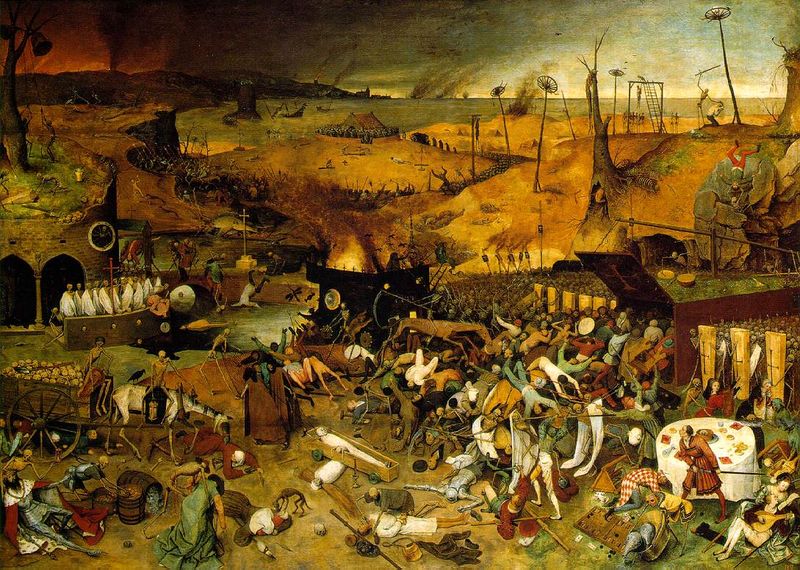 Pieter Bruegel the Elder, Triumph of Death, circa 1562, oil on canvas
This panoramic landscape of death depicts people of different social backgrounds - from peasants and soldiers to nobles and even a king and a cardinal - being taken by death indiscriminately.
July 14, 2008
return of the sublime
After Kant, who reserved the concept of the sublime for nature ---and understood it in terms of the as a presentation of unpresentability--- the sublime becomes a historical constituent of art. This category is rarely mentioned in artistic discourse in Australia, even though it can be seen in various visual works. The sublime is that which, in its infinity, appears as shocking and overpowering; from within the opacity of the art work the sublime means the negation of the idealist conception of a harmonious aesthetic synthesis between sensuous appearance and spiritual content (the beautiful);
In The Touch of Art: Adorno and the Sublime Espen Hammer comments on the return of the sublime in late modernity:
hardly any aesthetic category has attracted more attention than the notion of the sublime. From Barnett Newman’s invocation of America as the post- or non-historical space of the sublime event and Derrida’s reading of the sublime in Kant’s Third Critique as a non-representable disruption of a metaphysics of presence to Lyotard’s conception of a presentation of the unpresentability of ideas of totality and, most recently, Rosalind Krauss’ anti-Greenbergian rehabilitation of Bataille’s notion of l’informe, the fracturing and destabilizing operations of the sublime has often come to be seen as the defining characteristic of modern art überhaupt.
The return of the sublime is not limited to aesthetics as there are wide-ranging ethical, political and epistemological implications. Consequently, the sublime has also figured prominently as a focal point for conceptualizing the nature of modernity itself. Hammer comments:
In this respect, the most influential contribution has no doubt been Lyotard’s discourse, which, by aiming to offer an account of modernity purged of all illicit reference to finality and closure, links the artistic sublime to the nihilistic affirmation of an unrestricted hyper-reflexivity, perspectivism and experimentalism: for Lyotard, the arché of the modern is the anarché of the postmodern. The consummate exhaustion of the “presentable” world of cosmos and mundus is thereby affirmed as fate.
July 13, 2008
the photographic gaze
Late 19th century photography worked in terms of the colonial or anthropological gaze that reminds us of the unequal power relations on the Australian frontier, as expressed in the way that indigenous peoples were reduced firstly to passive witnesses and finally to objects of curiosity.The anthropological casts a surveillant and voyeuristic gaze that silences the indigenous subject.
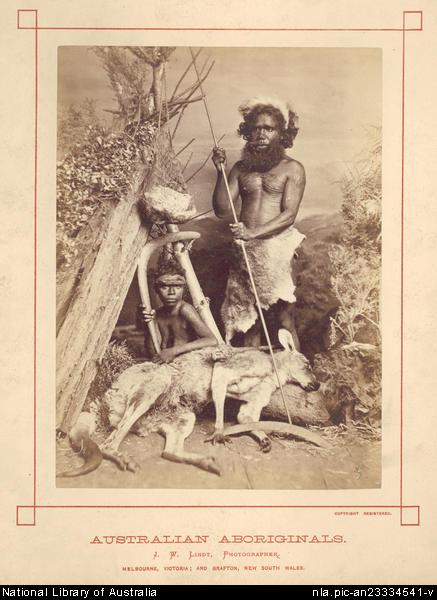 Lindt, J. W. (John William), Australian Aboriginal, circa 1873, photograph, sepia toned
The faux studio constructions assembled by Lindt, with their artefact props and painted landscape backdrops are a feature of J.W. Lindt's Album of Australian Aboriginals, which were originally created during the early 1870s in his Grafton studio. Lindt's Album of Australian Aboriginals does appear to be prepared as an exercise in exoticism that constructs the indigenous subjects by a colonial vision.
The boundary lines between the colonized and the colonizers remain fairly rigid, whilst anthropology make photography its handmaiden or instrument.
July 12, 2008
a national festival of photography
The Picture Paradise: Asia-Pacific Photography1840s-1940s at the National Gallery of Australia is part of a larger number (50) of photographic exhibitions around the country that constitute one festival--Vivid My interest is in the intellectual discourse around this festival in our visual culture as distinct from the art historical discourse around photography.
This is what I came across: Photographies; New Histories, New Practices It sounds promising---the conference will be interdisciplinary in scope, exploring connections with anthropology, ethics, history and much more. It aims to consider new ways of thinking about photographic history, writing and practice. Nothing much is online apart from the abstracts. Geoffrey Batchen's paper, which is about the debate in the photographic world about the effects of the advent of digital technologies, abstract looks interesting. He says:
not much has been said about the economics of photography at any stage of its history. There are a few honorable exceptions, of course, but in general the literature on the history of photography has tended to avoid discussion of the tawdry commercial side of the photographic industry, to repress even the notion that photography is an industry. This repression, another sign of the dominance of art history as a way of talking about photography, is faithful to nineteenth-century prejudices, when there was a concerted effort to associate photography with those "in society" rather than with those "in trade." It is time to overturn this prejudice and consider the degree to which a history of photography should be based on a business, rather than a fine art, model. In short, we need to think of photography as a form of work and the photographer as a worker if we are to ever grasp the full complexity of the photographic experience.
How true. I cannot economically survive as a photographer. So I am an amateur. Batchen says that his paper will go back again to the beginnings of photography, a moment long framed by the preoccupations of Romanticism, in order to reconsider this new phenomenon within the economic, social and political contexts of industrialization and consumer capitalism. Particular attention will be paid to Henry Talbot's effort to establish a photography business.he says that from this consideration, an alternative model of photographic history will be proposed, a model with implications for our understanding of photography's past, but also its present and possible futures.
I wonder what the alternative model of photographic history will be?
July 7, 2008
Hegel on freedom: a note
Hegel’s freedom claim in the Philosophy of Right is that the subject is ‘at home’ only when it lives under laws, customs, practices and institutions the underlying rationale of which it can recognize, i.e. understand and affirm as rational. And it can recognize and affirm these laws because they have in their turn been made by rational human subjects.
For Hegel this is historically the case in modern times. In modernity, claims Hegel, the actual customs, practices and institutions that shape the lives of subjects enjoy authority and deserve respect only in virtue of their underlying rationality. Laws, for instance, have to win acceptance insofar as they manifestly satisfy the interests of those subject to them. He says:
The principle of the modern world requires that whatever is to be recognized by everyone must be seen by everyone as entitled to such recognition.
The underlying rationality of actual institutions does not lie on their surface; it is buried within them. This is why Hegel insists that we modern subjects need not religion but a Science of Right, the task of which is to uncover and make public the implicit rationality of custom and law. For Hegel, the task of philosophy was still to recognize the rationality in the actual.
In response we can say that fundamentally irrational institutions that in Hegel’s eyes are merely ‘lazy’ have their own survival mechanisms, including the ability to cloak themselves in the appearance of rationality.
Alison Bennett: To Occupy
The Australian National University's School of Art has a n exhibition gallery entitled the Photospace Gallery. It will show some work by Alison Bennett entitled To Occupy: panoramic interiors of concrete fortifications from the 4th -14th August. Bennett says that:
This series of images is an investigation into the notion of inhabitation as a negotiated process. Through practice-based research, the series has become focused on the interiors of concrete fortifications along the east and south coasts of Australia. I am interested in the ‘shudder’ one experiences when encountering a room that has resonance; that has duration; where past, present and future collapse.”
I understand 'shudder' as an aesthetic concept that refers to the experience of the historical sublime.I take this understanding from Adorno, and it is shorthand for Adorno's aesthetic fear that elicits "responses like real anxiety, a violent drawing back, an almost physical revulsion.
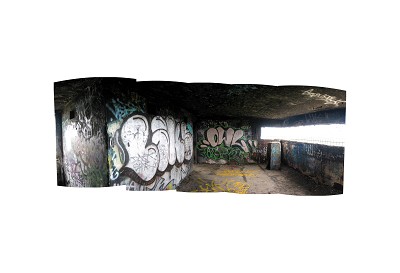 Alison Bennett, Malabar, from the To Occupy series
Bennett explores this shudder by referencing to interiority in architecture and psychology. She says that in architecture 'shudder' is used to describe the experience of being in an interior space; it is used in psychology to describe one’s interior life, what it feels like inside your head.
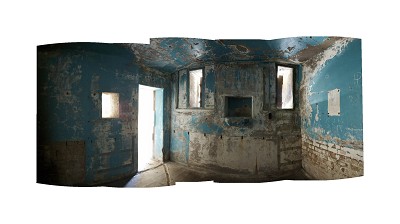 Alison Bennett, Middle Head, Blueroom, from the series To Occupy
In AestheticTheory Adorno claims that works of modernist art can, in virtue of their characteristic autonomy,successfully capture and impart the shudder. Here the shudder is not just a response to primal amorphousness and undifferentiation; it is the appropriate response to the abstract nature of modern life. The shudder is the involuntary and immediate reaction of revulsion which discloses the modern administered world as radically evil.
July 5, 2008
analytic philosophy
In his The Enlightenment Project in the Analytic Conversation Nicholas Capaldi states that by "the Enlightenment Project" he means "the attempt to define and explain the human predicament through science as well as to achieve mastery over it through the use of a social technology". Analytic philosophy has been a dominant intellectual movement in the 20th century and a reflection of the cultural pre-eminence of scientism. The central element in the analytic conversation has been the Enlightenment Project: the appeal to an autonomous human reason, freed of any higher authority and channeling itself through science as its privileged tool.
Capaldi argues that:
Metaphysically, analytic philosophy adheres to a monistic naturalism/scientism. It views the world as self-explanatory, considers metaphysical truth to be equivalent to the structure revealed by the philosophy of science, and maintains a continuity between human beings and nature that allows the use of grammatical criteria to identify fundamental realities. In its scientism, analytic philosophy considers science to be intellectually autonomous and self-legislating: the whole truth about everything; basic science to be physical science; the world to be ontologically purposeless, mechanical system composed of discrete entities, atoms, hat retain their character irrespective of context, interact according to natural laws in ways that can be understood as a serial, causal sequence; science to be a unity whose subjects are a special kind of objects, that views world-understanding
as fundamental, self-understanding as derivative, and models social science after the physical sciences; scientific explanations to be superior to all others (because they uncover an objective, realist, structure that exists independently ofthe observer, express that structure’s necessary causal relations, relate deductively, and can be empirically verified); and explanations to be eliminative reductions or exploratory hypotheses about reality’s hidden substructure.
What we have is a deconstructed, mechanized, unteleological naturalism that claims to be able to abstract the hidden structure of reality and to make mental acts intelligible. It assumes the universe to be a materialist system.
July 3, 2008
Visible City Project
The Visible City Project seeks to understand the different roles that artists play in imagining and helping to design 21st century cities. The project seeks to discern how art practices function in specific contemporary urban contexts as a tool for enhancing communication and renovating democratic citizenship. They investigates how art practices function in specific contemporary urban contexts to educate about and transform the experience of urban dwelling in light of the changing technological, economic and cultural experiencesof globalization.
Christopher Smith says:
As the contemporary cityscape becomes increasingly characterized by capitalist social relations mediated by postmodern permutations of the spectacle and monitored/regulated by the repressive regime of ubiquitous panoptical surveillance, there is an ever more urgent, critical need for creative, playful interventions that construct and present alternate ways of seeing, imagining and engaging with the city. By inter/dis-rupting and intentionally intervening in the everyday order of contemporary urban life, interventions are responsible for constructing new and creative models for what Guy Debord called the “conscious alteration of everyday life,” actively seeking to create moments of autonomy and sites of resistance, however fleeting, fragmentary, transitory or ephemeral. As a response to privatization, militarization, sanitization, and other imposed practices of hypercapitalist urban redevelopment, urban interventions provide instances in and through which to creatively re-imagine—and thereby re-construct and re-inhabit—the city.
They are informed by, and build on, McLuhan's view that artists, could transform things like language or technological media into ‘antienvironments’, making us aware of the way a medium of communication acts upon the content of what is communicated.
July 1, 2008
Flusser on interpreting images
In the Introductory Note to hisTowards a Philosophy of Photography Vilém Flusser highlights the role of interpretation of the image. He says that:
The significance — the meaning — of images rests on their surfaces. It may be seized at a glance. However, in this case the meaning seized will be superficial. If we want to give meaning any depth, we have to permit our glance to travel over the surface, and thus to reconstruct abstracted dimensions. This traveling of the eyes over the surface of an image is "sanning." The path followed by our scanning eyes is complex, because it is formed both by the image structure and by the intentions we have in observing the image. The meaning of the image as it is disclosed by scanning, then, is the synthesis of two intentions: the one manifest in the image itself, the other in the observer. Thus, images are not "denoting" symbol-complexes such as numbers, for instance, but "connoting" symbol-complexes: images offer room for
interpretation.
As the scanning glance travels over the image surface, it grasps one image element after another: it establishes a time-relation between them. It may return to an element already seen, and thus it transforms "before" into "after." He says that:
Such space-time as reconstructed from images is proper to magic, where everything repeats itself and where everything partakes of meaningful context. The world of magic is structurally different from the world of historical linearity, where nothing ever repeats itself, where-everything is an effect of causes and will become a cause of further effects. For example, in the/historical world, sunrise is the cause of the; cock'scrowing; in the 'magical world, sunrise means crowing 'and' crowing means sunrise. Images have magical meaning. If images are to be deciphered, their magical character must be taken into account.
Photography, the first of all technical image processes, was invented in the 19th century to re-charge texts with magic, although its inventors may also have been unconscious of this purpose. The invention of photography is just as decisive an historical turning point as was the invention of linear writing. With writing, history as such begins as the struggle against idolatry. With photography, "post-history" begins as a struggle against textolatry.