June 30, 2008
anti-modernism?
If the core narrative of modernity, or industrial-technological society, is progress, a belief that technological development means socio-economic improvement, then the heart of antimodernism is a realization that “progress” has an underbelly—that technological industrial development has destructive consequences in three primary and intertwined areas: nature, culture, and religion. So antimodernism is a fundamental counter theme implicit or explicit within modernity, which is often expressed in terms of a growing recognition of cultural disintegration as a direct consequence of industrial modernity. It is an expression of the “dark side” of modernity.
So argues Arthur Versluis in Antimodernism in Telos (Winter 2006). He says:
there is ...a spectrum from “soft” to “hard” antimodernism. Hard antimodernists seek to leave modernity behind or to overthrow it, whereas those closer to the “soft” antimodernists only criticize it or, if they are a bit stronger in aim, hope to transform modernity into something else. Much of what we will discuss under the general heading of antimodernism, particularly in the forms it took in the nineteenth century through the mid-twentieth century, was more along the lines of reformist efforts or critiques....We see this soft antimodern tendency in the emergence of the craft movement of the late nineteenth and early twentieth centuries, inspired by John Ruskin and William Morris. Driven by a strong anti-industrialism,
Ruskin, Morris, and other less well-known English figures encouraged a movement toward handwork and cottage industries, toward printing and woodworking and textile manufacture, in a way that was consciously
opposed to mass production. They imagined a new non-industrialism that could be based on quality of life, not quantity of production.
Art was perceived as way to create a sub-world that could exist outside modernity and offer imaginative freedom from it without altering the actual conditions of society as a whole. Versluis says the trajectory is one of a subworld. The natural trajectory of those who love nature and loathe its depredation by corporations is to leave society behind and go off into the wild; just as the natural trajectory of those who despise the alienation and shoddiness of modern industrialism is to attempt to create “sub-worlds” or creative realms in novels films, music, and “virtual reality”.
There, modernity has no hold—even if modernity and industrial technology alone provide the means for these virtual realms. In some respects, then, cultural antimodernist trajectories play into and even support the modern industrial-technological enterprise because they offer “escapes” from it rather than a transformation of it.
For Versluis a good example of hard anti-modernism is is ecological antimodernism, with its swsweeping indictment of modernity:
One can understand this indictment rather easily when one recognizes the extent and magnitude of industrial society’s destruction of nature. Consider, for instance, the annihilation of entire mountaintops in coal regions of the eastern United States. In the early twenty-first century, it has become common practice for large corporations to simply blow up the tops of mountains, extract the exposed coal, and, in the place of green mountaintops, generate devastated lunar landscapes whose detritus and lack of vegetation mean that sometimes thousands of people are driven from their homes, rivers flood and wash away whole valleys, and so forth. In the face of these practices, and the general incapacity of ordinary people to effectively oppose such destruction, one can understand how ecological radicalism would develop.
Mmodernity carries within it the seeds of its own opposition. Antimodernists, far from representing
a purely negative or pessimistic current, advance a critique of the society in which we live in order to call us toward a better one.
June 27, 2008
Hegel: natural beauty
Hegel, in the opening of the Lectures on Aesthetics, says that the sensuous objects produced by art, or indeed any product of the spirit, must always outstrip any of the beauties of nature in philosophical
significance:
For artistic beauty is beauty born and reborn out of spirit, and in as much as spirit and its productions stand higher than nature and its appearances, so is artistic beauty higher than the beauty of nature. Indeed, when considered formally, even a bad idea, in the way it goes through a person’s head, is higher than any product of nature, for in such ideas or notions spirit and freedom are always present. For example: in its content, of course, the sun appears as an absolutely necessary moment, while an askew notion appears accidental and, in passing, disappears; but taken in itself such a natural existence as the sun is indifferent, in itself not free or self-aware, and when we consider it in the context of its necessity with other things, so do we not consider it in itself and thus not as beautiful.
June 25, 2008
Adorno, shudder and the aura of art
In The Splinter in Your Ear: Noise as the Semblance of Critique in Culture, Theory & Critique, (2005) Nick Smith says that the source of the new aura of the work of art, rather than unblemished Romantic beauty, is now its sheer irreconcilability. Smith says that for Adorno:
The strangeness of the object evokes a response not like the fawning admiration of the beautiful but more like the suppliant terror of the sublime. ‘Shudder’, Adorno’s shorthand for this aesthetic fear, elicits ‘responses like real anxiety, a violent drawing back, an almost physical revulsion’...... Shudder horrifies us by inducing ‘a sense of being touched by the other’, and the point of contact reaches us not in a long awaited embrace, but in a harrowing shock.... Unlike the angelic offering of the beautiful, the hand that grabs us from behind in shudder will be disfigured by ‘the scars of damage and disruption…’ When we encounter the possibility of a suffering, gasping breath beneath a cacophony of unnerving noise, we feel offended, afraid, and complicit. Just as J. M. Bernstein argues that a work of art expresses meaning like a body suffering expresses meaning, so when confronted with such an object we feel the need to assuage the suffering and fear being overtaken by whatever has inflicted the pain. ...The very distinction between witnessing suffering and undergoing suffering is threatened.
Smith says that the entirety of Aesthetic Theory is devoted to mapping these limits of instrumental reason and art, and narrating how art embodies what philosophy cannot translate into conceptual knowledge and how art depends on philosophy to interpret its nonparaphrasable claims.
June 23, 2008
Adorno, identity thinking, particularity
In The Splinter in Your Ear: Noise as the Semblance of Critique in Culture, Theory & Critique, (2005) Nick Smith gives a good account of Adorno's argument about identity thinking.
He says that for Adorno, all cultural analysis must begin with an account of abstract identification, which specifies an individual thing in the world, picks it out as a member of a group, and places it under a concept. Regardless of whether I understand the thing as an instantiation of a Platonic form or an example of a scientific class, what matters is that the object is no longer a unique and strange thing but is rather a member of a category that makes sense to me. He adds:
This process, which Adorno names ‘identity thinking’, causes a belief that concepts fully capture the objects to which they refer ...When we consistently disregard particularity while reinforcing similarity, we forget the notion of something genuinely concrete, particular, unique, non-fungible, or incommensurable. The material world is made to fit the abstract idea and actual things are seen as nothing more than exemplars of their concepts. Abstract classifications do not, however, inhere in objects but, rather, are artefacts of intellectual organization. My classifications are merely constructs of convenience.
Because identity thinking pretends that concepts exhaust their objects, the particularity of things will remain overlooked and in reason’s blind spot. When Adorno claims that the ‘splinter in your eye is the best magnifying glass’, the splinter marks precisely this blindness to particularity.....The notion of aura, which Adorno shares with Walter Benjamin, preserves concrete particularity against identity thinking and its practical apotheosis in universal commodification.
As our most basic form of understanding, identity thinking is born not in the search for objective truth but rather in egoistic instrumentality. With cognition bound in this way to use, a direct causal relationship can be traced between conceptualisation, instrumentalisation, commodification and domination. So we have the
degradation of reason into identity thinking.
June 21, 2008
Jane Austen + the virtues
In Jane Austen’s Philosophy of the Virtues Sarah Emsley follows Alistair MacIntyre in seeing Austen as “the last great representative” of the “tradition of the virtues”. Jane Austen emerges from these pages as a woman who takes ethical development and the vocation of novelist seriously.
Emsley sees Austen as conservative yet flexible, crucially interested in how the classical and the Christian virtues interact and sometimes compete in life as lived in her time. Emsley argues with conviction that Austen’s heroines are less centrally concerned with “Whom shall I marry?” than with “How should I live my life?”—and accordingly that Austen’s novels present, in diverse ways that highlight various virtues and combinations of virtues, moral educations that prepare her characters for ethical action in their communities. Thus Austen’s fictions offer “living arguments” for the practice of the virtues, both classical (prudence, justice, fortitude, temperance) and Christian (charity, faith, hope).
Slavoj Zizek calls Jane Austen “the only counterpart to Hegel in literature” for the way that her novels employ dialectical progression as a tool for arriving at a pure truth (62). Zizek provides many examples of different Austenian equivalents to Hegelian theories. Additionally, he suggests that whether or not Austen was actually purposely utilizing and referencing Hegel, she was still the only writer of her time to truly understand the philosophy of human interaction and relationship.
Austen participates in the longstanding debate about the choice "between virtue and commerce, virtue and corruption, virtue and passion," a debate that has been engaged in "every phase of Western tradition,
June 20, 2008
note on the sublime
Luke White on the history of the notion of the sublime. He says:
The word 'sublime' is used colloquially nowadays as a vague superlative. However, in particular in the realms of philosophy, literary studies, art history or cultural criticism, it has a range of more specific meanings. It might be used to refer to the transcendent, the numinous, the uplifting or the ecstatic. More particularly, it is also used to refer to the awe-inpiring, the grandiose or great. For some, the sublime is that which is terrifyingly vast or powerful. For others, the sublime is that which is unpresentable, ungraspable or unimaginable. Above all, the sublime has come to refer to the 'rush' of intense aesthetic pleasure paradoxically stemming from the displeasure of fear, horror or pain.
June 18, 2008
tumblelogging
A nice idea. A tumblelog may be the solution to the survival of conversations as a weblog. I cannot do the philosophy any more. I just don't have the time. So I have been more or less letting it go.
However, a Tumblelog may the doorway that I step through, and then see what happens. It is one interesting way of keeping conversations going.
I'd come across the work of Colin McCahon in New Zealand---see here and here over at junk for code. I found the work interesting and so I decided to pick up from there.
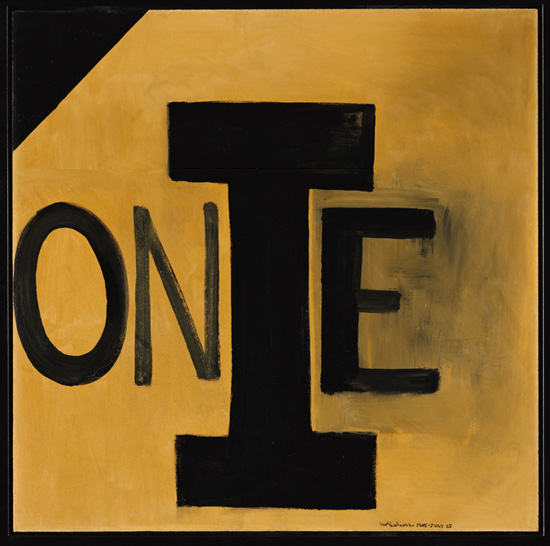 Colin McCahon, One 1965, synthetic polymer paint and polyvinyl acetate on composition board
The Colin McCahon database Happy exploring.
June 14, 2008
history as petrifed nature
In his study of the seventeenth-century German baroque dramas, The Origin of the German Mourning Plays, Walter Benjamin conveys the idea of history as “petrified nature,” and nature as “petrified history.” The popular baroque emblems of human skeletons and skulls signify the idea of history as constant mortification and transience. In the baroque image of the fossil is embodied the idea of the survival of the past in the present.
Theodor Adorno in this essay “The Idea of Natural History,” offers a philosophical interpretation of Benjamin’s idea of natural history. In “The Idea of Natural History,” Adorno compares Benjamin’s
concept of natural history with Lukácsian idea of “second nature.” This term designates, for Lukács, the reified world of capitalism, the alienated world, the world of convention. If Lukács demonstrates the retransformation of the historical, as that which has been, into nature, then here is other side of the phenomenon: nature itself is seen as transitory nature, as history.
For Benjamin the emblem of natural history is “a cipher to be read.”
June 8, 2008
content and form
A lecture by Graham Coulter-Smith
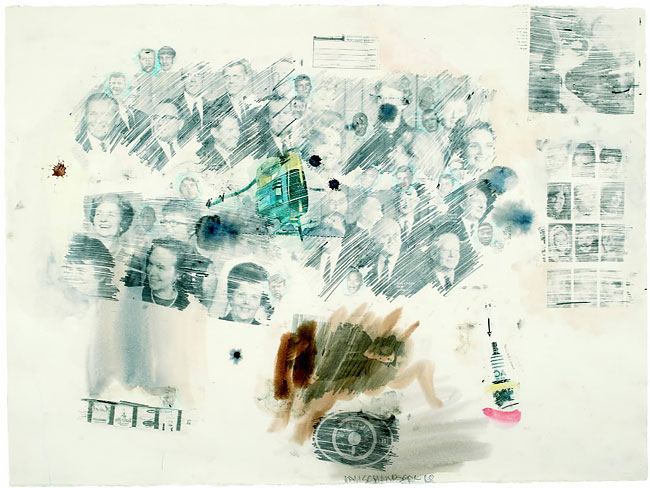 Jonathan O’Hara Gallery
Robert Rauschenberg: untitled, 1968 from Transfer Drawings From the 1960s, watercolor and pencil
Jonathan O’Hara Gallery
Robert Rauschenberg: untitled, 1968 from Transfer Drawings From the 1960s, watercolor and pencil
Coulter-Smith says that:
Rauschenberg and Johns challenged abstraction by using representational elements in their work. But in so doing they did not herald a return to the tradition of narrative painting that modern art had broken with. Instead they introduced a different way of dealing with imagery, one that is in many ways abstract. Instead of being concerned with visual abstraction, however, these artists were concerned with linguistic abstraction.
June 5, 2008
access
Mostly I despair over academia's reluctance to embrace open access publishing. I've been told it would be career suicide to favour open access journals over the closed and secretive traditional type, and that not even co-authoriship with an established name would help. This strikes me as ethically questionable coming from sociology. Then along comes stuff like this which seems to at least represent a bridge between the old and the new.
I was scouting around the net trying to get a handle on Latour and Law and Actor Network Theory and found this via Law's publications listing at the Lancaster website. The alphabetical listing is impressive: Cronin, Jessop, Law, Tolmie, Urry - these are not names to be sneezed at. Urry is particularly good at the mobilities of globalisation and is one of the few to have done some decent empirical research on cosmopolitanism. He's done a Bourdieuish exercise with photography and visual mobilities which I thought was very clever.
These are not necessarily peer reviewed, published papers which is both good and bad. Bad because of traditional bibliography requirements, good because you can get a handle on the writer's thinking as it progresses, which is something the net can do that scholarly publishing can't. Or not very well anyway, and certainly not all in one place. Law's stuff is written in ordinary English rather than obscure terminology, which is good when you're trying to learn something new.
The object, the actant, is a relatively new concept that was difficult to refigure from the realist notion of an objectively existing, material object to the relationally existing conceptual object which is the socially and culturally constructed artefact that is/was the poll wars, or Antony Green's calculator, or the worm. Consistent with the actant, these things acted upon us, invited or enabled us to act with, and upon, them, and exist as tools we can think with in Levi-Strauss' terms. We did not create them all, but we did construct the meaning of all of them.
The dynamics of the time, from November 2006 to November 2007, were difficult to describe as both discrete events and a collective mosaic with cumulative meaning. But Law helps here too, arguing that the requirement for specificity is a bit of a con job that produces misleading results. We'd be better off accepting that life is messy and research would produce better knowledge if methodologies acknowledged that. How to explain the relationship between The Australian dummy spit editorial and the number of Kevin Rudd's MySpace friends? How to explain the cumulative effect of the Chaser's YouTube videos from APEC and little nobody's comments about election leaflets dropped in their neighbourhoods? You can't do that in any kind of central-theme way. You just have to accept that the mess that was online participation during 2007 added up to a really big mess that provided a certainty that wasn't available anywhere else.