May 31, 2008
Sadie Plant on Situationist International
A quotation from Sadie Plant’s The Most Radical Gesture: The Situationist International in a Postmodern Ag:
A staggering abundance of commodity choices is offered, and identification is demanded not with a single commodity but the commodity system itself: it is the spectacle as a whole which is advertised and desired. The lights, the opportunities, the shops, the excitement: the attraction of capitalist societies has always been their glamorous dynamism, the surfeit of commodities and the ubiquity of choice they offer. But in practice, anything can be chosen except the realm in which choice is possible. One can choose to be, think, and do anything, but as the roles, ideas, and lifestyles possible within capitalist society are allowed to appear only to the extent that they appear as commodities, the equivalence and homogeneity of commodities is inescapable in the most private aspects of life. The shops always carry everything except the thing one really wants; they are ‘full of things’.”(Plant 1992: 24).
You can read the book online.
May 29, 2008
Dialectic of Enlightenment revisited
I've always struggled to grasp the argument is Adorno and Horkheimer's Dialectic of Enlightenment. Though I've read it several times, I've never firmly grasped its argument about he assumptions of instrumental reason. Even though I understood that it was a philosophical critique of the positivist Enlightenment I never clicked into how the Freud psychoanalysis fitted into this critique.
What if this text can can be interpreted as a genealogy critique? This is what Roger Foster argues in Dialectic of Enlightenment as Genealogy Critique in Telos Summer 2001
He says:
Genealogy is a form of critique which uses historical analysis to undermine the ideological self-understanding of dominant thought structures. Historical analysis is employed to uncover needs and
interests central to the formation of thought systems, but forgotten or repressed when that system becomes dominant. Horkheimer and Adorno use genealogy to criticize a positivist variant of rational thinking that defines itself as rational thinking as such. Here cognition takes the form of a classification of facts within mathematized formulas, which serves productivity through increased control over natural processes. Horkheimer and Adorno understand positivism as the philosophical expression of that structure of knowledge concerned with the technically useful. By means of genealogy, they criticize the positivist version of the Enlightenment, and not reason as such. The purpose this critique is to uncover alternative possibilities of rational thinking, which are suppressed by the positivist definition of reason.
Foster says that Horkheimer and Adorno develop this genealogy critique by modifying the cultural anthropology deployed by Freud in Totem and Taboo. In this work, Freud constructs an interpretation of “primitive” thought organized around psychoanalytic categories. Animistic beliefs, Freud argues, derive from the cultural equivalent of that psychic process which, at the individual level, gives rise to obsessional neurosis. Foster says that:
Freud is thus able to dispense with the view of early ethnologists that animism is a result of intellectual error, and also with the Durkheimian view that animism represents a hypostatization of social forces. Horkheimer and Adorno modify Freud’s account by arguing that animism and mythic thought systems in general originate in a primordial fear of the unknown. The positivist Enlightenment can then be revealed by genealogy critique as a culturally sublimated expression of primordial fear. On this basis, they are able to uncover the contingent, non-rational origins of the restriction of thought to the technically useful.
May 27, 2008
digital divide
Tim Luke in an article entitled Dealing with the Digital Divide: The Rough Realities of Cyberspace in Telos (2000) says that:
The Net is about digital capitalism. Ordinary access to, and everyday use of the Internet is quite unequal. First, the Internet’s routers, switches, and connections are owned by a few, but sold, leased, or rented to the many. Second, getting into cyberspace for any individual costs a great deal of effort, money, and time. Third, planned and unplanned obsolescence is the essence of cyberspace, so all of these collective infrastructure and individual end user costs have to be paid over and over again simply to maintain functionality. Consequently, inequalities of wealth and differences in status offline are directly translated into tremendous inequities in the online environment.
He says that for or Washington, the digital divide is simple: who has access to new information technologies, like digital telephones, personal computers, and network connections, and who does not. Digitalization seems to be creating many more new inequalities and injustices. For instance, only a few of “the young” in the richer, more progressive areas of advanced capitalist societies have good PCs and Net
connections at home, at school, or at work. Nor everyone has fast bandwidth net connection, and sophisticated software resources, even though the digerati assume they can essentially jack into the virtual equality, cyberliberty, and netcentric fraternity emerging from every dataport
The rhetoric about the openness and equality of digital society, then, is rather cynical.
Luke ends by saying that:
The politics of networked places and cultures in digital domains are shaped by the answers to one question: “who decides what knowledge is and who knows what needs to be decided? In the computer age, the question of knowledge is now more than ever a question of government.” Whose government, for whom, where, when, and how are all intriguing questions, and their answers are difficult. Power and knowledge mostly flow for the benefit of those few on the upside of the digital divide, as the raw edge of new inequalities trace who wins and loses out along the rippling flows of the Net. While some assert that there are no “haves” and “have-nots” in cyberspace, only the “have-nows” and “have-laters,” not having computers and Net connections closely parallels not enjoying most other types of power, status, and wealth offline. Moreover, the many who do not have most other highly valued goods now are very unlikely to get them later, and this includes the computers and connectivity causing the digital divide to persist.
May 25, 2008
May 23, 2008
Queenie McKenzie
An example of indigenous art from the Kimberley region:
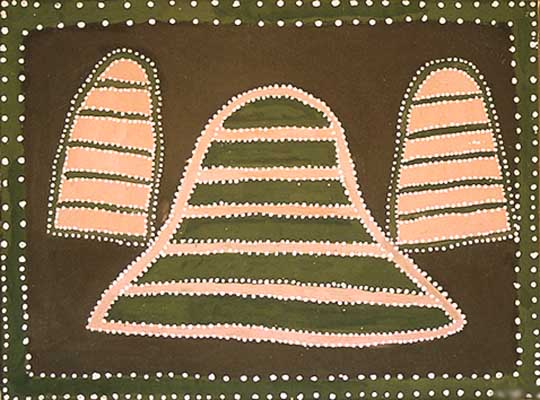 Queenie McKenzie, Yoorlgoobun - Blackfella Creek, ? Ochres on Canvas,
May 19, 2008
May 18, 2008
May 15, 2008
nonidentity
Although Adorno’s Negative Dialectics and Aesthetic Theory, published some twenty years after Dialectic of Enlightenment, were regarded as proof of Adorno’s hostility toward political praxis by the generation of the
New Left, these texts open up the categories of cognition and subjectivity to the promise of a reconstructed reason by presenting a phenomenology of what cannot be reduced to the terms of instrumental reason and what, in the object, is non-identical with the subject and totality.
Adorno argued that human beings, in their interaction with nature, should understand that objects are not made fully transparent o humans through concepts. And it is what remains outside the grasp of concepts, the particular, that must be preserved. Within such a cognitive ramework, human beings, who are also objects, are also irreducible to abstract universal categories.
May 13, 2008
May 9, 2008
May 8, 2008
The void created by the death of God had, for Nietzsche, left human being still confronted by the incredible horror of life, by a profound suffering, just as it had his Greek and Christian ancestors. In Beyond Good and Evil: Prelude to a Philosophy of the Future Nietzsche says:
The discipline of suffering, of great suffering – do you not know that only this discipline has created all enhancements of man so far? That tension of the soul in unhappiness which cultivates its strength, its shudders face to face with great ruin, its inventiveness and courage in enduring, persevering, interpreting, and exploiting suffering, and whatever has been granted to it of profundity, secret, mask, spirit, cunning, greatness -- was it not granted to it through suffering, through the discipline of great suffering?
That horror of life and its suffering had already produced the ascetic ideal. For Nietzsche, the ascetic ideal, with its claim that human suffering has meaning, with its hatred of self and world, and the omnipresence of guilt, that has shaped Western man, is an historically determinate response to “metaphysical need,” the need to construe one’s life as meaningful, a form of “metaphysical comfort,” the belief that the pain that we endure in this life can be redeemed in an other-worldly domain of existence.
open access humanities' journals + medicine
I've just stumbled into the Open Humanities Press -- a collection of open access journals in the humanities. What a wonderful idea in contrast to the Griffith Review being hidden behind a subscription wall despite the public subsidy from the Australia Council.
As the folks at Cosmos and History say:
Open-access journals offer free access to articles and broaden the readership of publications beyond the restrictions of traditional commercial publishing. In any 12 month period Cosmos and History has around 900,000 ‘hits’, this equates to around 140,000 ‘unique visits’. However, what really matters is article downloads; currently with five issues published we are getting around 150 article downloads a day, with some individual articles being downloaded as often as 10 times a day.
Opponents of the open access journals assert that the pay-for-access model is necessary to ensure that the publisher is adequately compensated for their work. Scholarly journal publishers that support pay-for-access claim that the "gatekeeper" role they play, maintaining a scholarly reputation, arranging for peer review, and editing and indexing articles, require economic resources that are not supplied under an open access model.
Well the digital age changes a lot of that, and so we have something like Philosophy Ethics and Humanities in Medicine.
The editors say in the first issue:
Those interested in the conceptual and historical roots of medicine will not need reminding that early on work in natural philosophy spanned philosophy, science, and medicine. While scientific advances have led to the development of an ever-growing range of scientific disciplines and medical specialties, a consideration of the grounding concepts and ethical principles that underlie health care remains as crucial as ever. Indeed, advances in knowledge, and changes in practice, mean that these grounding concepts and ethical principles require constant reconsideration and reworking. This, then, is the work of philosophy of medicine, of bioethics, and of work at the overlap between the clinic and the humanities.To our knowledge Philosophy, Ethics, and Humanities in Medicine is the first open-access journal that aims to expand the discussion on health care by focusing on the intersection between philosophy, ethics, and the humanities and clinical theory and practice.
An interesting article in an early issue of Philosophy, Ethics, and Humanities in Medicineis Grant Gillett's Medical science, culture, and truth He says that medical science has followed the ideal of scientific objectivity so that we make observations, offer theories about the realities they indicate and assess those theories in the light of our ongoing accumulation of clinical and scientific evidence.This scientific objectivity is now stated in terms of scientific realism according to which the world is the way science says it is because there is a transparent and simply verifiable correspondence between our scientific descriptions and the reality they describe. On this view, science reveals the nature of the world and the processes going on within it and discloses facts about human health and disease.
May 5, 2008
technology: from industrial to digital
This is a classic example of old industrial technology:

Bernd and Hilla Becher, Styrofoam plant near Cologne, Germany, 1997
The new technology is the internet and BitTorrent files---that gives us the capacity to “hyperdistribute” --- to send a single copy of a programme to millions of people around the world efficiently and instantaneously. In his post Unevenly Distributed: Production Models for the 21st Century on the the human network. Mark Pesce describes the far reaching implications of this technology. Referring to YouTube he says:
When the barriers to media distribution collapsed in the post-Napster era, the exhibitors and broadcasters lost control of distribution. What no one had expected was that the professional producers would lose control of production. The difference between an amateur and a professional – in the media industries – has always centered on the point that the professional sells their work into distribution, while the amateur uses wits and will to self-distribute. Now that self-distribution is more effective than professional distribution, how do we distinguish between the professional and the amateur? This twenty year-old doesn’t know, and doesn’t care.
There is no conceivable way that the current systems of film and television production and distribution can survive in this environment.
Pesce says that this is an uncomfortable truth, but it is the only truth on offer this morning. I’ve come to this conclusion slowly, because Bit Torrent and YouTube seems to spell the death of a hundred year-old industry with many, many creative professionals. H e adds that This means that the one-size-fits-all production-to-distribution model, which all of you have been taught as the orthodoxy of the media industries, is worse than useless; it’s actually blocking our progress because it is effectively keeping us from thinking outside the square.
May 4, 2008
analytic philosophy + Hegel
As is well known analytic philosophy's narrative holds that it began in a reaction against "Hegelian thought," specifically, the neo-Hegelianism of late 19th century Britain. Russell and Moore overthrew the doctrines of internal relations, of the falsehood of the partial and the truth only of the whole, and of the fundamentally spiritual nature of the world. Most important, they brought into philosophy the new logic that had revolutionized a discipline that hadn't changed significantly since Aristotle invented it.
As we know Russell particularly promulgated a 'shadow Hegel,' a distorted, even mythical image that justified his philosophical patricide, and he sold it effectively for the rest of his life. After the Cambridge Two slew the Hegelian father and liberated philosophy from his oppressive regime, Hegel and Absolute Idealism became taboo, mentionable only with disgust, scorn, and ritualistic excoriation.
The 'shadow Hegel', of course, is the British Hegelians, whose alleged idealistic excesses gave rise to ‘analytic philosophy. The disgust, scorn and contempt then ignored the way that Continental European philosophy over the last two centuries has been so many different responses to Hegel.