September 29, 2006
when technology rules
This what happens to nature from the exploitation of natural resources through mining.
A highly coloured contaminated river that flows through the town:

Gary Sauer-Thompson, Queenstown River, 2006
a highly coloured contaminated rock faces:
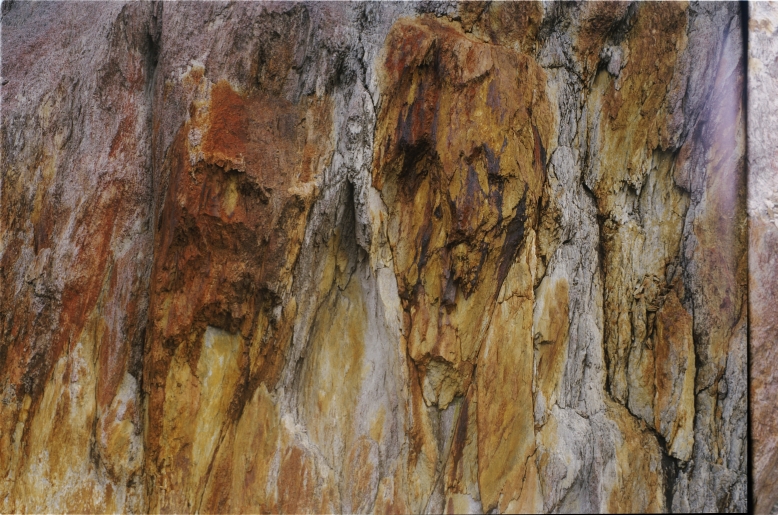
Gary Sauer-Thompson , Rockface Queenstown, 2006
It is a bare landscape with neer a touch of green growth. The place is Queenstown, Tasmania.
It 's history kinda makes sense of Heidegger's analysis of the completion or closure of metaphysics and his thinking of the age of technology in terms of the Gestell. The show the way that aesthetic experience and rationality can oppose, instrumental rationality and the technological mode of being.
Can aesthetics and meditative thought preserve a resource against technicist nihilism embodied in mining that destroys the earth?
September 28, 2006
the reception of Levinas
My guess is that Levinas is being read in those parts of Anglo-American universities that embraced French poststructuralism and who were concerned by the ethical impoverishment the deconstruction stream of this philosophical movement. Ethics is becoming a central concern in the humanities (and social sciences?) and Levinas is rapidly becoming a central figure. The exception to this claim would be the theological reception of Levinas in the Anglo-American Catholic universities.
Why the turn to Levinas amongst continental universities in Anglo-Amercian universities? My judgement is that it is because Levinas' chief philosophical concern was with ethics as a first philosophy and that ethics is to be understood in terms of an infinite responsibility to the other. The attraction of this is that it breaks with the liberal individual subject concerned with rights or utility and driven by self-interest by introducing inter-personal relations; and provides a way to grasp that relation in terms of a face-to-face relation.
What Levinas argues is that Heidegger's Being and Time presupposes, but does not explore, an ethical relationship with the other human being or person to whom I speak. Levinas argues that this relation takes place in the concrete situation of speech--- of conversing with a particular person. It is this relationship which is ethical. Unless or social relationships are underpinned by an ethical relationship to the other person then we fail to acknowledge the humanity of the other person.
It is appealing isn't it? Much better than utilitarianism which treats the other person as an object of my self interest that I can instrumentally use to further my self interest. It questions the assumption of a spectator view from nowhere by highlighting the perspective of a individual emmersed in the world.
September 26, 2006
beyond romanticism to Puritjarra
Romanticism depends upon the assumption (in the west) of the separation of nature and culture. Before we can contemplate any spiritual union or sacred reunification, separation is required. Thus, Romanticism, developed through a series of associations--intuition over rationality, feelings over beliefs, with a sense of mysticism and oneness with Nature--as though it was possible to overcome the alienation and reification that had emerged with capitalism, industrialization, and urbanization. Nature was often pictured by the Romantics as the garden, the landscape, the village, or the earth that conjured up an idealized pastoral space----a paradisical Eden-which constituted the natural habitat for the soul.
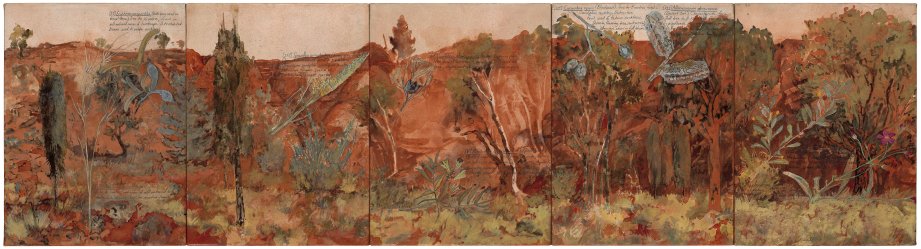
Mandy Martin and Jack Gillen, Puritjarra Flora, Found local and sourced pigment, ochre and acrylic on Arches paper,
Puritjarra cannot be seen as the garden, the landscape, the village, or the earth envisioned as an idealized pastoral space. What is being painted is a panorama of the approach to the rock shelter and escarpment that captures the rich and diverse beauty of desert flora.
Is there an Australian romatnicism then? One that steps beyond Wordsworth and the English romantics? One that considers nature as something other to the garden, the village, or the earth as an idealized pastoral space? The short answer is wilderness--wild untamed nature. Australians moved from a view of nature as possessing value only to the degree to which it can be put to use (utilitarianism) to a view of wilderness having intrinsic value entirely on its own.
The idea of wilderness has been a fundamental tenet of the environmental movement in Australia. For many Australians wilderness stands as the last remaining place where civilization has not fully contaminated the earth. It is an island in the polluted sea of urban-industrial modernity, the one place we can turn for escape from our modern way of life. Wilderness presents itself as the best antidote to our human selves, a refuge we must somehow recover if we hope to save nature.
The desert---Puritjarra----is not wilderness per se as it is, and has been, inhabited by aboriginal people. Puritjarra is not a pristine sanctuary where the last remnant of an untouched, endangered, but still transcendent nature can for at least a little while longer be encountered without the contaminating taint of industrial civilization. Instead, it's a product of aboriginal civilization, and could hardly be contaminated by the very stuff of which it is made.
We need to be aware that wilderness is a cultural construct. If you back 200 years says William Cronon:
a wilderness then was to be "deserted," "savage," "desolate," "barren" ---in short, a "waste," the word's nearest synonym. Its connotations were anything but positive, and the emotion one was most likely to feel in its presence was "bewilderment" or terror. ... In its raw state, it had little or nothing to offer civilized men and women. But by the end of the nineteenth century, all this had changed. The wastelands that had once seemed worthless had for some people come to seem almost beyond price. That Thoreau in 1862 could declare wildness to be the preservation of the world suggests the sea change that was going on. Wilderness had once been the antithesis of all that was orderly and good---it had been the darkness, one might say, on the far side of the garden wall---and yet now it was frequently likened to Eden itself.
September 25, 2006
Heidegger, eco-poetics, deserts (Puritjarra)
In previous posts I have connected Heidegger's understanding of dwelling to Puritjarra as a place and Heidegger's understanding of releasement to painting the country by aboriginal artists. I have done this by relying on Strata: Deserts, Past, Present and Future,an environmental art project about a significant cultural place.
Now I want to do the same with Heidegger's understanding of eco-poetics. We can turn to a paper entitled Earthsongs: Ecopoetics, Heidegger and Dwelling by Michael Peters and Ruth Irwin to get a grasp of eco-poetics. They start by introducing Jonanthan Bate's The Song of the Earth, which Bates says is a book about:
why poetry continues to matter as we enter a new millennium that will be ruled by technology. It is a book about modern Western man's alienation from nature. It is about the capacity of the writer to restore us to the earth which is our home.
Peters and Irwin interpret Bates to be arguing that restoring us to the earth is what good ecopoetry can do and ecopoetics (rather than ecocriticism) is not just the pastoral theme, which Bates asserts, following de Man, may be "in fact, the only poetic theme," it is poetry itself . Ecopoetics is more phenomenological than political and while its force does not depend upon versification or metrical form, it constitutes the most direct return to the place of dwelling. Bate explains:
Ecopoetics asks in what respects a poem may be a making (Greek poiesis) of the dwelling place -- the prefix eco- is derived from the Greek oikos, "the home or place of dwelling." I think of this book as an "experiment in ecopoetics". The experiment is this: to see what happens when we regard poems as imaginary parks in which we may breath[e] an air that is not toxic and accommodate ourselves to a mode of dwelling that is not alienated.
Peters and Irwin say that when Bate uses the concept "dwelling" he is self-consciously drawing on his earlier understanding of Wordsworth---for Wordsworth "remains the founding father for a thinking of poetry in relation to place, to our dwelling on the earth"---and running this sense of place together with the special sense that Heidegger gives the term in two essays based on lectures delivered in the early 1950s (Building Dwelling Thinking (1950) and Poetically Man Dwells 1951). This gives us a peculiar set of relationships between place, poetry, and bioregion.
Instead of Wordsworth and poetry we can turn to the paintings of Puritjarra, which is beyond Haasts Bluff, some seven hours travelling west of Alice Springs, which were included in the Strata: Deserts, Past, Present and Future project.
Strata: Deserts, Past, Present and Future is an environmental art project about a significant cultural place--- Puritjarra
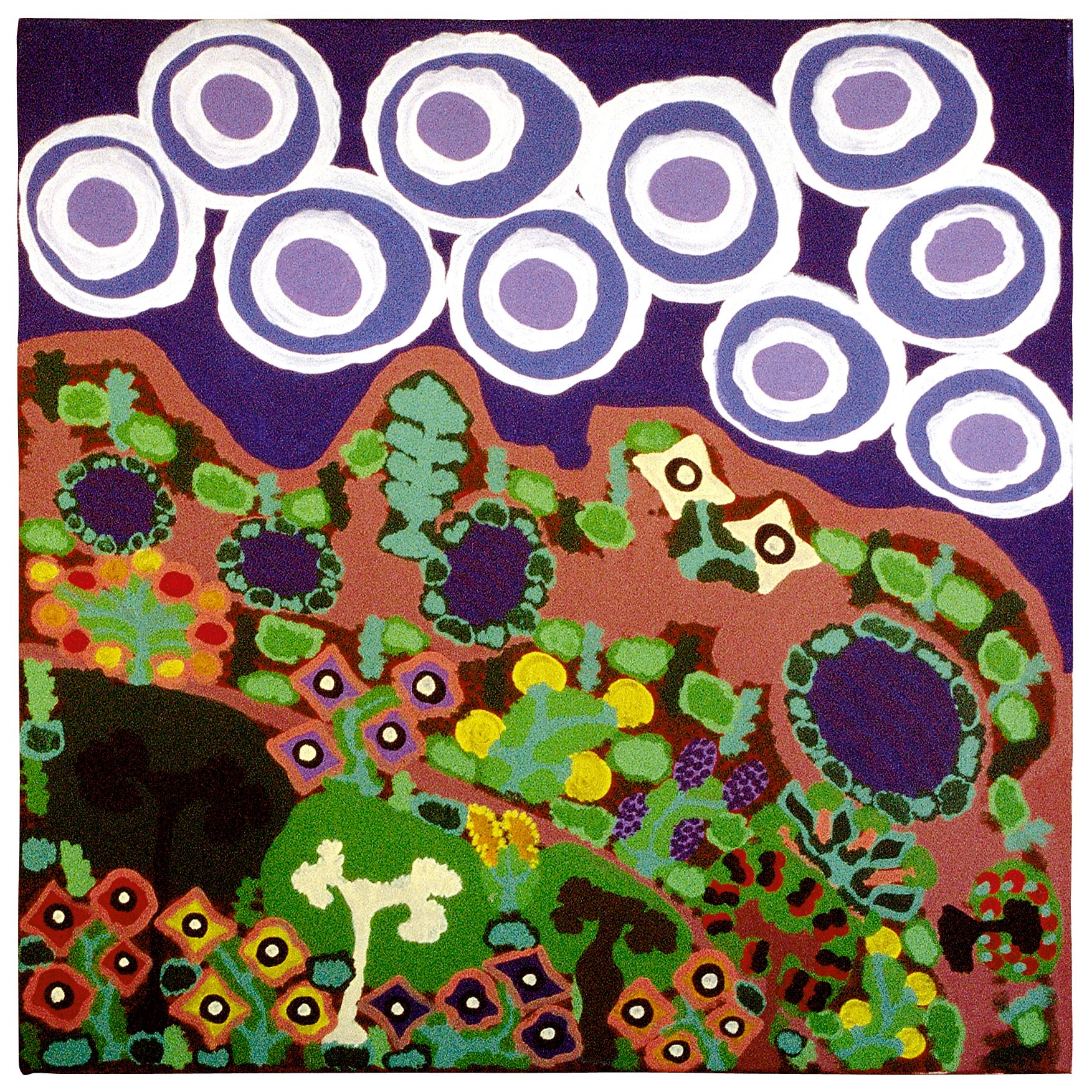
Daisy Napaltjarri Jugadai, My Country, Acrylic on canvas,
September 24, 2006
Heidegger & Puritjarra
Mike Smith, an archaeologist at ANU, says that between 1986 and 1990, he has carried out three seasons of digging at the rock shelter known as Puritjarra, and that he has spent the better part of a decade since then analysing and publishing the results. He says that a site like Puritjarra is not just sequence and chronology, but also a dynamic part of landscape - a place on someone's itinerary as they moved across western central Australia, stepping out across the desert.
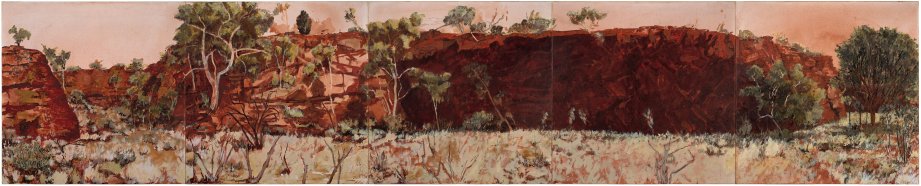
Mandy Martin, Puritjarra 3, Found local and sourced pigment, sand, ochre and acrylic on canvas
Mike Smith suggests that we can explore the links between people and place in Puritjarra by following the fortunes of Aboriginal people associated with the area as well as following the events shaping its cultural and natural landscapes ... bringing together archaeology, anthropology and history'. Can we connect this to Heidegger's argument that the modern devastation of nature is the result of the predominance of our modern “technological” understanding of the world, which, in turn, he sees as the culmination of the western “metaphysical” tradition. In his later writings on “dwelling” Heidegger presents an account of a wholesome “non-technological” understanding of the world. Was there a different understanding of the world at Puritjarra?
Mike Smith says:
The first people to visit Puritjarra would have found a huge domed rock shelter very like the one we see today. Structurally, it is a mature rock shelter. There is little evidence of any significant rock fall during the formation of the archaeological deposits, apart from some shedding of large boulders along bedding planes and slip faces in the centre of the overhang. The shelter owes its domed shape to slip faces inherited from an ancient Devonian dune, which now forms the sandstone roof of the shelter. This gives a sense of a desert within a desert. Standing in the deepest part of my excavations, I would be shoulder deep in a Quaternary desert, the walls of my trench spanning 100,000 years of desert history. But, looking up, I would see the hollowed out form of an ancient dune, literally the underside of an ancient coastal desert, about 360 million years older.
What of the people in this place? All Smith says is that though the archaeological evidence is imperfect, it provides a record of a society with deep roots, interacting with a series of changes in population, technology and landscape, and an overall trend over 300 centuries towards increasingly consolidated use of the Cleland Hills.
So how did they understand their place? It would be different from the technological understanding of the world that Heidegger says manifests itself as an estrangement from the world, an existential sense of homelessness. Technological man, swept along in the blind currents of fashion, fluid money markets and job flexibility, is portrayed as being no longer in touch with the earthiness of things.The people who dwelled at Puritjarra would be in touch with the earthiness of things.
September 23, 2006
Heidegger, dwelling, releasement
In his essay Building Dwelling Thinking, Heidegger argues that mortals dwell by safeguarding the fourfold (the belonging-together of earth and sky, divinities and mortals) in its essence:
Mortals dwell in that they save the earth. ... To save properly means to set something free into its own essence. To save the earth is more than to exploit it or even wear it out. Saving the earth does not master the earth and does not subjugate it .... Mortals dwell in that they initiate their own essential being -their being capable of death as death - into the use and practice of this capacity, so that there may be a good death.
In this 'precarious age', we have forgotten how to dwell, have forgotten to save the earth. As Simon P. James says in his article, 'Heidegger and the Role of the Body in Environmental Virtue':
To free ourselves of the alienating influence of technology and recover our rootedness in the world, Heidegger maintains that we must cultivate a mode of being he calls a "releasement toward things." To be "released" toward a thing is to attend to it as the particular thing that it is, rather than as a placeholder for some other thing that would serve the same function....When they are "let be" in this way, Heidegger writes that things "gather world." The idea here is that attending to a thing can illuminate a world, a world, that is, understood not as an object (planet Earth, for instance) but as an arena within which things show up as significant things in the first place.
James says that it is essential to realize that, in Heidegger's understanding, the phenomenon of a thing's gathering world does not primarily involve one's simply remembering a place distant in time, since it can involve the more interesting phenomenon of one's "coming home" to the place where one is presently abiding. It involves the phenomenon when, in a moment of clarity, one looks toward the cathedral of one's hometown as if for the first time, and is filled with a sense of belonging. In doing this, Heidegger maintains, we have made the strange "leap" "onto the soil on which we really stand," and out of the alienating grip of a technological mode of being that we currently live.
Can Heidegger's understanding'of a thing's gathering world' be connected to the people living in the Australian desert? Mandy Martin, who painted Puritjarra with aboriginal artists, says:
Puritjarra is a place held in the mind's eye of the artists who know it. Those allowed to paint its stories do so in a way that falls between mimetic and symbolic painting. Literally so, for some of the artists who are virtually blind now or too sick to visit such far away, inaccessible country, even though it is theirs. They create paintings that, as Nicolas Rothwell writes (of another place), 'for all the depiction of tree and earth, are not so much landscapes as memory-scapes-memorials to empty country.'.. Daisy captures in a stylised but dazzling personal language all the bush tucker of the place. Narputta does the same, but peoples the empty place with repeated brown figures standing naked amongst the abundant flowering plants and trees. It is some time since they have physically visited the place.
This painting the country connects with Heidegger's understanding of releasement. According to James:
In order to describe what releasement might involve, Heidegger cites examples of certain practices--pouring wine from a jug, cultivating crops, and so on---which, he holds, can be thought of as the constituents of a way of life he calls "dwelling"....Accordingly, releasement is exemplified not by the environmental philosopher serenely pondering the possibilities of reawakening a respect for things, but by the skilled craftsperson attuned to the materials with which he or she works--the cabinetmaker, for instance, "answering" and "responding" "to the different kinds of wood and to the shapes slumbering within the wood."...Clearly, when the released individual acts, he or she acts in a certain frame of mind, she might be attentive or appreciative or something of this sort, but releasement itself would not seem to be something exclusively cognitive, it would seem to be a bodily as much as a mental comportment.
Painting the country would be an example of releasement as a practice:
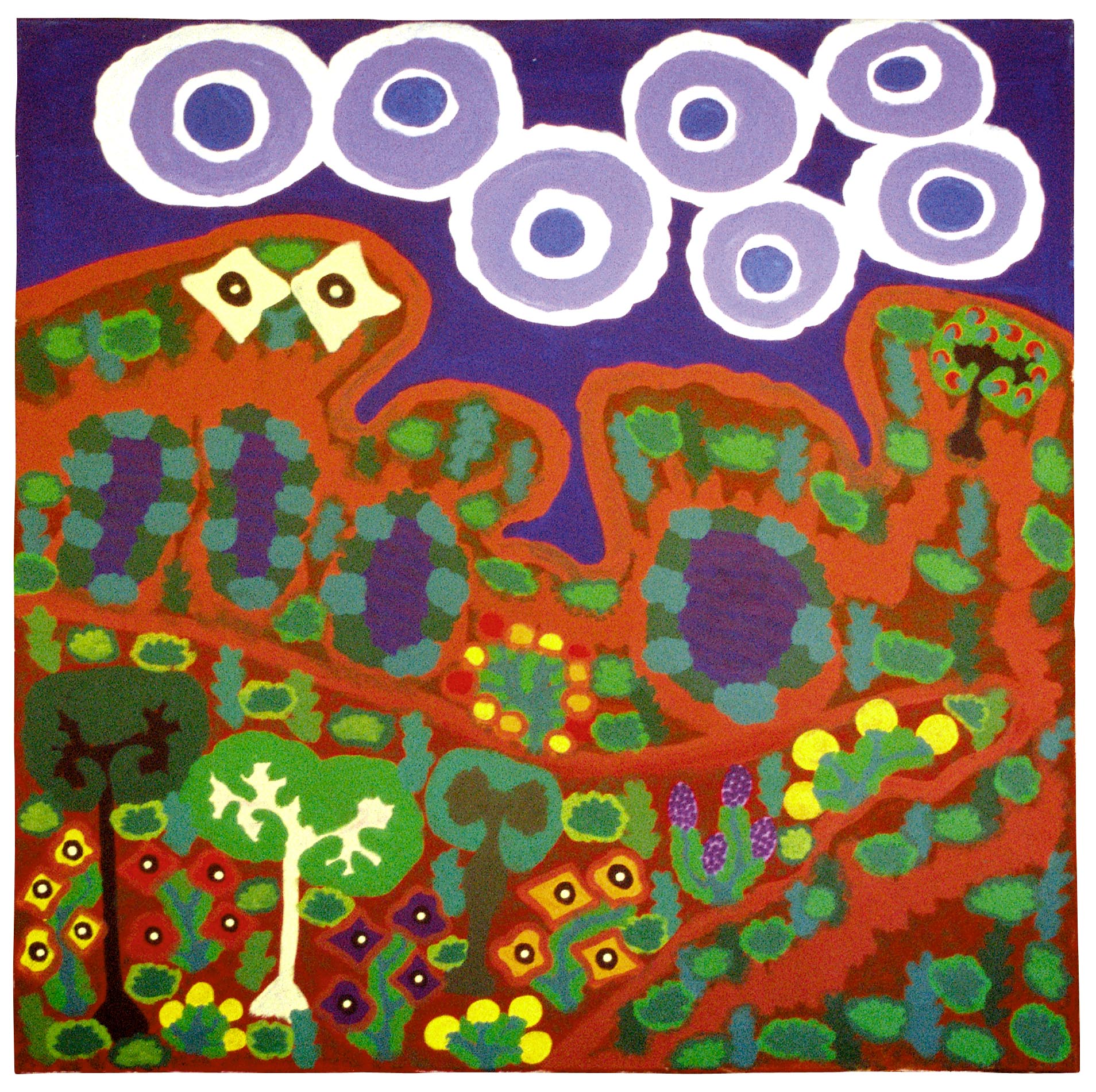
Daisy Napaltjarri Jugadai, Muruntji, Acrylic on canvas,
We do need to turn to eastern philosophy to understand what Hedeigger is saying.
September 22, 2006
desert places
Australian deserts are generally not often seen as specific places with their own history that can be read. Puritjarra, a rock shelter in the Cleland Hills in western central Australia provides archaeological evidence of human existence in the region going back 35,000 years.Libby Robin, in Strata: Deserts, Past, Present and Future describes this place:
We are in sandplain country travelling west, deep in Pintupi-Luritja country, beyond Haasts Bluff, some seven hours travelling west of Alice Springs. We are beyond where the MacDonnells are a solid range - they are now just outliers on our right, an archipelago of islands in a sea of desert. We are also beyond cattle, sheep, clay and reliable water. This blue mallee, spinifex and desert oak country continues on westwards from here, dominating sandplains all the way to the Pilbara in Western Australia.
Robin says that the sandplain country absorbs water like a sponge. Without a claypan base, even ephemeral waters are not retained, except in the rocky ridges. Desperate times forced western desert peoples to leave their country, so their movements are indicators of the ecological stress of long waterless periods, periods when water and food were scarce.
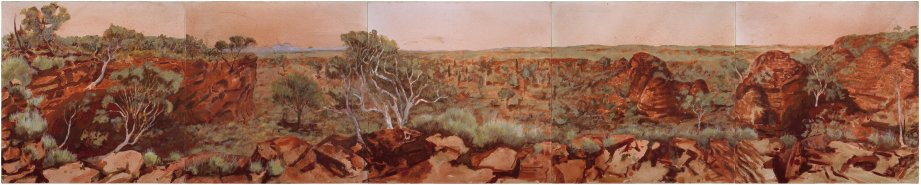
Mandy Martin, Puritjarra I, Found local and sourced pigment, sand, ochre and acrylic on canvas, 2004
As the introduction to this book says this:
is a very long history of dwelling in a place that is very dry and difficult for people to find water, food and shelter. Although the climate has varied over these millennia, Smith and others have established that this desert environment has been very dry for at least 100,000 years - and that most of the past desert environments in this long period have been at least as dry as conditions prevailing at present.
Dwelling evokes Heidgger's being, which is realized as "being-there" or "being-in-the-world".
Heidgger insisted that one cannot "be" in an abstract sense without being in and of a particular place, situation, or context- "Being-in-the-World," or Being-There, Dasein. Heidegger claims that humans do not "inhabit" like animals do-- they "dwell," and that "dwelling" takes place not so much in a site or "environment" as in a "world" --animals supposedly have no "world."
September 21, 2006
Zizek on the death of psychoanalysis
Slavoj Zizek says that in recent years, it’s often been said that psychoanalysis is dead. New advances in the brain sciences have finally put it where it belongs, alongside religious confessors and dream-readers in the lumber-room of pre-scientific obscurantist searches for hidden meaning. He asks:Is psychoanalysis outdated? He answers:
It certainly appears to be. It is outdated scientifically, in that the cognitivist-neurobiologist model of the human mind has superseded the Freudian model; it is outdated in the psychiatric clinic, where psychoanalytic treatment is losing ground to drug treatment and behavioural therapy; and it is outdated in society more broadly, where the notion of social norms which repress the individual’s sexual drives doesn’t hold up in the face of today’s hedonism. But we should not be too hasty. Perhaps we should instead insist that the time of psychoanalysis has only just arrived.
Why so? Zizek says that traditionally, psychoanalysis has been expected to enable the patient to overcome the obstacles preventing his or her access to normal sexual satisfaction: if you are not able to get it, visit an analyst and he will help you to lose your inhibitions. Now that we are bombarded from all sides by the injunction to ‘Enjoy!’, psychoanalysis should perhaps be regarded differently, as the only discourse in which you are allowed not to enjoy: not ‘not allowed to enjoy’, but relieved of the pressure to enjoy.
Zizek says:
In our ‘society of the spectacle’, in which what we experience as everyday reality more and more takes the form of the lie made real, Freud’s insights show their true value. Consider the interactive computer games some of us play compulsively, games which enable a neurotic weakling to adopt the screen persona of a macho aggressor, beating up other men and violently enjoying women. It’s all too easy to assume that this weakling takes refuge in cyberspace in order to escape from a dull, impotent reality. But perhaps the games are more telling than that. What if, in playing them, I articulate the perverse core of my personality which, because of ethico-social constraints, I am not able to act out in real life? Isn’t my virtual persona in a way ‘more real than reality’? Isn’t it precisely because I am aware that this is ‘just a game’ that in it I can do what I would never be able to in the real world?
He concludes: what appears in the guise of dreaming, or even daydreaming, is sometimes the truth on whose repression social reality itself is founded. Therein resides the ultimate lesson of The Interpretation of Dreams: reality is for those who cannot sustain the dream.
September 19, 2006
psychoanalysis, happiness,subjectivity
One way that we can broaden the debate on economics and happiness is through a psychoanalytic understanding of the subject, or in this case a psychoanlaytic perspective on liberal consumerist subjectivity. The dominant understanding of the subject--eg., economics--- has historically given precedence to the autonomy and self-consciousness of the human being and experience over the social and cultural situation in which human beings live and act. This gives us self-knowing, unified, and stable self. Psychoanalysis forms a deep ground for the challenge to the Cartesian subject or humanist idea of the self: a being who is fully conscious and fully present to himself, and who lives outside of his language and symbols, which are only tools through which he articulates the truth and stability of an identity which transcends culture.
Contemporary concepts of subjectivity (postmodern) emphasize the link between power, language, and identity and the fundamental interdependence of human beings with their social and cultural environment.Thus we have Clive Hamilton's true self and false self created by the seduction of our desires by advertisers. We can introduce the split subject of psychoanalysis. Psychoanalysis questions the subject's autonomy in that individuals are always "split" subjects, divided between the levels of their conscious awareness and the unconscious. Subjects are always divided between what they consciously know and can say about market things, and a set of more or less unconscious beliefs they hold concerning individuals in consumer advertising, and the kind of economic regime in which they live.
On this account advertisers tap into our unconscious desires and we buy consumer goods because they affirm our deepest desires about what we want to be. So we are not doing what the libertarians----those who think that individuals should be free to pursue whatever they desire ---say we are doing: choosing the kind of person we want to become. If the libertarian self is an ongoing project of taking responsibility for your own life, then it is within power relations and cultural order of the market that shape our desires. How we interpret our desires is formulated by our culture; 'interpret' here should be understood in the fullest sense -- this is how we experience them.
In Freudian psychoanalysis, subjectivity designates a process governed by what lies outside the control of the consciousness of the individual, namely by the violent impulses or desires of the unconscious. It holds that these need to be, and can be, integrated into a psychological whole and it gives us the endless negotiation between the socialised self, the ego, and the primitive animal self, the id. This is a formalisation of the age-old problem of human being's struggle against their carnal urges, (or in religious terms, 'original sin' ). In post-Freudian psychoanalysis subjectivity depends on language and is radically "decentered" or alien to itself. It is the product of both a distorted reflection of itself in someone else's eyes and of a system of language) that pre-exists the subject and is shared by all and
controlled by none. In this sense, subjectivity is not the discourse of the autonomous self as understood by the libertarians.
September 18, 2006
happiness, wellbeing, flourishing
There is an interesting post by Don Arthur over at Club Troppo on happiness, which can be interpreted as part of this debate on the relationship between economic progress and happiness. Does economic progress lead to greater happiness?
Clive Hamilton at the Australia Institute has argued that money doesn't buy happiness. This argument basically says that the ethos of neo-liberalism places too much emphasis on money and not enough on the things that really matter. Can't buy me love etc. We may be richer in terms of household income but our quality of life has deteriorated. The debate has been joined by Andrew Norton.
There has been a tendency to run happiness and wellbeing together, and when they are distinquished in terms of interpreting wellbeing in terms of the Aristotelian idea of eudaemonism as flourishing life, this is often interpreted (eg., by Hamilton) in the terms of the true self as opposed to the false self seduced by advertisers appealing to our deepest desires. Now that is not Aristotle. Hamilton's talk about a true self and spirit is a distorted interpretation of Aristotle.
Aristotle's conception of 'happiness' (a utilitarian category) is the good life which can be interpreted as a flourishing life well lived. That is an objective conception---what is good for the organism---and not the subjective one of the utilitarians---happiness according to my individual preferences or desires.
Aristotle operates with an organic conception of human nature--as distinct from the mechanistic conception of the utilitarians---and he holds that human beings are self-organizing and so are different from watches.
The talk about essences in Aristotle refers to what makes a thing or entity what it is as distinct from some other thing. So some hold that blond hair or a penis is not a what characterises the difference between a human being and stone. It is more likely to be rationality or language use.
Aristotle was reworked by Hegel and Marx in terms of essences and appearances in that a thing can appear to be 'x' but is actually 'z' (eg.,a market society appears to a collection of free individuals acting in terms of self interest but is essentially structured by power relations) whilst holding to the objectivity of appearances. They are just as real as the power relations. Platonism (appearances are illusions) has been dumped.
Hamilton 'true self' talk is actually linking back to the classical Marxist definition of ideology as a (market) discourses that promote false ideas (or "false consciousness") in subjects about the political regimes and societies they live in. Because these ideas are believed by the subjects to be true, they assist in the reproduction of the existing status quo. To critique ideology, according to this position, it is sufficient to unearth the truth(s) the ideologies conceal from the subject's knowledge. Then, so the theory runs, subjects will become aware of the political shortcomings of their current way of life and be able and moved to better them.
Zizek has argued that the operation of ideology today is not "they do not know it, but they are doing it", as it was for Marx. It is "they know it, but they are doing it anyway". Zizek's position is that nevertheless this cynicism (about market ideology) indicates the deeper efficacy of political ideology per se. Ideologies, as political or rmarket discourses, are there to secure the voluntary consent. Zizek argues, subjects will only voluntarily agree to follow one or other such arrangement if they believe that, in doing so, they are expressing their free subjectivity, and might have done otherwise.
September 16, 2006
Zizek reviewed #2
I'm returning to Fredric Jameson's review of Zizek's The Parallax View on the London Review of Books site. An illustrated version of the Jameson review of Zizek's text can be found at Subject Barred. It is visually interesting.
Jameson says that Zizek's insistance:
on appearance now seems to bring us around unexpectedly to the whole vexed question of postmodernism and postmodernity, which is surely nothing if it is not a wholesale repudiation of essences in the name of surface, of truth in the name of fiction, of depth (past, present or future) in the name of the Nietzschean eternally recurring here-and-now. Zizek seems to identify postmodernism with 'postmodern philosophy' and relativism (an identification he shares with other enemies of these developments, some of them antediluvian, some resistant to the reification of the label), while on the other hand he endorses the proposition of an epochal change, provided we don't call it that and provided we insist that it is still, on whatever scale, capitalism--something with which I imagine everyone will nowadays be prepared to agree. Indeed, some of his basic propositions are unthinkable except within the framework of the epochal, and of some new moment of capitalism itself; Lacan is occasionally enlisted in the theorisation of these changes, which have taken place since Freud made his major discoveries.
We have seen some of these basic propositions in this post.Jameson then useful explores the category of jouissance. Jouissance is usually translated from the French as “enjoyment”. As opposed to what we talk of in English as "pleasure", though, jouissance is an always sexualised, always transgressive enjoyment, at the limits of what subjects can experience or talk about in public. The result of transgressing the pleasure principle is not more pleasure, but pain, since thre is only a certain amount of pleasure that the subject can bear. Beyond this limit, pleasure becomes pain, and this "painful pleasure" is what Lacan calls jouissance: jouissance is suffering.
Jameson says that jouissance is perhaps the central or at least the most powerful category in Zizek's explanatory resources; a category capable of projecting a new theory of political and collective dynamics as much as a new way of looking at individual subjectivity.He says that to grasp the implications it is best to see jouissance as a relational concept rather than some isolated ultimately determining instance or named force.
In fact, it is the concept of the envy of jouissance that accounts for collective violence, racism, nationalism and the like, as much as for the singularities of individual investments, choices and obsessions: it offers a new way of building in the whole dimension of the Other (by now a well-worn concept which, when not merely added mechanically onto some individual psychology, evaporates into Levinassian sentimentalism). The power of this conception of envy may also be judged from the crisis into which it puts merely consensual and liberal ideals like those of Rawls or Habermas, which seem to include none of the negativity we experience in everyday life and politics. Zizek, indeed, includes powerful critiques of other current forms of bien-pensant political idealism such as multiculturalism and the rhetoric of human rights admirable liberal ideals calculated to sap the energies of any serious movement intent on radical reconstruction.
All these ideals presuppose the possibility of some ultimate collective harmony and reconciliation as the operative goal or end of political action. They are associated, for Zizek, with an absence of antagonism that Zizek’s identifies as human subjectivities permanent split: it bears a gap within itself, a wound, an inner distance that can never be overcome.
September 15, 2006
Heidegger's ethical current
In Chapter 5 of his thesis Robert Tulip says that there'is a definite ambiguity, if not a real lack of consistency, in the relation between the ethical dimension of his thought and his denial of the significance of ethics for his ontology as a whole.'
He locates the ethical undercurrent in Heidegger's texts as a response Nietzsche's understanding of nihilism as the emptying out of the values of society. Tulip says that with the traumatic and meaningless situation of the collapse of everything previous thought had relied on, it had become essential to begin anew to establish a phenomenal ground for meaning. Only by genuinely confronting indisputable truths, such as pain, death and love, can we break free from destitution and start to again become "capable of our own mortality". Tulip says:
With this last statement, the ethical message implicit in his ontology starts to break out of the restraints he has placed around it. The disclosure of pain, death and love, the hardest truths of life, is only possible on the basis of a resolute authenticity which is at once caring, open and true to itself. An important factor for the development of a possible ethical meaning for Heidegger's ideas is thus that becoming "capable of mortality", in all its anguish and limitation, is an essential precondition for authenticity.
Consequently, as Tulip points out, Heidegger's 'grounding of ontology in existence, although presented as purely ontological, actually establishes a relation which is ethical in essence, because taking it seriously effects a transformation in our conduct, away from the false values of both metaphysics and ignorance, towards the authentic values of truth, care and openness.'
September 14, 2006
ethics in Heidegger
This thesis by Robert Tulip is interesting, given Levinas' ethical turn against Heidegger's ontology. It explores through:
an analysis of texts including Being and Time, An Introduction to Metaphysics and the Letter on Humanism, that Heidegger's existential ontology contains a significant ethical dimension. His focus on the 'question of the meaning of Being' gives the impression that his writings had little relation to ethics, but his thought must be interpreted in ethical terms because his phenomenological analysis of human existence (Dasein) understood meaning and truth in relation to humanity.
So we have an ethical ontology, or rather a definite ethical undercurrent informing Heidegger’s work, that is not made explicit and remains at the level of an undercurrent, or an impulse giving direction and meaning to his ideas.The ethical implication is that the existential analytic must necessarily address the wellsprings of action; in its concern about dispositions and attitudes, moods and emotion, the existential analytic immediately confronts phenomena which are key motivations of human behaviour. In Chapter 5 of the thesis Tulip says:
If these existential phenomena are excluded from the domain of philosophical truth, as demanded by traditional metaphysics, the search for truth will be forced to relegate major practical areas of ethical concern to the status of passionate opinion and will be unable to comment. The traditional separation of ontology and ethics underlying this attitude was formalised by David Hume, whose doctrine that reason is the slave of the passions implied that interest, rather than logic, was the basis of morality, and that statements of fact, the only proper concern of ontology, can provide no guidance about what we ought to do. In similar vein, Kant, who held that the twin sources of philosophy are “the starry heavens above and the moral law within”, held that these two are respectively the objects of separate critiques of pure and practical reason
Heidegger, in contrast, focuses on integrating the rational and the affective, bringing moods and dispositions within the horizon of thought as essential constituent ‘existentiales’ of Dasein.
September 13, 2006
a comment on Levinas
Terry Veling wrote a straight-forward and authoritative article entitled "Facing Me" for the Melbourne Age about Levinas's understanding of ethics. I found the link to the article here. Unfortuantely, I have not been able to find the original article in The Age. Here is an extract:
'According to Levinas, we experience the transcendence of life primarily in the face of the human person. Every face we encounter is a face of otherness. Every face says, "I am other to you." Every face says, "I am not you." Every face says: "Don't kill me, don't absorb me into your world, don't obliterate me by making me the same as you. I am other. I am different. I am not you."
The face of the other breaks into my world and calls out to me. I am not an I unto myself, but an I standing before the other. The other calls forth my response, commands my attention, refuses to be ignored, makes a claim on my existence, tells me I am responsible. And this always. I will never be freed from the face of the other. So much so, that we are never released from the other's speaking to us and calling forth our response. As the haunting phrase of Matthew's gospel says, "the poor you will always have with you" (26:11). And as Levinas says, "it is impossible to evade the appeal of the neighbour, to move away." The human person "faces" me, and this "toward me" is both a profound appeal against my indifference to your naked vulnerability, and an accusation that prohibits my violence toward you.
"Being faced" means finding ourselves faced by a continual requirement of responsibility to and for the other. Even a casual reflection on our lives will reveal how bound we are to others, how constantly we are beset by the demands of obligation and the requirements of love - to family and friends, to those we work with, to neighbours and strangers, to those in our society whom we do not know yet whose claim on our lives we feel nevertheless.
This is a simple and yet increasingly stunning thought for me. The face of the human person, those that I encounter every single waking day of my life - on buses and trains, in the streets, at work, on television - everywhere, everyday, the "other" is before me, facing me. Perhaps this is what is meant when the biblical tradition says that humanity is made in the "image of God"...
September 12, 2006
Levinas: Entre Nous
I bought a copy of Levinas's Entre Nous Thinking-of-the-Other this afternoon. The book is a collection of essays written over a long period of time starting from 1951--'Is Ontology Fundamental'. As I came to understand in beginning to read expressed in Totality and Infinity Levinas’s phenomenology of existence focused on intersubjectivity and asserts the primacy of ethics. It is the ethical turn in French philosophy in which ethics is accessible through the human experience of the other open to all.
Levinas’s insistence on the ethical as the foundation for the human self hinges largely on the concept of the other, who transcends the self’s natural solipsism and penetrates the totality of history through the face, and whose gaze beckons us to realm of the infinite, thus summoning us to follow the imperative of ethics. It is this concept of the other as the central reference for ethics that has become the hallmark of Levinas’s philosophy.
In the essary 'Is Ontology Fundamental' levinas writes:
Thus we are responsible beyond our intentions. I t is impossible for the attention directing the act to avoid inadvertent action. We get caught up in things; things turn against us.That is to say that our conscioussness, and our mastery of reality through consciousness, do not exhaust our relationships with reality, in which we are present with all the density of our being. It is the fact that, in Heidegger's philosophy, our consciousness of reality does not conicide with our dwelling in the orld that has created a strong impression in the literary world.
September 11, 2006
9/11: Remembrance
Five years on the site of the World Trade centre has become known as ground zero. Some images are still too raw and jarring for Americans.
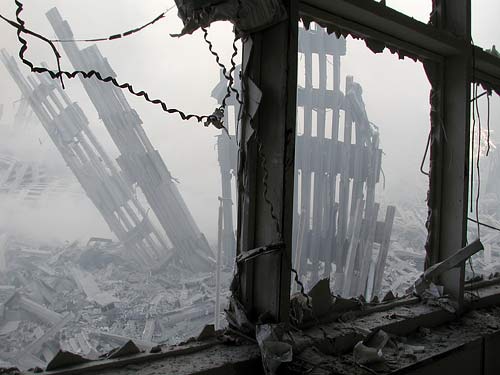
John Albanese
Ground zero is now a scared site in New York.
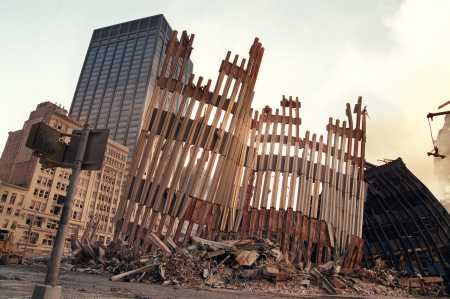
Nick Fanelli
Graham Morrison
Memorial events were taking place around the world today on the fifth anniversary of the 9/11 attacks in the US. I've just watched on television the thousands of people at Ground Zero gathering for a moment's silence to mark the time when the first plane hit one of the twin towers five years ago.
What is lacking is a cognitive mappingof 9/11 that is different from Washington's 'war on terrorism' narrative. Slavoj Zizek approaches this by asking: 'What, then, is the historical meaning of 9/11? It's a good question. He says:
...terror legitimises the all-too-visible protective measures of defence. The difference of the war on terror from previous 20th-century struggles, such as the cold war, is that while the enemy was once clearly identified as the actually existing communist system, the terrorist threat is spectral. It is like the characterisation of Linda Fiorentino in The Last Seduction: most people have a dark side, she had nothing else. Most regimes have a dark oppressive spectral side, the terrorist threat has nothing else.
That is whywe often suspect that the terror alerts---Sydney is not safe--- are designed to accustom us to a permanent state of emergency. Where all that is publicly visible are the anti-terrorist measures themselves - a space is opened up a space for manipulation of such events.
Zizek also says that:
Today, we live in a post-utopian period of pragmatic administration, since we have learned the hard lesson of how noble political utopias can end in totalitarian terror. But this collapse of utopias was followed by 10 years of the big utopia of global capitalist liberal democracy. November 9 thus announced the "happy 90s", the Francis Fukuyama dream of the "end of history", the belief that liberal democracy had, in principle, won, that the search was over, that the advent of a global, liberal community was around the corner, that the obstacles to this Hollywood happy ending are merely local pockets of resistance where the leaders have not yet grasped that their time is over.
September 8, 2006
Zizek on postmodernity
In this article in the London Review of Books Zizek says that in postmodernity:
Everything is turned back to front. Public order is no longer maintained by hierarchy, repression and strict regulation, and therefore is no longer subverted by liberating acts of transgression (as when we laugh at a teacher behind his back). Instead, we have social relations among free and equal individuals, supplemented by 'passionate attachment' to an extreme form of submission, which functions as the 'dirty secret', the transgressive source of libidinal satisfaction. In a permissive society, the rigidly codified, authoritarian master/slave relationship becomes transgressive. This paradox or reversal is the proper topic of psychoanalysis: psychoanalysis does not deal with the authoritarian father who prohibits enjoyment, but with the obscene father who enjoins it and thus renders you impotent or frigid. The unconscious is not secret resistance to the law, but the law itself.
That is a major rupture with puritan capitalism of the nineteenth and early twentieth century.
Zizek says that the psychoanalytic response to the 'risk-society' theory of the reflexivisation of our lives is not to insist on a pre-reflexive substance, the unconscious, but to suggest that the theory neglects another mode of reflexivity. For psychoanalysis, the perversion of the human libidinal economy is what follows from the prohibition of some pleasurable activity: not a life led in strict obedience to the law and deprived of all pleasure but a life in which exercising the law provides a pleasure of its own, a life in which performance of the ritual destined to keep illicit temptation at bay becomes the source of libidinal satisfaction.
That's quite a reversal.
Zizek adds:
Regulatory power mechanisms and procedures become 'reflexively' eroticised: although repression first emerges as an attempt to regulate any desire considered 'illicit' by the predominant socio-symbolic order, it can only survive in the psychic economy if the desire for regulation is there - if the very activity of regulation becomes libidinally invested and turns into a source of libidinal satisfaction.
Everything has been sexualized.
September 7, 2006
notes on the sublime
The Romantics understood the sublime to be central to an appreciation or awareness of art and nature. Both terrifying and exhilarating, sublime experience defined the work of authors and artists who sought to stretch the bounds of sensory perception, and represented one of the most important challenges to the rationalism of Enlightenment thought. The sublime had little traction during twenthieth century modernism and it is often held that the sublime goes into cold storage after romanticism and the decay of the Romantic aesthetic.
The sublime has returned in postmodernity clustered around in the idea of limit-experience
The two major philosophers of the sublime are Edmund Burke and Immanuel Kant. Both distinquished the sublime from the beautiful. Burke understood the sublime in termsd of the imagination being moved to awe and instilled with a degree of horror by what is "dark, uncertain, and confused." He associates it with self-preservation.
Kant understood the sublime in terms of greatness and boundlessness, and he talked in terms of one's inability to grasp the enormity of a sublime event, such as an earthquake, or death, or absolute disaster (the Holocaust).The (dynamically) sublime names experiences like violent storms or huge buildings which seem to overwhelm us; that is, we feel we 'cannot get our head around them'. Kant argues however, that the sublime is more than the mere overwhelmingness of some object: what is actually sublime are ideas of our own reason, namely, the ideas of absolute totality or absolute freedom. Hence the sublime is linked to the moral idea of freedom. Though the sublime is a two-layered experience what is properly sublime and the object of respect is the idea of reason, rather than the awesomeness of nature.
Jean-François Lyotard reworks Kant in that , for him, the sublime's significance is in the way it points to an aporia in human reason; it expresses the edge of our conceptual powers and reveals the multiplicity and instability of the postmodern world. The attempting to think impossible thoughts, embrace paradox, face inconceivable disaster: these themes have been taken up by Jacques Derrida and Maurice Blanchot, who both write of encountering limit-experiences that produce sublime emotions.
September 5, 2006
Detritus
From Sleeping by the Mississippi
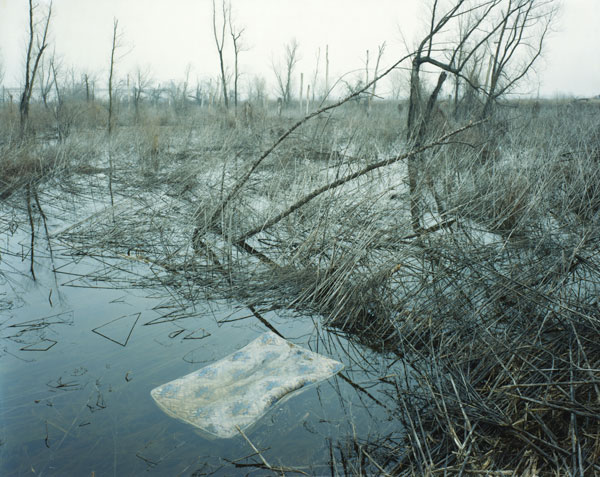
Alec Soth, Helena, Arkanas, 2002
it is not quite detritus is it. That refers to organic waste. This is human rubbush--treating nature with no respect.
September 3, 2006
Zizek reviewed
Fredric Jameson reviews Slavoj Zizek's The Parallax View, which attempts to rehabilitate dialectical materialism. Jameson says:
Zizek is one of the great contemporary practitioners. The old stereotype is that Hegel works according to a cut-and-dried progression from thesis, through antithesis, to synthesis. This, Zizek explains, is completely erroneous: there are no real syntheses in Hegel and the dialectical operation is to be seen in an utterly different way; a variety of examples are adduced. Still, that stupid stereotype was not altogether wrong. There is a tripartite movement in the Hegelian dialectic, and in fact, Zizek goes on, he has just illustrated it: stupid stereotype, or the 'appearance'; ingenious correction, the underlying reality or 'essence'; finally, after all, the return to the reality of the appearance, so that it was the appearance that was 'true' after all.
Well the objectivity of appearance is a better position than saying appearances are an illusion and only essences are real--as held by Plato.
Jameson goes on to say that:
This is why the dialectic belongs to theory rather than philosophy: the latter is always haunted by the dream of some foolproof self-sufficient system, a set of interlocking concepts which are their own cause. This dream is of course the after-image of philosophy as an institution in the world, as a profession complicit with everything else in the status quo, in the fallen ontic realm of 'what is'. Theory, on the other hand, has no vested interests inasmuch as it never lays claim to an absolute system, a non-ideological formulation of itself and its 'truths'; indeed, always itself complicit in the being of current language, it has only the vocation and never-finished task of undermining philosophy as such, by unravelling affirmative statements and propositions of all kinds. We may put this another way by saying that the two great bodies of post-philosophical thought, marked by the names of Marx and Freud, are better characterised as unities of theory and practice: that is to say that their practical component always interrupts the 'unity of theory' and prevents it from coming together in some satisfying philosophical system. Alain Badiou has recently coined the expression 'anti-philosophy' for these new and constitutively scandalous modes of intervening conceptually in the world; it is a term that Zizek has been very willing to revindicate for himself.
Hell, we have long ago rejected the modern idea of philosophy as the dream of some foolproof self-sufficient or absloute system, a set of interlocking concepts which are their own cause. Philosophy since Heidegger has long returned to everyday life.
September 2, 2006
anti-humanisms
It's everywhere these days isn't it. The genes explain everything. They drive the world and us. We are born hard-wired and pretty well everything about us can be explained in terms of the survival of the genome. Culture is written into our genes and reason is a product of natural selection. We are but devices created by our genes for their own survival.
 Bruce Petty
I guess it makes a change from the older kind of a full blown full-blown reductive naturalism--- the physicalists who used to say that we are nothing but molecules, or nothing but atoms, or nothing but protons, electrons, and neutrons (this was before quarks.)
Biological reductionism is a form of anti-humanism as it skewers the view that human beings are conscious moral agents, able to influence, if not control, their collective future. Yet this anti-humanism is often ignored---rarely do you hear the argument against the assumption that naturalism entails reductionism. The latter presupposes that, in studying any higher organizational entity, the whole can be explained by the parts, the complex by the simple, the higher by the lower. If you are 'depressed', it is because you have a biochemical imbalance, rather than, perhaps, that your life has no meaning, have no job or in a bad relationship. If one goes to war it is because of individual 'aggressive genes', rather than complex socio-political forces over which we have little control.
Suprisingly the conservative focus is on the anti-humanism within the humanities departments of universities---not that of biology departments. What is in the foregrround is the heady mix Freudianism Marxism, structuralism and post-structuralism, that highlighted the psychological unconscious of Freud (and Lacan), the historical unconscious of Marx (and Althusser) and the semiotic unconscious of structuralism. This is an anti-humanism because the the self is merely a set of nodes in a system of linguistic and non-linguistic signs, so that far from speaking language, language spoke in them. We are soluble fish in a sea of discourse, whose dominant forms — and what passes for objective truth is determined by power.