October 31, 2006
traces
This 1950's underground bunker Codename "Turnstile" was intended to be the UK Government's very own emergency hideaway in the event of nuclear war. This was at a time when the fear of nuclear weapons was at its highest.

Jason Orton
Orton's photographs represent the traces of human habitation of this cold war time capsule. I'm not sure a 'trace' captures the reality of nuclear technology.
October 30, 2006
heidegger & marx?
Is there a relationship? Was there an engagement in a philosophical sense?
Michael Eldred says that
from the standpoint of the respective issues of Marxian and Heideggerian thinking, there is, at least for me, an unsettling point of contact, a locus of striking similarities between Marx's and Heidegger's texts which absolutely challenges us to delve into the issue. It is a kind of overlapping between Marx's late texts and those of Heidegger's with regard to their respective assessments of the modern epoch: the epoch of the bourgeois-capitalist form of society on the one hand, and the technical age on the other, as they reveal themselves respectively in the texts of each thinker, reveal remarkable resemblances, despite all their profound differences. It will be worthwhile comparing the language of the set-up (Gestell) with that of capital, and closely and persistently investigating both these languages (and the thoughts they express) in their relatedness as well as their essential difference
Does Marx continues the philosophical tradition ratehr than questioning it? Is that how Heidegger sees Marx?
October 29, 2006
October 27, 2006
identity politics
Michael Collins in a review of Amartya Sen's latest book --Identity and Violence: the Illusions of Identity--- at Open Democracy says that Sen challenges the communitarian philosophy that our identity is something fixed, to be realised and acknowledged as one would a pre-existing natural phenomenon. This presupposition underpins the basis of fundamental neoclassical economics: the 'rational agent' who makes decisions independent of political, social and historical situations. The reality is that we all have multiple identities and so a single fixed identity involves have the fallacy of defining the multiple and shifting identities present in every human being in terms of a single, unchanging essence.
Edward Said has argued that the practice whereby the fluid and evolving nature of identities, as well as the differences within cultural or civilisational groupings, are obscured has been (and remains) part of the way in which the West has viewed and constructed identities for its 'others'. The superficially diverse but essentially monolithic body of humanity that Europeans began to encounter from the fifteenth century onwards, and which - bound together by their supposed irrationality - acted as a foil to Europe's self-identified 'Age of Reason' in the seventeenth and eighteenth centuries. In turn, however, the rise of 'Occidentalism' has come to countervail 'Orientalism' and inform the way in which 'the East' views Europe, America and 'the West'; often exhibiting a similar tendency to caricature and simplify.
This helps to make sense of the 'liberal' criticism of the small number of Muslim women who wear the niqab. This liberal opposition presupposes an explicit kind of freedom to choose within pre-defined boundaries. So we have the irony of liberals forcing women to take off their veils, thereby undercutting the western liberal values of tolerance and democracy. This reduces Muslim people to members of religious communities and to being carriers of a monoculture.
Collins says that the issue of the niqab:
...elaborates Sen's theoretical framework, encouraging us to address the web of meanings within which women might choose to wear such a garment. Some women may wear a veil through fear of punishment. Others may be rejecting the degrading commodification of the female body in modern capitalist societies. Or they may be computing a host of factors at the same time, allocating different weight to each.
Denying this multiplicity leads to the poiltics of them and us and conform or get out.
October 25, 2006
difference
The traditional metaphysical relationship between identity and difference is not just a topic of discussion amonmgst philosophers. It is also embodied in every day life, where it becomes a political issue. It signifies separateness for some.

These meanings around the veil mean that it won't go away as a political issue. The French have banned not only the full veil but also head scarves in schools. Some German regions have banned the head scarf for civil servants, and they are not permitted in Turkish universities at all. The British are debating and fighting over it, and slowly the issue is coming to the United States. Debate about the veil inevitably leads to discussions of female emancipation, of religious freedom, and of the assimilation, or lack thereof, of Muslim communities in the West.
Anne Applebaum has an article in Slate that picks up on the issue that I mentioned here ---Muslim women wearing a veil that covers the whole of the face except the eyes (niqab) in western liberal democracies.
In the article she says:
And yet, at a much simpler level, surely it is also true that the full-face veil---the niqab, burqa, or chador---causes such deep reactions in the West not so much because of its political or religious symbolism, but because it is extremely impolite. Just as it is considered rude to enter a Balinese temple wearing shorts, so, too, is it considered rude, in a Western country, to hide one's face. We wear masks when we want to frighten, when we are in mourning, or when we want to conceal our identities. To a Western child--or even an adult--a woman clad from head to toe in black looks like a ghost. Thieves and actors hide their faces in the West; honest people look you straight in the eye.
If Western tourists can wear sarongs in Balinese temples to show respect for the locals, so, too, can religious Islamic women show respect for the children they teach and for the customers they serve by leaving their head scarves on but removing their full-face veils.
Is it that cut and dried?
Jodie over at Long Sunday says that 'the emphasis on the face as the single element marking Western-ness seems arbitrary. If there are a variety of practices of display and concealment, practices that change over time, then covering or revealing the face should be understood within this larger field of variation.' Secondly, Jodi argues that Applebaum runs tourism and citizenship together.
October 24, 2006
Heidegger: rethinking technology and metaphysics
Holger Schmid, in his paper "Heidegger: Logos and the Essence of Technology," given at the Proceedings of the 35th Annual Meeting of The North American Heidegger Society, questions the interpretation of Heidegger as a romantic. We have to rely on Michael Kelly's interpretation of the paper. Kelly says that:
Rather than a form of romanticism, Schmid argues that Heidegger's fascination with the Greeks, particularly Aristotle and Heraclitus, results from his desire to uncover the relation between modern technology and the birth of metaphysics. In his essay on Heraclitus' fragment B 50, Heidegger talks of the forme''s notion of logos as a 'flashing' up of the primordial unthought essence of language, a laying-out or laying-before (lege), which constituted a unity of world and language, a unity upon which language was considered parasitic. Schmid maintains that with the extinction of Heraclitus' 'flash,' completed in Aristotle's De interpretatione where speech, semainein, first appears as knowing, the former's logos comes to take on the meaning of language understood as a tool of ordered, calculative reason. The apophantic dimension of the original encounter with being now is lost, and the course of the essence of modern technology, which, of course, is nothing technical, now is set (PHC 109-111). Schmid terms this new phase of logos under Aristotle the unpoetic, and clearly it imposes the limit of excluding the primordial relation between world (or being) and language, for it ensnares entities within its 'ordered' propositions. Hence, the essence of modern technology consists in the world showing itself in concealment only...
Do we need to return to Heraclitus to grasp the direct connection between the height of the technological age and the beginning of metaphysics through thinking, then rethinking Heraclitus' logos, the original connection of world and language? Why cannot we do the rethinking from the present technological domination from within technoscience?
Since few of us have the skills or the education to rethink a Heraclitean fragment in ancient Greek, why cannot we situate a critical philosophy in modernity's time-consciousness so that it understands itself as fully situated in its time with an ever-shifting and open-ended horizon of possibilities, to which it responds by disclosing alternative ways of thinking and acting. Isn't an alternative way of thinking within the technological enframing of technoscience a caring for the survival of the ecosystems that support human live? One that avoids the ecotopian project of 'returning to nature' ----fleeing the city or embracing wilderness.
Freya Mathews has a passage in her Reinhabiting Reality, which resonates strongly with the critique of technological 'enframing' (as distinct from poietic techne) developed by Martin Heidegger. She states that:
Modern society does not engage with world but encroaches upon it. It does not tend and cherish the ground of being, bringing forth in new poetic forms that which is already potentiality within it, but blasts and quarries the ground, imposing its own alien designs upon it. (RR, 23)
The result, as Mathews poignantly illustrates with regard to the industrial makeover of her own childhood home on the erstwhile urban-rural fringe of Melbourne, is a world rendered into blocks, devoid of the complex contouring and mysterious meanderings of natural becoming, utterly empty of meaning and stripped of grace.
She suggests that an alternative way of thinking and acting of conserving and cherishing the ecosystems that support human life: healing those things and places that are given to us here and now, such that they might become more conducive to the flourishing of more-than-human life.
October 22, 2006
dumping Adorno
In this article in Axess Eric Bonner says that reclaiming Enlightenment has become a matter of importance. Here is the argument:
Many on the left have come to consider the Enlightenment with its commitment to universal values as imperialist in its intent and a form of domination that privileges the white, male, bourgeois scientific, capitalist and imperialist worldview associated with the West. Conservatives have, meanwhile, juxtaposed the Enlightenment against Islam as justifying a "clash of civilisations." Both underestimate the radical and critical character of the Enlightenment. The former does so because it is precisely enlightenment values that ultimately call for recognising the other, including the excluded, and contesting the arbitrary exercise not merely of political but also, in principle, of economic power. As for the neo-conservative defense of western civilisation, unsurprisingly, it is always mixed with anti-modern prejudices. These followers of “enlightenment” bemoan sexual license and the decline of family values, cultural "nihilism" and the loss of tradition, tolerance for divergent life-styles and the erosion of national identity. Their "West" is not the "West" of the Enlightenment.
Bonner says that he enlightenment attack upon received traditions, popular prejudices, and religious superstitions was generally accepted as the foundation for movements concerned with fostering democracy and social justice during the nineteenth and well into the twentieth centuries. It was the Dialectic of Enlightenment by Max Horkheimer and Theodor Adorno that undermined this.
Bonner acknowledges that Adorno and Horkheimer were primarily concerned with criticising enlightenment generally, and the historical epoch known as the Enlightenment in particular, from the aims of enlightenment itself. An unrealised happiness, a sense of existential security, was the standpoint from which the failings of enlightenment, in both its senses, should be judged. The masterpiece of Horkheimer and Adorno was thus actually meant as the basis for what would later become a more positive appropriation that would carry the title "Rescuing the Enlightenment" (Rettung der Aufklaerung).
According to Bonner this reclamation project was never completed. Horkheimer would ultimately embrace a quasi-religious "yearning for the totally other" while Adorno became ever more interested in a form of aesthetic resistance that was philosophically grounded in "negative dialectics." This tacilty collapses them into, what the fundamentalist strand of the Enlightenment tradtion (neo-positivism?) see as the Romantic tradition's anti-Enlightenment irrationalism. Modern philosophical irrationalism was seen retrospectively by philosophers and historians as the source of the racist and totalitarian movements of the twentieth century.
October 21, 2006
Levinas & Heidegger #2
In his article on Levinas entitled 'Excursus: Levinas' ethics of the Other' Michael Eldred says that Levinas, in his early article entitled 'Is Ontology Fundamental?', claims that in spite of Heidegger's fundamental ontology locating itself in the midst of lived existence, it nevertheless interprets existence narrowly as understanding. Eldred says that it is:
plain to any reader of Sein und Zeit that understanding is only one mode in which the world opens up to Dasein; the other, equiprimordial mode is moodedness or disposition (Befindlichkeit), the mode in which Dasein is how it is and how it has been cast. Levinas even makes mention of attunement (Gestimmtheit) in passing but returns nonetheless to the claim that understanding is all-dominating in fundamental ontology
Eldred says that moodedness opens Dasein up to the world more deeply than knowing it, and moodedness is on a par with understanding in opening up the world. Levinas does not acknowledge this, and even uses the terms 'understanding' and 'knowing' interchangeably, which only causes more confusion.
October 20, 2006
Levinas & Heidegger
As we know Levinas distinquishes himself from Heidegger in terms of the Other and he states that this difference is a new idea that Heidegger has missed. Is it the case that Heidegger 'missed' something? or is it the case that his project of thematization and the reduction of being to ontology does not reflect what is to dwell in a world. Does Heidegger imply that the Other cannot be thematized because it is that which is beyond the realm of understanding? Or does Levinas open up a different account of what it is to dwell in a world?
Michael Eldred in this article on Levinas entitled 'Excursus: Levinas' ethics of the Other' says that:
In a short article first published in 1951 entitled 'Is Ontology Fundamental?', Levinas briefly presents a case for a negative answer to this question. This negative answer bears and marks his entire thinking, and that to such an extent that it is by and large a negative movement, akin even to negative theology. There is no doubt that Levinas has a genuine phenomenon in view, a phenomenon that opened up and provided the essential impetus for dialogical philosophy. Levinas is also correct in pointing out that Heidegger's fundamental ontology, as presented in Sein und Zeit and lecture courses throughout the twenties, does not enter into an interpretation of this phenomenon but rather keeps it at arm's length. But whereas Levinas argues for a strong distinction between what he calls metaphysics, which is concerned with infinitude, and ontology, which he claims to be totalizing, the thesis presented in the present excursus is that Heidegger, even in shying away from the dialogical phenomenon, provides an indispensable placeholder and starting-point for adequately interpreting it.
Eldred argues that not only Levinas throws the baby out with the bath water but that, in mixing theology with philosophy, Levina's texts take on the hue of a dogmatic, incantatory insistence.
We will explore this argument over the next few posts.
October 19, 2006
Heidegger+ Marcuse
I've just come across this an article by Robert C. Scharff on Andrew Feenberg's Heidegger and Marcuse in an online journal Techné: Research in Philosophy and Technology. It takes me back to the time when I struggled through reading Marcuse on Heidegger without having read Heidegger. I was lost but somehow the attempt to enrich Marxism with a better take on human existence appealed. But it seemed to go nowhere.
Scharff says that the Heidegger known to Marcuse is not just the Heidegger of Being and Time, but the Heidegger who had already been a very creative appropriator of Aristotle for close to a decade. Others have stressed Heidegger's working out his notion of being-in-the-world as care in light of an interpretation of phronesis, and early commentators follow Gadamer in focusing on this.
Feenberg points out, however, that the ontological significance of Aristotle's notion of techné as a kind of production (poiesis) is also crucial to Heidegger, and not just in his later thinking specifically about technology. Citing the famous "Aristotle-Introduction" of 1922, of which Marcuse had a transcript, Feenberg stresses the fact that when Heidegger raises the question about the being of human being, he turns to Aristotle's Nichomachean Ethics, not to the physical or metaphysical works. And if we look in the Ethics for Aristotle's basic sense of human being---i.e., "'being in life' as [directly] experienced and interpreted"---we see that he understands human beings, not primarily as a kind of object placed in a world full of various kinds of theoretically knowable objects, but as an entity that produces, makes, and uses things... Here we find the roots of Heidegger's phenomenology of human existence, and---in spite of the standard story and Marcuse's own later denials--two features of this phenomenology left a permanent mark on Marcuse's thinking. For him, after Heidegger, we can take as established the ontological priority of practical and productive life; and given that priority, we can begin to transform Heidegger's own hopelessly abstract and ultimately unsuccessful efforts to critically confront the currently inauthentic condition of this life--by turning his notion of authenticity into the Marxist-inspired idea of a "free appropriation of the human essence in a socially concrete form through the liberation of labor".This is a different interpretation to that which says that Heidegger's Being and Time way to undermine the philosophical hegemony of theoretical being-in-the-world is to find beneath it another mode of being-in-the-world so different in its makeup that the contrast between the two modes will prompt us to ask, what then "is" it to be-in-the-world, such that existence has legitimately two and possibly many more forms?
October 17, 2006
Heidegger and romanticism
I've always read Heidegger as a romantic.Like many others I guess, I located Heidegger in the anti-positivist and antinaturalist arguments of Dilthey, Husserl, and to a lesser extent Kierkegaard, Jaspers, and others, all of whom spoke for some aspect of human experience that seemed ill-served by the reigning objectivist model of knowledge derived from mathematics and natural science.
In this review of Nikolas Kompridis (ed.), Philosophical Romanticism Daniel Dahlstrom, states that in the penultimate chapter Dreyfus and Spinosa challenge thsi interpretation::
Dreyfus and Spinosa contend that, despite some appearances to the contrary, Heidegger is neither a "nostalgic romantic" nor akin to later romantics who focus on loss and destruction, itself a technological reaction to technology, of a piece with the project of mastering--and thereby succumbing--to it. The problem for Heidegger, Dreyfus and Spinosa submit (somewhat precipitously, in my view), is not so much the destruction of nature and culture or a self-indulgent consumerism as it is the exclusive hold of a certain style of practices of revealing people and things, practices of technicity that inhibit our openness to those people and things, while suppressing alternatives. The key to technicity's dominance is the endless transformability of people and things, both construed as part of a standing-reserve, reserved for no one in particular. The very antithesis of anything conspiratorial, the metaphysical shroud of modern technology prevails over everything with the single, amoral dictate of making the most of possibilities.
This is a systems view in that we become part of a system that no one directs but which moves towards the total mobilization and enhancement of all beings, even us.
Dahlstrom says that Dreyfus and Spinosa contend the situation is not hopeless:
Japanese culture allegedly attests to the possibility of using technology without taking over its understanding of being, and the history of Western thinking shows that this understanding, like other understandings of being, is not inevitable but received. Beyond recognizing technicity for what it is, namely, a relative, historical understanding of being, Heidegger's positive response to technology consists in, not simply accepting the mystery of the gift of this understanding, but also protecting "endangered species of practices," engaging in marginal ("focal") practices that resist optimization.
Dreyfus and Spinosa elaborate how the account applies significantly to use of a computer. Though use of this technology absents us from local worlds, it can, by the same token, also make us sensitive to their multiplicity so long as we recognize that such use discloses only one possible world and "we maintain skills for disclosing other kinds of local worlds".
October 16, 2006
Luke Slattery on critical literacies
In the Australian Financial Review Luke Slattery, the AFR’s education editor, has an op-ed (not online, subscription only) that Australia has been seduced by the credo of critical literacy. What is critical literacy? Slattery says that:
Critical literacy draws its authority from the postmodern movement that swept thrrough the Anglophone universities in the 1980s and 90s......Critical literacy is looking at texts--or interrogating them...for explicit or tacit traces of class, gender and race. That is sociology. It's an ideology. And it's a cliche
Quoting the introduction by Ira Shor to a text entitled Critical Literacies in Action Slattery says that critical literacy represents a challenge to the status quo, as an insurrection of subjugated knowledges----it's learned dissent.
What is wrong with that? Shouldn't we be taught to engage in an active, challenging approach to reading and textual practices; one that involves the analysis and critique of the relationships among texts, language, power, social groups and social practices?
Well it doesn't teach students the analytic tools to be critical about critical literacy itself and it ignores the aesthetics of representation. Good points. Slattery goes onto link critical literacy to postmodernsim and to talk about Foucault and Derrida as the high priests of postmodernism that is hostile to truth reason and objectivity that underpin Western cvilization.
Ho Hum---- this is a sophsticated account of the pomo dragon that so concerned so many cultural conservstives and modernists. There is more Slattery here on the postmodern the bogeyman in case you are interested.
October 14, 2006
aesthetics as ideology?
Though Terry Eagleton in his The Ideology of the Aesthetic acknowledges that the aesthetic is "an eminently contradictory phenomenon", the thrust of his argument is to reduce its potential for disruption by positing it as an ideological tool of the bourgeoisie. To this end, he begins by placing the rise of aesthetics as an object of enquiry in a relation with absolutist power:
What germinates in the eighteenth century as the strange new discourse of aesthetics is not a challenge to that political authority; but it can be read as symptomatic of an ideological dilemma inherent in absolutist power. Such power needs for its own purposes to take account of "sensible" life, for without an understanding of this no dominion can be secure. The world of feelings and sensations can surely not just be surrendered to the "subjective", to what Kant scornfully termed the "egoism of taste"; instead it must be brought within the majestic scope of reason itself.(p. 15)
This passage sets the tone for the whole study: different accounts of aesthetics are reduced to particular socio-historical determinations in order to be explained in terms of the universal categories of class struggle and the state.
October 13, 2006
Wassily Kandinksy
An example of romantic art built on color dissonances? One whose impulse works through Jackson Pollock, Barnett Newman and Mark Rothko ; a religious impulse of intensely subjective, emotional experience that projects one’s own feelings into external nature?
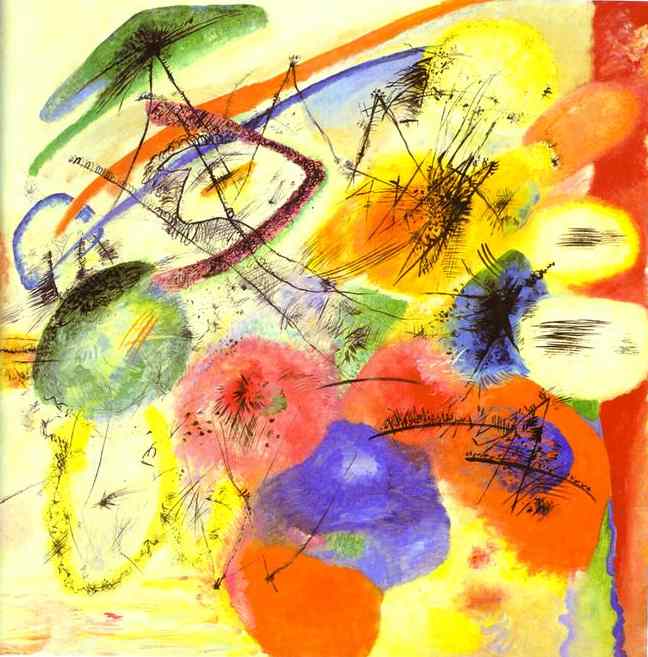
Wassily Kandinksy, Black Strokes I. 1913. Oil on canvas. 129.4 x 131.1 cm. The Solomon R. Guggebheim Museum, New York, NY, USA.
In kandinsky's understanding of romanticism beauty is that which corresponds to an inner spiritual need.
October 12, 2006
notes on philosophical romanticism
As we know though the roots of romanticism are to be found in early German idealism romanticism, which challenged the idea that philosophy and the arts must be kept separate. However, as the literary component of Romanticism has been studied and celebrated in recent years, its philosophical aspect has receded from view.This holds that we break down the barriers between art and life, so that the world itself becomes "romanticized." What we have inherited is the construction of an opposition between late Enlightenment and Romantic aesthetics that turns its back on any possibility of a radical potential in Romanticism.
Romanticism is not a purely European phenomenon: the development of romanticism can be traced through to North American philosophy in the era of Emerson and Dewey, and up to the current work of Stanley Cavell and Richard Rorty. Philosophical romanticism offers an alternative to both the reductionist tendencies of the naturalism in 'analytic' philosophy, and deconstruction and other forms of scepticism found in 'continental' philosophy. It is commonly understood to place an emphasis on art and imagination as a critical reaction to the mechanical view of some Enlightenment philosophers.
Philosophical romanticism is a critical response to the Enlightenment interpretation of modernity that involves an endeavor by philosophy to make sense of its own historical conditions and forms of expressing itself. The traces of philosophical romanticism can be found in the opposition to both the reductionist tendencies of the naturalism in 'analytic' philosophy, and deconstruction and other forms of scepticism found in 'continental' philosophy. It is often understood as representing a shift from the objective viewpoint of science ( the world understood from no particular viewpoint) to seeing it from a particular or subjective viewpoint; or through a number of categories.
We have alsos inherited the vierw that romanticism empower poetry to save philosophy from its inability to grasp conceptually its own ideals. Art, in playing this ideological role of disguising philosophy's "inability to grasp conceptually its own ideals", effaces social and political contradictions that should be made available for rigorous scientific critique. Thus we have Terry Eagleton's equation of the aesthetic with the ideological.
October 11, 2006
reading the landscape
This saltlake is an environmental consequence of irrigated agriculture along the South Australian section of the River Murray

Gary Sauer-Thompson, saltlake, the Murray series, 2004
The more the farmers irrigate the more the salty groundwater rises and runs into the river. The water authorities pump the salty water out of the River Murray in order to protect irrigated agriculture (vineyards) and they dump it an artifical lake. They then pretend that life abounds in the salt lake. The highly saline water slowly seeps back into the river through underground channels.
Does the opposition to this environmental damage, and to the economic utilitarianism that justifies this mechanized irrigation industry, make one a romantic? Since we are not talking about wilderness, then how does a romantic aesthetic help us to make sense of this opposition? The only romantic aesthetic I know about is an idealist one based around categories such as spirituality, creativity process, uniqueness and diversity. On this interpretation romantic aesthetics indulges in political quietism by escaping from material reality to questions of self-reflection and self-consciousness.
October 9, 2006
Heidegger and care
I want to return to this post on Heidegger's ethics. That was based on Chapter 5 of his thesis where Tulip argued that there'is a definite ambiguity, if not a real lack of consistency, in the relation between the ethical dimension of his [Heidegger's] thought and his denial of the significance of ethics for his ontology as a whole.'
I've always interpreted certain words in Heidegger's text such as care, as having ethical content; as suggesting something more, or deeper, than norms, rules or rights. However, Tulip says that:
Heidegger's ethics are not specifically articulated in Being and Time; indeed, he described his own interpretation as "purely ontological in its aims, and far removed from any moralising critique of everyday Dasein".... For example, care (Sorge) is the central theme of Heidegger's whole philosophy, and the term in which Dasein finds its meaning... but perplexingly, it is a term he is at pains to divest of ethical content. So he writes that care is not to be understood primarily as a positive ethical term, along the lines of 'devotedness' or 'the cares of life', although these do come into it. Instead, 'care' is "the existential condition for their possibility".
I've always interpreted care as an ethical virtual with ethics being understood in terms of ethos. Maybe I'm reading something back into Heidegger from the latter texts?
Tulip suggests that it is the Letter On Humanism that we find ethics being grounded in the phenomenon of ethos.
October 8, 2006
desert lakes
A satellite image of the Turpan Depression nestled at the foot of China's Bogda Mountains. It is courtesy of Jeff J Hemphill at UCSB Department of Geography, Santa Barbara, California:

Turpan Depression (salt lakes sand dunes below sea level), China, Landsat
Desert lakes are generally shallow, temporary, and salty. Because these lakes are shallow and have a low bottom gradient, wind stress may cause the lake waters to move over many square kilometers. When small lakes dry up, they leave a salt crust or hardpan. The flat area of clay, silt, or sand encrusted with salt that forms is known as a playa.
Turpan was once an important strategic point on the Silk Road. Is this desert and salt lake the result of human exploitation from agriculture based on tapping the water in the wells at the base of the mountains? The Karez, an irrigation system of wells connected by underground canals, is considered as one of the three great ancient projects in China.
October 4, 2006
art + philosophy
The art history account says that this example of 20th-century expressionist art is one of a series of still lifes depicting carcasses, slabs of meat, and hanging fowl that Chaim Soutine, a Russian-born artist who spent his entire career in France, painted between 1922 and 1925. It says that while such images make deliberate reference to a long tradition of the subjects of butchers, market-stalls, and game in paintings by Rembrandt, Chardin, and Goya, whose works Soutine (1893-1943) studied in his visits to the Louvre, his thick, modernist application of paint serves almost as a physical metaphor for flesh and blood. Executed with an overloaded brush, the surface of the composition is powerfully dense:
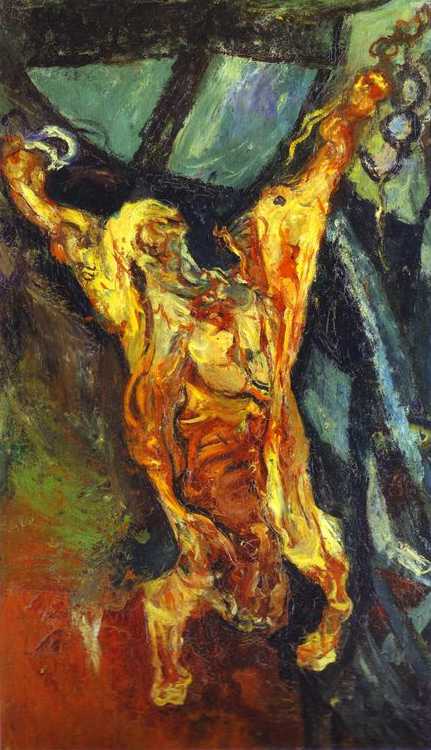
Chaim Soutine, Carcass of Beef, 1924, Oil on canvas.
Chaim Soutine is appropriated as a father figure of different traditions, of American Abstract Expressionism and British expressive realism. Soutine isinterpreted as one of the 'essential outsiders of the twentieth century, an artist without final home or place. He doesn’t fit the conventional categories of art, as the curators suggest. He insists upon what his society ignores, rejects, or forgets. He is a figure like Nietzsche, Dostoevski, or Kafka, one whose heated imagination seems to flare out -- prophetically -- from marginal rooms and cramped circumstances.'
What does a philosophical aesthetics say about butchered meat, blood and putrefying flesh? A modernist one informed by Adorno's argument that art is left reeling because of the ways in which modern capitalist life has turned into fragments.
According to this review of J. M. Bernstein's Against Voluptuous Bodies: Late Modernism and the Meaning of Painting, Soutine expresses more directly a problem hit upon by Kant: the problem of duality according to which humans are explained as physical things on the one hand (part of nature, of the physical sciences), and maker of thoughts and inhabitor of freedom on the other. By referring art to a philosophical problem, art in its implicit way aims to reveal the deepest/metaphysical conditions of human existence, and does so -- can only do so, like philosophy -- by speaking in and through the age.
Is this what Soutine is doing? Unfortuately I don't know enough about his work.
October 3, 2006
understanding philosophy
Philosophy is the work of critical reflection that is bought to bear on unreflective everyday life. This kind of philosophy seeks to pick out and analyze the common shared features that underlie our everyday expereince to make explicit what is implicit in our ordinary social know-how.
The philosopher, unlike the natural scientist, does not claim to be providing us with new knowledge or fresh discoveries, but rather with reminders of what we already know but continually pass over in our day-to-day life. A phenomenologically-informed philosophy reminds us of what is passed over in the naivety of what passes for common sense.
Thus philosophy seeks to consider life as it is lived by human beings fully engaged in the world.
October 1, 2006
Dominique Janicaud + humanism
I do not know the work of Dominique Janicaud at all. I have a vague understanding that Janicaud 's basic strategy with regard to Heidegger's work, with particular reference to the question of metaphysics and its overcoming, was that he opposed Heidegger's alternative between the completion of metaphysics in technology (Gestell), on the one hand, and the experience of meditative thinking (Gelassenheit), on the other.
Janicaud's position is often described as an overcoming of all claims at overcoming. So what does that mean? Is this a sort of reiteration of Heidegger's idea that we should cease all overcoming, specifically the overcoming of metaphysics? Does it mean that Janicaud understands 'meditative thinking' in terms of an abandoning of rationality? Does it mean that Dominique's critique of Heidegger's division between meditative thinking and technologized reason echoes Habermas's critique of Adorno's univocal notion of instrumental rationality opposed to aesthetic experience?
I have just come across this review of Dominique Janicaud's 'On the Human Condition' by Vicki Kirby, which helps. Kirby says:
Janicaud is wary of technology's ability to manipulate life. He sees in the Promethean dream of a scientific instrumentalism a desire to control and dominate Nature and to transcend human imperfection and finitude. Indeed, this unwelcome possibility is even heralded in a specific example: "the overcoming of the human by a Successor without face or body, but infinitely more intelligent and robust than us" (p. 27). Janicaud certainly concedes that life and intelligence could assume a silicon form, "a vast bank of self-programmed data, without any anchorage in flesh and blood" (p. 29). However, his point seems to be that even this "totally inhuman" operation that can overcome "the limits and moorings that made man's 'humus'" (p. 29) must remain tethered to its human creator. If there is, indeed, an inseparable and ironic relationship between the human condition and the power of technology to completely transform that condition, then the ethical responsibility for technology's threat and its promise remains with Man.
I don't know where the essays in 'On the Human Condition' fits into Janicaud's work. The above passage does resonate with the view that technology has the ability to manipulate life and lead humanity towards being inhuman. But it implies that the political and ethical consequence of technological change doesn't automatically herald the displacement or transcendence of the human condition. Instead, the assessment of innovations such as human cloning, genetic engineering, the promise of machine intelligence can only be made by returning to some notion of the human. How then is Janicaud wedded to humanism, given technology's ability to manipulate life?
Kirby quotes Janicaud:
However inhuman the universe produced by technology is, it still refers to the human, which is its source, uniquely capable of using it and giving it meaning. That which endangers humanity, then, really derives from itself: a freedom that turns against itself.
Kirby says Janicaud's point is that we should not conceive humanism in opposition to the inhuman -- the sub-human -- nor in opposition to the technological transformations and promises of the superhuman. The base animality of the subhuman as the inhuman? Does that mean humanism is identifed with consciousness instead of corporeality or embodied being?
Talking in terms of the base animality of the subhuman implies that our bodies are containers for consciousness and ignores the way that embodiment is lived out in its specificity and the way that it is socially and techologically situated in a culture where specific types of bodies (body images) are privileged. There is not a universal body as implied by the 'base animality of the subhuman' nor even two gendered bodies; rather we have multiple and shifting bodily modalities. We can talk in terms of body modalites---bodies in-use---because embodiment is more than the body being a surface for social inscription.