November 29, 2006
biophilosophy renews vitalism?
A quote:
Whereas the philosophy of biology renews mechanism in order to purge itself of all vitalism ('vitalism' is one of the curse words of biology...), biophilosophy renews vitalism in order to purge it of all theology (and in this sense number is vitalistic).
Vitalism has consistently distinguished itself from mechanism and positivism. The notion of life has always favoured an idea of becoming over one of being, of movement over stasis, of action over structure, of flow and flux.'Life, in this sense, can be understood in its opposition to mechanism. According to Scott Lasch:
One could trace this opposition, and that between ‘being’ and ‘becoming’ back to that between Heraclitus’s metaphysics of flux and Plato’s predominance of form. There are dimensions of vitalism also in Plato, as there are in that are seen as the most ‘mechanistic’ of thinkers such as Descartes or Kant or say the late Emile Durkheim. There are especially important elements of vitalism in Aristotle. The primary distinction between mechanism and vitalism may be in terms of vitalism’s self-organization. In mechanism, causation is external: the paths or movement or configuration of beings is determined. In vitalism causation is largely self-causation. And beings are largely indeterminate.
He adds that:
power is always for vitalists (from Spinoza) a question of potentia (puissance) and potestas (pouvoir). Puissance is power to and pouvoir is power over. ‘Sensory’ vitalists like Bergson and Deleuze are theorists of puissance, while the more ‘agonistic’ tendency in vitalism focus on pouvoir. In Nietzsche, puissance is life itself. It is energy: a sort of self-generating life-force. But puissance and pouvoir are closely intertwined. Nietzsche’s will to power is puissance.
November 27, 2006
not quite human
Australian artist Patricia Piccinini created this for her 2003 Venice Biennale exhibition We Are Family. This features a variety of bizarre genetically engineered organisms that are strikingly different to what we know, but at the same time, strangely familiar.
The figure (sculpture) is not really human but it gives a feeling of flesh and blood, of a living creature--posthumans.
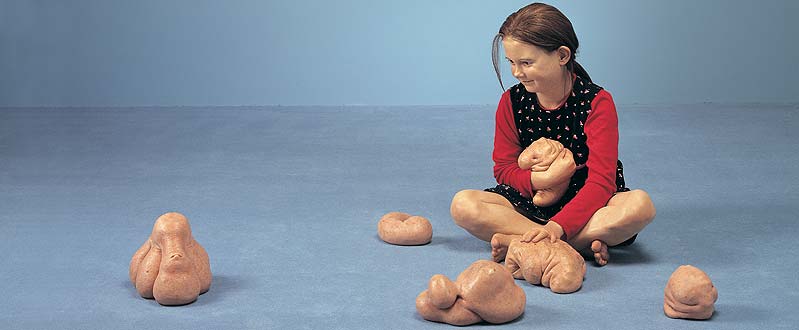
Patricia Piccinini, Still Lives with Stem Cells, 20003
This aises questions about our attitudes towards physical disability and pre-implantation genetic diagnosis. While we afford some parents the right to screen embryos for genetic mutations that signal a possibility that the potential child may have a debilitating disease, would we allow the selection of physical attributes that seem more desirable? Given the technology, would we choose to eliminate disability, imperfection and difference all together?
November 26, 2006
a note on biophilosophy
Is biophilosophy simply the opposite of the philosophy of biology?
Not quite. Biophilosophy is certainly a critique of the triptych of philosophy of biology. But it is also a way of moving through the soul-meat-pattern approach, while taking with it the radicality of the ontological questions that are posed, and which often get reduced to epistemological concerns over classification. Whereas the philosophy of biology is concerned with articulating a concept of 'life' that would describe the essence of life, biophilosophy is concerned with articulating those things that ceaselessly transform life. For biophilosophy, life = multiplicity. Whereas the philosophy of biology proceeds by the derivation of universal characteristics for all life, biophilosophy proceeds by drawing out the network of relations that always take the living outside itself
November 24, 2006
considering biophilosophy
What, then, is biophilosophy?
To begin with, biophilosophy is not the same as the philosophy of biology. What is usually referred to as the philosophy of biology has both a syntagmatic and a paradigmatic side to it, a horizontal and vertical dimension to it. The horizontal dimension is the elucidation of universal characteristics of the organism which are perceived to be part of its essence or principle of organization (growth and decay, reproduction and development, evolutionary adaptation). The vertical dimension is the development of this thinking historically in Western thought, from Aristotle, to natural history, to Darwinian evolution, to the new synthesis in genetics and biochemistry. In general, the philosophy of biology highlights and extends the philosophical dimensions of biological knowledge. Issues pertaining to evolution, biological determinism, dualism, mechanism, and teleology may be considered in the context of the life sciences such as comparative anatomy, physiology, genetics, biochemistry, embryology, germ theory, developmental systems theory.
November 23, 2006
Elizabeth Grosz + counter-history of philosophy
In Time Travels: Feminism, Nature, Power Elizabeth Grosz has a first section of 3 essays under the title nature 'Culture and the Future.' They deal with the way that postructuralism presupposes nature to be static and fixed, with all change and movement coming from culture. A passive nature is what is transformed and dynamized by culture.
One of these chapters is on Deleuze's reading of Bergson's texts. It is entitled 'Deleuze, Bergson and the Virtual', and in it she reads Deleuze on Bergson in terms of the counter-history of philosophy ----one that veers off from the accepted traditions of philosophy to create something new and unexpected. She says that what Bergson offers is a philosophy of movement:
Bergson is above all a thinker of dynamic movement, action, change...What Bergson has to offer by way of understanding difference, becoming, duration, and life has yet to be effective.(p.94)
How does that veer off from the accepted traditions of philosophy? Hegel, for instance, was also a philosopher of dynamic movement, action, change. I can only presume that Grosz reads Hegel as a Platonist--dynamizes a static Idea. He had nothing to say about nature. Sure Hegel's philosophy of nature was pre-Darwinian and so had no concept of evolution, but he had a philosophy of movement in nature based on contradiction.
Grosz picks up on Bergson's vitalism and says that there is something in Bergson's vitalism that is wayward or unpalatable:
Or at least, Deleuze's reading of Bergson self-consciously aims at bringing out the monstrous and the grotesque in Bergson's work....Deleuze wants to bring out as well as produce a certain perversion of Bergson's writings, and in doing so, I believe, he brings us to the verge of a philosophy adequate to the task of the thinking the new, a philosophy for the future, a philosophy beyond Platonism, and thus beyond the phenomenon of negation and dialectic which have dominated Western thought since Plato.
This is fine as it goes. However, the idea of movement did not originate with Bergson. It goes back to Aristotle. Aristotle was not just a footnote to Plato. He was also a thinker of change, as was Hegel. Was there not an emphasis here on a theory of becoming in place of the Platonic emphasis on being?
November 22, 2006
the conservative attack of postmodernism
An interesting review that explores the conservative attack on postmodernism in the academy launched under the name of relativism on the grounds that postmodernist discourses largely confined to the academy really do pose a serious threat to truth within the national culture at large. Behind this Anglo-American aversion to postmodernism we find an an attack on the entire Continental tradition of philosophy (a tradition that includes no less than Kant, Hegel, Fichte, Nietzsche, Husserl, and Heidegger) as being wilfully obscurantist. Most of this is rhetoric in defence of a fundamentalist Enlightenment tradtion.
We now have a tradition of 'postmodernism bashing' within what are called the culture wars in popular culture.
November 20, 2006
technoscience
Sheila Jasanoff in Designs on Nature: Science and Democracy in Europe and The United States argues that societies once based on industry are now increasingly based on knowledge. In other words, the wealth of nations no longer rests on the exploitation of natural resources or production capabilities. Rather, it rests on knowledge---specifically scientific knowledge and technical expertise. In knowledge-based societies, she argues, knowledgeable individuals constitute possibly the most important form of capital---and government policies increasingly reflect this development. As policies change, so too does the distribution of resources and the economic and political roles of science and industry.
Biotechnology is one example of scientific knowledge and technical expertise--technoscience.
November 19, 2006
November 16, 2006
November 15, 2006
redesigning humans
James Hughes' Citizen Cyborg defends "transhumanism," the idea that people should be allowed to become "more than human. The scientific enlightenment and new technologies are now pushing the boundaries of humanness. He says that:
In the next fifty years, life spans will extend well beyond a century. Our senses and cognition will be enhanced. We will have greater control over our emotions and memory. Our bodies and brains will be surrounded by and merged with computer power. The limits of the human body will be transcended as technologies such as artificial intelligence, nanotechnology, and genetic engineering converge and accelerate. With them, we will redesign ourselves and our children into varieties of posthumanity.
Langdon Winner says that the techno-utopians say the benefits of technoscience 's contemporary developments will be an entirely new creature, one usually named cyborg. For Gregory Stock in Redesigning Humans: Choosing our Genes, Changing our Future(2002) this will develop through genetic choice technologies (GCTs) are market commodities subject to the desires of individuals. Hence, the market is the best way to select good GCTs (the ones people actually want to buy) to enhance our humaness.
Winner adds that the techo-utopian's post human argument is the following:
The trajectory of development points to revolutionary outcomes, foremost of which will be substantial modifications of human beings as we know them, culminating in the fabrication of one or more new creatures superior to humans in important respects. The proponent insists that developments depicted are inevitable, foreshadowed in close connections between technology and human biology that have already made us "hybrid" or "composite" beings; any thought of returning to an original or "natural" condition is, therefore, simply unrealistic, for the crucial boundaries have already been crossed. Those who try to resist these earth-shaking developments are simply out of touch or, worse, benighted Luddites who resist technological change of any sort. Nevertheless, the post-humanist assures us, there is still need for ethical reflection upon the events unfolding. For although these transformations will necessarily occur, we should think carefully about what it all means and how we can gracefully adapt to these changes in the years to come.
I remember reading Lee Silver's Remaking Eden: Cloning and Beyond in a Brave New World (1998). It was grounded in the gene technology of biotechnology and the biomedical sciences but its brave new world of human perfectibility based on gene enhancement was a dystopia.
November 14, 2006
a postmodern cyborg
Chris Hables Gray has a paper entitled Understanding the Postmodern Cyborg. The paper is a covering and mapping of the ground opened up the undermining of artificial-natural, human-machine, organic and constructed by the figure of the cyborg.
Gray starts by delineating the recent shift to postmodernity:
We don't live in the stable modern world our grandparents did. Their belief in inevitable, comfortable, progress has been supplanted by our realization that scientific and technological innovation are relentless and quite ambiguous. Our ancestors' acceptance of the natural limitations of space-time and life and death have been replaced by the fear and hope we feel about space travel, apocalyptic war, immortality, global pandemics, virtual community, ecological collapse, scientific utopias and cyborgization. The modern assurance that we humans control our own destiny has been blasted away by horrific wars, ecodisasters and a proliferation of new scientific discoveries and technological innovations that range from the sublime to the patently evil, as a few hours of television viewing or internet surfing can easily demonstrate.At the root of all of this change is that great creation of the modern era: technoscience. I use this term advisedly, knowing it will annoy a large number of readers who like to keep their science and technology separated, at least conceptually. But while science and technology are clearly different things sometimes, they are also often mixed together in ways that are impossible to untangle.
Now the new technosciences, which are making the nanotechnology revolution a reality, including in particular genetic engineering, promise that we will be creating creatures that can't even be classified as humans. However,
I would have thought that an informational global capitalism would something to do with shift to postmodernity and the emergence of technoscience, but we can leave that to another time. Let us then accept that postmodernity is transitory-- it is a crisis---and shift to the figure of the cyborg and cybernetic systems in postmodernity.
Gray says that though the 'twentieth century human body can be conceived of through any number of rich and insightful metaphors.Though it is a disciplined body, a textualized body, a gendered body, and a resisting body, it seems to him more and more that one of 'the most fruitful metaphors is to conceptualize the human body as a rhetorical and material construction of the discourses and cultures of technoscience, the mass media, and the military; a creature that combines informatics, mechanics, and organics: a cyborg.' He adds:
Many humans are now literally cyborgs. Their inorganic subsystems can range from complex prosthetic limbs to the programming of the immune system that we call vaccinations. In the industrial and so-called post-industrial countries a "cyborg society" has developed where the intimate interconnections and codependencies between organic and machinic systems are so complex and pervasive that whether or not any particular individual in that society is a cyborg, we are all living a cyborgian existence.
Many examples in the military, space exploration, the mass media, art medicine etc are given to illustrate how we are living a cyborgian existence in postmodernity, then explores the phenomena of disembodiment in cyberspace.
He adds that citizenship is being reconfigured by the cyborg technosciences and by the direct challenges to the very idea of the human, which are coming from genetic, medical, computer, and military technologies. If citizenship is worth preserving it must by cyborged, with a full understanding of all the relevant technical, philosophical, historical, and political implications.
One big problem is our limited technical understanding of systems. So it isn't just technological breakthroughs that are driving the information revolution, the revolution in systems thinking has played a key role. Some of the best theorists have returned to Wiener's argument that artificial and natural systems are basically the same. Kevin Kelly, for example, has written a book called Out of Control: The New Biology of Machines, Social Systems, and the Economic World that links them together along with the libertarian political agenda that is championed by Wired Magazine, which Kelly happens to be executive editor of. "Out of control" doesn't mean running amok. It means outside of external control; these systems run on their own dynamic. They can't be directed.
November 13, 2006
nature, cyborgs & networks
In a posthuman world, where there is the merging of human and machine (cyborgs) and the rise of artificial intelligence, this kind of awesome romantic understanding of a sublime nature looks decidedly old fashioned.

Ansel Adams, Winter Storm
In the world of biotechnology where the corporeal and ontological boundaries between human and non-human nature have been eroded posthuman means :
a scepticism about life being inevitably dependent on “embodiment in a biological substrate”; a readiness to see consciousness as an “epiphenomenon” and a “minor sideshow” in determining “human identity”; a willingness to regard the body as an “original prosthesis” whose principle can be extended; faith in the promise of “seamless” articulations with “intelligent machines.” There is, as a variation, the focus on the “cybernatural” and the “postnatural,” pointing towards “the possibility of forms of vitality which do not find their support in the organic processes of matter . . . but rather in the arena of the artificial,” such that “the cybernatural designates any practice which uses the space of the virtual screen as a space of ‘second nature’ through a conflation of information with vitality.”
We are cyber sapiens--a creature part digital and part biological---embedded in networks. As Donna Harraway says "Technology is not neutral. We're inside of what we make, and it's inside of us. We're living in a world of connections - and it matters which ones get made and unmade."
November 12, 2006
a divine nature
The American wilderness was seen as the physical expression of the divine, unsullied by civilization. Writers beginning with Ralph Waldo Emerson and Henry David Thoreau praised the redeeming value of nature in opposition to the onward march of civilization. So did Ansel Adams:

Ansel Adams, The Tetons and the Snake River, Grand Teton National Park, Wyoming, 1942.
What is depicted is an endangered wilderness. Adams depicts the beauty of nature threatened by the ever-encroaching civilization. This prompted the creation of the National Park system and the conservation movement. Nature is God's living laboratory. Beauty is revered because it is morally uplifting.
Nature is the touchstone here---this works within the unconconscious understanding of nature expressed in 'nature as natural', which presupposes that it's just how the world is; we can't change it. Isn't nature constructed? The snow on Adam's mountains would be melting from global warming caused by the greenhouse emissions from fossil fuel power plants. The trees would be dying from lack of rain.
November 9, 2006
posthuman as cyborg
One solution to Fredrick Jameson's lost (dissolved or fragmented subjectivity) liberal humanist subject in postmodernity is the cyborg --a synthetic figure of human and machine. It refers to the way that technology penetrates the membrane of our skin so as to produce the technological body. It offers an alternative to the back-to-nature ethos of those romantics harking back to some mythical pretechnological past.
Donna Harraway, who makes the case for the cyborg figure in her 'A Manifesto for Cyborgs: Science, Technology and Socialist Feminism in the 1980s', says that this figure is neither bounded nor autonomous as it is a function of multiple, intersecting communication networks. She says that a cyborg body is not innocent; it was not born in a garden; it does not seek unitary identity. With an intimate experience of boundaries, their construction and deconstruction and a penchant for fusing, coupling and (re)assembling parts, the cyborg is both a material being in constant flux, and a framework through which to imagine new collaborative and collective identities.
A function of multiple, intersecting communication networks? What does that mean? A hacker? It refers to the shift shift from thinking of individuals as isolated from the "world" to thinking of them as nodes on networks. So being a cyborg isn't about how many bits of silicon you have under your skin or how many prosthetics your body contains.
Harraway's argument is that our technological world:
is one of tangled networks - part human, part machine; complex hybrids of meat and metal that relegate old-fashioned concepts like natural and artificial to the archives. These hybrid networks are the cyborgs, and they don't just surround us - they incorporate us. An automated production line in a factory, an office computer network, a club's dancers, lights, and sound systems - all are cyborg constructions of people and machines.Networks are also inside us. Our bodies, fed on the products of agribusiness, kept healthy - or damaged - by pharmaceuticals, and altered by medical procedures, aren't as natural as The Body Shop would like us to believe. Truth is, we're constructing ourselves, just like we construct chip sets or political systems
Being a cyborg is about networks.
November 8, 2006
nature & civilization
This is how many in the humanities understand the question of nature--in terms of the female body as nature and the primitive:
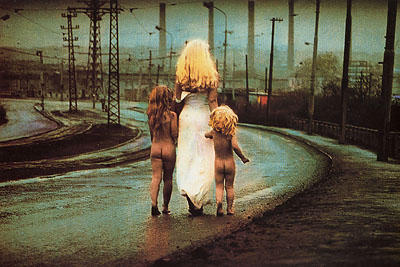
Jan Saudek, Fate Descends towards the River Leading Two Innocent Children, 1970
The female body as biological is what is critiqued. If we are our biology then we need a complex and subtle account of that biology; one that avoids the reduction of the social and the cultural to the biological as routinely performed by sociobiology.
November 7, 2006
posthuman
It is sometimes argued that novel biotechnologies, such as xenotransplantation and cross-species gene transfe,r are shaking our belief in an autonomous human subject, as they question the naturalized division between human–animal–plant life forms, and draw awareness to the genetic and structural similarities between them. Optimistic posthumanist thinkers argue that the breaching of this boundary between human nature and non-human nature should propel us into a posthuman future characterized by a new ethical appreciation of our non-human ‘cousins’.
It is true that universal subject of liberal humanism has, along with its Cartesian metaphysics, is under pressure. Postmodernism is widely credited with imploding, or at least destabilizing, the binary oppositions that underpinned the intelligibility, autonomy and integrity of the modernist subject.The old distinctions between culture and nature, consciousness and body, human and machine, masculine and feminine, and reason and unreason are no longer perceived to provide an unproblematic foundation for identity.
This was argued early by Fredric Jameson in his seminal "Postmodernism, or The Cultural Logic of Late Capitalism," where he recast the decentred subject as schizophrenic For Jameson, postmodernism signals, above all, a loss of depth. The waning of affect, the eclipse of parody by pastiche, the loss of the historical referent, the flattening of space into surfaces, the abandonment of theoretical depth models, and the schizophrenic aesthetic are all symptomatic of "a new kind of superficiality" that Jameson argues is the 'supreme formal feature" of the postmodern.
Jameson then identifies the decentred subject as the causal link between late capitalism and the postmodern aesthetic. Jameson's thesis depends upon the assumption that the subject is no longer bounded, centred or possessed of psychic depth. Though he is unclear of about which economic, technological or political tendencies of late capitalism are implicated in the postmodern shift from an alienated to a fragmented subject he does argue that in late capitalism time, language and subjectivity are thrown into crisis.
November 5, 2006
becoming
The tradition of critical theory and feminism that entered the universities in the 1980s--that is, the mix of Lacanian psychonanalysis and Deriddean deconstruction was not very favourable to ontology, nature or biology. Nature was seen as a constructed object, as the result of cultural and inscriptive production by language. So was what missed was understanding nature or life in terms of dynamic change --- or in Nietzschean terms as becoming.
This was Nietzsche's interpretation of Darwin's understanding of life as a dynamic process of change. Nietzsche transformed being indifferent to history into becoming; as a becoming without the definitive features of Aristotlean being.
November 4, 2006
here today gone tomorrow?
This is what we may well lose because of global warming:

Mt Erebus Glacier floats over Ross ice shelf, Antartica Landsat, 2002
That melting is the effect of a technocratic mode of being in a freewheeling capitalism.
November 3, 2006
a blind reason
A good article on reason by Soumaya Ghannoushi in The Guardian. It starts thus:
We are witnessing the rise of an arrogant secularist rhetoric founded on belief in the supremacy of reason and absolute faith in science and progress, dogmas which arouse ridicule in serious academic and intellectual circles nowadays. Hearing its proponents defend their rigid notions, you would be forgiven for thinking you were in the presence of the fathers of positivism: Auguste Comte, Diderot, or Condorcet, or that you were back in the Victorian and Napoleonic eras with their high hopes of remaking the world and human destiny in light of the utopias of reason and progress.
It is the return of a fundamentalist Enlightenment--a right wing hard edged positivism tied to free markets and big technology. Ghannoushi then says :
These high priests of rationality, who in Britain include in their ranks such names as Richard Dawkins and Anthony Grayling have erected a world of dichotomies, borders and fences: secular v religious, rationality v superstition, progress v backwardness, public v private. This simplistic worldview fails to take account of the complexity of cultural and historical processes, or of intellectual and human phenomena.
It's a secularist dogmatism.
November 2, 2006
crisscrossing Marx and Heidegger
Michael Eldred says in his Capital and Technology: Marx and Heidegger that the questions concerning the essence of capital and its relationship to the essence of technology need to be explored and that Marx and Heidegger touch each other in their respective thinking most intimately. Each of these thinkers has answered one of the two questions concerning the essence of capital and the essence of technology, but in different languages. The task is thus posed as a kind of labour of translation.
Eldred gives a very Heideggerian reading of Marx when he says that:
According to Marx, the essence of capital is the endless, limitless valorization of value, an essence which sets itself up "behind the backs" of people, as Marx often puts it (e.g. Gr.:136, 156). Setting-up and valorization are the respective essential actions of the respective essences, whereby action here cannot be thought in terms of human action, but as destiny that prevails over everything. To think valorization as attributed to destiny goes against the grain of Marxian thinking, of course, for which something destinal would have to be treated as a fetishism which could be dissolved by deciphering value and valorization as a "social product just like language" (MEW23:88). Nevertheless, just as the essence of technology is nothing technical, the essence of capital is nothing economic; the valorization of value cannot be thought ultimately as an economic phenomenon. Marx's critique of political economy is not a theory of the capitalist economy with the appropriate specialized concepts; rather, it is a questioning and a presentation of the essence of capital which — now expressed in Heidegger's language — is not a human machination.
The capitalist world gathers itself in money; in the thing 'money', the world worlds capitalistically, as soon as the movement of valorization of everything achieves an absoluteness. Everything that is (exists) has a direct or indirect relation to money; the totality of beings passes through money.
Eldred brings Heidegger into the picture by linking capital and technology thus:
The value-forms analyzed by Marx, such as commodity, money, (productive, circulating and interest-bearing) capital, wages and ground rent, cover the totality of beings: things, humans, earth and sea. There is hardly anything, not even the sky, that cannot be valorized, even in a narrow economic sense (e.g. air traffic corridors). The circuits that Heidegger describes in various texts are in truth, i.e. in their full uncoveredness, circuits of capital, without him ever bringing this to light. Most importantly, the restless snatching away of everything into some circuit or other can be concretized with reference to the intertwining of circuits of capital in the form in which it appears in everyday life, e.g. as the activity of huge, global stock companies networked with their suppliers. Because everything can be valorized, capital penetrates into every ontic nook and cranny. Everything obtains a price in the circling of value as capital, if only indirectly.
Then we have the contrast between Marx and Heidegger. First Marx:
The Marxian critique of capitalism is only superficially a critique of private property insofar as the latter is still thought as in the hands of subjects. On the deepest level of essence it is even less a critique of one class by the other. We must finally take leave of such readings of Marx's writings if they are still to be able to open up an historical future. The critique of political economy shows that all the subjects, including the ruling class subjects, are dragged into the circling of valorization, so that all of them can and must be regarded as mere "character masks", as personifications of value-forms. Marx however remains dominated by metaphysical thinking insofar as he leaves the human essence located in subjectivity — albeit an alienated subjectivity.
Secondly Heidegger:
In Heidegger, by contrast, the gaze is fixed on thinking that calculates and sets up representations, i.e. on the modes of thinking that decide how beings are unconcealed as real. This includes in the first place the modern sciences which cast the reality of everything real as measurability and calculability and accordingly do research into a reality thus set up, uncovering beings and making them accessible to knowledge and, more essentially, to the grip of the grasp. Heidegger wants to promote another type of thinking counterposed to thinking that sets up representations and calculates, whereas Marx is for a practical revolution of social relations in which a conscious (and still calculating, positing) sociation of production is to be set up. The two thinkers are thus in this regard historical worlds apart from each other.
I'm puzzled as to why practice is left out, because it is revoluttionary practices in Marx and marginalised practices (as opposed to thinking) that Heidegger counterposes to a technological mode of being.
November 1, 2006
Heidegger's encounter with Marx
In his exploration of the encounter between Heidegger and Marx through Heidegger's Letter on Humanism Michael Eldred notes that Heidegger speaks in terms of a productive dialogue with Marx on the terrain of alienation. He adds:
It may be regarded as significant at this point that Heidegger here, where he speaks of a productive dialogue with Marxism, immediately starts talking about the essence of technology as "unconditional production": "The essence of materialism is concealed in the essence of technology." (p.337) Heidegger wants to locate Marxism from the standpoint of his thinking of the essence of technology as a "destiny of the history of being". The fact that in modernity all beings appear as the material for labour is to be traced back to technology and finally to te/xnh as a way in which "beings are revealed" (ibid.). In this way, Marxian materialism is to be given its well-considered metaphysical location. Marxism resonates further in the Letter on 'Humanism' with the words "communism" (p.337), "internationalism" (p.337) and "collectivism" (p.338) in which "an elementary experience" (p.337), namely the experience of the way of revealing of modern technology in "unconditional production" "is world-historical" (ibid.). Marxism is however, according to Heidegger, caught within the metaphysics of subjectivity and even the unification and uniformization of humanity in an internationalism and collectivism would only mean the "unconditional self-assertion" of the "subjectivity of humanity as a totality"
So we have a collective reshaping of the world that remains within the metaphysics of subjectivity. Heidegger leads Marxian materialism back to Hegel's Phenomenology of Spirit as the self-organizing process of unconditional producing, that is objectification of the real by humans experienced as subjectivity.