December 31, 2006
re-reading Darwin with Grosz
I see from this review by Claire Perkins that Elizabeth Grosz has two recent books dealing with metaphysics (ontology) nature and life ---Time Travels, which draws together eight years worth of essays that I have previously mentioned in this post and Nick of Time, which I have yet to read. The latter seems to be more centrally concened with nature and life as becoming.
Perkins says that the figures across the books, and the books themselves, are linked by the motivation to recognise the full force of temporality in relation to life:
Given Deleuze's own sustained engagements with both Nietzsche and Bergson it is perhaps not surprising to find these as two of the figures whose understanding of temporality is here central to a practical ontology of becoming. The figure who stands out across the two books is Darwin, although what Grosz is ultimately drawing out in her engagement with his work is what Deleuze (with Guattari) also notices, namely just how nomadic Darwin's contributions to an understanding of life are.
Perkins says that Grosz's ontology of becoming is developed by exploring how Darwin's account of life can be understood as an open and generative field constituted by forces of growing complexity. 'The features of this system, in Grosz' extrapolations, do not exhibit stasis and essence, but are more appropriately understood as "active vectors of change."'
Perkins says that in the Nick of TimeGrosz engages in a self-critique whilst developing an ontology of becoming through exploring the practical implications for living beings of their immersion in the continuous forward movement of time.
The explicit link that Grosz makes here is to the body. The ontology of life that she draws out in Darwin impels an understanding of bodies as beings that are foremost temporal, rather than spatial. In this movement Grosz readily acknowledges the ways in which she is moving beyond the relationship between biology and culture she has worked with previously. What she is also moving beyond, of course, is the still influential strangle-hold that psychoanalysis has on the biology-culture model. The biological body is here explored neither as a passive receiver of cultural inscription, nor as an "alien" force which inhibits such inscription, but as an interactive surface which gives itself up to cultural location
What is produced is a Deleuzian Darwin.
December 30, 2006
techno optimism
Will Hutton has an op-ed in The Observer on the 5 big ideas that illuminate and
change our lives. The first two ideas are about cyberspace and they dovetail into human subjects becoming immortal in the new web community. I will be finally freed from my body and able to asssume complex identities.The first big idea is from influential web guru Tim O'Reilly on the significance of the emergence of web 3.0, when the architecture will become yet more sophisticated. The precursors are the participative and enabling sites such as Wikipedia, Flickr, MySpace and YouTube. means:
Search engines will no longer list data; they will answer your questions. Web 3.0 will mean that the web becomes a permanent part of our consciousness, conversation and cognition. Ultimately, a chip in our brain will connect us in real time to the entire web, adding immeasurably to the power of memory.
Huh? Why in the hell would I want my mind to be connected in real time to YouTube? What kind of craziness is that? There is a heap of junk there, a lot of it from amateurs and the culture industry Why would want to float amongst that virtual world as a disembodied consciousness? What is the attraction of this kind of post-corporeality?
Hutton's second big idea is from Ray Kurzweil who says that:
chip power is growing so exponentially that by the late 2020s there will be sufficient cheap computing power to reproduce every single minute function of the human brain. Kurzweil sounds crazy, but his track record of predictions over 20 years has been eerily accurate. Machines and human beings, he argues, are on a convergent course. Machines will increasingly assume human characteristics and humans the facilities of machines. Kurzweil even dares to believe that via three 'ibridges' - bio-engineering, artificial intelligence and new foods - human beings will keep death at bay. Chips in our brains and bodies will freeze the ageing process and via the successors to web 3.0 ensure that everyone will be at the frontier of knowledge
Why would I like to be like a computor? I'm happy being me, even if I am going to die.Thes big ideas sound 1980s techno-utopia revisited. Perfection at last is the promise of the gee-whizzery of virtual systems.The price to be paid for a cyber life in a world of nowhere is a turning away from the fleshy, face-to-face encounters with other people in a particular place.
December 29, 2006
phenomenology as a historical relic?
Phenomenology as a tradition is associated with continental thinkers like Brentano, Husserl, Heidegger, and Merleau-Ponty. These figures are long dead. Can we talk about the Phenomenological tradition in the past tense? Or is it still living in the continental wing of Anglo-American philosophy departments?
I mention this because the poststructuralist turn has pushed phenomenology into the background, and the philosophical focus, which was now on the text, signs, intertextuality---was counterposed to the body as biological stuff of human matter. This trajectory often lead to the enclosure of textuality to the point that 'there is no outside language.'
'Where then is phenomenology? Is it reduced to being about the productivity of consciousness in generating meaning and value from the meaninglesss of the natural order? To what was prior to structuralism? Haven't we inherited the phenomenologist vs post-structuralist schematic and this is now a traditional way of reading in continental philosophy?
Does this way of reading continental philosophy make sense in terms of the blurring of the boundaries between ideality and matter?
December 28, 2006
nature as the other of culture
I'm returning to this post about nature. Nature was seen by the left politics of the 1980s as timeless, unchanging raw material that was dynamized and rendered historical through the activities of the cultural. Mind imposes its categories on an inert nature. Nature was deemed to be the opposite of culture; culture was outside nature; or beyond the natural. On this account discourse constitutes its object, and there is no outside of language.
I was always uncomfortable with this social constructivism as I undertood nature to be changing, dynamic and historical. I was uneasy with the way the poststructuralist left assumed that culture writes on and scripts nature. Nature was what had to be overcome. It puzzled me that in the natural/cultural duality nature was assumed by many on the radical side of politics to be timeless, unchanging raw material after Darwin.
Had they not read Darwin? Did they not understand that evolution was about change and difference? Darwin's concept of natural selection is that organisms better adapted to a particular environment are more successful in reproducing and passing on their adaptations. But the critics viewed natural selection as a weak and limited force that only culled negative traits. To the contrary, Darwin argued that natural selection was the dominant force of evolution. Moreover, it could build up the fitness of organisms by gradually selecting "positive" traits that better adapted an individual to its environment. Did the postructuralists have no understanding of the biological sciences and theway they held that evolution worked in terms of gradual changes?
Where was their materialism? Was everything to be about models of language and representation. An idealism?
Had they not read Nietzsche, or grasped the way he understood nature after Darwin in terms of a natural world being a productive set of forces, which confront each other and then work out their relations?
So I turned away from cultural studies, because of the way it made nature redundant. Culture and representation do have an outside---storms, droughts, dust--and this outside is a world of change and emergence. It is not an unchanging given. Nature is full of these chaotic forces that we don’t really control, and at best what we can do is carve out a location, a territory, and in the process of carving out a territory, which is the primordial impulse of architecture, we also carve out something like a body for ourselves..
December 27, 2006
evolutionary biology & reductionism
We live in a Darwinian world. So we can kiss Aristotle and Hegel's philosophy of nature goodbye is the standard argument. They are irrelevant. What if we read a Darwinian world from a dialectical perspective? That would focus on the conceptual framework of evolutionary theory that is deployed to make sense of, and explain evolution.
Conventional Darwinism consists of three fundamental ideas: that natural selection works almost entirely at the level of organisms (rather than at multiple levels extending from genes to species), that selection is the exclusive shaper of evolutionary change, and that the extrapolation of minute, incremental changes can explain the entire history of life.
For many evolutionary biologists the ever-extending grand evolutionary synthesis promulgated in the 1930s and 1940s offers adequate explanations. Modern darwinians are largely reductionist in approach--whilst paying some lip-service to the possibility of constraints, the reality of mass extinctions and the like--they view evolution in general as microevolution plus lots of time and some contingency.
Is this synthesis adequate to its task? Do the metaphysical concepts need re-working? Are their conceptual gaps?
December 26, 2006
postructuralism + evolution
This picks up on this post here, which mentions Elizabeth Grosz's recent collection of essays entitled Time Travels: Feminism, Nature, Power I want pick up on Grosz's argument about postructuralism's presupposition about nature: it is static and fixed, with all change and movement coming from culture. A passive nature is what is transformed and dynamized by culture. One of the odd aspects of poststructuralism is that it had little to do with the biological sciences. Somehow the focus on deconstructing the liberal subject, or the turn to embodied subjectivity, never placed the human beings within nature as understood by the biological sciences. It was almost as if human beings were inside culture and society but outside nature.
Rarely, if ever, was there an engagement with the current conception of evolutionary theory that emerged from the 1920s to the 1940s, when geneticists, mathematicians, naturalists, and paleontologists reached a consensus on how evolution works. Called the Modern Synthesis, the theory merged the 19th-century botanist Gregor Johann Mendel's discoveries of inheritance patterns with Darwin's ideas of evolution by natural selection. At its core, the Modern Synthesis holds that microevolution -- the minor changes at the level of each individual -- can explain the broad patterns in the history of life, also known as macroevolution.
What of Gould and Eldredge's idea of punctuated equilibrium? This is evolution by jerks. It interprets the fossil evidence as suggesting that evolution worked in terms of species remained essentially unchanged for millions of years, and then disappeared abruptly, only to be replaced, in a blink of geologic time, by markedly new species.
Gould and Eldredge's implication they two drew from their findings is that punctuated equilibrium suggests a different style of evolution, in which species, not just individuals, competed against one another for survival -- a concept dubbed "species selection."
What of evidence that life on earth occasionally suffers instantaneous catastrophes that temporarily shatter the rules of gradual Darwinian evolution, he says. Mammals replaced the dinosaurs not because the latter were ill-adapted to their environment but because they were wiped out by a gigantic asteroid impact. Such calamities make it impossible to extrapolate the big changes in evolution from the kind of small-scale, microevolutionary steps visible at any moment in time.
December 24, 2006
Heideggger: The End of Philosophy and the Task of Thinking #2
We can return to Heidegger's The End of Philosophy and the Task of Thinking (1969) to read in light of Nietzsche's concerns about nurturing new ways of thinking in Human, All To Human. How does Heidegger map the thinking of 'the new' after the end of philosophy? What is the matter that needs thinking, by we can add, Nietzsche's free spirits? What new is being created here?
In the earlier post we had got as far as Heidegger saying that the questioning in terms of philosopher's call to return to the things themselves helps us n become aware of something which it is no longer the matter of philosophy to think conceals. This 'something' is at itself precisely where philosophy has brought its matter to absolute knowledge and to ultimate evidence. Heidegger then asks: 'But what remains unthought in the matter of philosophy as well as in its method?' He answers in terms of a possible letting-appear---an 'opening':
Speculative dialectic is a mode in which the matter of philosophy comes to appear of itself and for itself, and thus becomes present [Gegenwart] Such appearance necessarily occurs in some light. Only by virtue of light, i.e., through brightness, can what shines show itself, that is, radiate. But brightness in its turn rests upon something open, something free, which might illuminate it here and there, now and then. Brightness plays in the open and wars there with darkness. Wherever a present being encounters another present being or even only lingers near it----but also where, as with Hegel, one being mirrors itself in another speculatively---there openness already rules, the free region is in play. Only this openness grants to the movement of speculative thinking the passage through what it thinks. . We call this openness that grants a possible letting-appear and show "opening.”
Heidegger adds that tn the history of language the German word Lichtung is a translation derived from the French clairiere It is formed in accordance with the older words Waldung [foresting] and Feldung [fielding].
The forest clearing [or opening] is experienced in contrast to dense forest and to open something means to make it light, free and open, e.g., to make the forest free of trees at one place:
The free space thus originating is the clearing....It is necessary for thinking to become explicitly aware of the matter here called opening.....we must observe the unique matter which is named with the name "opening" in accordance with the matter. What the word designates in the connection we are now thinking, free openness, is a "primal phenomenon"... All philosophical thinking that explicitly or inexplicitly follows the call "to the thing itself" is already admitted to the freespace of the opening in its movement and with its method. But philosophy knows nothing of the opening. Philosophy does speak about the light of reason, but does not heed the opening of Being.
Heidegger then adds that presence as lingering in openness always remains dependent upon the prevalent opening. What is absent, too, cannot be as such unless it presences in the free space of the opening. All metaphysics, including its opponent, positivism, speaks the language of Plato. Plato sure looms large for Heidegger. The opening is named Aletheia, unconcealment, by Heidegger, and it means means 'the place of stillness which gathers in itself'
December 23, 2006
a progress grown desperate
I'm dipping in and out of Nietzsche's Human, All Too Human. It is all I can manage at this Xmas time of the year. At the moment I am reading the fifth section, which is entitled 'Tokens of Higher and Lower Culture', in volume 1. In this section Nietzsche is exploring the building of a new culture out of the old one by the free spirits as opposed to the fettered spirits.The free spirits are those who have liberated themselves from tradition. A central concern for Nietzsche is with character, in that free spirits need to be strong and aggressive to build a new culture.
Nietzsche says:
'Our age gives the impression of being an interim state; the old ways of thinking, the old old cultures are still partly with us, the new not yet secure and habitual and thus lacking in decisiveness and consistency. It looks as though everything is becoming chaotic, the old becoming lost to us, the new providing useless and growing ever feebler'. (para. 248, p.117).
Postmodernism is the name we currently give to the new today. This new grows ever feebler. The attacks from the fettered spirits in the old positivist/modernist culture continue. They have tradition on their side.
Nietzsche goes onto remark that...we cannot return to the old, we have burned our boats; all that remains is for us to be brave, let happen what may.--let us only go forward.. Contra Nietzsche, we build the new out of the old. The old provides the building blocks. for the new
Nietzsche, in Human All Too Human, is very much within the Enlightenment tradition of Voltaire. Christianity represents the old and Nietzsche argues that 'there will never again be a life and culture bounded by a religiously determined horizon. '
December 22, 2006
a personal interlude
A denuded landscape. The barrenness is the consequences of early 20th century copper mining. All the trees were chopped down to fuel the furnances, whilst the chemicals used (sulphur) killed off the vegetation.
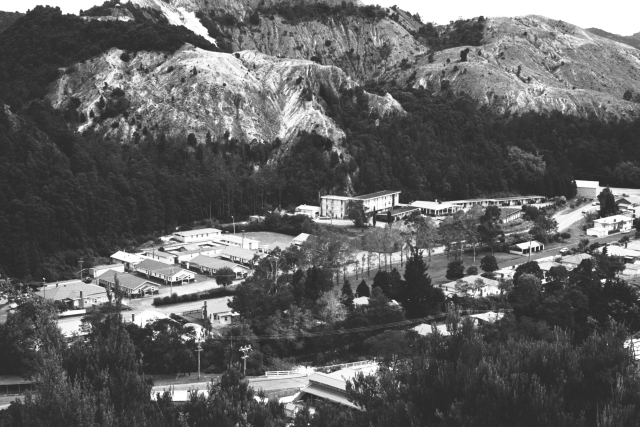
Gary Sauer-Thompson, Queenstown, Tasmania, 2006
Being a tourist in Queenstown for a few days was entering an old early industrial form of the technological mode of being; that of a resource-based economy, which created wealth by turning the environment into a wasteland. The new form of the technological mode of being is a digital one : where the body disappears and mind is downloaded into a computer programme or network. So said the techno-utopians of the 1980s.
December 21, 2006
Elizabeth Grosz, Darwin, ontology
I have previously mentioned Elizabeth Grosz's Time Travels: Feminism, Nature, Power here in relation to Deleuze's reading of Bergson. In this post I want to explore Elizabeth Grosz's reading of Darwin. In Chapter two of the book, entitled 'Darwin and the Ontology of Life', she asks two questions. The first is:
What, then, does Darwin offer to metaphysics? A new understanding of life as never self-identical, life as that which never repeats itself though it varies endlessly, life as a "solution" to the problems that matter poses, the overcoming of the obstacles of material existence, life as something that cannot contain itself in its past or present, but which asymptotically tends to the future. (p.41)
The second question is:
What is his [Darwin's] contribution to ontology? That life and matter are the two main orientations to the universe: to the degree that matter tends to conform to the principles of of closed sytsems, life remains in excess of systematicity, open-ended, unpredictable. Life introduces a kind of veering -off-course in the systemacity of closed Newtonian systems: it signals an irrational excessive, or explosive investment in transformation that cannot be contained in the lawlike predictabilites of closed systems. It introduces suprise and unexpectedness into an ordered universe.
Life emerges from matter, that is chemical arrangements that may under certain circumstances exhibit emergent properties that carry their past along with them into the present and the future.
Grosz adds that:
Darwin politicized the materiaal world itself by showing that it is an emergent or complex order that generates surpsing configurations and the endlessly unexpected, by showing that it could be otherwise than its present and past forms.
This breaks with the reductionist physicalism of Australian materialism ythat reduced everything to the entities of physics.
December 20, 2006
Heidegger: The End of Philosophy and the Task of Thinking
I have just come across a digital version of Heidegger's The End of Philosophy and the Task of Thinking (1969), which I read about ten years ago. It made a big impact on me. It was a sign post I followed, as it were. So it is good to come back to the signpost and see where I stood a decade ago.
In this late text Heidegger asks two questions: 'What does it mean that philosophy in the present age has entered its final stage?' and 'What task is reserved for thinking at the end of philosophy?' On the former question Heidegger says that:
The end of philosophy is the place, that place in which the whole of philosophy's history is gathered in its most extreme possibility.End as completion means this gathering...The development of philosophy into the independent sciences which, however, interdependently communicate among themselves ever more markedly, is the legitimate completion of philosophy. Philosophy is ending in the present age. It has found its place in the scientific attitude of socially active humanity. But the fundamental characteristic of this scientific attitude is its cybernetic, that is, technological character. The need to ask about modern technology is presumably dying out to the same extent that technology more definitely characterizes and regulates the appearance of the totality of the world and the position of man in it.
Consequently, theory means now the categories are allowed only a cybernetic function, but denied any ontological meaning, and so the operational and model character of representational-calculative thinking becomes dominant.The end of philosophy proves to be the triumph of the manipulable arrangement of a scientific-technological world and of the social order proper to this world.
Update: 21 December
At the time I'd read this account of the completion of (a positivist/realist) philosophy in terms of a scientific/physicalist philosophy that dominated the Anglo-American academy and accepted that utiltiarianism was a part of a scientific-technological world. But 'completion' puzzled me in the sense of there was no allowance made for a vitalist historical philosophy that was aligned with the health sciences and in opposition to biomedicine.
Secondly what place was there for a philosophy aligned with art--the kind that Nietzsche had developed? Didn't this open up possibilities for philosophy to become another kind of philosophy? It is at this point that we need to look at Heidegger's second question---'What task is reserved for thinking at the end of philosophy?' On this Heidegger says that the mere thought of such a task of thinking sound strange to us:
A thinking that can be neither metaphysics nor science? A task which has concealed itself from philosophy since its very beginning, even in virtue of that beginning, and thus has withdrawn itself continually and increasingly in the times that followed? A task of thinking that ---so it seems --- includes the assertion that philosophy has not been up to the matter of thinking and has thus become a history of mere decline?
Heidegger says that this different kind of thinking is modest in character:
the thinking in question remains unassuming because its task is only of a preparatory, not of a founding character. It is content with awakening a readiness in man for a possibilitywhose contour remains obscure, whose coming remains uncertain. Thinking must first learn what remains reserved and in store for thinking to get involved in. It prepares its own transformation in this learning ..... The preparatory thinking in question does not wish and is not able to predict the future. It only attempts to say something to the present which was already said a long time ago precisely at the beginning of philosophy and for that beginning, but has not been explicitly thought..
What then was said a long time ago at the beginning of philosophy? Was that a different ontology to the physicalist/machinic one of our scientific-technological world? Is it the task of thinking in later modernity to recover/develop this? Heidegger approaches the question of the task of thinking at the end of philosophy by way of a discussion of philosophy's 'return to the things themselves' as articulated by Hegel and Husserl. This will help us to bring the task of thinking to view.
So where does that leave us? Of what help is this discussion to us as we attempt to bring the task of thinking to view? Heidegger says:
They don't help us at all as long as we do not go beyond a mere discussion of the call. Rather, we must ask what remains unthought in the call "to the thing itself".... But what remains unthought in the matter of philosophy as well as in its method?
How then are we to understand or respond to the call?
December 19, 2006
Heidegger, bodily existence
Though Heidegger does not write all that much on the body as in embodiment his understanding of the body explicitly confronts Cartesian mind/body dualism in that he rejects the idea that a body takes up a bit of space like a thing in favour of bodily being. In Nietzsche vol. 1, where he is discussing rapture as an aesthetic state, he says:
Ultimately we dare not split the matter in such a way, as though there were a bodily state housed in the basement with feelings dwelling upstairs. Feeling, as feeling oneself to be, is precisely the way we are corporeally. Bodily being does not mean that the soul [consciousness/mind?] is burdened by a hulk we call the body. In feeling oneself to to be, the body is already contained in advance in that self, in such a way that the body in its bodily states permeates the self. We do not 'have' a body in the way we carry a knife in a sheath. Neither is the body [Leib] a body [Korper] that merely accompanies us and which we can establish, expressly or not, as also present-at-hand. We do not 'have' a body [Leib] rather, we 'are' bodily[leiblich]. (pp.98-9)This idea of bodily state, bodying, bodying forth, or being embodied hints at, or points to, the idea that as beings-in-the-world we are bodily, and that embodiment mediates our existence. This is what was taken up, and developed in the Phenomenology of Perception by Merleau Ponty.
What we can see though, is that Heidegger's lectures on Nietzsche in the 1940s, picks up on Nietzsche's vitalist treatment of the body in the Will to Power and in Thus Spake Zarathustra----where the body is understood as a site of history shaped by forces--- and then begin to rework them. Heidegger's brief remarks are then picked up, and then elaborated, by both Merleau Ponty (embodiment) and then Foucault (the body is understood in historical terms).
I guess what I am beginning to realize is just how important or crucial Heidegger and his lectures on Nietzsche, with their critique of Nietzsche's individualism/voluntarism, is for French philosophy in the 1960s. This not the usual postructuralist reading in the Anglo-American academy. That places Nietzsche in the foreground and Heidegger in the background. I would argue that Nietzsche's influence is mediated by Heidegger.
December 18, 2006
Deleuze & the baroque
Gilles Deleuze investigated the concept of the Baroque in The Fold, Leibniz and the Baroque (1988). Leibniz is the philosopher of the Baroque---of the pleat, of curves and twisting surfaces, and the world of of things folded in draperies, tresses tesselated fabrics, domestic architecture that bends upper and lower levels etc etc.
Deleuze developed his approach to the Baroque from the concept of the fold whch is the expression of matter and produces form. In keeping with Leibniz's theory of the monad, that the whole universe is contained within each being, like the Baroque church, Deleuze argues that the process of folding constitutes the basic unit of existence.
Michael Cutaya says that Deleuze outlines six traits of the baroque, which account for the extreme specificity of the Baroque, and the possibility of stretching it outside of its historical limits of the Baroque to art in general, and the contribution of Leibnizianism to philosophy:
The first of these traits is the fold, which the baroque develops as an infinite process. The fold is the expression of matter and produces form. The second trait concerns the relationship between the inside and the outside: 'The infinite fold separates or moves between matter and soul, the façade and the closed room, the outside and the inside.'.... To the infinite receptivity of the facade responds the infinite spontaneity of the inner rooms of action. The third trait concerns the resolution of this tension across a divide in two levels: the high and the low. The facade-matter goes below and the soul-room above. The fold, moving between, differentiates into pleats of matter on the outside and folds in the soul inside: matter and manners. The fourth trait is the unfold, which is not the contrary of the fold, but the continuation of its act. The unfold is the manifestation of the action of the fold. The unfolding does not reveal a void but more folds: folds are always full. Textures constitute the fifth trait of the baroque: texture is constituted by the manner into which the matter is folded; it is the forces of resistance of the material. The sixth and last trait concerns the paradigm of the fold: the search for a model through the choice of material but also through its formal expression. The baroque fold can only appear 'with infinity, in what is incommensurable and in excess, when the variable curve supersedes the circle.'
December 16, 2006
being a fleshy subject in a spam ecosystem?
We are entering the Xmas period when the blogging productivity of bloggers predictably and necessarily drops off. Mine has. I'd been meaning to write about the way the human subject is digitalized and decentred through a network of data flows in cyberspace. These computer generated flows stream around us and into our mail boxes, weblogs and media channels. We are enmeshed in them.
Many argue that cyberspace offers us an escape from our physical constraints. We overcome the failures of the flesh and live inside the matrix or virtual community. The body is a burden/incomplete/disabled. In cybespace we can manufacture our identities and be whoever we want to be.
So what is actually happening in the landscape of cyberspace that transcends the old Cartesian co-ordinates and dualities? A cyberspace that is a world of representations and pure information in which there is no physical life. In this world being bound to the corporeal is deemed to be living a primitive life ---ie., one that is immersed in nature.
I say 'data flows' not 'information' flows as I've been struggling with the relentless porn spammer attacks, my weblogs going down, and building and rebuilding defences against the relentless attacks. Almost nine out of every ten emails sent globally is spam--unsolicited commercial e-mail. What is happening is that innocent mails are getting blocked. "Botnet" attacks are a major spam driver. These attacks, often facilitated by a virus, hijack groups of computers and use them to send spam messages that clog up the servers and bring down our hosting companies. This is how I've been experiencing cyberspace.
It appears that the spammers increasing the use of botnets. Australia was one of the most heavily targeted countries in 2006. Spammers are using more sophisticated techniques to dodge the ISP filtering systems, most notably the use of "image spam"--- messages contained in images designed to foil text-based filters. So we are no longer using the Internet to correspond and share information--it's choked wth porn spam. So we have a spam ecosystem and we need to install spyware shield, firewalls and anti-virus protection. This is one aspect of a virtual life is it not?
My concern has nothing to do with the moral panic surrounding the equation "internet = porn" advocated by conservatives. Nor am I reducing virtual worlds to porn data flows and viruses and spam. My question is: Why would you want to reject a corporeal or bodily existence and embrace living inside this matrix of porn data flows and viruses in a geography of elsewhere as a disembodied subject? Why would I want to forget my flesh and become one with the transcendent and realize the power of the mind? The issue is not that there is no body in virtual space, especially when it is understood in terms of pure representation, but the evaluation of the body as expendable; the flesh is the residual (immutable) something which techology is articulated against.
December 14, 2006
Delanda on Deleuze's ontology
I'm reading Manual Delanda's Intensive Science and Virtual Philosophy---a study of Deleuze's ontology of dynamic processes written in the style of analytic philosophy. Delanda says that a key concept in Deleuze's texts is the concept of multiplicity and the role this category plays is that it is a replacement for the older category of an essence. Delanda says:
The essence of a thing is is that which explains its identity, that is those fundamental traits without which an object would not be what it is.if such an essence is held by many objects, then possession of a common essence would also explain the fact that these objects resemble each other and, indeed, that they form a distinct natural kind of things.That's a good account of essence. That category has its roots in Aristotle and was reafirmed by Hegel and Marx. Delanda says that even if the details of a given process account for the resemblances among the products which make us classify them as members of the same kind, there may be similarities of process which still demand an explanation. He adds:
And when accounting for these common features we may be tempted to to reintroduce essences through the back door. It is in order to break this vicious circle that multipliciities are introduced. And it is because of the tenacity of this circle that the concept of multiplicity must be so carefully constructed, justifying each step in the construction by the way it avoids the pitfalls of essentialism.
Delanda says that multiplicities specify the structure of space of possibilities, spaces which in turn explain the regularities exhibited by morpho-genetic processes.
December 13, 2006
Nietzsche: philosophy as self-mastery
Back to Nietzsche's Human, All too Human which is addressed to free spirits. He understands this text in terms of being a spiritual cure, or self-treatment that overcomes his romanticism (expressed in The Birth of Tragedy); self-treatment in the sense of self-mastery. So we have the abandonment of a pessimistic romanticism with an analytic naturalism. Nietzsche writes in the 'Preface' to Book One:
From this morbid isolation, from the desert of these years of temptation and experiment, it is strill a long road to that tremendous overflowing certainity and health which may not dispense even with wickedness, as a means and fishhook of knowledge, to that mature freedom of spirit which is equally self-mastery and discipline of the heart and permits acess to many and contradictory modes of thought--to that inner spaciousness and indulgence of superabundance which excludes the danger that the spirit may even on its own road perhaps lose itself and become infatuated and remain intoxicated in some corner or other, to that superfluity of formative, curative, moulding and restorative forces which is precisely the sign of great health, that superfluity which grants to the free spirit the dangerous priviledge of living experimentally and of being allowed to offer itself to adventure: the master's privilege of the free spirit!
What we have here is a romance with science that endevours to characterize a new kind of free spirit: one that is liberated from those forms of thinking that stunt, fetter, bind and hobble us to a form of thinking that requires independence, strength and courage. This kind of freedom is something that has to be acquired through self-mastery---a process involving sickness, convalescence and becoming healthy.
December 12, 2006
from body parts to cyborgs
I've lost a number of recent posts for some reason over the last few days including those on Nietzsche's Human, All too Human. Bandwith problems apparently. One of the lost posts was on Ian Hacking's review of Lesley Sharp's Strange Harvest: Organ Transplants, Denatured Bodies and the Transformed Self in the London Review of Books. In this review Hacking says:
Thanks to its own success, organ transfer is in crisis: there are not enough donors. In the UK, four hundred people are said to die each year for lack of organs; many more wait endlessly, in states ranging from ill-health to agony. Hence the dubious trade in which a rich person goes to poor countries to buy a kidney from a very poor man whose aftercare is horrendous and whose life after donation will be one of illness. Hence the use of body parts from executed criminals. These are both facts of contemporary life. The first is shameful; the second case is more complicated. I am totally opposed to the execution of human beings, but I can’t see the harm in reusing their body parts. Then there are the horror stories of unwanted prisoners deliberately executed for organ harvesting.
He then asks:
How do we get more organs? First, by relaxing standards. Donors deemed to be at risk for such transmissible diseases as hepatitis used to be excluded. No donor over 70 was considered. Today, in the US, if the recipient is willing to accept the risk, such donors are accepted; better risk being sick than dead. Second, by allowing donations from non-heart-beating donors – a practice now spreading from Spain to other countries. Third, through the use of new technologies. Research is currently being conducted into the use of electromechanical organs, and organs from other species.
It is the last possibility I am interested in--the post-human one.
Hacking asks: should we aim at making cyborgs: humans with, say, implanted electromechanical pumps called artificial hearts? Or should we focus on hybrids: humans with, say, hearts transplanted from pigs? Pigs are considered more promising as donors than simians: proximity on the evolutionary tree is less important than structural and functional parallels, so long as the rejection problems can be solved. Engineering design comes first; biochemistry resolves the side effects.
He says that Sharp reports that, for this reason, expert opinion is quite strongly in favour of hybrids over cyborgs. Better to use an organ where most of the design problems have been worked out in the course of mammalian evolution, than to play God or Darwin and try to do it ourselves by imitating the real thing.
December 7, 2006
Nietzsche: Human, All Too Human
I have just bought Nietzsche's Human, All Too Human: A Book for free Spirits (2 vols) ---his expression of a personal and cultural crisis in which he starts to put the Enlightenment (Voltaire) and Romanticism (Schopanhauer and Wagner) into question. Nietzsche, as a free spirit, stands in the former tradition to dig himself out of the latter. It is a neglected text--I read a musty old library copy ten years ago ---one that is generally seen to be of little interest to those postmodernists interested in Nietzsche.
The style is aphoristic in the manner of a Montaigne or La Rochefoucauld. The text is written by a cultural critic who is engaged in a diagnosis of what ails his culture and threatens its future; a critic working within the Enlightenment tradition of radical ethical critique; one who works away to expose illlusions, false hope and dangerous palliatives so as to ensure a future worth having and a life worth living.
It reaches back beyond the Enlightenment to classical philosophy's medical/ethical conception of philosophy ( eg., as practised by Epictetus or Seneca), as an art of healing us from the suffering caused by believing in bad ideas. bad ideas make us sick and unhappy. So we need some diagnosis and therapy to recover our health. It is this conception of philosophy----spirit physicians is what Nietzsche calls its practitioners--that is overlooked by much of the secondary literature on Nietzsche.
December 6, 2006
goodbye Oz Lit?
The Australian ----- the only national broadsheet, which publishes the nationwide Higher Education supplement--- recently had an article by Rosemary Neill entitled Lost for Words, which charts the decline of Oz Lit. The argument is this:
Three decades after we shook off the colonial hangover, Pierce [Peter Pierce, the inaugural professor of Australian literature at James Cook University] and others claim a new cultural cringe is infesting our halls of higher learning, encouraging the neglect of Australian literature...The decline of Australian literature is also blamed on funding cuts and the inexorable rise of postmodern theory, a charge that supporters of that theory deny strenuously. [Pierce]He says the rot set in when academics who "abased" themselves before the altar of literary theory acquired institutional power and "captured literature departments in the '80s". Postmodern literary theory - and its near-relation, cultural studies - do not accord canonical works, Australian or otherwise, a privileged place. Such theories hold that everything from Big Brother to Charles Dickens's Bleak House and Peter Carey's Bliss is a text, thus diminishing the role of serious literature as a defining cultural force. The bitter divisions provoked by the rise of theory are well known. Yale University professor Harold Bloom has attacked cultural studies as an enemy of reading and part of the "lunatic destruction of literary studies". In Australia, what remains largely unexplored is the role imported, voguish theories have played in the destruction of our literature.I would have have thought that the decline has to do more with neo-liberalism, the demand that universities run themselves as businesses, goverrnment funding cuts and lack of student interest, rather than the postmodern critique of the Oz Lit canon. The claim that cultural studies is responsible for bad things happening to literary study is a wedge in the cultural wars being run by the culturally conservatives of the Murdoch Press.
As Prof Graeme Turner points out
Australian literature, however, is not alone. There is a widespread decline in the number of chairs in humanities disciplines where most of us would accept the need to maintain a national capacity. Among those it has affected are Australian Studies, English literature, Classics and a raft of European and Asian languages such as Russian and Indonesian. This cannot be sheeted home to the usual suspects - cultural studies or postmodernism. Rather, this is what you get when you allow the market too much influence over the content and structure of higher education.
December 5, 2006
False dilemma of modernity?
Mark Mitchell in The False Dilemma of Modernity says that we moderns face a dilemma:
On the one hand stands the grandeur of enlightenment rationalism, claiming that humans are capable of achieving certain knowledge of universal truths by virtue of the rational minds with which we are endowed. On the other hand stand the so-called postmodernists, who deny any form of epistemological foundationalism and hold that truth is nothing but the construction of a particular society; thus, all truth claims are necessarily local in nature, and aspirations to universal, objective truth represent mistakes at best and intellectual imperialism at worst.
This dilemma often comes across in the form of enlightenment blackmail: we must embrace enlightenment rationalism, along with its ideals of universalism and certainty that rejects any dependence on tradition or authority if we want to avoid postmodernism, with its particularism and relativism.
Mitchell argues that the key to understanding the progression from modernism to postmodernism lies first in comprehending the important way postmodernism rejects modernism and second, in the perhaps even more important way that it accepts the premises of modernism.
On the one hand, postmoderns reject the modern attempt to secure an indubitable epistemological foundation. There is, for the postmodern, no such foundation, and the attempt to secure such a thing is merely the vanity of a particular individual or society. In rejecting epistemological foundationalism, the postmodern rejects the primacy of epistemology. In place of epistemology, the postmodern begins with ontology. Such an ontology, like the modernist epistemology, begins with the human being and attempts to forge meaning from that finite starting point. Thus, rather than beginning with God, the postmodern begins with man...man finds himself completely embedded within a particular culture, language, religion, and historical moment. These particularities serve to constitute man's reasoning capabilities; thus, what he is and what he thinks are the products of the situation into which he has been born.
Well that is reasonable enough account, as far as it even if it leaves out Heidegger. Mitchell, however, then links particularism and relativism to give us a apostmodernism based on anti-realism, skepticism, nihilism and the twin vices of complacency and pride. That characteristation of postmodernism is asserted not argued.
Mitchell says that this overlooks a third alternative, one that does not succumb to the aspiration of a God's eye-view, as does the enlightenment rationalist, or retreat into the misshapen hovel of relativism with its attendant subjectivism, as do the post-modernists. He argues this alternative overcomes the problem of modernity by pushing beyond it while at the same time reaching back to recover a pre-modern insight that was jettisoned by those committed to the modern project.
The third alternative is practical knowledge gained through doing.Turning back to Polanyi Mitchell says:
Practical knowledge precedes the knowledge of rules, for one must possess a degree of practical knowledge in order properly to apply the rules. But if practical knowledge is not learned by the study of explicit rules, then one must acquire it through doing. But how can a person practice an art if he does not yet know how to do so? One must submit to an authority in the manner of an apprentice--we learn by example.
Or through trial and error that gives rise to skilful coping as Heidegger argued. The acquisition of skills, does not necessarily require submission to a master.
Mitchell, however, sticks with Polanyi and he goes on to highlight the importance of tradition:
...if knowing is an art, and if learning an art requires dwelling in the practices of a master, then it follows that there must exist a tradition by which an art is transmitted, and any attempts categorically and systematically to reject tradition are logically incompatible with knowing. If that is the case, then we must conclude that the ideal of a tradition-free inquiry is simply impossible.
So we have the hermeneutic insight that we live embedded in a circle of interpretations with our biases, filters and prejudices. Mitchell says that:
Tradition, for Polanyi, is not a simple and stable resource that can be accessed in a purely objective fashion. Instead, Polanyi's traditionalism is dynamic on several levels. First, it encourages a certain degree of dissent ... Second, tradition is dynamic in that we cannot participate in it without changing it...traditions do not exist apart from the communities that embrace and transmit them to subsequent generations. Thus, knowledge is essentially social. But the claim is even stronger, for rather than being merely social, knowledge is communal in the sense that traditions persist only in communities which embrace a particular tradition as an orthodoxy.
December 1, 2006
cynical reason
Peter Sloterdijk in The Critique of Cynical Reason calls cynical reason an "enlightened false consciousness". Sloterdijk writes:
Cynicism is enlightened false consciousness. It is that modernized, unhappy consciousness, on which enlightenment has labored both successfully and in vain. It has learned its lessons in enlightenment, but it has not, and probably was not able to, put them into practice. Well-off and miserable at the same time, this consciousness no longer feels affected by any critique of ideology; its falseness is already reflexively buffered.
Sloterdijk wants to find out why the promises of the Enlightenment have failed. In the 18th and 19th century, rationalism and criticism promised a liberation of mankind from false idolatry, oppression and ignorance through the slogan “Knowledge is Power”. In the 20th century, however, this great project got stuck in mass destruction, disillusion, and cynicism, which especially prevailed among those who were optimists in the 1960s.