August 31, 2006
better than well
In the emerging partnership between bio medicine and the biotechnology in the 21st century we sense something unusual and worrisome. The emerging biotech century dramatically ups the ante of biomedical interventions because it so thoroughly increases biomedicine’s reach into the fabric of our daily lives.
As can seen in this post some use terms like 'cyborg' or 'posthuman' to descrbe this concern,whilst others use the bioethics terminology of enhancement technologies. The phrase 'enhancement technologies' entered the bioethics literature in the 1980s with the advent of new gene therapies. Bioethicists worried that the potential for human genetic treatment would also bring the peril of new eugenic manipulation. They attempted to distinquish the good from the bad by drawing a bright line distinction between treatment and enhancement--with treatment being the good genetic manipulation and enhancement the bad genetic manipulation.
Carl Elliott argues in his Better Than Well: American Medicine Meets the American Dream that the treatment-enhancement distinction does not hold up all that well.
The new biotechnologies prove too slippery for the rigid binary treatment or therapy-enhancement distinction and With the advent of Prozac, Ritalin, Viagra, Propecia (for baldness), Protropin (growth hormone), Botox, aging science, sex-reassignment surgery, cochlear implants, and the explosion of cosmetic surgeries the priorities of the treatment-enhancement distinction can often flip. Enhancement can become more desirable and more valuable than treatment. Plus, the treatment-enhancement distinction can blur beyond recognition when the same technology is used as either a treatment or an enhancement.
As Marilyn Gardner says in a review of Elliot's book:
Physical transformation represents only part of the burgeoning makeover industry. Those seeking self-improvement can now alter their emotions and behavior as well, even if no "before" and "after" photos can quite register the change. Feeling shy? Just take Paxil. Depressed? No problem - pop a Valium. Need calming? Reach for Ritalin. Want greater sexual prowess? Try Viagra. For every "social phobia" that ails you, there's a pill designed to increase confidence and self-assurance. These "enhancement technologies," as Carl Elliott calls them in his engaging and provocative book, "Better Than Well," are closely connected to questions of identity - questions, he says, that involve "finding the self, changing the self, improving the self, or betraying the self."
Roger Muldar in this review says that Elliott's:
...central argument is that American culture sees the power of individual authenticity as the moral ideal. Within this, conscience is incorporated as the moral guide and the concept of self-fulfilment is seen as a democratic right to pursue ones own vision of the "good life". The problem with this vision is that the fulfilment is largely self reverential and therefore there are constant doubts over whether this fulfilment is adequate. The lack of any fixed or agreed upon success or failure imparts a sense of unease; we are constantly wondering whether we could be better---i.e. could be more fulfilled. This unease leads to the increasing use of enhancement techniques to ensure that we are near the top in being self fulfilled or at least reasonably competitive. The recurring problem is that we can never be sure; there is no way of validating our happiness in relation to others' happiness.
Therapy transforms into enhancement. As this reviewer notes by 'simultaneously concentrating on enhancement technologies and American cultural identifications, Elliott makes it clear that medical enhancement technologies have fully inserted themselves into American identity dynamics and the circuits of American popular culture.'
August 30, 2006
shift in therapeutic cloning debate
There is a debate about therapeutic cloning----cloning-for-biomedical-research----currently happening in Australia. There are some strange views despite the ban on reproductive cloning: ie., cloning-to-produce-children through the implantation in a woman's womb of an embryo created in the lab using a technique called somatic cell nuclear transfer.
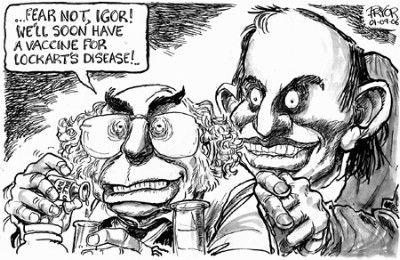
Pryor
The issue of the moment is: should we proceed with cloning for bio-medical research or should we continue the ban on cloning-for-biomedical-research?The quality of the debate is low.
Underpinning the debate are differing perspectives about the moral status of the cloned human embryo and the consequences for our moral sensibilities of legalizing their production and destruction. Peter Berkowitz usefully summarizes these perspectives in his review of the Kass Report ie., the report issued by the President’s Council on Bioethics, entitled Human Cloning and Human Dignity: An Ethical Inquiry. Berkowirtz says:
On one end of the spectrum, where many scientists seem to reside, is the view that the cloned human embryo “should be treated essentially like all other human cells,” and hence is deserving of no more respect than any other microscopic particle. For those who hold this view, embryonic stem cell research presents no moral dilemmas, and therefore it follows that research should proceed forthwith. On the other end of the spectrum, where many pro-life conservatives stand, is the view that a human embryo, however it came into being, is deserving of the same respect and rights as a fully developed human being. For them, too, the moral issue is uncomplicated by consideration of other goods: Since it is immoral to create and then destroy a human being for the benefit of another, cloning-for-biomedical-research should be banned immediately and permanently (and indeed is in a sense worse than cloning-to-produce-children, which at least aims to bring a human being into existence, not to harvest certain parts of a developing human life and then discard it).
What about those who stand between the two poles?
Berkowtiz says:
In the middle are those who believe that the human embryo, a human being in the very earliest stages of development, is deserving of heightened respect, but less respect than a human being at later stages of development, say a fetus or a viable baby or an adult human being. And they believe that policies that implement systematic disrespect for developing human life are likely to have consequences for how fully developed human beings come to think of themselves and others. Unlike those who see no moral obstacle to the use and destruction of human embryos on one hand, and unlike those who see an insuperable moral obstacle to such use even for a good cause on the other hand, those who attach “intermediate and developing moral status” to the embryo face a stiff challenge in formulating policy. For not only must they give some content to the in-between sort of respect they believe is owed to nascent human life, they must also balance that good and its implications against other competing human goods.
Several years ago those favor of the four-year moratorium on research held that the potential of making discoveries that may reduce suffering and cure disease was outweighed by the combination of several considerations: the respect that is owed to developing human life; the need to debate and design effective regulatory mechanisms before research on cloned human embryos begins; and the need to prevent the moral harm to society that would result from further undermining our shared sense that human life must not be reduced to manufacture and marketing. Since then the ground has shifted in favour of proceeding with research on the grounds that what is owed to the millions who suffer debilitating diseases overrides what is owed to the human embryos.
August 28, 2006
Nietzsche & postmodern nihilism
Nietzsche is concerned with the decadence of modernity--- European society and culture generally---and how this cultural ill--nihilism--might be cured. Nietzsche characterises nihilism as the highest values devaluating themselves with truth as a key value in this self-devaluation. Modernity itself is defined in terms of constant overcoming; that is, creation of the new that overcomes the old.
This overcoming is essentially bound up with the modern narrative of progress; by overcoming the old history moves towards a future state of enlightenment. This state of enlightenment is understood as a return to an origin, a secure ground or foundation for the rationality that illuminates society in its ideal state. So a modernist conception of nihilism,follows modernism in general, as it employs a unilinear interpretation of history as it tells a single story, specifically about European society. Hence the transvaluation of values as the affirmation of life-- affirming rather than denying life---posits an overcoming of nihilism beyond it.
Is there a postmodern understanding of the process of nihilism and transvaluation? One in which the overcoming of nihilism is not thought of in modernist terms of a new era or a new foundation.
August 27, 2006
about analytic philosophy
Though philosophy in America today is overwhelmingly, philosophy in the analytic tradition, there is no longer an American strain of the tradition that is substantially different from what is found in Britain, Australia, New Zealand, Canada. If there is an integrated community of analytic philosophers from different countries, within which individuals move back and forth, then America is the center of that community, but it doesn't define it. So argues Scott Soames in 'Analytic Philosophy in America', where gives a history of the analytic tradition in the US without reference to its relationship to non-analytic continental philosophy.
The quote below is from Soames article:
In understanding the transition to the analytic period in America, it is important to remember that analytic philosophy is neither a fixed body of substantive doctrine, a precise methodology, nor a radical break with most traditional philosophy of the past -- save for varieties of romanticism, theism, and absolute idealism. Instead, it is a discrete historical tradition stemming from Frege, Moore, Russell, Wittgenstein, and the logical positivists, characterized by respect for science and common sense, belief in the relevance of logic and language for philosophy, emphasis on precision and clarity of argumentation, suspicion of apriori metaphysics, and elevation of the goals of truth and knowledge over inspiration, moral uplift, and spiritual comfort -- plus a dose of professional specialization.
This continuity thesis is at odds with the standard modernist interpretation that postulates analytic philosophy, as a discrete historical tradition that stands for, and is, is a radical rupture with nineteenth century philosophy. The radical rupture thesis has been analytic philosophy's self-understanding. Both the continuity and rupture interpretations treat analytic philosophy as a stand alone, self-contained entity, thereby reflecting the tradition's ontological assumption of external relations and its rejection of internal relations.
Soames goes on to say that the emergence of analytic philosophy in America was marked by three events:
(i) the arrival from Europe of leading logicians, philosophers of science, logical positivists, and other analytic philosophers (ii) the transformation of the Harvard department led by Quine in the 1950s, and 60s, and (iii) the vast post-war expansion in higher education in America, which came to encompass a substantial drain in philosophical talent from Britain to the United States----including (for varying lengths of time) such figures as Paul Grice, Stuart Hampshire, J. O Urmson, and the British trained (though American born) Philippa Foot.
I didn't know about the last bit--but it was the same as in Australia upon reflection. Here it was also held, along with Quine's well known thesis that "philosophy of science is philosophy enough," which reworked Carnap's claim that "Philosophy is to be replaced by the logic of science--- that is to say, by the logical analysis of the concepts and sentences of the sciences" in his The Logical Syntax of Language (1934, 1937). This stream of philosophy subsequently broadened into metaphysics, physicalism, the nature of time and space etc.
Quine's heroic claim that could no hold up, given the effect of logical positivism on ethics. As Soames points out the period from the mid-30s to the early 60s had been the heyday of emotivism and evaluative non-cognitivism.
For many years, one of America's most well-known analytic writers in ethics was Charles Stevenson, whose 1937 "The Emotive Meaning of Ethical Terms," and 1944 Ethics and Language, had become classics. In these works, he argued that the function of evaluative terms --- like good, bad, right, and wrong--- was not to describe the world, or courses of action, but to express one's emotional attitude toward them. Sentences containing such terms were not, he maintained, used to make statements that could be true or false, but to express feelings and guide action. As a result, normative theories about the right and the good could not be objects of knowledge, or even rationally justified belief, and so were excluded from the proper domain of philosophy. As Stevenson put it at the end of his famous article, since "x is good is essentially a vehicle for suggestion, it is scarcely a statement which philosophers, any more than other men, are called upon to make. To the extent that ethics predicates the ethical terms of anything, rather than explains their meaning, it ceases to be a reflective study." Accordingly, he thought, the only job for the moral philosopher was to explain how evaluative language works.
That got rid of ethics in a way. It meant that utilitarianism ruled in Australia unchallenged until the work of John Rawls began to have its impact.
My experience was that a large part of the analytic identity was that it was defined against non-analytic continental philosophy which was treated as an enemy--eg., Derrida and Foucault. It was an antipathy to naturalism that was often thought to be constitutive of the Continental tradition and that much of the antipathy of Anglophone philosophers to the Continental tradition is justified.This antipathy goes back to to Hegel, who is interpreted as an obscurantist metaphysician who rejected the first great naturalistic turn in philosophy in modernity.
August 24, 2006
creating life
The definition of life is a deeply contested one in biophilosophy as the break with Aristotle's conception of reproduction and growth as phrases of one single process of development is severed, with biology shifting to a purely geneticist account of evolution. Life itself now entails a continual creation of unpredictable novelty (genetic differentiation) as opposed to those like Daniel Dennett who see in a new form or quality only a rearrangement of the old and nothing absolutely new. In biophilosophy a philosophy of life is exemplified, in different ways, in Bergson’s elan vital, Nietzsche’s will to power and Deleuze’s virtuality.
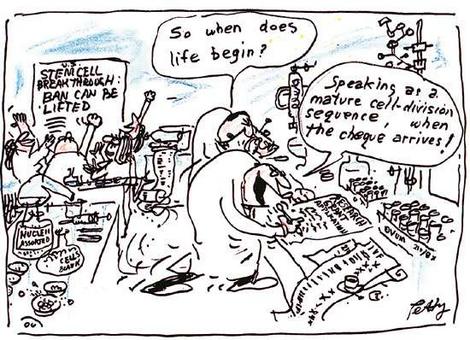
Petty
Philip Ball in Prospect says that:
Two years ago American scientists created life. Or did they? It all depends on what you mean by life. More specifically, it depends on whether you are prepared to regard viruses as living entities. Viruses have genes, and they replicate, mutate and evolve, all of which sounds lifelike enough. And in August 2002, a team at the State University of New York (SUNY) announced that it had made a virus from scratch, by chemistry alone.What this meant was that, for the first time since life began over 3.5bn years ago, a living organism had been created with genetic material that was not inherited from a progenitor.
As Ball points out the SUNY researchers choose to award the honour of being the first synthetic organism to a virus that scientists have spent decades trying to eradicate, a cause of human disability and death: polio.
The virus has come into the centre of both biophilosophy and our virus as metaphor narratives--- in the latter the virus sttnds for the devastation of the human population and so throw into reverse the endless forward motion that constitutes life on this planet.
August 23, 2006
biotechnology and human perfection
Sitting behind the public debates about biotechnology and the regulation of human cloning is a concern about the use of biotechnical powers to pursue the age old dream of "perfection," both of body and of mind. It is often surfaces in comments about the pursuit of optimum babies, "man playing God," or about the Brave New World or a "post-human future." Then the concern drops into the background. But this concern about using biotechnology to achieve human perfection to overcome the limitations of bodily decay, psychic distress, and the frustration of human aspiration never goes away. It keeps on re-surfacing.
In a 2003 lecture entitled Beyond Therapy: Biotechnology and the Pursuit of Human Improvement Leon R. Kass, Chairman of The President's Council on Bioethics, addresses this concern from a bioethical perspective. He said that these are powers that affect the capacities and activities of the human body, powers that affect the capacities and activities of the mind or soul, and powers that affect the shape of the human lifecycle, at both ends and in between. He adds:
We already have powers to prevent fertility and to promote it; to initiate life in the laboratory; to screen our genes, both as adults and as embryos, and to select (or reject) nascent life based on genetic criteria; to insert new genes into various parts of the adult body, and someday soon also into gametes and embryos; to enhance muscle performance and endurance; to replace body parts with natural or mechanical organs, and perhaps soon, to wire ourselves using computer chips implanted into the body and brain; to alter memory, mood, and attention though psychoactive drugs; and to prolong not just the average but also the maximum human life expectancy. The technologies for altering our native capacities are mainly those of genetic screening and genetic engineering; drugs, especially psychoactive ones; and the ability to replace body parts or to insert novel ones.
He states that these powers have not been developed for the purpose of producing perfect or post-human beings. They have been produced largely for the purpose of preventing and curing disease, and of reversing disabilities. Yet the "dual use" aspects of most of these powers, encouraged by the ineradicable human urge toward "improvement" and the commercial interests that see market opportunities for non-therapeutic uses. Once in the marketplace , these techniques and powers can be deployed to produce desires where none existed before, and things often go where no one ever intended.
In his lecture Kass leave aside the pursuit of optimum babies or better citizens, to concentrate on the strictly personal goals of self-improvement, to those efforts to preserve and augment the vitality of the body and to enhance the happiness of the soul. He says that:
These goals are, arguably, the least controversial, the most continuous with the aims of modern medicine and psychiatry (better health, peace of mind), and the most attractive to most potential consumers---probably indeed to most of us. It is perhaps worth remembering that it was these goals, now in the realm of possibility, that animated the great founders of modern science: flawlessly healthy bodies, unconflicted and contented souls, and freedom from the infirmities of age, perhaps indefinitelyWe are already walking down this pathway are we not? With respect to the pursuit of "ageless bodies," we can replace worn out parts, we can improve upon normal and healthy parts, and, more radically, we can try to retard or stop the entire process of biological senescence. With respect to the pursuit of "happy souls," we can eliminate psychic distress, we can produce states of transient euphoria, and we can engineer more permanent conditions of good cheer, optimism, and contentment eg., Ecstasy, (the forerunner of Huxley's "soma" ) and powerful yet seemingly safe anti-depressant and mood brighteners like Prozac.
Kass introduces the distinction between 'therapy' and 'enhancement' to explore this ethically: 'therapy' is the treatment of individuals with known diseases or disabilities; enhancement,' is the directed uses of biotechnical power to alter, by direct intervention, not diseased processes but the "normal" workings of the human body and psyche (whether by drugs, genetic engineering, or mechanical/computer implants into the body and brain). He goes on to say that:
Those who introduced this distinction hoped by this means to distinguish between the acceptable and the dubious or unacceptable uses of biomedical technology: therapy is always ethically fine, enhancement is, at least prima facie, ethically suspect. Gene therapy for cystic fibrosis or Prozac for psychotic depression is fine; insertion of genes to enhance intelligence or steroids for Olympic athletes is not. Health providers and insurance companies, by the way, have for now bought into the distinction, paying for treatment of disease, but not for enhancements.
Kass then argues that this distinction is inadequate and finally unhelpful to the moral analysis. He says that:
Needless arguments about whether or not something is or is not an "enhancement" get in the way of the proper question: What are the good and bad uses of biotechnical power? What makes a use "good," or even just "acceptable"? It does not follow from the fact that a drug is being taken solely to satisfy one's desires that its use is objectionable. Conversely, certain interventions to restore natural functioning wholeness----for example, to enable postmenopausal women to bear children or sixty-year-old men to keep playing professional ice hockey--- might well be dubious uses of biotechnical power. The human meaning and moral assessment are unlikely to be settled by the term "enhancement," any more that they are by the nature of the technological intervention itself.
What needs to be question is the idea of human perfection and Kass argues that a flourishing human life is not a life lived with an ageless body or untroubled soul--genuine human flourishing, he says, is rooted in aspirations born of the kinds of deficiencies that come from having limited and imperfect bodies.
August 22, 2006
ethics of biotechnological experimentation
The ethics of biotechnological experimentation with human subjects is a critical moral point in which science and ethics intersect; and it is one that involves the relation between the scientific enterprise and the social values. It is at this point that the modernist goals of medical progress run up against our concern for the inviolability of the human person, and this is a place where society, usually with more-than-willing collaboration of scientists and physicians, erect restrictions, mostly procedural, on what scientists and physicians may freely do to human beings. Ethics then leds to politics as regulation of the questionable means used to pursue excellence or human perfection.
Some argue that we need to decide where the line is between legitimate therapy and enhancement, and argue that in the course of drawing that line, we also beed to try to articulate what human goods are at stake in drawing a line, whether for moral or regulatory purposes. This often focuses on the means used , it can also focus on the modernist aspiration to remake nature, including human nature, to serve our purposes and satisfy our desires. The problem is the drive to mastery of nature.
This is the perspective of Heidegger and Adorno and suprisingly it makes contact with Michael Sandel on the President's Council on Bioethics. He says that the main problem with enhancement and genetic engineering is not that they undermine effort and erode human agency. The:
... morally troubling feature is a kind of hubris and a picture -- a world picture in which we, as human beings, aspire to mastery or sovereignty or control -- ultimate control -- over nature and ourselves such that we come to be and to see ourselves as self-creating beings who can make ourselves over according to our desires.
He calls this the the hubris objection. He adds that, unlike accounts that emphasize the loss of human powers and the erosion of human agency, the hubris objection can explain our moral hesitation to embrace certain genetic alterations of animals. The genetic improvement of animals---- altering the gene that makes chickens want to run free--- represents the ultimate human dominion and mastery.
In his background paper Sandel goes on to say that:
If something like this is true, then the philosophical stakes in the debate over enhancement and genetic engineering are higher than we are accustomed to think. Sorting out the ethics of enhancement will force us to reopen questions that have been largely ignored since the 17th century, when the mechanist picture of nature came to prominence in moral and political philosophy. From the start, the project of mastery and the mechanist picture have gone hand in hand. The discovery that nature was not a meaningful order but a morally inert arena for the exercise of human will gave powerful impetus to the project of mastery, and to a vision of human freedom unfettered by the given. We may now have to choose between shaking off our unease with enhancement and finding a way beyond mechanism to the re-enchantment of nature.
August 20, 2006
beyond wellness
I see that in the US the President’s Council on Bioethics has been having an ongoing inquiry/conversation into biotechnology that resulted in a report entitled "Beyond Therapy: Biotechnology and the Pursuit of Happiness."
The conversation is an important one as it is about advances in genetics, drug discovery, and regenerative medicine promise cures for dreaded diseases and relief for terrible suffering. Advances in neural science and psychopharmacology promise better treatments for the mentally ill. Techniques of assisted reproduction have already allowed for over one million infertile couples to have their own children. Without such advances, past, present, and future, many of us would lead diminished lives or not be here at all. These advances facilitate the pursuit of happiness, since biotechnology is a form of human empowerment that takes us beyond nature's givens as is. This raises the issue of willful control or mastery and control.
This biotechnology raises tough questions about our ethical ends of the good life--living well, living a flourishing life -- life and the benefits and harms of pursuing our ends, even our worthy ends, by the new biotechnologies. In the case of the new technologies employed in conventional medicine, the answers about ends are quite clear. We want to heal the sick. We want to relieve the suffering, and our new abilities might let us do so more effectively.Some crucial questions of means remain, but we basically agree about the ends.
But the same technologies will have the power to reach far beyond the traditional domain of medicine and allow us perhaps to alter or improve our bodies and minds for ends other than a restoration of health.To what ends beyond therapy should we put these technologies? And what might be the consequences of pursuing those ends using our new biotechnical powers?
A frequently suggested basis for distinguishing between proper and improper uses of these new technologies is the distinction between those uses of new biomedical technologies that aim at therapy and those that aim at non-therapeutic enhancement. A therapy, roughly defined, is a treatment for a disorder or deficiency, which aims to bring an unhealthy person to health. An enhancement is an improvement or extension of some characteristic, capacity, or activity.
August 18, 2006
human cloning
I see that in July 2002 the President's Council on Bioethics under President Bush chose to engage with the ethics of, and public policy related to, human cloning as its first topics of inquiry. Human cloning, has been, and is due to be currently debated in the Australian Parliament as a conscience vote. We could do with a National Council on Bioethics in Australia to help us to come to grrips with the issue of cloning for biomedical research, where the public policy option on the table is one of legislative prohibition. It would give rise to more debate on contentious issues such as therapeutic cloning.
The report issued by the President's Council on Bioethic is entitled Human Cloning and Human Dignity: An Ethical Inquiry. The Report says that:
The intense attention given to human cloning in both its potential uses, for reproduction as well as for research, strongly suggests that people do not regard it as just another new technology. Instead, we see it as something quite different, something that touches fundamental aspects of our humanity. The notion of cloning raises issues about identity and individuality, the meaning of having children, the difference between procreation and manufacture, and the relationship between the generations. It also raises new questions about the manipulation of some human beings for the benefit of others, the freedom and value of biomedical inquiry, our obligation to heal the sick (and its limits), and the respect and protection owed to nascent human life. Finally, the legislative debates over human cloning raise large questions about the relationship between science and society, especially about whether society can or should exercise ethical and prudential control over biomedical technology and the conduct of biomedical research.
The Council produced policy recommendations on two issues. All 17 members of the council who cast votes recommended an outright congressional ban on reproductive cloning or, in the report's preferred language, "cloning-to-produce-children." Concerning therapeutic cloning--or in the report's preferred language, "cloning-for-biomedical-research,"---a majority of 10 members of the council recommended a four-year national moratorium to allow for further study of the moral, political, and scientific issues. A seven-member minority recommended that cloning-for-biomedical-research be allowed to proceed promptly, subject to strict federal regulation.
Research on the latter is problematic. On the one hand, it could lead to important knowledge about human embryological development and gene action, both normal and abnormal, ultimately resulting in treatments and cures for many dreaded illnesses and disabilities. On the other hand, the research is morally controversial because it involves the deliberate production, use, and ultimate destruction of cloned human embryos, and because the cloned embryos produced for research are no different from those that could be implanted in attempts to produce cloned children.
August 17, 2006
Nietzsche: nature as will to power
In Wildness as a Critical Border Concept: Nietzsche and the Debate on Wilderness Restoration Martin Drenthen spells out Nietzsche's philosophy of nature in terms of the will to power. He says that:
According to the theory of will to power, all of nature consists of a dynamic struggle between a plurality of competing forces that try to overpower each other. Nature is a complex of commanding and obeying forces. In this struggle, contingent temporary organisations emerge, that are then again being overpowered by other forces, thus constantly shifting the power-balance. These natural forces are not blind, physical forces, but have an 'inner side'. All of nature (not just living nature) has a striving towards 'internalisation': all that is, exist not just as a force (i.e. something that works externally on other entities), but also as a will (i.e. with an interior quality), and as interpretation. Having an interior, mental, quality is not something exclusively human, but is an aspect of everything that exists in nature.
Nature is understood as a never-ending struggle of different, competing, interpretations, which all try to overpower the others; human beings are mere parts of that ongoing process in nature.
August 16, 2006
Nietzsche, moral crisis, nature
Martin Drenthen's paper, Wildness as a Critical Border Concept: Nietzsche and the Debate on Wilderness Restoration makes some interesting remarks on Nietzsche's philosophy of nature. Drenthen says that Nietzsche not only provides us with a fundamental diagnosis of the moral crisis of our culture but, that in his philosophy a new, albeit paradoxical, form of respect for nature can be discerned. According to Nietzsche, there is a fundamental link between the crisis in contemporary morality and our problematic relationship with nature.
Drenthen gives us a standard account of Nietzsche's perspective on the moral crisis, when he says that:
According to Nietzsche, this ambiguity in our relation to nature is a symptom of a more fundamental crisis of our culture: we no longer seem to have commonly accepted criteria that can give us moral orientation, but, at the same time, we do not know how to live our lives without such criteria....We moderns suffer from a total loss of moral orientation, although, most of the time, we do our best to push away this awareness. Nietzsche tries to come to terms with this irretrievable loss of ground, to find a way to cope with it. In Nietzsche's view, philosophers should be like physicians of a culture: they should analyse cultural phenomena as symptoms of underlying natural physiological processes (in terms of weaknesses and strengths, health and disease), and from this diagnosis come up with a treatment for that culture's illnesses.
The reason for our moral crisis is that the traditional foundations of morality no longer function. Interestingly, Drenthen says that Nietzsche criticises the dominant ethics that conceives morality as something that singles out humans from nature. He criticises this interpretation of the nature of morality not just because it is false but also because, in Nietzsche's view, the unnatural morality has become a force that inhibits the flourishing of human nature.
Drenthen says that Nietzsche is motivated by a deep distrust of the anthropocentric idea that humans have a special position in the universe because of their moralityand that he seeks to transcend the all-too-human--what environmental philosophers call an anthropocentric morality. He adds:
Nietzsche criticises our inability to come to terms with the insight that we are no different from the rest of nature: now that we no longer believe in a supernatural miraculous source of morality, our old moral self-understanding is rendered obsolete, and we must dare to go on naturalising ourselves more radically, in an effort to find a new type of ethics that is more in line with (our understanding of our place in) nature. Much of Nietzsche's philosophy can be seen as an attempt to come up with an account of nature that explains how all aspects of human nature are just elements of an all-embracing nature.
The 'will to power ' is the way Nietzsche endeavors to show that humans are part of nature.
August 15, 2006
mourning
A quote from Derrida's essay 'Violence and Metaphysics', ( in Writing and Difference) where Derrida responds to the ethical philosophy of Emmanuel Levinas.
"That philosophy died yesterday, since Hegel or Marx, Nietzsche, or Heidegger—and philosophy should still wander toward the meaning of its death—or that it has always lived knowing itself to be dying... that philosophy died one day, within history, or that it has always fed on its own agony, on the violent way it opens history by opposing itself to nonphilosophy, which is its past and its concern, its death and wellspring; that beyond the death, or dying nature, of philosophy, perhaps even because of it, thought still has a future, or even, as is said today, is still entirely to come because of what philosophy has held in store; or, more strangely still, that the future itself has a future—all these are unanswerable questions. By right of birth, and for one time at least, these are problems put to philosophy as problems philosophy cannot resolve."
This reads like a mourning the death of philosophy, or metaphysics that suggests a finding a way out of philosophy, or the need to move to new ground. Of course, Derrida warns of the dangers of mourning, while insisting that mourning is both unavoidable and impossible? Mourning demands or obligates us to declare our debts. The act of mourning becomes a continued way of 'speaking to' the other who is gone, even though the other is gone, in spite of the fact that the other is gone, precisely because that other is gone.
another comment on war
Mazen has a blog where he posts drawings, comments and there is even a "musical" recording of bombs falling.
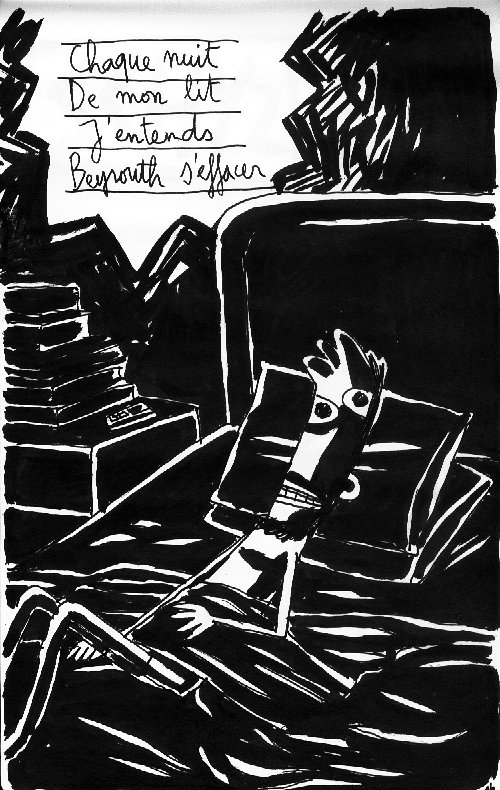
Marzen Kerbaj, 2006
each night
from my bed
i hear beirut
being erased
August 14, 2006
reading philosophy differently
Theodore Schatzki states the divide between analytic and continental philosophy quite well in his review of Stephen H. Daniel (ed.), Current Continental Theory and Modern Philosophy, Northwestern University Press, 2005:
One portentous historical dividing line between so-called analytic and continental philosophy has been their divergent attitudes toward history and the different views this divergence implies on the distinction between writing history and addressing systematic issues. Whereas "continental" philosophers often pursue philosophical issues by working with and through the ideas of past thinkers, "analytic" philosophers infrequently do this, instead viewing history as a distinct subfield with little to contribute on current issues in epistemology, philosophy of language, or philosophy of mind.
The text being reviewed by Schatzki does this by exploring the relationships between French theorists and the canonical modern philosophers. Their interpretations of the canonical modern philosophers are generally seen to unearth overlooked aspects of modern thought, and to present or pursue new ways to study modern philosophy.
One of the essays by Boundas explores this relationship in terms of Deleuze's distinction between the history of philosophy and the becoming of philosophy. According to Deleuze, official history of philosophy oppresses thought by instructing philosophers to present the ideas of predecessors instead of thinking. paraphrassing Boundas's argument Schatzki says that according to Deleuze:
To think, to do philosophy, means to "free life out of the space where it was imprisoned, one writes in order to trace lines of flight" (...these are Deleuze's words). The philosopher who thinks does not flee past philosophers. Rather, he or she works through their texts to free concepts, assumptions, and the unsaid so that these elements can coalesce, with elements from other philosophies, as new concepts appearing in new assemblages of thought that are dedicated to questions and problems different from those animating past philosophers' texts. In proceeding thus, as does Deleuze when writing about past philosophers, the thinker participates in the becoming of philosophy. "Don't . . . interpret; experiment!" (... again, Deleuze's words).
The canonical modern texts are ones with and through whom the French philosophers think. Does that capture the relationship between the two?
August 10, 2006
interpreting Blanchot
I struggle with the texts of Blanchot, especially with his writings on literature and criticism. What he is saying eludes my understanding and I end up holding very little in my hands that I can do anything with.,even though I realize that in Blanchot's world the propositional style of philosophical thinking has little ground on which to maneuver.
This quote from this review by Gerald Bruns of Leslie Hill, Brian Nelson, and Dimitris Vardoulakis (eds.), After Blanchot: Literature, Criticism, Philosophy---a volume of essays---is of help:
In both his fictional and his discursive writings Blanchot explores the phenomenological question of what it is like to experience this excessive region of exodus, exile, and extravagance. What happens is evidently even more radical than the reversal of consciousness that Hegel describes in his famous account of experience (Erfahrung) in the introduction to the Phenomenology. The possibility of experience itself is turned inside out, rather the way it is in mystical experiences in which one is no longer a subject who can see or hear or experience anything at all.
This is what I struggle with. I cannot get a grip on it, let alone understand being a subject who can no longer see or hear or experience anything at all.
Hill cites the following passage from Blanchot's essay, "La Disparition de la litterature" in the The Book to Come [1959], trans. Charlotte Mandel (Stanford: Stanford University Press, 2003):
[It] is the essence of literature to escape any essential determination, any assertion that stabilizes it or even realizes it: it is never already there, it always has to be rediscovered or reinvented. It is not even certain that the word literature or the word art corresponds to anything real, anything possible or anything important. . . . Whoever asserts literature in itself asserts nothing. Whoever looks for it looks for only what is concealed; whoever finds it finds only what is on this side of literature or, what is worse, beyond it. That is why, finally, it is non-literature that each book pursues as the essence of what it loves and wants passionately to discover. (p. 201)
It's an aesthetic nominalism--but does that help us to grasp what Blanchot is saying when he says that reading is haunted by the spectre of the unreadable.
August 9, 2006
a comment on war
I've commented on the Israeli bombing of Lebanon over at public opinion. I cannot do philosophy on this subject, so I will let Marzen, a contemporary Lebanese artist, speak:
blablabla
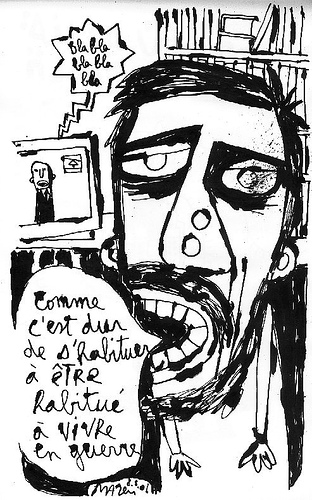
it's really hard to get used to being used to live in war.
August 8, 2006
Nietzsche, therapy, eudaimonia
In her review of Horst Hutter's Shaping the Future: Nietzsche's New Regime of the Soul and Its Ascetic Practices Jessica N. Berry queries the key category of therapy in Shaping the Future. She says:
The centrality Hutter accords this concept, I think, places an entirely appropriate emphasis on Nietzsche as a psychologist. Nietzsche surely understood himself in this way--indeed, as "a psychologist without equal"--but in a philosophical climate that is mostly hostile to empirical psychology, this facet of Nietzsche's thought is too often downplayed. Appreciating properly the value Nietzsche himself places upon psychological insight, however, depends once again on our having grasped precisely what gains such insight should yield.
She asks: What kinds of therapeutic methods and results does Hutter take Nietzsche to have in mind?
Berry rightly questions a pop psychology or marxist interpretation of therapy and says that a more promising
possibility for understanding the notion of therapy in Shaping the Future, given the link Hutter would like to forge between Nietzsche and his predecessors in antiquity, would involve reading Nietzsche as a eudaimonist. She adds:
It is unfortunate that eudaimonism as such gets no discussion here, but that in itself is symptomatic of one final, though critical, shortcoming of this book. From the first page, Hutter makes bold claims about the importance of the Greeks for Nietzsche. However, his exegesis does not provide a full enough picture of the ancients to whom Nietzsche is supposedly so indebted: Hutter makes interpretive claims about figures from the Pre-Platonic philosophers through the Hellenistic schools, but gives the reader virtually no textual references with which to anchor his sometimes highly controversial readings.
Berry says that according to Hutter, Nietzsche is in some respects an Epicurean, in some respects his views are "Platonic-Aristotelian", elsewhere Hutter claims the influence of Socrates, Empedocles, Hippocrates, and Hesiod. But in none of these cases does he discuss or provide references to the ancient texts; rarely do we even see references to Nietzsche's remarks on these figures. At most, the author should claim resemblance to these Greek thinkers, and that only in qualified respects; there is insufficient textual support for some of the very ambitious interpretations of ancient figures offered by Hutter.
Isn't Nietzsche working more in the Stoic tradition of philosophical therapy?
August 7, 2006
Nietzsche's ascetic practices
I'm back from holidays. I''ve just noted this review of a book by Horst Hutter entitled Shaping the Future: Nietzsche's New Regime of the Soul and Its Ascetic Practices. It accords with my understanding of Nietzsche's moral philosophy, namely philosophy as a form of therapy, the understanding of which is based on philosophers in antiquity.
Hutter says that Nietzsche's philosophical striving is designed to initiate ascetic labors of self-transformation in free-spirited readers and to provide the foundation for the creation of new values.therapeutic project Hutter says that Nietzsche's philosophical therapy falls into two phases, one deconstructive and one reconstructive: the task involves both a conceptual effort to undo his and others' 'embodied' opinions and then awakening the ability to move toward a vibrant 'healing culture' based on an affirmation of life.Nietzsche's texts are intended to recruit those whom he calls free spirits, but the task to which they are called is to become "commanders and legislators, [who] determine the whereto and the what--for all human beings.
Hutter interprets this philosophical therapy in terms of a five-step program for self-overcoming:
The "ascetic labors" outlined under this program include (1) retreats into solitude, (2) the cultivation of challenging (even agonistic) friendships, (3) relentless self-scrutiny in the exercise of writing and reading, (4) close attention to "nutrition" (in an expansive sense that includes food as well as ideas and environmental stimuli of all sorts), and finally, (5) the physical activity of dance.
It's a more classical--Stoic--reworking of self-creation, in the form of "giving style" to one's character.