July 25, 2006
on holidays
I'm on holidays for the next few days in the Clare Valley in South Australia, and then a few more days the following week in Robe. Then I'm back to work in Canberra after a day or so in Adelaide.
I doubt if I will be able to blog whilst on holidays as access to the internet will be difficult. Australia is very poorly serviced by way of broadband infrastructure and both of the holiday cottages I will staying at do not have access to the internet. Since there are no internet cafes in either Clare or Robe--neither have wireless---and so I will only be able to utilize public forms of access---the public library.
So I will take a break from philosophy
July 22, 2006
Foucault and truth telling #2
A quote from Paul Allen Miller's Truth Telling in Foucault in Parrhesia:
For Kant, Foucault contends, founded a critical philosophy that could go in two directions. It could move toward an analytic of truth,such as that found in Anglo-American philosophy, or toward an ontology of the presentsuch as that found in Hegel, Nietzsche, and the Frankfurt School. Foucault explicitly locates himself in this latter tradition at the beginning of the course. This self-categorization within the tradition of the "ontology of the present" in turn helps to explain the importance of the concept of "habitations of thought" and the centrality of the discourse of truth in relation to instances of power as a form of critique. For the ultimate topic of these lectures is nothing less than how does philosophy become the way in which truth is spoken to power: what does this genealogy tell us about the relation of philosophy to democratic speech, about the constitution of the subject as a speaker of truth, and about the relation of a discourse of truth-telling to specific instances of power?
How does philosophy become the way in which truth is spoken to power.That is a good way to understand a politically informed ethical philosophy, isn't it.
July 21, 2006
Foucault + truth telling
Paul Allen Miller's Truth Telling in Foucault in Parrhesia refers to Foucault's 1982-83 course at the College de France, "Le gouvernement de soi et des autres," .this is concerned with “truthtelling”---or more literally, and the constitution of the subject in relation to historically discrete structures of power.
In these lectures Foucault traces a fundamental shift that occurs in the way parrhesia is conceived, from the inherited right of democratic speech in the agonistic politics of fifth-century Athens to the honest speech offered by the philosophical counselor to the prince or other instances of aristocratic and sovereign power in the fourth century and the Hellenistic period.
July 19, 2006
Deleuze & Hegel
Deleuze was well-known for his antipathy towards dialogue. Philosophy, as Deleuze and Guattari observe, is never about dialogue, even less about communication; far from being a harmonious discussion aiming at rational consensus, philosophy is more akin to a violent encounter between heterogenous forces that might open up the possibility of thinking the new. From this Deleuzian perspective, the history of philosophy is less a story of the striving for truth or realisation of reason than a history of productive misreadings, of errant couplings, perverse conceptual encounters producing monstrous offspring. Witness Deleuze's remarks about conceiving the history of philosophy as a kind of "buggery."
In a review of Slavoj Zizek's recent book, Organs without Bodies, in Parrhesia Robert Sinnerbrink says that there are two discernible approaches to the Hegel-Deleuze relationship.
These are:
...the 'recidivist' or 'assimilationist' reading, which maintains that despite his avowed anti-Hegelianism, Deleuze inadvertently relapses into dialectics at crucial points in his philosophical project, which can therefore be reconciled with Hegelianism (here one could include Judith Butler, Catherine Malabou, and Zizek himself). And the 'incommensurabilist' or 'radical separatist' reading, which holds that there is no possible compromise between Hegel and Deleuze; Deleuze's thought marks a radical break with Hegelianism tout court (Deleuze's own position, Hardt, Massumi, and most Deleuzian commentators).
From the Deleuze I have read I would agree with Sinnerbrink 's judgement that both interpretations apply. Sinnerbrink says:
...the 'young' Deleuze’s critique of Hegel does revert to, or at least remains compromised by, a residual dialectical aspect (particularly in Nietzsche and Philosophy), whereas the 'mature' Deleuze’s entire project
(from Logic of Sense and Difference and Repetition onwards) is an attempt to break free---via Nietzsche and Spinoza but also a multiplicity of other perspectives from structuralism to avant-garde art and literature---of the totalising character of Hegelian dialectics, above all its failure to think the advent of the New.
Deleuze's Hegel is reductive and monological and, I would add, it is designed to forecloses any possibility of a productive encounter between dialectics and difference.
between Hegelian dialectic and Deleuzian difference.
July 18, 2006
psychoanalysis & Holocaust
Is a major problem both of contemporary public life and of psychoanalysis is that the Holocaust has not been understood? And thus, remains an omnipresent dimension for understanding what goes on in the Middle East today, the West's complex relations to the Islamic world, and the on-going "wars on terrorism"? Have we come to terms with the fact that, nonetheless, it did happen—how to assess its sheer facticity without recourse to the denial which has arguably been the most widely practiced response to the event.
It is argued in Psychoanalysis After Auschwitz?: The "Deported Knowledge" of Anne-Lise Stern by Michael Dorland that:
So from the indifference that those who did return from the camps experienced in immediate postwar societies, and so powerfully written about in the literary works of Primo Levi, Robert Anthelme, or Charlotte Delbo, through to the present-day, it is difficult not to come to the conclusion that many, many millions of people can be blithely slaughtered and, except for those immediately concerned, it really does not seem to matter very much at all. That is what it means to live in the After-Auschwitz, a moment in time where human life attains a nadir of worth.
How then to "think" about Auschwitz without "papering" it over? What role here can psychoanalysis perform, if any? These are the questions Anne-Lise Stern asks.
Stern gives her answer in terms of savoir-deporte deported-knowledge is, knowledge about what it means to be refuse, a 'loque'. the garbage can of the camps is a precise historical formation of the unconscious---the "anus mundi" and the task of the psychoanalyst is to attempt to decode, through the analysis of word-play, symptoms, dreams, slips of the tongue, etc.—how it is structured "like" a language,
July 17, 2006
living with the Holocaust
We we live more or less normally, in "the longest shadow" of an event or series of events, which some sixty years later we are still uncertain what to call: Churban, genocide, Holocaust.S Do we need a return to Freud to understand this?
July 16, 2006
Merleau-Ponty: bodies +flesh
Steven Rosen says:
Perhaps more than any other phenomenologist, it was Merleau-Ponty who made it clear that, in the lifeworld, there can be no categorial division of object and subject. The lifeworld subject---far from being the disengaged, high-flying deus ex machina of Descartes---finds itself down among the objects, is "one of the visibles" ....is itself always an object to some other subject, so that the simple distinction between subject and object is confounded and "we no longer know which sees and which is seen" ...Merleau-Ponty's placement of the subject among the objects was of course no materialistic reduction of the subject to the status of mere object (an inert lump of matter). Rather, his grounding of the subject is indicative of the ambiguous dialectical interplay of subject and object that is found in the lifeworld.
This leads to the body subject-and to an embodied subjectivity, with its sense of bodily contact with objects in the world and with others. The 'ambiguous dialectical interplay of subject and object that is found in the lifeworld' leads to bodily attachment to a geographical location and encountering it in the fullest sense. Bodies have their worlds, and understand their worlds. Bodies are "lived experience" in that bodies have tacit understandings of the world which are independent of any sort of cognitive map.hence the idea of body-subjects.
In Merleau-Ponty's last and incomplete work The Visible and the Invisible, the notion of "flesh" is introduced.
I haven't read the book as it is out of print.Marjorie O’Loughlin in Intelligent Bodies and Ecological Subjectivitiessays:
"Flesh" refers to the capacity of being to fold in upon itself, its simultaneous orientation to inner and outer. Using the term "double sensation," Merleau -Ponty describes the transfer of what is touching to that which is being touched, explaining that the touching subject passes over into the rank of the touched, descending into things, such that it is the one touch which occurs in the midst of the world and in things...t is his articulation of the tangible which is particularly significant, signaling a radical departure from the Western philosophical tradition in which, while the toucher is always touched, the one who sees merely does so from a distance and is, therefore, not implicated in what is seen. His discussion of the tangible underscores a determination to depict both "subject" and "object" in a generalizeable visibility, which is, for each, the same visibility -- that is, the same "flesh."
July 14, 2006
Merleau -Ponty+bodies
A quote from here:
For Merleau-Ponty, consciousness is not just something that goes on in our heads. Rather, our intentional consciousness is experienced in and through our bodies. With his concept of the lived body, Merleau-Ponty overcomes Descartes' mind-body dualism without resorting to physiological reductionism. Recall that for Descartes the body is a machine and the mind is what runs the machine. For Merleau-Ponty the body is not a machine, but a living organism by which we body-forth our possibilities in the world. The current of a person's intentional existence is lived through the body. We are our bodies, and consciousness is not just locked up inside the head. In his later thought, Merleau-Ponty talked of the body as "flesh," made of the same flesh of the world, and it is because the flesh of the body is of the flesh of the world that we can know and understand the world
And:
It is important to understand that Merleau-Ponty is not resorting here to physiological reductionism. The physiologist, at least traditionally, sees the body as separate parts that work together like a machine. For Merleau-Ponty, however, the body cannot be understood as separate parts but must be understand as a whole, as it is lived. The body as it is lived is an experiential body, a body that opens onto a world and allows the world to be for us. Physiology is not pointless; it has value, no doubt. But it does not get at the lived body. If we want to understand the body as it is lived in our experience, we have to use a phenomenological method. Merleau-Ponty would go so far as to argue that physiology is a second-order, intellectual abstraction from the primordial, lived body. In this sense, phenomenology can understand and incorporate physiological insights, but physiology is unable to incorporate phenomenological insights when it begins with a reductive approach.
July 13, 2006
resistance, body, poststructuralism
In a previous post on David Couzens Hoy's Critical Resistance: From Poststructuralism To Post-Critique I mentioned this interpretation of poststructuralism:
If "critique without resistance is empty and resistance without critique is blind," then the critical task of poststructuralist thought is to account for the possibility of resistance to political and psychic subjugation without resorting either to the master-narratives of the Enlightenment or romanticized notions of a pre-discursive self untouched by power.
Hoy says that this account has its roots in Nietzsche and Deleuze's 1962 Nietzsche and Philosophy. The word 'post-critique' replaces the term 'poststructuralism' for a theoretical era no longer under the influence of structuralist linguistics. Why post-critique? It is unclear. What Neale says is that the rise of poststructuralist thought were based on French readings of Nietzsche. What interests Hoy is the way the French readings of Nietzsche demonstrate:
...the body as the site upon which modern technologies of power inscribe themselves--technologies which, to borrow Nietzsche's language in The Genealogy of Morals, are designed to domesticate the human body to the point where it can make and hold to promises. This is most cogently articulated in his argument that Nietzsche's interest in the body as the source of resistance marks a decisive epistemological departure from the Enlightenment's identification of freedom with rational self-consciousness.
Well that is roughly how I understand 'poststructuralism'. The figure of the body is crucial to the poststructuralist critique of modern philosophies of consciousness or reflection, such as Kant or Hegel.
Neale says that Hoy's argument is that Nietzsche's:
interest in the body as the source of resistance marks a decisive epistemological departure from the Enlightenment's identification of freedom with rational self-consciousness. The crux of his claim, in effect, is that "in contrast to Kantians and Hegelians, who believe that freedom and autonomy require rational self-transparency,Nietzscheans think that much of what we do is conditioned by embodied social background practices that we do not and perhaps cannot bring fully to consciousness." This Nietzschean move toward a genealogy of modern cultural and social practices of embodiment must be understood, Hoy rightly suggests, if one is going to begin to think in terms of post-critique.
Where's Merleau-Ponty in this account? Doesn't his understanding of embodiment refers to the actual shape and innate capacities of the human body-- that it has arms and legs, a certain size, certain abilities? Embodiment as the bodily aspects of human subjectivity is a central theme in European phenomenology and the most extensive treatment can be in the works of Maurice Merleau-Ponty.
Merleau-Ponty's account of embodiment distinguishes between the objective body,which is the body regarded as a physiological entity, and the phenomenal body, which is not just some body, some particular physiological entity, but my (or your) body as I (or you) experience it. As the Cambridge Dictionary of Philosophy states:
Typically, I experience my body (tacitly) as a unified potential or capacity for doing this and that-typing this sentence, scratching that itch, etc. Moreover, this sense that I have of my own motor capacities (expressed, say, as a kind of bodily confidence) does not depend on an understanding of the physiological processes involved in performing the action in question.The distinction between the objective and phenomenal body is central to understanding the phenomenological treatment of embodiment. Embodiment is not a concept that pertains to the body grasped as a physiological entity. Rather it pertains to the phenomenal body and to the role it plays in our object-directed experiences.
So why do we privilege Nietzsche? Why not read Nietzsche from the perspective of Merleau-Ponty's. Do we such a radical rupture? We start anew with Deleuze' reading of Nietzsche?
July 12, 2006
Merleau-Ponty: from lived body to "intercorporeity"
As we know much continental philosophy is a reactions against the intellectual heritage of classical modern science and philosophy, Galilean-Cartesian physics, and Cartesian mind-body dualisms. This heritage, passing through Newton and Laplace, Comte and 19th-century positivism generally, had a reach long and powerful enough to be a viable option even in the 20th-century contexts. Merleau Ponty's earlier phenomenology---ie., The Phenomenology of Perception---stressed the lived-body (le corps propre) as against the objective body studied in the sciences, and a body-consciousness as opposed to a non-corporeal Cartesian cogito.
Merleau-Ponty's later work, represented principally in The Visible and the Invisible, suggests that the lived-body has become what he calls "intercorporeity". According to Merleau-Ponty our inherence in the world means that the world is capable of encroaching upon and altering us, just as we are capable of altering it. Such an ontology rejects any absolute antinomy between self and world, as well as any notion of subjectivity that prioritizes a rational, autonomous individual, who is capable of imposing their choice upon a situation that is entirely external to them.
In the last phase of his thinking he therefore strives ever more resolutely to free himself from the received view of intentionality as subjectivity standing over against and external to objects radically heterogeneous with it, and as occupying a specious present sharply distinct from past and future moments in a linear temporality. Body and world, like past and present, he now insists, are "interwoven" in such a way that seemingly neat conceptual distinctions between them are bound to distort and misrepresent the phenomena as we actually live and understand them in preconceptual, prereflective, prearticulate ways.
Now, there is flesh because we are corporeal, obvious enough when we take 'flesh' in its literal meaning. It is the body's presence, then, that places us in the world fundamentally as an event of openness
July 10, 2006
Merleau Ponty: embodiment #2
The more I think about Merleau Ponty the more I realize the significance of what he has achieved in terms of the Cartesian mind body problem. The complement of this is mind/body dualism, the separation of the interior mind of the individual from his/her own material body. The "theater of the mind" metaphor generates a root absurdity: the individual speaks what his or her mind is thinking. This separation of language and mind implicitly privileges the individual to the exclusion of the crucial notion of person. The focus becomes the mind (not language) and the individual as the subject, not the person as a social being.
The dualistic conception of body and mind gives rise to the problematics of subjectivity and objectivity: i.e., there is a split between subjectivity and objectivity, as in the subject of the body and soul. This provides the foundational inside/outside dualism; a nonmaterial world comprised of an inner mind substance versus an outside world of material substances or things -including other people.confusing the body with the "organism." The human organism is an asocial, complex, biological entity. The human body is a social, complex, cultural entity. So we have the disconnection of mind from language, and the conflation of body with organism,
Merleau-Ponty addresses this problem through the category of “embodiment.” Embodiment is the answer to this dualism: according to it, we are neither purely mind/soul/spirit nor are we body/object/thing – 'embodiment' is the essential link between these two seemingly separate entities. 'Embodiment' is quite different from the conception of the body as an object/thing. To explain this embodiment, Merleau-Ponty incorporated the early 20th century French philosopher, Henri Bergson’s concept of “le vecu,” or “the lived.” Taking this, Merleau-Ponty added “body,” to create “the lived body.” This presupposes a world that is experienced phenomenologically: we experience the world perceptually and in an embodied way.
In his The Phenomenology of Perception. Merleau-Ponty theorizes that we experience the world in an embodied, gestural, ambiguous and meaningful way. The key chapter of this work is entitled “Body as Speech and Expression,” which discusses to the extent that we are embodied in the world as subjects. In addition to this, we are also speaking (gestural speech is regarded as language here) through our own embodiment. Additionally, this speech is expressive. As a result, embodiment is both meaningful and expressive.
The body-subject is Merleau-Ponty's major attempt to overcome mind-body dualism. Merleau-Ponty suggested that mind and body are both centered in, and mediated by, the subject's being-in-the-world. If mind is a ghost in the machinery of the body (moving or not), the body is the only reality left for the location of agency. If the body as machine (the objective body), is rejected as such because of its deterministic status, then the body as "lived," the subjective-body, must be accepted as the only remaining alternative to determinism.
The problem I have here is that the 'lived body' is structured around the primacy of perception Teven though there is no experience without speech. Where is language in relation to lived body? What we have is the tacit or pre-reflective cogito ---the idea that there is a cogito before language, or to put it crudely, that there is a self anterior to both language and thought that we can aim to get in closer contact with. The notion of a pre-reflective cogito hence presumes the possibility of a consciousness without language, and it exhibits something of a nostalgic desire to return to some brute, primordial experience.
July 9, 2006
Foucault, resistance,
A review by Neal Keye of David Couzens Hoy, Critical Resistance: From Poststructuralism To Post-Critique in Foucault Studies (no 3). Keye says:
In these, the twilight years of "theory", it is easy to forget the discursive upheavals signaled by the appearance of "poststructuralism" on the Anglo-American critical scene in the sixties and seventies. Writing against the canon of sacrosanct ideas bequeathed by modern humanism and its forms of knowledge ---from hermeneutic obsessions with depth and meaning to the historicist belief in history as narrative representation---writers such as Michel Foucault, Jacques Derrida, and Julia Kristeva openly challenged these idealist renderings of language and history, implicating them in histories of violence, domination, and exploitation.
Keye adds:
As a result of this materialist mode of questioning the modern history of ideas, their theoretical interest in the intersection of the body, language, and the dynamics of history made it possible to resist or effect a critical relation to the humanist regime that has undeniabl dictated the modern exegetical and historical disciplines since the late eighteenth century, the social genealogy of which Foucault so remarkably described in The Order of Things and The Archeaology of Knowledge.
Keye says that Hoy's Critical Resistance is a timely reminder that poststructuralism is something more and other than an exotic French import:
The book opens with a wide-ranging introduction to the concept of resistance -- a persistent critical issue in poststructuralist theory, but one that the Anglophone tradition in philosophy and critical social theory has largely ignored, if not repressed. And while this resistance, as it were, to theorizing about resistance in the Anglophone tradition possesses a historicity that Critical Resistance does not examine, Hoy consistently argues that the challenge facing those who wish to defend a poststructuralist politics is to show how the diferent kinds of resistance articulated in poststructuralism ---from the body of resistance in Foucault to the ethical resistance of the Other in Levinas ---are not reactive evasions of the political, but rather critical interventions in practice.
He says that if "critique without resistance is empty and resistance without critique is blind," then the critical task of poststructuralist thought is to account for the possibility of resistance to political and psychic subjugation without resorting either to the master-narratives of the Enlightenment or romanticized notions of a pre-discursive self untouched by power.
July 8, 2006
living with animals
In her article, "Eating Meat and Eating People" Cora Diamond explores the meaning of our lives when they are open to animals. In the article Diamond explores vegetarianism and the reasons for it in debate with animal liberationists. She shows the positions of Peter Singer and Tom Regan to be dehumanizing. She believes there are reasons to respect animals, but they are not those given by Singer or Regan. Both these animal liberationists, she charges, have misunderstood how important our sense of humanity is in creating our moral universe, and she thinks they do violence to our moral fabric when they level the nuanced distinction between us and animals for their purposes. Rather, Diamond suggests, we should think about how our sense of humanity already has possibilities in it fordeepening our moral relations with animals.
The problem is, it is hard to make sense of what Diamond means in the short space of an article. What would it look like to find possibilities in our sense of humanity for deeper moral relations with animals? Don’t we already think it is human enough to slaughter them at will and in the most degrading and industrial of manners? Diamond did not explain enough of what she meant. Raimond Gaita in his book The Philosopher’s Dog, examines how his shared life with animals, especially his German shepherd Gypsy, allows us to see what it is to be meaningfully human. Not surprisingly, being meaningfully human is enriched through relationships with animals. Heidegger or Agamben could have said that, too. The question is, specifically, why? What do animals show us and we them? What do we share? How is life enriched?
Gaita understands, following Diamond, that the question of marking the difference between humans and animals is not derived from any special properties. Rather, it is something in our form of life: a way we bring up our young and treat each other, formed out of so many factors we could not responsibly enumerate them.
Death for us is not the same as death for the dog. To deny that is to be oblivious to meaning. Dogs howl at the death of their fellows, and they can miss each other and people terribly. But they do not revisit the shrines of their ancestors, or bring flowers to their parents’ grave three decades after their deaths. There is nothing speciesist in acknowledging such facts. On the positive side because we can form a relation with animals that relation is meaningful, we can treat them in some respects as we would want to be treated and care for them as fellows on this "death-bound journey." The issue is whether what we do to them is a meaningful and rich relation flowing from our sense of our own humanity.
Gaita's argument is that we do not have to live with factory chicken farms and that, out of a desire to
live meaningfully, we should not treat animals as beasts of burden. We can relate to animals so much we mourn for them or we can simply care that they have a fair chance in life even when, eventually, we kill them. Relating to animals opens up our lives and makes them more meaningful, because it deepens our reverence for life.
July 6, 2006
Deleuze+ virtual
It is argued that Deleuze replaces the true/false or real/unreal opposition by the actual/virtual distinction. The virtual and the actual are important concepts for Deleuze. According to Deleuze virtual and actual are both real, but not everything that is virtually contained (immanent) in this world is or becomes actual. The difference between virtual and actual is an important philosophical claim that Deleuze makes which again needs much more elaboration than is possible to give here. To put it simply the virtual (dreams, memories, imaginations, pure qualities) is real insofar as it has an effect on us, the virtual insists on the actual.
He states that there is no actual image which is not embedded in a 'mist' of virtual images. And on the other hand virtual images react to actual images. The difference between the actual and the virtual is a difference in time (once more it is clear here that Deleuze is a philosopher of time): it is the present that passes that defines the actual; the virtual is defined by the past that conserves itself.
July 5, 2006
Heidegger, ethics, care
Robert Tulip in Chapter 6 The Place of Ethics in Heidegger's Ontology says that the existential analytic of Dasein brought a new dimension to the western philosophical tradition, in that Heidegger’s emphasis on 'place' and on 'world' sought to re-orient thought to the unitary human level through a paradigmatic critique of the modern Cartesian ontology. He says that:
The ontology of Dasein is built around the observation that human existence is essentially temporal, which means that time is the only horizon within which we can understand the nature of our being and that we are thrown into a world not of our making. Heidegger sought to interpret this horizon by designating the unity of the temporal structure of our existence as'‘care' ...Care is the central theme of Heidegger's whole philosophy, and the term in which Dasein finds its meaning.
Care is an ethical term.
...care is akin to openness, for which the way things and people matter to us is essential.... when things matter to us, we care for them in a specific way, which Heidegger terms 'solicitude'... Concern with food and clothing, and the nursing of the sick body, are forms of solicitude as are considerateness and forbearance. Such concern can occur in an authentic or an inauthentic way, and the difference arises from whether or not we are open to the consequences of our concern. Authentic solicitude retains the dignity and respect proper to care; it seeks to "leap ahead and liberate", by helping "the other to become transparent to himself in his care and to become free for it", while inauthentic solicitude tends to "leap in and dominate", paternalistically making decisions to create a situation of dependency.
July 4, 2006
Heidegger & ethics
Robert Tulip in Chapter 5 of his The Place of Ethics in Heidegger's Ontology says that there is:
... a definite ethical undercurrent informing Heidegger’s work, but it is not made explicit and remains at the level of a hidden ‘elan’, an impulse giving direction and meaning to his ideas. That his ethics take the form of such an unsaid elan, rather than an explicit teaching, can be attributed both to his wish to re-establish thought on the foundations of existential ontology, and to his serious criticisms of the way ethics has functioned in philosophy in the past...The discussion in the Letter on Humanism about the relation of ontology to ethics provides the only direct exposition of an ethical dimension in Heidegger's thought, with its development of the existential analytic into the suggestion that ontology is itself the original ethics.
I've always worked with a sense of an ethical undercurrent in Heidegger, though I have been very unclear as to what the undercurrent is. Tulip says that:
One of the key arguments of the Letter on Humanismis a development of the thesis presented in the Introduction to Metaphysics that 'the ethical' has become the degraded modern moral counterpart of what the ancients understood as the 'ethos'. If our ethics are effectively to assist the understanding of truth and the improvement of the human situation, they cannot be only a matter of arbitrarily decided rules and norms, but must be anchored in the ground of our Being. .... For Heidegger, this primal subsistent basis is identified with the 'ethos'. He therefore suggests that ethos "denotes not mere norms, but 'mores' based on freely accepted obligations and traditions".
Ethos comes to mean whatever norms or rules prevail in a particular situation.
July 2, 2006
being untimely
Jodi Dean, who runs the I Cite weblog, has a brief post on Theory Blogging --its about blogs and scholarship in the academy. There are some comments on the post by McKenzie Wark, an Australian postmodern scholar who now lives in New York. Wark, the author of The Hacker Manifesto, says:
I'm also skeptical about its [blogging] value for scholars, particularly young ones. It may stimulate a tendency to groupthink, and an addiction to a certain temporality for thought. How is one to think in an untimely fashion with a constant hum of day-to-day discourse going on in the background?
Well, an engagement for those in Australia with the issue raised by the cartoon would be untimely. It sure would avoid the group think:
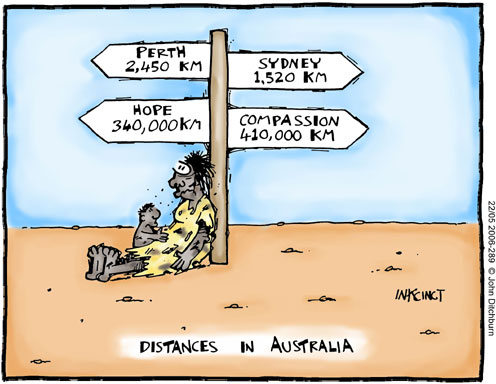
Professor Boni Robertson, author of the Women's Task Force on Violence report in 1999, which revealed a horrific level of violence in Aboriginal communities in Queensland, told The Australian.
"Enough is enough. Aboriginal Australia right now is in a position of fear and uncertainty. People don't know where we're heading - there is just this blame, blame, blame. That doesn't mean to say we shouldn't do something about the violence and the substance abuse. Nobody wants to see a child hurt or violated. But there has to be a more productive, pro-active way of dealing with it than having to resort to those antiquated solutions that have proven time and time again not to have worked...The violence is terrible, but our people have been saying it's been there for years and years and years. The only thing that's changing is that the consequences of the violence is getting worse and the causes of the violence is getting worse - impoverishment is getting worse in our communities.
The federal Government is conducting a law-and-order campaign whilst not focusing on the causes of the violence - poverty, disempowerment and alcoholism.Of course, an engagement with such an issue requires some theory if we are in Wark's words, to 'hack the new out of the old.' How would theory blogging help 'create the possibility of new things entering the world.'?
Jodi has an article in Bad Subjects entitled Blogging Theory She writes:
At any rate, missing from nearly every account of blogs and blogging is the genre of academic blogs, and its even smaller subset, the theory-minded blog--no doubt because the number of such blogs and their readers is small and their discussions specialized if not downright esoteric--Badiou, Benjamin, Blanchot, Heidegger, Zizek.The theory blogs---and I am thinking primarily of about thirty or so interconnected blogs---generally combine personal and theoretical explorations, discussions of culture and politics, reflections on academic practices, and anything that strikes the blogger’s fancy.
There are very few of these theory weblogs in Australia. Some are written by younger academics.
Jodi adds that whilst these theory blogs share a thread of theoretical concerns, they also differ greatly:
The authors might be single or groups. They might or might not allow comments. They might post daily or less than once a week. Their tones and personalities differ. Some blogs are playful, filled with rough and tumble banter. Others feel a bit like a seminar or like meeting up in a restaurant or bar after the seminar has ended in order to continue the discussion. Still others have the feel of reflections, notes, and drafts, moments of thought and writing usually more private and isolated now open to those who might want to consider them, who might have a suggestion or two. I think of notebooks left open for other’s marginalia.
Philosophical conversations is more notes and moments of thought, an oneline notebook almost.
Jodi then adds that what is particularly remarkable is the way these differing blogs interact in terms of an ongoing conversation;
conversations moving from one site to another or taking place on several sites at once, conversations branching into differing sets of links, never encompassing them all, but rarely limited to one. So, some of the same people appear in various conversations, although not all of the same people will comment at each blog. What the theory blogs suggest, then, is a practice of blogging that is more than journalism, more than diary keeping, and more than remediation. Ours is a practice of critical conversation beyond and through existing institutional frameworks.
Yes.