June 29, 2010
Jane Fulton Alt: prescribed burning
This image is of a prescribed prairie burn to remove accumulated dead vegetation and to release seeds from dormancy. By opening the woodlands to more sunlight, the fires prepare the soil for new spring growth.
 Jane Fulton Alt, Burn No 79, From The Burn series
There is a big debate about prescribed burning in the national parks of Australia as a way to reduce the dead matter load that would fuel a bush fire. Prescribed burning is sometimes known as back burning in Australia. It is means deliberate burning being carried out in the name of ‘hazard reduction’ – in order to reduce the available ‘fuel’ (native vegetation) for potential future wildfires or bush arson.
Thousands of hectares are burnt in a free-for-all and thousands of native animals are roasted. Mosaic burning is too labour intensive and the typically inaccessible gullied terrain and thick forested vegetation of many national parks makes mosaic burning impracticable and too costly. Often this is all about operational efficiency, not ecological biodiversity.
June 27, 2010
the internet + reading
In his 2008 article, Is Google Making Us Stupid? What the Internet is doing to our brains, in The Atlantic Nicholas Carr argues that what:
the Net seems to be doing is chipping away my capacity for concentration and contemplation. My mind now expects to take in information the way the Net distributes it: in a swiftly moving stream of particles. Once I was a scuba diver in the sea of words. Now I zip along the surface like a guy on a Jet Ski...Thanks to the ubiquity of text on the Internet, not to mention the popularity of text-messaging on cell phones, we may well be reading more today than we did in the 1970s or 1980s, when television was our medium of choice. But it’s a different kind of reading, and behind it lies a different kind of thinking—perhaps even a new sense of the self.
The internet is weakening our capacity for the kind of deep reading that emerged when an earlier technology, the printing press, made long and complex works of prose commonplace. Carr adds:
The kind of deep reading that a sequence of printed pages promotes is valuable not just for the knowledge we acquire from the author’s words but for the intellectual vibrations those words set off within our own minds. In the quiet spaces opened up by the sustained, undistracted reading of a book, or by any other act of contemplation, for that matter, we make our own associations, draw our own inferences and analogies, foster our own ideas.
Carr's new book, The Shallows: What the Internet Is Doing to Our Brains, expands on the ideas of his essay. The argument is the same. The internet is rewiring our brains. The result: a distracted, fidgety, addiction to picking up small pieces of information before clicking on to the next thing; and an inability to concentrate for very long on more substantial work.
There are echoes of older debates here about mass media---in the 1940s and 50s, comic books and rock music were going to turn the young into juvenile delinquents. In the 1960s television was going to rot our brains.They were deemed to be simplistic forms of written and visual entertainment. Now its the internet.
June 21, 2010
publishing: innovation
The publishing industry that has been challenged by the rise of digital publishing and much criticized by new media pundits as out of touch. Publishing is no longer about the printing press since writers are now sharing their work online, while writing it, and writers and readers are begining to create an eco-system of give and take that could exist in print, online, and be served piece-by-piece. The publishing industry needs to quickly get up to speed with the changes occurring in the industry because of the digital revolution or get left behind.
Sam Cooney in New publishing models: a shifting of power at Meanland says that focus shouldn’t be on the fallacious expiration date of the industry, but rather on how publishing is being transformed through the birth of new publishing models that are popping up. He says:
The traditional commercial publishing model is stacked against the majority of writers. If you were fortunate enough to have a manuscript accepted by a publishing house and sign a contract, the whole process is then lengthy and complex. Editors, printers, shippers, wholesalers, distributors, marketers, booksellers – all take time and money to publish and flog your work, and then there is no way to find out who is reading your words. And the actual chances of an author making a living from the book are remote.
Some new movements, such as print-on-demand publishing, and ebooks have created a whole range of new models for the industry, give power back to the author --enabling writers to put forward their work into the public domain, and reclaim both the control and the rewards of book publishing. Writers can wrestle back control of their work.
An example is Cory Doctorow's new short story collection, With a Little Help. He writes about the process here at Publishers Weekly.
June 20, 2010
Grateful Dead: Dark Star (Sunshine Daydream version)
Sunshine Daydream is an unreleased movie shot at the Grateful Dead's 1972 Veneta, Oregon concert to benefit the Springfield Creamery in nearby Springfield, Oregon. The title of the film is taken from the coda section of the Dead song "Sugar Magnolia". The concert itself was organized by Ken Kesey and the Merry Pranksters and this festival like concert was shot with synchronized, handheld cameras.
The Grateful Dead played all afternoon and into the dark after an opening set by the New Riders of the Purple Sage. This version of Dark Star is from the third set:
Sunshine Daydream is something of a missing link. It offers possibly the best testament as to why the Grateful Dead became such an enduring phenomenon.
Grateful Dead shows generally had a positive, happy atmosphere, as the band and the audience interacted with each other to create a special environment of musical celebration. This original Deadhead phenomenon is difficult to represent on film.
These were more innocent days. Dancing naked at a summer musical festival would not be accepted today after the long conservative backlash.
You can imagine the moral outrage from both Murdoch's tabloids and conservative politicians if such a concert happened today in Australia.
June 19, 2010
Clay Shirky: Here Comes Everybody
The rise of digital communications technologies has caused turmoil in the publishing industries. Newspapers and magazines, book and music publishers, and Hollywood studios are all feeling squeezed as the printing and distribution services they provide become less and less valuable and people start to take the digital technologies into their day-to-day lives.
It was the limitations of 20th-century media technologies conferred a privileged position on the relatively small circle of journalists, critics, musicians, actors, directors, and authors fortunate enough to have access to them. And just as the printing press democratized access to the written word, the Internet is democratizing publishing. Rather than managing or coordinating its thousands (millions?) of users, Flickr lets them coordinate themselves. Flickr simply provides a platform for them to share photos and form groups
The passage below is from Clay Shirky's book Here Comes Everybody: The Power of Organizing Without Organizations, (2008) which explores the effect of new digital technology on regimes of cultural creation. He argues that social tools such as a blogging software like Wordpress and Twitter, file sharing platforms like Flickr, and online collaboration platforms like Wikipedia support group conversation and group action in a way that previously could only be achieved through institutions.
On the Tools and Transformation post on the Penguin blog he says that the internet, like the printing press in 1450, also:
democratizes both production and consumption of media. It too is producing a staggering volume of new material, some good but most flyweight. It too is upending the role of traditional gatekeepers and destroying the older economics of scarcity. And it too is leading to a cottage industry of hand-wringing: "Why can't we just get a little bit of internet, but keep most things the way they were?" (and, deliciously, this argument is often made on weblogs, in order to get more readers quickly.)
No longer does publication require the purchase of expensive printing presses, broadcast stations, or 35mm cameras. With these economic barriers removed, every content consumer is a potential producer, and publishing is limited only by time and ability.
He adds that:
The problem with this view is that there is no intellectually coherent conservative position with regard to the printing press. Most of the defenders of current culture don't even try to explain why it was OK that the printing press destroyed scribal production, but not OK that the internet threatens newsprint, or why a proliferation of new creators and experimentation with new forms was good in 1508 but bad in 2008. It is simply assumed that revolutions in the past were good but those in the future are bad (and of course all of this is painted on the broadest possible social canvas, to hide the "Life was better when I was younger" flavor of the argument.)
The Internet won’t kill news and entertainment outlets or political parties. Our traditional institutional organizations will continue to exist in this new Web 2.0 world, but their influence will weaken since news is no longer an institutional prerogative. It’s part of a communications ecosystem, occupied by a mix of formal organizations, informal collectives, and individuals. The more an institution or industry relies on information as its core product, the greater and more complete the changes it now faces.
Shirky finishes by saying that with the internet it is not too early to tell that we are in for a significant transformation of intellectual life, and the lesson from the last revolution (the printing press) is that the way to make society better is not to try to preserve the old forms, but to experiment, wildly, with new ones, including hybridization of the book with the web.
June 18, 2010
Small Faces - Ogdens' Nut Gone Flake
Ogden's Nut Gone Flake is the magnum opus of The Small Faces. Released in 1968 this album by these East Ender lads is a mix of Cockney whimsy, hard rock, blue-eyed soul, druggy freakbeat sensibilities and musical hall story telling. It is widely regarded as a classic album.
It is split into two distinct sides. Ogden’s' first half consists of six tightly buzzing slices of the psychedelic r ‘n’ b that was now their stock in trade. This selection is from the first side of this intriguing concept album:
Sadly, the Small Faces themselves crashed and combusted in 1969 shortly after the album was released.
The core of the Small Faces was the songwriting team of Marriott and Ronnie Lane. Marriott left to form Humble Pie and the rest of the band reformed to became The Faces.
This selection is from the second side of the album, which is s based on an original fairy tale about a boy called Happiness Stan.
The voice over, or rather the spoken word recitations, are courtesy of actor/recitalist Stanley Unwin. Despite one complete airing on British TV (Colour Me Pop) Ogden’s Nut Gone Flake was never performed live due, in part, to its complexity. They only mimed to it on one episode of Colour Me Pop.
June 17, 2010
Wingless Angels: Oh what a Joy
This track is from Wingless Angels 11, an album of Rastafarian spirituals, which is the group's first release in 13 years. The original album was released in 1997
It is being released by Keith Richards whose connection with the group goes back to the early 1970s when the Rolling Stones' were recording the music for their album Goat's Head Soup at Dynamic Studios in Kingston.
I Write My Name/Good Morning is from the original 1997 album. The selections are mostly traditional Christian hymns that have been retooled to Rasta ends.
The Wingless Angels aren't a group in the commercial sense, more like a collection of musical neighbors whom Keith Richards recorded one evening in his own back yard in Ocho Rios in the fall of 1995. He then spent a couple years doing light overdubs on the recording before releasing it on his own label in 1997.
June 16, 2010
images of war
The April 2010 issue of Media, War & Conflict is about the images of war. Images of war are politically powerful, which is why they have been contested and restricted throughout history. Images tell a more compelling story than words, providing good reasons for governments’ traditional attempts to control images either by not showing them to the public or by imposing tight restrictions on their use.
Shahira Fahmy in the Introduction says that:
Scholars of mass communication most often analyze text at the expense of images, hence underplaying the significance of the visual in connecting with audiences. According to Messaris and Abraham (2001): ‘The special qualities of visuals – their iconicity, their indexicality, and especially their syntactic implicitness – make them very effective tools for framing and articulating ideological messages’ (p. 220, emphases in original). In other words, they suggest that visuals and text are distinct yet equally important parts of the news-making process.
Despite recognizing the importance of images, only a few scholars have examined the visual portrayal of news events.
They found image choices dramatically influenced how the audience perceived these events. Past studies have consistently shown that competing media outlets portray events in different ways, carefully selecting particular images as visuals are consistently used to present specific views to the audience.This is particularly true during times of crisis.
In her recent book, Packaging Terrorism, Moeller (2009) asserts that governments and their media have been generally interested in ‘distancing their own citizens and audiences from the negative human consequences of their nations’ own policies – and are equally interested in emphasizing the human costs of their enemies’ strategies’ (pp. 147–8).
Moeller's basic premises in this text are that “terrorism has been the main event of the twenty-first century”, that such attacks are “likely to be framed so that [the news outlet’s] audience feels vulnerable”, both terrorists and the “War on Terror” exploit a politics of fear, that “news organizations chauvinistic[ally] focus on the news that is geographically and psychologically closest to their audience” and that both terrorists and the Western media “want to keep their own message in the public view”.
June 15, 2010
Barthes + photography
In Barthes, Autobiography and Photography (Colloquy 18, 2009) Fabien Arribert-Narce says that Roland Barthes' interest in photography began at a very early stage in his career. Indeed, several texts in Mythologies, one of his first major works, and published in 1957, are dedicated to the role of photography in French society of the 1950s.
At this time, Barthes was interested in the potential of the photograph as a powerful mass communication medium used, for example, to glorify Hollywood actors. In the following years, his work focused mainly on advertising and press photography, with articles such as The Photographic Message (1961) and Rhetoric of the Image (1964), in which he analyses the ways in which pictures convey meaning. At this stage, he conceived the photograph as a fundamentally ambivalent and paradoxical object, involving the ìco-existence of two messages, the one without a code (pure denotation), and ìthe other with a code (that is to say a whole range of connotations). Barthes thus highlights the photograph's capacity to fascinate us, working as an analogue of the real, giving a direct access to its referent on the one hand, and, on the other, to convey information and to be read like a text.
He remained loyal to this double approach until the very end of his career, and in particular in the last book he published (in 1980), Camera Lucida. In this text he focuses more on the photographic referent, this book being one of his most personal texts, in which he adopts a phenomenological approach to define photography,
June 9, 2010
pictures + text
As Andy Grundberg points out in this review of Robert Bergman: Portraits, 1986–1995 at the National Gallery of Art, Washington, in Aperture's blog Exposures though there is nothing radical about Grunberg's compositions, but his harmonic handling of color and his choices about how to fill the frame show that he is attuned to the legacies of his contemporaries William Eggleston and Nan Goldin.
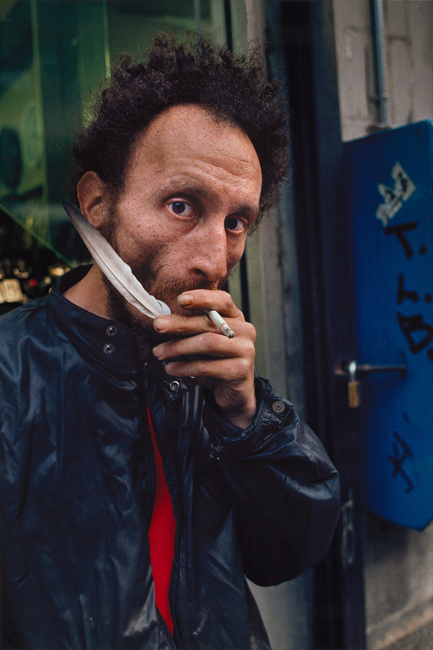 Robert Bergman, Untitled, 1989, inkjet print, printed 2004
Gundberg, the former New York Times critic, goes on to say:
there’s a temptation to dismiss Bergman’s pictures as latter-day Bowery Bum photography. Most of his ink-jet-produced, moderately sized prints show us the faces of people he encountered on the streets of major cities in the Midwest and eastern United States. They are posed portraits: the subjects gaze down or away into the distance, or else stare confrontationally at the camera. For the most part, the people appear to be downtrodden or at least on the outs with conventional society; more than a few seem afflicted with a wasting disease.
The portraits remind me of the world of Baltimore represented by The Wire but Grundberg refers to the Robert Frank and The Americans. In his Crisis of the Real: Writings on Photography, 1974-1989 he interprets Frank as "the somewhat narcissistic reflection of a personality caught up in the romance of the existential dilemma."
Grundberg continues:
Unfortunately it is impossible to verify any of the questions a viewer might have about these people, since Bergman calls each image “Untitled” and provides it with only a date. No name, no location, no facts except those given by the lens—presumably Bergman wants his subjects to be open
to whatever preconceptions and prejudices his viewers may project onto them. In the context of the gallery, though, this denial of extrapictorial detail seems less a social statement than an aesthetic position: we are forced back on Bergman’s compositions, his use of color, the consistency of his choices of framing, even his decision about which subjects to shoot.
What is wrong with this lack of text? Bergman's roots are in modernism, with its hostility to the literary and its teaching that photography shouldn't be painterly. We are forced to look at the images before us without a caption that interprets the image.This photography is blunt.
 Robert Bergman, Untitled, 1994, inkjet print, printed 2004
Rather than explore this issue Grundberg turns to Bergman's motives:
Surely he can’t be concerned that these pictures in any way improve the lives of the people they portray, since we don’t know where or who they are. Perhaps the ambition is for our regard of the pain of others to make us more attuned to human suffering in general (come back, Susan Sontag, please), but this aim is attenuated by our prior experience of pictures in the same vein. We might expect anyone conversant with recent photographic practice to know this as an existing critical problem, which leaves us with a far less ennobled idea of what is afoot here: that Bergman is out to convince us that he is a great photographer. Unfortunately, he has appeared a half-century too late.
That's strange given what Bergman says in this interview about his isolation and the art world's indifference to his black and white work.
June 7, 2010
Flotilla Choir presents: We Con the World
The spoof YouTube clip below is set to the tune of the 1985 charity single We Are the World and it features Israelis dressed as Arabs and activists, waving weapons while singing: "We con the world, we con the people. We'll make them all believe the IDF (Israel Defence Force) is Jack the Ripper." The reference is to the Free Gaza flotilla.
The clip features a group led by the Jerusalem Post's deputy managing editor Caroline Glick, wearing keffiyehs and calling themselves the Flotilla Choir. The footage is interspersed with clips from the recent Israeli raid on the Gaza-bound aid ship, the Mavi Marmara.
The Israeli government press office distributed the video link to foreign journalists at the weekend, but within hours emailed them an apology, saying it had been an error. Well they might. The video shows a striking gap between how Israeli's view the flotilla and the rest of the world does, thereby highlighting Israel's increasing isolation.
June 6, 2010
the Bauhaus
In a review of some recent books on the Bauhaus at the New York Review of Books by Martin Filler says:
What made the Bauhaus such a truly revolutionary undertaking was not so much its departure from prevailing aesthetic norms—specifically its rejection of historical styles—but rather its systematic recasting of the way in which the fine and applied arts were taught. During the nineteenth century, the rapid emergence and proliferation of new manufacturing methods and building technologies led to the establishment of polytechnic schools that concentrated on the practicalities of engineering and construction rather than the niceties of stylistic correctness or adherence to established precedent. In the decades just before the Bauhaus was founded, there were a few piecemeal attempts to reform some of the German and Austrian crafts schools established during the age of industrialization.
Filler says that the hallmark innovation of the Bauhaus was the Vorkurs (preliminary course), a required introductory class that provided intensive back-to-basics immersion in the fundamentals of color theory and composition, with an emphasis on the arrangement of tonalities to achieve specific optical effects, and on recombinations of pure geometric form as the elemental building blocks of design.
June 1, 2010
Deepwater Horizon: photograph of oil spill
Workers clean up the oil from the Deepwater Horizon disaster, as the oil impacts Redfish Bay in Louisiana's Birdfoot Delta, where the Mississippi river empties into the Gulf of Mexico
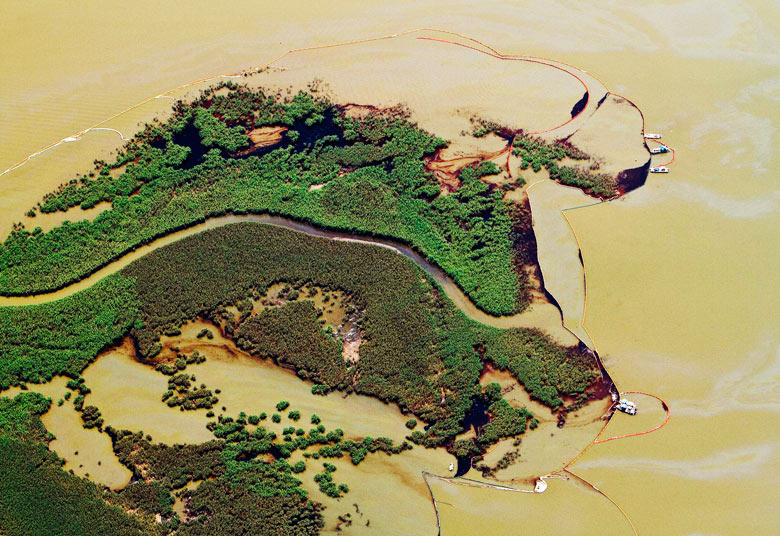 Jeffrey Dubinsky/Reuters
Independent scientists and government officials say there's a disaster we can't see in the Gulf of Mexico's depths due to two massive underwater plumes of what appears to be oil, each hundreds of feet deep and stretching for miles.
BP, which continues to downplayed everything from the amount of oil spewing into the Gulf to the environmental impact, denies the existence of the deep water plumes.