May 29, 2010
Sally Man: Proud Flesh
Sally Mann's husband, Larry Mann has muscular dystrophy and she made a series of black-and-white photographs portraits taken over six years entitled Proud Flesh. The relation of artist and model is, traditionally, a male-dominated field that has yielded countless appraisals of the female body and psyche, and Mann reverses the role by turning the camera on her husband.
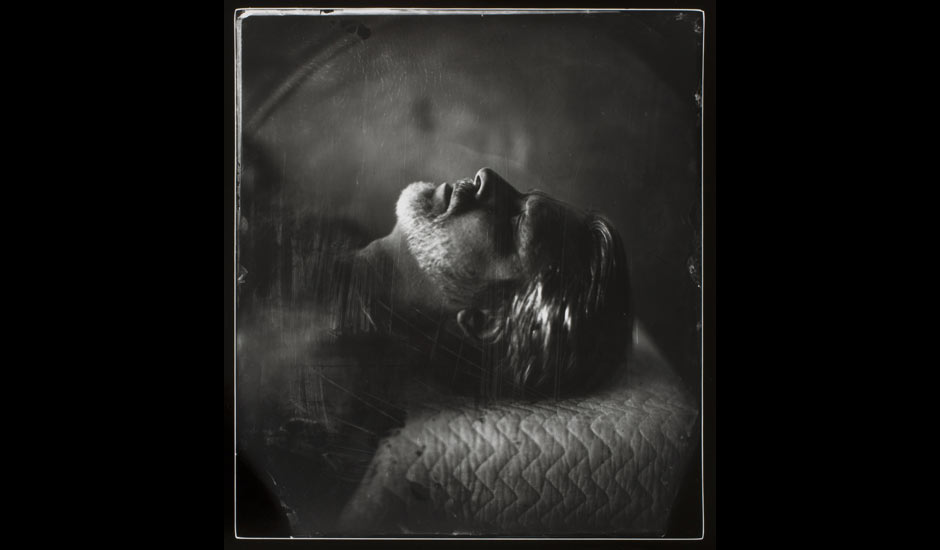 Sally Mann, Was Ever Love, 2009, silver gelatin print, from the Proud Flesh series
The images are contact prints made from her working with wet-plate collodion negatives, produced by coating a sheet of glass with ether-based collodion and submerging it in silver nitrate.
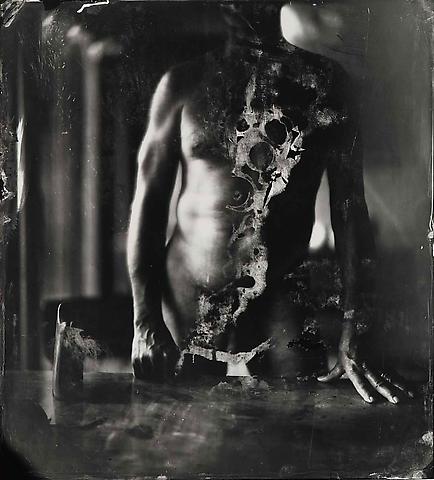 Sally Mann, Hephaestus, 2008, Gelatin silver print, from Proud Flesh series
Mann exploits the surface aberrations that can result from the unpredictability of the process to produce painterly photographs marked by stark contrasts of light and dark, with areas that resemble scar tissue. In works such as Hephaestus the scratches and marks incurred in the production process become inseparable from the physical reality of Larry's body.
May 26, 2010
e-books
I'm increasingly reading online rather than buying books--dipping in and out of Google Books. I no longer think of buying books for my bookshelves or even building new bookshelves. I would suspect that book sales are dropping for the publishing industry.
Now that the iPad is seen as the container for a new kind of book, this post on why e-books failed previously and may again is worthwhile reading, as we move into a post-Gutenberg world. The publishing industry is standing in the way, protecting its profits from hardback sales because they reckon that cheap e-books are going to cut into their bread-and-butter retail sales.
In Challenging publishers to change isn’t the safe path Mitch Ratcliffe says that currently we are:
at a time when readers are beginning to define the use of their attention in radically different ways, collecting not whole finished works, but instead discovering parts of books in other books, on Web pages and in articles, and reading their way into those titles over time. Reading relationships are accretive, they build up over time. You find a quote you like and recall it, perhaps writing it down. Later, you come across the author’s name, the same quote or another quote somewhere else and make additional connections to the work where that quote resides. Finally, you might go searching for the book or the author to see the whole idea in the context it was presented, in a book you order online or check out from a library.
The argument is that publishers need to reject the idea of a finished and closed product that exists between the covers of a book so that the work can be freed to interact with readers in a networked marketplace.
Future eBooks will contain multimedia (video), 3d graphics, sound files, and more. Instead of just words on a page we will layer video throughout the text, add photos, hyperlink material, engage social networks of readers who will add their own videos, photos, and wikified information so that these multimedia books become living, breathing, works of art. They will exist on the Web, be ported over to any and all mobile devices that can handle multimedia, laptops, netbooks, and e-readers in a networked world. Such open books will incorporate the interaction of readers.
Soon we will be reading books on the iPad and our bookshelves will look to be historical objects wrapped in nostalgia of old black and white photographs.
May 25, 2010
tumbling
Conversations is my online scrapbook in which I put bits and pieces without thinking in terms of posts:
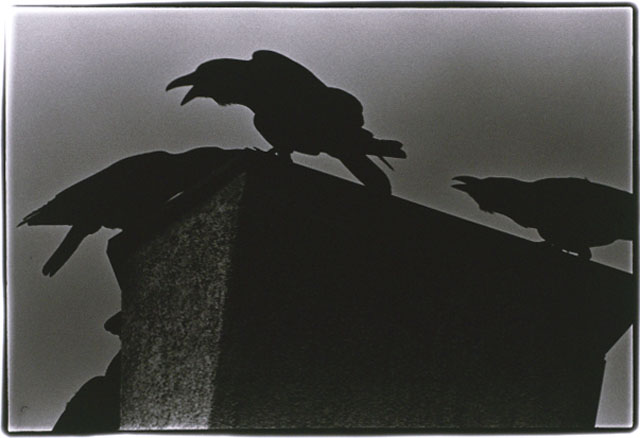 Masahisa Fukase, Shibuya, from Ravens, 1985, gelatin silver print
I use conversations to post stuff I come across, which I want to both share with others and to ideas (eg., mimesis) that I can come back to latter for longer blog posts.
There is an article on Tumblr at American Prospect by Marisa Meltzer called the Curated Web that explores Tumblr's Web site own analogy: "If blogs are journals, tumblelogs are scrapbooks." She highlights Tumblr's "reblog" button that allows one tumblelog's content to be shown on another.
Meltzer says that it takes a classic function of blogs -- highlighting and linking to the work of other bloggers -- and makes it instantaneous, eliminating even the need to copy and paste.There is no "stealing" words or images, only reblogging. Hence the idea of an online community and it iths built-in community -- a more formal linkage than most traditional blogs have -- that leads to Tumblr's focus on curation.
Scrapbook is a good idea for tumbleblogs as these are personal sites: what people use the platform to post stuff they find of interest to them. It's low maintenece. Meltzer however is more interested in the emergence of a micro-communities out of tumbleblogs:
At its best, Tumblr is a sort of modern-day zinemaking. Zines, self-published do-it-yourself magazines (often featuring photos and text cut from other magazines and photocopied) with limited distribution, have always been a part of underground culture, both as a product and as a galvanizing part of the community. As in the zine world, activists and weirdos alike thrive in their Tumblr microcommunities, posting photos of signs that read "Feminism Is for Lovers" or collages of child stars. Blogs have been accused of killing off zines (though they are still being produced), and tumblelogs seem to channel the spirit of zines more so than any long-form blog.....Tumblr at its worst is even more casual and careless than the wider blogosphere.
Maybe. I do that online magazines in many different forms, will become ever more significant on the web.
mimesis: a note
I've always struggled to understand the term mimesis. I understand that the term mimesis is derived from the Greek mimesis, meaning to imitate; or as the OED defines mimesis, as "a figure of speech, whereby the words or actions of another are imitated" and "the deliberate imitation of the behavior of one group of people by another as a factor in social change". Once upon a time human beings were mimetically adept--eg., mimicry in dance and ritual life in aboriginal culture. Children playing today would an example of the mimetic faculty--the ability to mime and become and behave like someone else.
My difficulties come with the 20th century approaches to mimesis by authors such as Walter Benjamin, Adorno, Girard, and Derrida. They have have defined mimetic activity as it relates to social practice and interpersonal relations, rather than as just a rational process of making and producing models. Their approach emphasizes the body, emotions, the senses, and temporality. I kinda get that; sort of. But it eludes me.
The return to a conception of mimesis as a fundamental human property is most evident in the writings of Walter Benjamin who postulates that the mimetic faculty of humans is defined by representation and expression. But what does that actually mean for us today?
The resurfacing of the primitive in modernity? Modernity provides the cause and context for the resurgence of the mimetic faculty. So how does the story go?
The University of Chicago's useful keywords glossary of media terms comes in handy. The mimesis entry written by Michelle Puetz states that Adorno's discussion of mimesis originates within a biological context in which mimicry (which mediates between the two states of life and death) is a zoological predecessor to mimesis.
Animals are seen as genealogically perfecting mimicry (adaptation to their surroundings with the intent to deceive or delude their pursuer) as a means of survival. Survival, the attempt to guarantee life, is thus dependant upon the identification with something external and other, with "dead, lifeless material". Magic constitutes a "prehistorical" or anthropological mimetic model - in which the identification with an aggressor (i.e. the witch doctor's identification with the wild animal) results in an immunization - an elimination of danger and the possibility of annihilation.
With the rise of the Enlightenment in modernity we have the emergence of a world of restricted thought and suppressed alternatives. Rather than bringing forth a new age of human emancipation, the rise of Enlightenment reason has led to new forms of domination, it has become its opposite, it has reverted to myth. The dominance of positivist thinking reduces the space for critical experience and for rational consideration of the social and historic roots of present social structures and systems of knowledge.
Puetz goes on to say that in Adorno and Horkheimer's Dialectic of Enlightenment, mimesis (once a dominant practice) becomes a repressed presence in Western history in which one yields to nature (as opposed to the impulse of a [positivist] Enlightenment science which seeks to dominate nature) to the extent that the subject loses itself and sinks into the surrounding world. They argue that, in Western history, mimesis has been transformed by Enlightenment science from a dominant presence into a distorted, repressed, and hidden force. Artworks can "provide modernity with a possibility to revise or neutralize the domination of nature".
Michael Taussig's discussion of mimesis in Mimesis and Alterity is centered around Walter Benjamin and Theodor Adorno's biologically determined mode in which mimesis is posited as an adaptive behavior (prior to language) that allows humans to make themselves similar to their surrounding environments through assimilation and play. Through physical and bodily acts of mimesis (i.e. the chameleon blending in with its environment, a child imitating a windmill, etc.), the distinction between the self and other becomes porous and flexible.
Rather than dominating nature, mimesis as mimicry opens up a tactile experience of the world in which the Cartesian categories of subject and object are not firm, but rather malleable; paradoxically, difference is created by making oneself similar to something else by mimetic "imitation". Observing subjects thus assimilate themselves to the objective world rather than anthropomorphizing it in their own image
May 23, 2010
Frank Gohlke: photography and place
Frank Gohlke is an American landscape photographer who is o concerned with the world we made, rather than the natural world; preoccupied with the urbanization and the seamless mix between the human world and the natural world.
He entered the international scene in 1975 as one of ten artists featured in the groundbreaking George Eastman House exhibition New Topographics: Photographs of a Man-Altered Landscape, which is generating renewed interest due to a restaging of the show, now on a nine-city national tour in the US. New Topographics heralded an emerging generation of landscape photographers who questioned the prevailing romantic and pictorial paradigms embodied in the work of such canonical photographers as Ansel Adams.
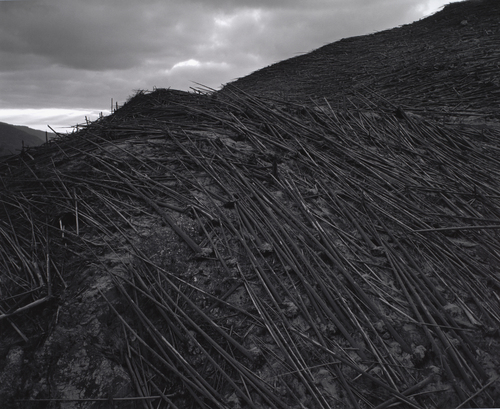 Frank Gohlke, Aerial View, Downed Forest Near Elk Rock, Approximately Ten Miles Northwest of Mount St. Helens, Washington. 1981. Gelatin silver print,
Gohlke's work is concerned with geography, topography, place, space and landscape. For instance, his work about Mount St Helens done from 1981 to 1990 explores the effects in the landscape of a volcanic eruption in 1980s and the clear-cutting by the logging industry.
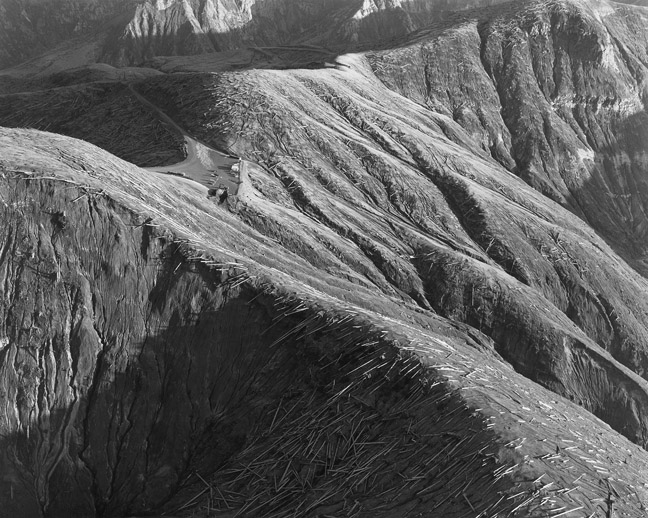 Frank Gohlke, Aerial view: looking southeast over Windy Ridge and visitors parking lot, 4.5 miles northeast of Mount St. Helens, Washington 1983, gelatin silver print.
What is interesting about Gohlke is his writing. He has written an essay on Photography and Place In it he says that:
places, like landscapes, do not occur naturally; they are artifacts. A place is not a landscape; places are contained within landscapes. Place is a possibility wherever humans linger, but it’s not inevitable. Sometimes we just occupy space. Places can be created intentionally or as a side effect of other actions with other intentions. Place seems to be more likely to come into being the longer we stay put, but many nomadic cultures roam in landscapes whose minutest features are named, recognized, and given a place in the story of a people and a world.
He adds:
Place has something to do with memory. The evidence of the actions of human beings in a specific locale constitutes a physical version of memory. In the visible traces of their passage I read the investment of desire, hope, ambition, sweat, toil, and love of people who set this location apart from raw space. I don’t need to identify the origin of every feature to sense its significance. The intentions of the inhabitants may be opaque to me; I only need to be aware that intentions were acted on here. Long-enduring Places demonstrate Wright Morris’s dictum that the things we care about don’t so much get worn out as worn in.
His color photographs of the Sudbury River in Massachusetts created between 1989 and 1992 represents the disconnect between the ideal of a bucolic, pastoral New England and the reality and complexity of an overgrown river that has been taken for granted.
May 21, 2010
photography + realism
The main concern of analytic philosophers who have written about still photography has been to characterize the nature of the causal link between object photographed and photographic image and to argue that this causal link represent the essence of photography. A particular kind of a realist aesthetic has been built around this causal link.
A recent survey of philosophical writing on the aesthetics of photography by Greg Currie ('Photography, Aesthetics of', in E. Craig (ed.), The Routledge Encyclopedia of Philosophy, vol. 7.1998), for example, concentrated exclusively on the question of the relation between photography's mechanicity and its alleged transparency to its objects arising from the optico-chemical causal link between a photograph and what it is of.
The realist argument (eg., André Bazin in his essay ‘The Ontology of the Photographic Image’, Stanley Cavell in The World Viewed, Roger Scruton's ‘Photography and Representation’ and Kendall Walton's ‘Transparent Pictures’) is that my photograph of Suzanne doesn't just look like her: it is somehow closer, or more intimately connected, to the her than a drawing or painting could be. These photographs do not involve significant intentional input and are therefore in some sense objective.
Photography overcame subjectivity in a way undreamed of by painting, a way that could not satisfy painting, one which does not so much defeat the act of painting as escape it altogether: by automatism, by removing the human agent from the task of reproduction. Photographs, because of their optico-chemical origins, are transparent to what they represent.
Photographs are more like mirrors than they are like paintings. photographs, because of their optico-chemical origins, are transparent to what they represent. Scruton drew the obvious conclusion from the transparency thesis: ---photographs are transparent to their objects, and so are not themselves of aesthetic interest.
The obvious flaw with this kind of reasoning is that a photograph shows us ‘what we would have seen’ at a certain moment in time, from a certain point if we kept our head immobile and closed one eye and if we saw things with the equivalent of a 150-mm or 24-mm lens and if we saw things in Portra NC and printed on paper or published on the web. So we have the photographer's interpretative role in photographic picture-making and photographs don't show us precisely what our eyes would have seen.
May 19, 2010
Olaf Otto Becker: Broken Line landscapes from Greenland
There is more on the latter photography Olaf Otto Becker, the German landscape photographer, at this post on junk for code. The video over the page is about Becker's Broken Line photographs of the Greenland coastline.
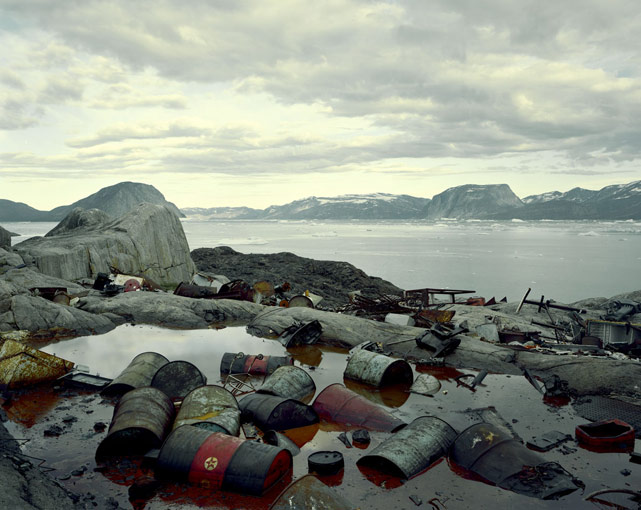 Olaf Otto Becker, ABBILDUNG 15 VON 23, from Broken Line series
Becker's images of the natural beauty of wild places avoids the National Geographic look: pretty photos that are little more than decorative (at best) and kitschy (at worst).
There is an interview with Olaf Otto Becker by Joel Colberg at Conscientious.
May 18, 2010
gentrification + urban life
The Atlantic has been running a series on urban life and the future of cities. One of these is gentrification-and-its-discontents by Benjamin Schwarz, The Atlantic’s literary editor and national editor.
It is structured around a review of Sharon Zukin's Naked City:The Death and Life of Authentic Urban Places and Michael Sorkin’s Twenty Minutes in Manhattan, both of which visits the argument laid out by Jane Jacobs in the 1961 classic The Death and Life of Great American Cities, which an important influence on the New Urbanism architecture and planning movement which emerged in the 1980s.
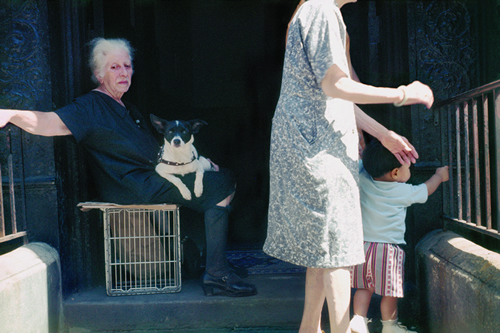 Helen Levitt, New York, circa 1971
Jacob's core argument is that local communities (‘urban villages’ ) engaged in a pitched battle against government bureaucratic power seeking to create a cookie-cutter corporate city of glass-box office towers, high-rise apartments, and limited-access highways. Zukin's work----Loft Living (1982), Landscapes of Power (1991), and The Culture of Cities (1995)-- chronicles how the forces of creative destruction of capitalism work to continually refashion the urban environment in pursuit of profit.
The result is a process of gentrification that usually forces out an area’s original working class inhabitants in favor of a more-affluent, middle class or professional clientele. Ironically, what happens in the process is that more and more of the urban environment has become just a ‘hipper’ variation of the standardized world Jacobs abhorred. Vince Carducci at Pop Matters says that Zukin evokes French urbanologist Henri Levebvre’s concept of ‘the right to the city’:
that is, the claim an individual or a group has to a particular piece of urban territory. In Zukin’s reading, this right is now negotiated as a clash of ‘authenticity’, the moral claims of old vs. new, of origins vs. style. The former often takes the form of the traditions and activities pursued by ethnic inhabitants of previous generations who populated a particular area, as in the soul-food restaurants, jazz and R&B joints, and sanctifying storefront churches of Harlem in its twentieth-century ghetto incarnation. The latter are basically the tastes and pursuits of what Richard Florida terms the ‘creative class’: the trendy little shops of entrepreneurial designers, nouvelle cuisine restaurants and cappuccino bars, microbreweries, galleries, and the like.
The transition is from a mass-manufacturing based system of production to a primarily knowledge-based consumer society.
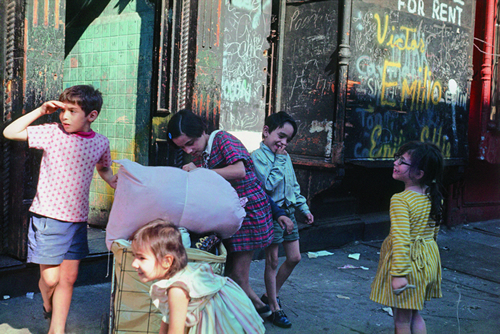
Helen Levitt, New York, circa 1972
Schwarz says that the lament for the the passing of SoHo’s exhilarating, creative days—characterized by “the mix of artists, crafts-people, small manufacturers, researchers, as well as of commerce oriented to their needs” (a few funky bars for the artists) fails to recognize that this SoHo was precisely the product of that rapid industrial decline, which made economically available to artists and their hangers-on all those cool industrial spaces that in more industrially vibrant times would have been used by, well, industry.
May 13, 2010
W. Eugene Smith: The Jazz Loft Project
W. Eugene Smith's The Jazz Loft Project arose out his Pittsburgh project. In 1955 he quit his longtime well-paying job at the magazine and turned his attention to a freelance assignment in Pittsburgh, a three-week job that turned into a four-year obsession. Smith never finished the book.
In 1957 Smith moved out of the home he shared with his wife and four children in Croton-on-Hudson, New York and moved into a dilapidated, five-story loft building at 821 Sixth Avenue in New York City’s wholesale flower district. 821 Sixth Avenue was a late-night haunt of musicians, including some of the biggest names in jazz—Charles Mingus, Zoot Sims, Bill Evans, and Thelonious Monk among them. His next-door neighbor was composer-arranger Hall Overton, and Smith was letting him use his loft as a rehearsal space for some of the era’s great jazzmen.
Not only did Smith photograph the musicians, he wired the whole building for sound, hooked up several tape recorders, and let the spools spin till they ran out, recording everything from jam sessions to conversations in the hallway.
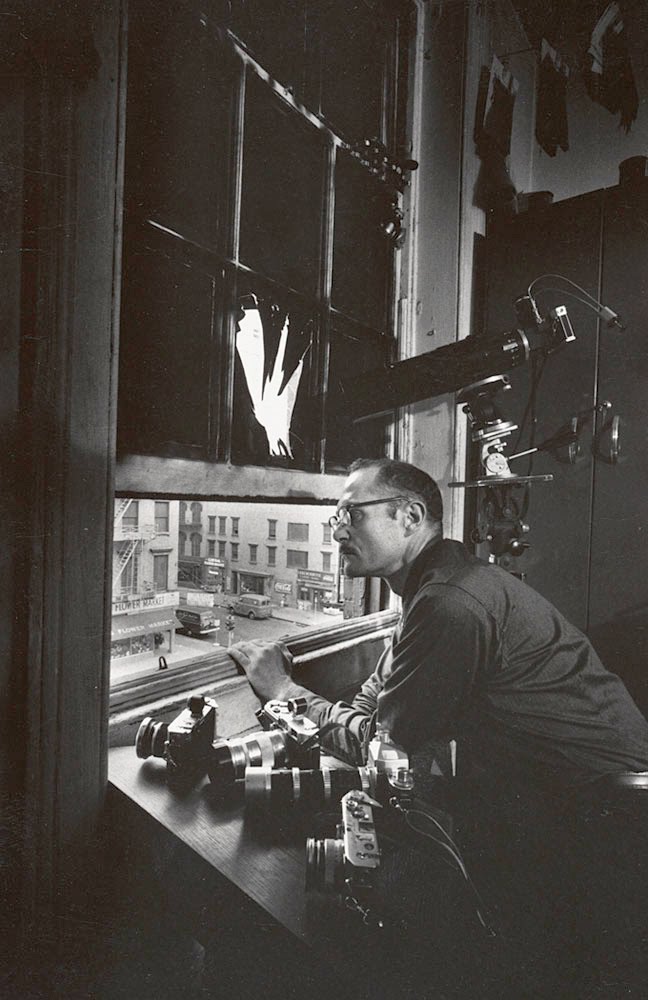
For the next eight years, the building became his home, his studio and, to an extent, his world. It also became the home of what came to be known as the Jazz Loft, a rehearsal and performance space that attracted the likes of Charles Mingus, Thelonious Monk and Bill Evans, as well as their retinue of musicians, hangers-on, dealers, girlfriends, visiting writers and photographers, and various colourful characters from the city's demimonde.
Diane Arbus passed through, as did Norman Mailer, Salvador Dalí, Henri Cartier-Bresson and Robert Frank. It became a kind of microcosm of the ever-changing nocturnal city.
As his ambitions broke down for the epic Pittsburgh project, Smith found solace in the chaotic, somnambulistic world of the loft and its artists which he documented in image and sound. Smith took an estimated 40,000 photographs of the jazz scene in and around the Loft. He also spent endless nights photographing the surrounding streets from his windowsill on the fourth floor. Frustrated by the limits of the still image, he placed microphones throughout the building to record rehearsals, impromptu sessions and even conversations.
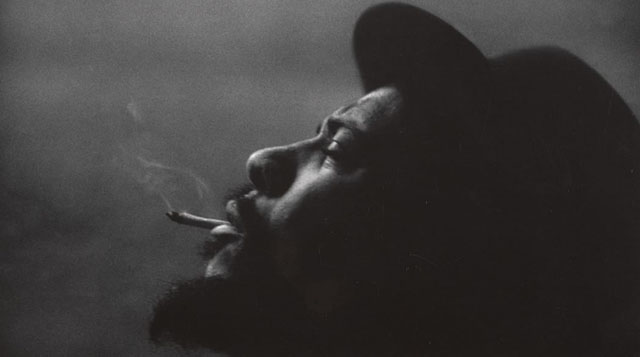 W.Eugene Smith, Thelonious Monk, Jazz Loft Project
The sounds and stories that emerged from those years are the basis for The Jazz Loft Anthology, a ten-part radio series now heard across four one-hour programs. This is a world in which playing music was sheer pleasure, without any thought of its destination or outcome; where jamming together was the greatest possible joy for hundreds of musicians who worked until 3 AM in clubs and then – looked for a place to play for a few more hours!
May 11, 2010
Grateful Dead: Dark Star Live Dead version
This is still my favourite version of the Grateful Dead's Dark Star-- it is the one from Live Dead recorded on February 27, 1969, at the Fillmore West:
Live Dead represents one peak of The Grateful Dead live--it is a land mark live album that captured the Grateful Dead's improvisations at their best prior to their 1977 peak.
Live Dead is still held to be amongst the finest of rock's live musical recordings.
Live/Dead has long been called the quintessential Grateful Dead album as it not only captures the band in all its late ’60s glory, but it also is the album that launched the jam band genre. This classic rendition of Dark Star, the Grateful Dead’s trademark tune, opened Live/Dead:
For decades, the 1969 album Live Dead was the seminal concert recording from the Grateful Dead. For decades, the 1969 album Live Dead was the seminal concert recording from the Grateful Dead. Today, the disc still holds its own, though the band has added to its line-up of live recordings with a formidable stream of releases via both the Dick's Picks and multi-track vault series.
May 1977 is often held to be the most impressive month of a year that is perceived as the best year of them all. The 5/8/77 Barton Hall, Cornell University show is regarded as the best Grateful Dead show of all time.
May 10, 2010
Victoria Square: cars remain
Victoria Square in SA has been long neglected. It is the centre of the CBD but rather than being a public square that is a gathering place it is a dead centre killed by cars. It looks the same as it did back in the 1950s. Now the Adelaide City Council has announced a revitalization programme by a special design team:
 Victoria Square
The square's northern half is an open space for large events with a giant jumbo screen, whilst the southern half becomes a public garden including a Kaurna Aboriginal heritage centre, cafes and wetland. The Grote-Wakefield streets east west crossing in the middle of the square remains open to daily traffic, as does the Traffic around the square, which will be reduced to a uniform three lanes, including one bus lane.
Why no tunnels? Since the car is not rolled back to make way for the movement of people what we have is a facelift of the existing square, rather than a shift to a piazza where there are no cars. It represents a failure of nerve and a lack of political courage.
May 5, 2010
the return of aesthetics?
In his essay "The Transformations of the Image" in The Cultural Turn: Selected Writings on the Postmodern, 1983-1998 Fredric Jameson says that the current postmodern age seems to be experiencing a general return to the aesthetic as a philosophical discipline at the very moment, paradoxically, when the trans-aesthetic claims of modern art seem completely discredited and a bewildering variety of styles and mixtures of all kinds flows through consumer society under its new postmodern dispensation. He adds:
The older aesthetic traditions were rarely prescient enough to theorize these new works, many of them incorporating new communications and cybernetic technology (film was already developed enough to produce several proposals for a specifically filmic aesthetics, but video, far more generally used and influential, came too late for that kind of theoretical codification). Meanwhile, the discrediting of the older modernist idea of 'progress' - the telos leading to new technical discoveries and new formal innovations - spells the end of evolutionary time in the arts and augurs a new kind of spatial proliferation of artistic modes which can no longer be valorized in the older modernist ways.
The general rhetoric about the need and value of art today and of aesthetic experience in general is far from justifying a wholesale revival of aesthetics as a philosophical discipline.
He adds that:
Finally, the general breakdown of the divisions between the older disciplines and specializations - in this case, the collapse of the once fiercely defended border between high art and mass culture (let alone daily life) - leaves traditional analyses of the 'specificity' of the aesthetic, of the nature or artistic experience as such, of the autonomy of the work as a space somehow beyond the practical and the scientific realms, in much uncertainty, as though somehow the very nature of reception and consumption (perhaps even the production) of art in our time had undergone some fundamental mutation, leaving the older paradigms irrelevant or at least outmoded.
May 4, 2010
photographs as art
In his essay Making Meaning: Displaced materiality in the library and art museum in Photographs Objects Histories: On the Materiality of Images (ed) Elizabeth Edwards and Janice Hart Glenn Willumson says:
In the United States, the elevation of photography into the sphere of the art museum is intertwined with the defined history of the medium. This process allowed photographs (always suspect because of their connection to mechanical reproduction) to move beyond amateur collectors and hobbyists and to attain the status of high cultural production. In the 1930s, the medium was of particular interest to the modern art museum because of its connection to technology and its availability to the popular imagination. These factors marked it as emblematic of the new machine age that was being celebrated by artists in the United States and Europe and by the Museum of Modern Art in New York
And:
Until late in the nineteenth century, the majority of photographs produced in society were commodities intended for sale. In their efforts to legitimise photography as a fine art, curators mask this history behind formal criteria based on the tradition of the fine art print. Beaumont Newhall at the Museum of Modern Art articulated the methodology that addressed these issues and that shaped the curatorial practice towards photography in the United States. His exhibition Photography 1839–1937 and its associated publications codified a history of photography within a practice rooted in contemporary art historical methodology. Based upon formal analysis, attention to the moment of production and a concern for the contemporary audience, this set of practices brought attention to the surface quality of the photograph.... Although material quality defined the fine historical print, its ‘thingness’ was absorbed unarticulated into an aesthetic discourse.
May 2, 2010
e-publishing
This is an interesting interview on self-publishing and e-books with Rudy Rucker. This takes us beyond the territory of this earlier post that is still dominated by the traditional forms of publishing.
Rucker is a science fiction author who has taken the digital plunge for his books and talks about it on his blog. He runs an online or webzine science fiction magazine called Flurb.
He shows what can be done with self-publishing. He charts a path for those like me who are taking the first hesitant steps in this direction with DIY publishing my photography.
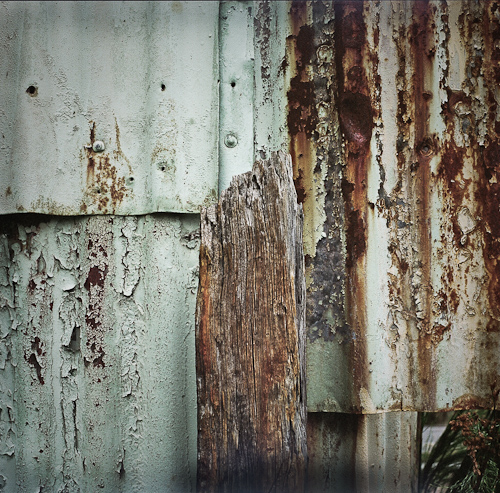 Gary Sauer-Thompson, Strahan, Tasmania, 2010
Rucker's book of paintings --Better Worlds---is the model for me.
As he points out:
Although I’m a well-known writer, I have zero reputation as a painter, and I was daunted by the prospect of trying to approach serious art world publishers. Also I liked the idea of very rapidly getting the book all designed and, in some sense, into print. Those who’ve put together photo books as gifts know how this feels.
By the way, I didn’t actually use the Lulu photo book templates to design my art book because these templates insist on cropping your pictures to certain fixed aspect ratios. And my paintings are in all kinds of different width-to-height ratios. Perhaps some other sites have more flexible photo book formats, I don’t know.
What I did instead was simply to design the paintings book in Microsoft Word, and to save this file as a PDF file, taking some pains to ensure that the images got saved at a (non-default) high resolution of 400 pixels per inch. And then I uploaded the PDF to Lulu, and that’s the book, designed exactly the way I want.
He adds that a nice thing about this set-up is that every now and then he can redesign the book and add all his most recent paintings.