May 29, 2009
photography and remembrance
Since its invention, photography has been inextricably tied up with the act of remembrance. Photographs, for instance, help us to recall family, beloved friends, special moments, trips, and other events, speaking across time and place to foster an emotional bond between subject and viewer. But what kind of memories are these? Can photographs conjure the immediate, physically embracing experience of involuntary memory (an emotional response stirred by smell and sounds), or is the photographic medium only capable of providing frozen illustrations of the past?
Nostalgia I would have thought. Recalling times, lives and persons gone with a fondness and sadness, if we think of family albums that reconnect us with a history that is long gone. People preserved memories as evoked by photographs, keeping them from becoming merely historical documents.
However, some claim that painted images – precisely because they lack the pictorial authority and truth-telling capacity of photography – can more easily trigger a free play of association or become a catalyst for a web of connections that relate to the viewer’s own memory bank. Inverting the photograph’s claim to instantaneity, the painstaking, artisanal nature of a painting’s own making metaphorically relates to the mental intensity and time required by the act of reminiscence. With photography in command of specificity, advanced painting seeks ambiguity.’
With photography we do seem to desire to connect with the historical reality in which the photograph was made. We imaginatively try to picture that history.
May 27, 2009
Joni Mitchell: Shine
I haven't listened to Joni Mitchell's music since Heijira (1976). I've heard bits of Mingus (1979) but I haven't bothered to explore the albumfurther.
Then I stumbled upon Shine from 2007. This is the second track:
I've begun to reconnect. The music sounds fresh. The lyrics have bite. This is no muzak.The tones are dark.
Another song from Shine--Bad Dreams are Good:
May 25, 2009
Lyotard + the sublime
The Kantian roots of the sublime is awe and exhilaration and it causes us to shudder.Luke White says that in the 18th and 19th century the sublime:
centrally implied an experience of being overwhelmed by art or nature, of being thrown into a kind of ecstasy of awe, wonder or terror. As the century wore on, it became increasingly associated with the paradoxical pleasure of the terrible and horrible, and increasingly understood as separate and even opposite to the beautiful: whereas the beautiful was pleasing to behold because it was small, pretty, soft, harmonious, and delicate, the sublime was pleasing in that it was majestic, grand, awesome, craggy, formless (monstrous even, for some writers) or terrible. Thus if a flower was pretty, what was sublime was a ravenous wild beast, a giant alpine crevasse, or the stormy ocean.
In one of his best-known essays, "An Answer to the Question: What Is Postmodernism?" Jean-Francois Lyotard suggests, that the sublime has become one of the key modes of aesthetic engagement in the postmodern era.
According to Jean-Francois Lyotard when art expresses the sublime it is “to present the fact that the unpresentable exists.” Lyotard sees the “fundamental task” of the avant-garde in its aesthetic resistance to the rationalising forces of capitalism through “bearing pictorial or otherwise expressive witness to the inexpressible. He views pop music and Hollywood cinema as not having within them the radical potential of the aesthetic that it is the mission of the avant-garde to preserve. Lyotard’s analysis is that the sublime, as a disruption in the smooth functioning of capitalism’s rational calculus of profitability, is fundamentally subversive.
According to Luke White in his Lyotard, Capitalism and the Sublime the sublime represents:
a break in the flow of discourse, where it isforced to confront its other (in Lyotard’s terms, something like the différend, what cannot be spoken, a muteness outside language) a moment in which the speaking and knowing subject is faced with the very aporia from whichdiscourse comes into being: a moment of “Is it – is something – is anything –happening?” (rather than “Such-and such is happening,” or even “Is this thing happening?”).
This logic of the 'now' is contrasted with that of the 'new' in which art (produced by the transavant-garde) strikes a balance between providing some form of “innovation” and giving the audience something familiar through which to start to make sense of this ‘new’ thing. The new is in collusion with the logic of the market... It is also to be seen in the 'neoexpressionist' and 'transavantgarde' painting that seemed to dominate the art markets of the 1980s, with painters such as Georg Baselitz, Francesco Clemente or Julian Schnabel fabricating their work from a tissue of quotations from art history. Against this, Lyotard pits a more positive form of the sublime which is embodied in avant-gardist art, a sublime which enters into the realm of the 'presentation of the unpresentable' through a programme of constant experimentation.
May 24, 2009
about Theory: a note
Postmodernism-bashing is still very common in Australian academia these days and it usually takes postmodernism and poststructuralism as identical. Gavin Kitching's The Trouble with Theory: The Educational Costs of Postmodernism" is a critique directed primarily at the poststructuralist contention that social reality and individual identity or subjectivity are ‘socially constructed’.
In a review of Kitching’s text Stephen Gregory in Dialogue (vol.27 No 3) says that:
The Wittgenstein of Philosophical Investigations in believing that ‘language gets its meaning from its use (ditto “discourse”) not from its “structure”’ because individuals use language in the same way they use tools to make kitchen cabinets . Poststructuralism, however, cannot adhere to this common- sense view of language (or ‘discourse’) because it starts out from the Saussurean idea of the essential arbitrariness of the sign, wherein the gap between word and meaning can only be closed artificially (by extra-linguistic circumstance as in everyday conversation, or by pre-determined means as in the creationist ideology of biblical iteralness). The use-value approach to language assumes an easy connection of meaning to intention, whereas the Saussurean view suggests that, whatever the intentions of the producer of a piece of language, its meaning will be decided by those who receive or read it. Many of the typical strategies of poststructuralist thought⎯and much that is difficult or unfamiliar in the art and literature labelled postmodernist ⎯ arise because their creators were among the first to work on the assumption that they themselves could not control the meaning of what they wrote or made.
A second consequence of the Saussurean view is the diminished authority and status of the ‘I’. The poststructuralist ‘I’ looks to write a ‘decentred’ self whose sovereignty, legitimacy and authority are seen as already compromised by external forces that contribute to its formation.
May 20, 2009
post colonial
Bernard Smith in European Vision and the South Pacific (1960), argued that the evolution of ideas and culture in Australia is essentially dialectical: externally generated concepts are not simply imported and assimilated but are also transformed by the experience of the locality into a hybrid form, which in turn informs the national tradition.
The local culture, despite its dependence and isolation, is given agency, hence opening the door to the possibility of an ‘original’ Australian culture. This originality is located in ‘Australia’s’ interpretation of influences and concepts, particularly as manifest in the work produced here.
An example from an German-Australian photographer:
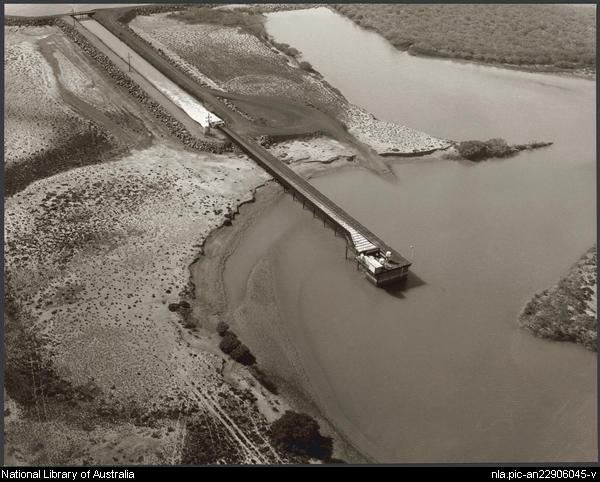 Wolfgang Sievers, Aerial view of solar salt fields near Dampier, Western Australia 1971, National Library of Australia
Over the past several decades, this contingent relationship has come to delineate the ‘antipodean’ identity, which is,“constructed between centre and periphery, across imperialism and place.” In Wolfgang Sievers and the Revisionism of Australian Migrant Art in the Melbourne Electronic Art Journal Dunja Unjarmandic developes this idea.
She says that:
there is an element of distancing and division that underlies his [Siever] images that is generated from the friction between his New Photography aesthetic and Australian subject matter. This element forms the ‘connotative’ message of Sievers’ images: the distancing effect presents the viewer with an alternative meaning of the subject matter and image construction, one that is more reflective of the locality’s influence on image production than an institutional analysis of Sievers’ work would allow.
For Barthes, the connotative message is a photograph’s ‘second’ meaning (the first being denotative, or “the necessarily real thing” in front of the camera), which emerges with the ‘coding’ of a photograph. The crux of Barthes’ argument is that ‘connotation’ is historical: it is defined by the spatio-temporal context in which it is
created.
This context is a juxtaposition of the European, and more generally Western, manifestation of modernity and its Australian counterpart that implies the time lag to which Australia is inevitably subjected. The social, cultural, and class-based predicaments that Europe faced during the intense industrialisation of Lang’s era could not be felt in their entirety in Australia.
May 19, 2009
Edward Burtynsky: manufactured landscapes
Nature transformed through industry is a predominant theme in the photographic work of Edward Burtynsky. His subjects include recycling yards, mine tailings, quarries and refineries. The quarries include those in Australia, and these are places that are outside of our normal experience:
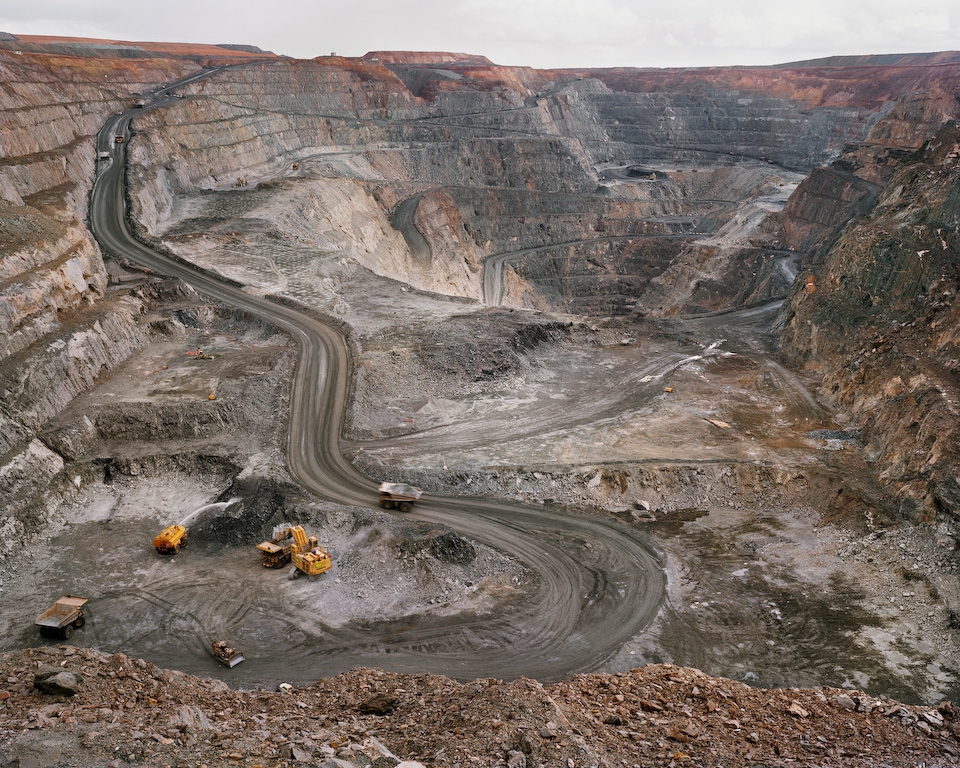 Edward Burtynsky, Super Pit # 2, Kalgoorlie, Western Australia, 2007
Though Burtynsky's large-scale photographs of ‘manufactured landscapes’ – quarries, recycling yards, factories, mines, dams---are of civilization’s materials and debris, Burtynsky represents them in a way that people describe as “stunning” or “beautiful". A forbidden pleasure--attraction and repulsion.
Burtynsky's work lacks the raw anger and the muckraking impulse of the documentary photographer. With Burtynsky's work there is a sense of the awesomeness of a process beyond human comprehension, a sublimity in the industrial mastery, and domination of nature.
 Edward Burtynsky, Silver Lake Operations # 3, Lake Lefroy, Western Australia, 2007
There is almost a Romantic quest for the monumental as expressed in Burtynsky images of the Carrara Marble Quarries and the Kennecott Copper Mine, where the earth has been cubed and hollowed out into epic amphitheatres. Burtynsky video of him talking about his work at the 2005 TED Prize. The talk includes examples of the work, which raises questions about sustainable living in industrial capitalism.
May 15, 2009
The Who: from Rock and Roll Circus
The Who - A quick one (While he's away) from Rock&Roll Circus (1968) --- it is some nostalgia as The Who were recently in Australia. I don't know what the reception was nor am I particularly interested. What we have is the video from the Rolling Stones Rock+Roll Circus. This live extravaganza of music with a circus theme was seen as a way to promote the Rolling Stones newly-released Beggars Banquet album.
Dirty Mac's performance of The Beatles' "Yer Blues" includes Yoko Ono, whose art roots were in Fluxus, kneeling on the floor in front of the musicians, completely covered in a black sheet. Ono's exploration of conceptual art and performance art did not go down well in the rock world. Nor did her use of her voice--- screams and vocal noise in lieu of words---as an instrument, depsite the links back to John Cage, LaMonte Young and Ornette Coleman.
Yoko Ono's avant-garde conceptual art seemed bizarre whilst her highly experimental rock & roll expressing rage and catharsis was too abrasive to accept. In creating intense, almost atonal rock Ono represented the avant-garde fringes of rock in the 1970s, but she was generally dismissed by many rock fans as a talentless charlatan.
May 13, 2009
Fluxus, chance, modernism
The Fluxus Reader. I've always understood the do it yourself movement known as Fluxus to be characterised by the idea of indeterminacy that tries to dissolve any fixed properties of art or music and so has its roots in Dada. Fluxus art lies between media (intermedia) and outside the established art institution.
The Fluxus idea of indeterminancy is one of the artist relinquishing, to a greater or lesser degree, the power to determine the form of a work, serving instead as a functionary, a facilitator of natural processes within a specific, limiting context (a poem, a drawing, a collage, playing music, a photo)? In this understanding of chance the practice is one of a denial of artistic choice in favour of the potency of apparently arbitrary natural processes.
Thus John Cage regarded music not as a communication from the artist to an audience, but rather as an activity of sounds in which the artist found a way to let sounds be themselves'. Is there a photographic equivalent of this? Or is this where the similarities between free form music and the photography of chance break down?
Fluxus was not intended as an art movement and it sought an alternative to the commercial gallery system, along with its faith in masterpieces created by talented artists appreciated by the suitably qualified spectator. If the efforts were directed at transgressing the boundaries of art, then what lay beyond the boundaries of the art institution? The answer is the traditional avant garde one: art activity must be withdrawn from its special status as rarefied experience and resituated within the larger realm of everyday experience.
Graig Safer in 'Laboratory in the Fluxus' in the Fluxus Reader says that this going beyond the art institution aimed to realize:
a social network built on playing through or interacting among people, activities and objects In this sense, Fluxus functions as more than a way to organise information it is also a way to organise social networks, networks of people learning These networks are based on an interactive model of art rather than on the traditional model of art as a oneway communication from sender to receiver, the notion of the artist offering inspired genius intended to dazzle spectators...participants interact with ideas, playing through possibilities rather than deciding on the meaning of a work once and for all.
This displaces the interpretation of Fluxus as an art movement of the 1960s and 1970s and changes the interpretation into a generative project that placed creativily and innovation in the hands of a linked networked community.It is cultural space that facilitated the enactment of multiple artistic agendas.
Stephen C Foster in Historical Design and Social Purpose: A note on the Relationship of Fluxus to Modernism argues:
that Fluxus was basically a reconfiguration of the modernist or avant-garde paradigms Its use of typically modernist and avant-garde terms might superficially seem to make Fluxus a maverick modernism Or one might speculate that the group kept the modernist model and adjusted, or even ditched, the content Regardless of the truth of the latter, it strikes me that what is more important is the group's reorganisation of
modernism's terms The importance of this resides in the fact that the canon of modernism or the avant-garde rests not in the specifics of the terms but precisely in their organisation
May 11, 2009
City futures
John Geraci in his The Future of Our Cities: Open, Crowdsourced, and Participatory at O'Reilly Radar says that cities everywhere find themselves faced with the challenge of gigantic budget shortfalls brought on by the recession. We begin to realize that our cities today are outdated models of inefficiency, consisting of centralized, top-down and non-participatory services and infrastructures. The results are spiraling city deficits, ballooning bureaucracy, and an inability to pay for basic services, paired with problems of wasted resources, scarcity and redundancies. The way to solve these problems is for cities to become more like the web, relying on decentralized, distributed, participatory and geo-aware services built with open source software than anyone can configure, maintain and improve. Geraci says:
The conversation about the future of our cities should involve the people living in those cities. But it should not be about which services to eliminate, it should be about how to reinvent these services as modern, efficient things, how to make them work at a fraction of their current cost, and, while we're at it, how to make them better than they are now. Why? Because cities don't have the money to improve, or even sustain these services on their own. Because people have good ideas, often more innovative than the ones coming from the cities themselves. And because increasingly, people have the means to actually build and implement these services - not as centralized, closed, top-down systems we think of as public services today, but as distributed, participatory web-based systems built using data open to all.
He says imagine what would happen if cities did throw their weight behind this kind of innovation? The landscape of those cities would change virtually overnight, with legions of new applications springing up to provide residents with every sort of information conceivable, making their decisions more informed, making their movements more coordinated, and ultimately making the cities themselves work better.
May 7, 2009
Benjamin: modes of perception
In "Contemplative Immersion: Benjamin, Adorno & Media Art Criticism" in Transformations Daniel Palmer argues that Walter Benjamin interpreted Dada as having been instrumental in challenging art’s autonomy, arts claims to eternal value and to the mode of contemplative immersion in which the viewing subject would often lose control of their senses and their sense of self. With Dada the spectator’s viewing relation had been politicised.
If the idea that the meaning of a work derives more from an audience’s interpretation of it rather than simply the author’s intent, then when art is shown at exhibitions in the art institution today, the conditions of its reception remain largely contemplative and solitary.In contrast Adorno argues that art is the realm of individual freedom. His aesthetic theory is traditional, in that he proposes that the significance of an artwork inheres in it, is actually present or abiding in, and the role of the viewer is to actively discover it.
May 6, 2009
turning to Walter Benjamin
I've turned to Walter Benjamin for my article for the One City: three views exhibition by altofotnet.org. I am interested in the role of the camera as a mode of viewing in modernity, the development of historical understanding, and a critical photography.
I've stumbled on this site, but many of the Benjamin links are broken. The most useful amongst them is that by Christopher Rollason. I also came across the special Benjamin issue of Transformations.
Rollaston points out in his Walter Benjamin's Arcades Project: Contemporary Cultural Debate in the West paper that for Benjamin the arcades have two faces:
The arcades are, certainly, a "primordial landscape of consumption"... temples of the commodity, with their seductively displayed, endlessly varied wares: "binoculars and flower seeds, screws and musical scores, makeup and stuffed vipers, fur coats and revolvers". ... They were created for purposes of profit, or indeed sheer speculation, offering the buildings' owners unrivalled financial opportunities by concentrating so many rent-paying undertakings within a small space. ... Seen from one point of view, then, they are archetypal manifestations of the expanding market economy - creations of private enterprise and sources of profit
The other face is that:
In their glass and steel design, they both reflect and inspire the utopias projected by the social visionaries of the nineteenth century, embodying the "anticipation and imaginative expression of a new world"... the utopian dimension of the arcades is implicit in the womb-like protection which they offered to the pedestrians who used them. The glass roofing and the insulation from the discomforts of the street created the sensation of an ideal, fairy-tale world existing in parallel to the muddy and noisy world outside. The shop-windows with their agglomerations of discrete objects on one level represented the apotheosis of the commodity as fetish, yet at the same time offered the passer-by images of a dream-world beyond the confines of the existing society:... The glass-roofed passages conjure up visions of utopia.
In the arcades the "desire for pleasure" becomes a "form of resistance". The arcades are both a source of deceptive illusion of a dream and the key to authentic historical understanding.
Fair enough. That was then. What of our time, when the arcades are historical form of consumption replaced by department stores and those that remain are surrounded by nostalgia and heritage? How does that authentic historical understanding help us now as we walk the city as photographers? Rollaston does address this as he says that he is interested to consider some of the ways in which Benjamin's Arcade book can shed light, not only on the nineteenth-century universe which is its declared subject, but also on some of the cultural phenomena and associated debates of our own time.