April 30, 2009
on Benjamin's Arcades Project
I've just stumbled up Heather M. Crickenberger's The Arcades Project Project, which explores Walter Benjamin's The Arcades Project, Crickenberger's project exists as a living, online scholarly hypertext that aims at both enacting and sharing scholarly research on Benjamin's work.
I am looking for material for my article for the One City: three views exhibition by altofotnet.org. Can I do all the research online? Or do I have to turn to the Library for help?
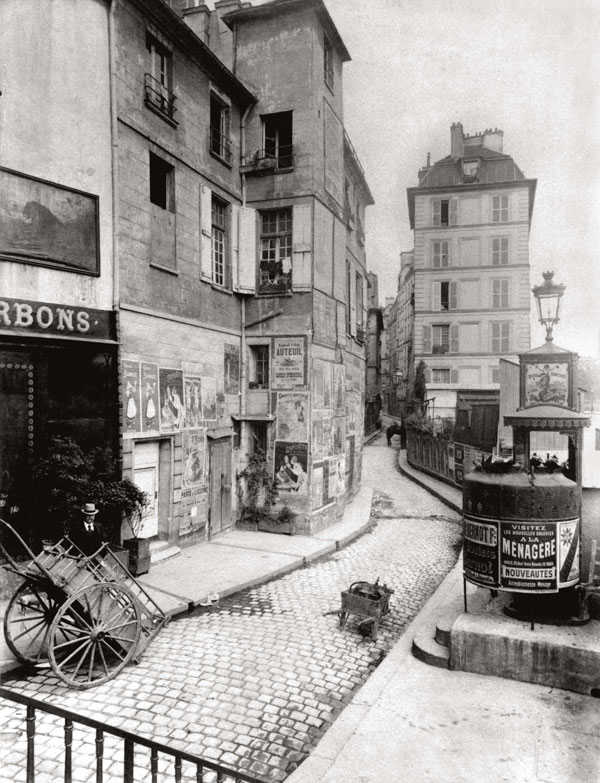 Eugene Agtet, Rue des Ursins, 1900, silver gelatin print
Atget and his photographs is a key figure in exploring modernity. If there is an Atget Rephotographic Project online (there is another here on Flickr), then there should be enough academic articles that link Benjamin to contemporary concerns for me to write the article. Atget is a key figure in exploring modernity
April 25, 2009
the pictorial turn: George L Dillion on
George L Dillion's text Writing with Images: Towards a semiotics of the Web starts with the pictorial turn. In the Introduction he says:
Scholars and critics have begun writing accounts of this "pictorial turn," "turn to the visual," or "foregrounding of the visual." These accounts cluster in two groups: stories of a Fall or falling out between words and images leading to the subordination of images to texts and closely related stories about the rise (or restoration) of images to the role of a new international medium or, alternatively, to the emergence of a new integration of imagetext or visual language.
I am sympathetic to this idea of the pictorial turn and the rise a visual culture and the decline of the literary culture. The days of the text's domination of the visual are rapidly drawing to a close with the turn toward the visual in which the ratio of text to image drops and the functions change: instead of image illustrating the main-meaning-bearing text, text now furnishes commentary on main-meaning-bearing images. We now live withe the dominance of images on the Web
Dillion says that:
One version of the Fall is W. J. T. Mitchell's, which starts from a notion of imagetext as a level of meaning which is not medium specific, in which word and image mutually complement and reinforce each other (not necessarily by "saying the same thing"). Mitchell disputes the Modernist notion that each medium has its own unique mode of operation and is best pursued by avoiding doing the work appropriate to another medium. This radical separation of media, Mitchell argues, may have the effect of protecting the visual arts from being annexed to talk and to verbal accounts of visual meaning, but it is not easy to find pure types anywhere in history nor is it exactly clear how we can talk about writing without involving the visual. There are no pure media, Mitchell argues, in the sense that Clement Greenberg among others assumed. So Modernism is the Fall for Mitchell, with its tendency to look down on Blake's illustrated books on the high art side and Trudeau's Doonesbury on the side of more popular culture. Mitchell identifies a major theme of post Modern art, especially visual art: how and in what interesting ways can the two signifying systems be set in motion within a single work?
April 24, 2009
history of photography
Geoffrey Batchen Burning with Desire: The Conception of Photography surveys the four decades prior to the medium's official birth in 1839. Batchen identifies a "desire to photograph", which begins to take hold of some curious minds around the 1790s. The ensuing three decades were a period of extensive experimentation, which culminated with photography's official unveiling before the Parisian elites.
Jorge Lopez in his review of the text says that:
Although Foucauldian studies of the photographic image have already been rehearsed by the likes of John Tag and more recently Jonathan Crary, Batchen remains concerned about the methodological impasse that such critiques have inadvertently posed: the project of emptying photography, as a medium, from any formal quality of its own, has ended up invalidating the very notion of photography. Indeed, the prevailing view in Anglo-american postmodern criticism defines photography as nothing but an instrument of power. Such an instrumental view rests on the idealist premise that operations of power somehow precede photography. Batchen combines Foucault and Derrida to argue that photography, like writing, is more than an inconsequential medium. Photography is, by definition, the writing of light. It is a paradox, a "message without a code" in which both nature and culture are directly implicated in a mutual play of power dynamics. Batchen advances the notion of "photopower" to reinvest photography with the value it lost to positivist aesthetics.
April 23, 2009
philosophy and photography
On e way of looking at photography is the art history one. This holds that from the time of its appearance, photography occupied a contested ground between art and science, some purists claiming it was not really art at all, but a craft, a technology, or, even less respectably, mere merchandise. This view faulted photography as an inferior, mechanical form of painting that required little or no artistic skill to perform. The very fact that this nineteenth-century dispute over the artistic value of painting
Photography's relationship with reality has historically been aligned with the positivist desire for impartial truth of what is. The conventional documentary images have historically has given photography its identity. The accompanying rhetoric - firmly linked to objectivity, veracity, knowledge and the claim that something is really only meaningful only in the event that it can be proven true or false--had become the standard means by which to measure the medium in the nineteenth century. The photograph represents empirical truth and photography became a popular example of the positivist view of the world: it represents things as they are without the distortions of human subjectivity. The implication was that photography was transparent, styleless, and a mere mirror reality. This was its ontology and it runs through photography journalism and documentary photography which constructs a narrative based on facts.
That rhetoric has been heavily contested and photography, along with its ability to represent what is has become highly politicised. There have been two reactions. Firstly, an emphasis on photography's potential as an art form of personal expression or narrative in opposition to photography associated with commerce. Pictorialists were fine art photographers. Pictorialism, for instance, began imitating paitings of the period, like Turner and Whistler, or even Japanese prints and it simulated foggy, hazy, unclear, dark paintings by using altered photography. "Pictoralist photography kind of leaned on painting and it was the other side of the dualism of positivist objectivity and individual expression. Within this duality there is a hierarchy: positivist objectivity was privileged over pictorialism, in the sense that the latter is subordinate.
Andso we have the scientism-aestheticism conflict with its faith in the objective powers of the machine and a belief in the subjective, imaginative capabilities of the artist")." Photography is torn between two languages, one expressive, the other scientific.
In the 1930s we had the restaging of the old debate over the artistic status of documentary photography, with some exponents of the often romantic, soft-focused, high-art school of photography regarding the work of Walker Evans and his colleagues as more sociology than art. The lines were not clearly drawn between the two camps by any means, with both Evans and Lange beginning their careers as "art" photographers and Weston affirming the social role of photography in some of his writing. Nevertheless, Evans regarded his work as representing a clear "counteraesthetic" mounted against the style of the "artistic and romantic" Stieglitz.
The documentary photography of Walker Evans both sought to represent the cultural and political chaos of the Depression with an eye toward penetrating the illusions of the American dream even as they sought to develop distinct representational styles of their own. This emergence of the new school of documentary photography as a serious visual art form is one in which Evans makes "photographs" as much the subject of his book (American Photographs) as America society.
The middle term between the two is formalism, which focuses on how photographs are made, rather than what they physically represent: the form is the content and it rejects both positivist realism and pictorialism. Formalism emphasizes compositional elements such as color, line, shape and texture rather than realism, context, and content. Everything necessary in a work of art is contained within it. The context for the work, including the reason for its creation, the historical background, and the life of the artist, is considered to be of secondary importance.
The American art critic Clement Greenberg, in an influential article in Partisan Review, argued that the value of art was located in its form. The representational aspects of a work of art are less important than those aspects which embody a thing's 'internal identity'. This led Greenberg to the conclusion that abstraction was the purest art of all in that modern painters were moving towards greater emphasis on the 'flatness' of the picture plane. This triumphal narrative represses Duchamp, the Surrealists and Warhol.
Greenberg's neo-Kantian aesthetics was premised on the idea that the judgment of beauty was (tacitly) universal and incompatible with interest and practicality. The judgment of beauty (what is good in art) is based on taste and experience of the good eye of the critic, independently of any specific knowledge of the circumstances of production or the tradition to which the art belongs.
Greenberg's own position on photography was dismissive as he saw photography's uses within an art context as very narrowly circumscribed. In this "utopian modernism" each discipline, but paradigmatically the discipline of painting, withdraws into what is unique to it--in the case of painting, into the optical--and through renunciation of everything extrinsic to the purely optical finds something positive.The historical situation for modernists was that painting was the core of art, not photography or sculpture. Painting was the key to the internal development of purifying art, which was deemed the goal of historical development of art. So argued Clement Greenberg. The history of art and the history of painting were identical.
In Greenberg's view, photography's transparent relationship to the world undermines any attempts on the part of photographers to make autonomous works of art. A photograph that respects the obligations of its own medium would be anecdotal and literary. Greenberg exiles realism from painting, yet requires it in photography. The limitation upon the medium's artistic potential was its indexicality--as either brute information or uninflected documentation. Each art then had to expel--or "repress"--whatever does not belong to its essence. The Modernist history of photography is marked by various, increasingly elaborate attempts to distinguish art photography from commercial and amateur productions
The inference is that any importance the event photographed may have had (which is what is emphasized in [photojournalism) other than as a configuration of shapes in space, is denied and so lost. The work is intended to be self-reflexive and subjective. Event is indistinguishable from non-event, bad timing is celebrated and tropes of photographic "failure" are used as signatures of a newly self-aware, self-critical tendency. These works were certainly framed institutionally as high modernism and were promoted with an emphasis on mastery and originality of the modernist artist in MoMA-style photographic formalism.
The first real advocate of formalism in photography was John Szarkowski. He became Director of the Department of Photography at MoMA in 1962. with a directive and desire to legitimate photography as a fine art. Szarkowski generated a transliteration of Greenberg's formalist aesthetics into photographic terms. He embraced the notion of medium specificity but rejected Greenberg's emphasis on the indexical essence of photography Szarkowski laid out his approach in 1966, in a brief but highly influential eponymous catalog essay for the exhibition "The Photographer's Eye." In it he distills the photographic medium to five properties: "The Thing Itself," "The Detail," "The Frame," "Time" and "Vantage Point."
He defines "The Thing Itself" as the actual, the presence of reality in the photograph, what is called the index. While Greenberg describes transparency as the key defining characteristic of photography, Szarkowski seeks to undermine the power of the index by revealing its artificially conventionalized nature. He writes that our faith in the thing itself "is naive and illusory, but it persists."(17) For him, photographs offer an illusion of transparency, which need not serve as a limitation, but merely add a frisson of reality to the image. Identifying the trace of the real as one of the defining characteristics of photography, Szarkowski claims it as part of his formalist model, even though it is a semiotic rather than an aesthetic property of the medium. Similarly, "The Detail" is a category designed to refute the notion that photographs are fundamentally anecdotal. The term does not refer to the precision of photographs, but rather to their capacity to resist narrative. Szarkowski asserts that the fragmentation created by cropping photographs allows an image to function as a symbol rather than a story because it is cut off from spatial and temporal continuity. "
The Frame" and "Vantage Point" are the two most dearly formal categories. The former refers to the edges of each image and the resulting geometric patterns created within the picture, while the latter describes the spatial relationship between camera and subject. "Time" also becomes a formal category for Szarkowski; it refers to the lines and shapes created in the composition at the moment of exposure.
Szarkowski was effective in legitimating a form of photographic modernism, complete with autonomous artworks and inspired authors. The theory was particularly useful to MoMA in allowing photographs made at any time for any reason to be judged aesthetically without reference to their original context. By daring to attempt to define photography in terms of medium specificity, Szarkowski opened the door to photographers making use of all photographic properties, including those that he deliberately repressed - indexicality, contingency and conventionality.
Yet the great river of painting ran out of puff after colour field abstraction, and the river became a network of tributaries that lacked any single current. The modernist narrative had collapsed.he way that modernism has been construed is crucial.There is a basic difference between European modernism and American modernism and Adorno's account of the former and Greenberg's account of the latter. It is the latter (American modernism and Greenberg's aesthetics) that is in contention. And for good reason.
Greenberg's art historical narrative and aesthetics is at the core of the disputes about artistic modernism since he argued that American modernism (that means painting--eg, abstract expressionism, colour field, hard edged abstraction) was an evolution from the modernism of the European avant garde; an an evolution towards the purity of the medium which is the end point of art. Any other path was a false path that lead to kitsch or novelty (as in novelties sold in stores). The only true road was abstraction---- ie., progress from naturalistic representation to abstraction to purity --- in this art historical narrative.
This grand narrative presupposed a kind of trans-historical essence of art that discloses itself through history. This trans-historical essence of art was then equated with a regional style of a particular period---the monochrome abstract. The implication is that art of any other style is false. So we have all the denunciations of the heretics and art that doesn't matter (eg., postmodernists in this discussion).
There are other characteristics of Greenberg's modernist master narrative: that each art stay within the boundaries of its medium and not usurp the prerogatives of any art or medium; that the evolution of art to purity was to be enacted through painting; the denunciation of parts of the European avant garde---Dada, surrealism--as historically retrograde and outside the pale of history; in 1992 looking back to the 1960s he said that nothing had happened in art for 30 years, and, in looking forward, he just saw decadence.
April 21, 2009
Grateful Dead: Ruben and Cherise
This is one of the 4 times the Dead ever played this tune, and they only did so in 1991, before e letting it live exclusively in the Jerry Garcia Band repertoire. 1991 is a transitional year. The Brent Mydland era of the Grateful Dead is over. Bruce Hornsby and Vince Wellick are now on keyboards. The video is home video footage mixed with a higher quality soundboard audio source.
It is an interesting interpretation of this Jerry Garcia Band standard. You do get a sense of the way their music takes the form of a jam that grows out of the song in this final version of the band. More from this period here.
April 17, 2009
Urban planning in South Australia
Steve Hamnett in Ten Years of Metropolitan Strategic Planning in South Australia provides the background to a research project at the University of South Australia which aims to critically review the aims and achievements of metropolitan strategic plans for Adelaide since 1990. He says that under the Brown and then Olsen Liberal governments there was an apparent lack of enthusiasm for the notion of a metropolitan planning strategy.
The government’s urban development agenda reverted to the pursuit of individual major investment projects across the metropolitan area – several at Technology Park in the northern suburbs and others close to Flinders University and the Adelaide airport.....there was a greater rhetorical emphasis on promoting a business environment conducive to investment. This strategy also reflected a desire to update Adelaide’s long-established centres policy, at a time of major growth in suburban retail centres, and it drew on the work of the ‘Adelaide 21’ project which had made a number of recommendations designed to reinvigorate the stagnant city centre property market and to reposition Adelaide as a city able to compete globally in certain niche export markets ...the defining characteristic of the period was the emphasis on providing a quick and certain planning approvals system for developers on the argument, regularly contested by some, that delay and inefficiency in the system were scaring off investors.
Strategic planning re-emerged with the Ran Labor Government, which was commited to making Adelaide a ‘leading creative and green city’ and identifies the planning strategy’s task as being to guide physical development and the growth of the city in ways which support this commitment.
There is acceptance of the notion that a compact urban form is likely to be more sustainable and early challenges to the urban growth boundary, mounted by large land developers, have been firmly resisted. However, Hammet says that:
In short, the strong commitment to ecologically sustainable development in the current draft metropolitan planning strategy appears to sit uneasily with what appears to be a dominant economic growth discourse in the State Strategic Plan and the accompanying infrastructure strategy.
We are in a period of strong economic growth now and have been for some time due to the economic boom, now gone bust. So what happens now?
visual imagery
Invisible Culture is dedicated to explorations of the material and political dimensions of cultural practices: the means by which cultural objects and communities are produced, the historical contexts in which they emerge, and the regimes of knowledge or modes of social interaction to which they contribute.
The latest issue is After Post-Colonialism. In her review of Robert Hariman and John Louis Lucaites. No Caption Needed: Iconic Photographs, Public Culture, and Liberal Democracy Dorothy Barenscott refers to the context of a deeply rooted Western tradition that emphasizes textual literacy and appears disdainful of popular media and adds:
the continued dominance of textual literacy and the limitations of current critical methodologies in the close study of images—the ramifications of which include the examination of public media images as mere spectacle or easily fixed propaganda.
There is an anxiety about the danger of images displacing realty. Writers such as Daniel Boorstin and Susan Sontag have issued dire warnings about the moral and political decline that is sure to occur as visual media create a world of pseudo-events, manufactured experiences, and the cult of celebrity
April 15, 2009
about memory
Pierre Nora in Reasons for the current upsurge in memory in Eurozine says that the explosion of minority memories of this kind has profoundly altered the respective status and the reciprocal nature of history and memory - or, to be more precise, has enhanced the very notion of "collective memory", hitherto little used.
Nora says that n a world in which you had collective history and individual memories, the historian exercised exclusive control, so to speak, over the past. This privilege had even been greatly consolidated over the last hundred years by what is sometimes referred to as "scientific" history.
History... was always founded on memory, as a discipline that aspired to scientific status had traditionally been built up in opposition to memory, thought to be idiosyncratic and misleading, nothing more that private testimony. History was the sphere of the collective; memory that of the individual. History was one; memory, by definition, plural (since by nature individual). The idea that memory can be collective, emancipatory and sacred turns the meaning of the term inside out. Individuals had memories, collectivities had histories. The idea that collectivities have a memory implies a far-reaching transformation of the status of individuals within society and of their relationship to the community at large. Therein lies the secret of that other mysterious shift which has occurred, and on which a little light needs to be thrown: the shift in our understanding of identity, without which it is impossible to understand this upsurge in memory.
In sum, there is a collective national history on the one hand, private memories on the other. The traditional national identity of Australia was constructed and developed for a century, and this was the mould that cracked. It cracked under a double movement: the internal collapse of the myth that bore the national project and the emancipation that liberated the minority cultures.
This double movement burst forth in the crucial decade of the 1970s with the result that the past has ceased to have a single meaning. The present is overlaid with an awareness of its own history and this necessarily allows for several possible versions of the past. Today the Left defends minority cultures while the Right stands guard over national culture.
April 9, 2009
WA Sutton
WA Sutton was a regionalist painter in the 1950's--1970s whose enduring theme has been an intense observation of the Canterbury landscape in the South Island of New Zealand
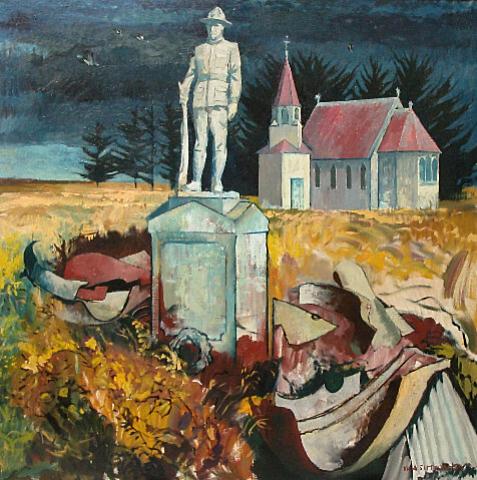 WA Sutton, Pastoral, oil on canvas, 1959
The works for which Sutton is best known include his ‘Church’ series painted in Canterbury in the 1940s and 1950s. In these works Sutton alludes to human inhabitation, colonisation, and mortality in the depiction of empty church buildings and silent graveyards.
He went increasingly abstract in latter years:
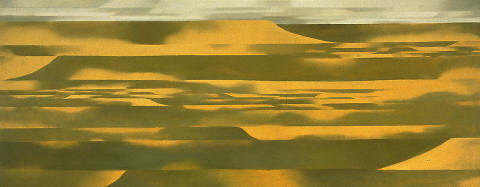
William A. Sutton, Threshold VIII, 1973
And:
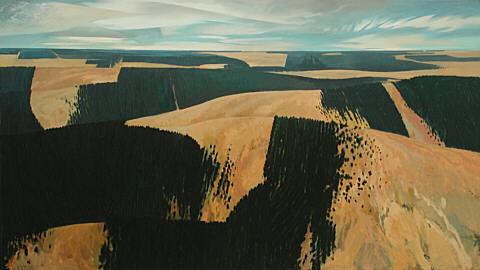 William A Sutton, Plantation Series XVII, 1988