March 25, 2009
March 24, 2009
Nietzsche and art
Friedrich Ulfers and Mark Daniel Cohen argue in Nietzsche and the Future of Art that a Nietzsche’s views on art were reflected to a significant degree in the work of artists in the years following his death, a period of development in the arts that saw changes in artistic method and purpose that rival any that preceded it—the period of Modernism.
It is the thesis of this paper that Nietzsche’s conception of art, and specifically his views as laid out in The Birth of Tragedy, directly foresaw and established a philosophical foundation for the primary developments in the art of the twentieth century in the Western tradition, laying out a role and vision for art that characterize the developments which define Modernism. It is an alignment of imagination, and a potential range of influence, that has been ratified by numerous artists who cite Nietzsche in their writings, and it can perhaps be most clearly observed in the principal achievement in visual art of the century—the development of pure, or nonrepresentational, abstraction.
One interpretation of Nietzsche has him valorize art as a standard against which he believes we should strive to live our lives. Despite the quite different strands to such an underlying assumption about Nietzschean aesthetics, it is common, if not to all, then to most, interpretations over a century and more of Nietzsche scholarship that Nietzsche is taken to have raised art to that standard and measure.
From the earliest interpretations of both Nietzsche and Zarathustra as prophetic ‘poet-philosopher’, to Bäumler’s and Heidegger’s strong emphasis on the Will to Power’s expression as art, Kaufmann’s post-war valorization of the Apollinian, French or post-structuralist interpretations of the creativity inherent in Nietzsche’s thought, to more recent Anglo-Saxon readings of Nietzsche’s thoughts on art, by Nehamas, Young and others, this assumption has remained\common and gone largely unchallenged.
March 20, 2009
Francis Bacon
Luke Skrebowski in The Vitality of the Accident: Francis Bacon’s Metamorphic Figuration argues that Bacon directly opposed the dominant Greenbergian doxa of his time, which prescribed abstraction and insisted that painting should progress rationally towards its own medium-specific “essence” by integrating accident into his figurative
working practice. He also challenged the residual humanism of the art institution that was still ensnared in a residual metaphysics that posited human beings as an“aeterna veritas,” a transcendent entity outside time and change. And he collapses Cartesian space.
This is argued for by examining Francis Bacon's Three Studies for Figures at the Base of a Crucifixion (1944)
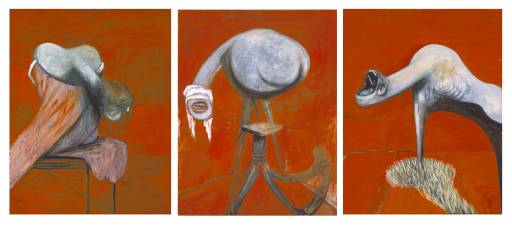
Skrebowski says about the collapsing Cartesian space:
We peer into the painting’s ground and catch what appears to be a familiar geometry. Running across the panels, sketched in thin, blacklines, the contours of a room present themselves. Tracing the lines, we attempt to model the perspectival space of the painting. Scanning the panels we fix on the leftmost and reconstruct a garret. On crossing panels,however, we are frustrated. The space of the middle panel recedes away ina vertiginous manner. Our gaze flicks to the right and finds here a shallow geometry that, while more probable, still seems incongruent. The room will not cohere. Reluctantly, we are made to inhabit an environment of collapsing Cartesian space.
March 19, 2009
Harvey on urbanization
In this article----The Right to the City David Harvey argues that the whole neoliberal project over the last thirty years has been oriented towards the privatization of control over the surplus. Urbanization we may conclude has played a crucial role in the absorption of capital surpluses and has done so at every increasing geographical scales but at the price of burgeoning processes of creative destruction that entail the dispossession of the urban masses of any right to the city whatsoever. He says:
the question of what kind of city we want cannot be divorced from the question of what kind of people we want to be, what kinds of social relations we seek, what relations to nature we cherish, what style of daily life we desire, what kinds of technologies we deem appropriate, what aesthetic values we hold. The right to the city is, therefore, far more than a right of individual access to the resources that the city embodies: it is a right to change ourselves by changing the city more after our heart’s desire. It is, moreover, a collective rather than an individual right since changing the city inevitably depends upon the exercise of a collective power over the processes of urbanization. The freedom to make and remake ourselves and our cities is..... one of the most precious yet most neglected of our human rights.
To claim the right to the city in the sense As Harvey mean it here is to claim some kind of shaping power over the processes of urbanization, over the ways in which our cities are made and re-made and to do so in a fundamental and radical way.
1950s suburbia is one example of the way that the city has been remade. Today the city has become a commodity in an urban world where consumerism, tourism, cultural and knowledge-based industries have become major aspects of urban political economy. The postmodernist penchant for encouraging the formation of market niches, both in urban lifestyle choices and in consumer habits, and cultural forms, surrounds the contemporary urban experience with an aura of freedom of choice in the market, provided you have the money. Shopping malls, multiplexes and box stores proliferate ...as do fast food and artisanal market places, boutique cultures etc.
March 3, 2009
Pyschogeography
Ian Sinclair, the Engllish writer says that psychogeography:
For me, it's a way of psychoanalysing the psychosis of the place in which I happen to live. I'm just exploiting it because I think it's a canny way to write about London....I can't live in Hackney. ... Nothing working, completely shot council, the banality of gradual dysfunction, the sense of the landscape becoming more intimidating.
The reference is to layers ofthecity and the way it changes through development. An indication of what Sinclair is referring to can be gleaned from Friedrich Engels writes in On the Condition of the Working Class in England, where he says that 1840s Manchester:
‘is particularly built so that a person might live in it for years and go in and out daily, without coming into contact with a working people’s quarter or even with workers, that is, so long as he confines himself to his business or pleasure walks’.
Urban space was so designed that businessmen could enter and leave the city ‘without ever seeing that they are in the midst of grimy misery that lurks to the right and left’. In effect, in 1840s Manchester, work was
being hidden through the very shape of the city itself. In Manchester, the modern industrial city was being
shaped according to an incredible contradiction. The poverty, filth and cramped favella conditions, the base
of the new economy, were duly swept aside. The essential had become the undesirable, the undesirable
became the ignored.
Cities have secrets and histories that need to be discovered. Psychogeography--walking the city---is one way to do this. For the Situationists the aim is to combat the banality and conformity of everyday life; and psychogeography became a major element, in the form of the dérive. This was an aimless, intoxicated drift across the city which, they hoped, would make the familiar surprising and the mundane strange. The British version was about surreptitiously slinking along, fumbling for the underbelly. It was about the arcane and the hidden, rather than the bourgeoisie and the banlieu collaborating on overthrowing the state. Still, this act of walking in cities that are increasingly hostile to the pedestrian means that it inevitably becomes an act of subversion.
The danger of course is the resistance to new development become anti-development. The Manchester Area Pyschogeographic's website makes clear how they felt about about the new developments of the 1980s and 1990s:
"
The talk was all about loft apartments, gentrifying 19th-century warehouses, and so on. We preferred it in its sordid decrepitude. Perversely, because no one else was saying it, we launched the first MAP newsletter, sending copies anonymously to anyone we thought mattered, setting out our case: no to gentrification, no to museumification. We were saying, let the buildings fall down, if they must. We wanted to walk unregulated, unrepaired, atmospheric streets."
March 1, 2009
Merleau-Ponty and the lived body
On The Philosopher's Zone on ABC (presented by Alan Saunders) Taylor Carman says:
what's really original about Merleau-Ponty is his idea that we have to understand perception as an embodied phenomenon. And what that means is that the thing doing the perceiving is a body, a bodily being. It's hard to say that without it sounding obvious and trivial, because we all know that we have bodies, and we all know that you have to have a body to perceive the world. The tradition had wanted to make a distinction between the mind, which is somehow what we really are, and the body, which is a kind of vehicle or instrument between us and the world. Merleau-Ponty wanted to get rid of that, what's called dualism, that distinction between mind and body, and he wanted to say we're one thing, we're an embodied, perceptual being. So all of our perceptual experience is a bodily experience, it's experience of being oriented in a world, a material world, that surrounds us and that we're part of. And there's really no room in our experience itself, for a conception of a disembodied mind that's somehow really the real site of the experience. The site, the location, the locale of the experience, is the body.
Latter in the programme Justin Tauber says:
One of the arguments Merleau-Ponty makes goes a little like this. When we see objects in the world around us, one of the conditions of their appearing to us as objects is that we see them as being able to be obscured, being able to be hidden, being able to recede into the distance and disappear from view. The possibility of an object is the kind of thing that can be absent as well as present. Now, interestingly, the body, when you start thinking about your experience of your own body, it doesn't have that character, the same character as an object has. A body is always present: not necessarily in front of us the way an object is, in the sense that I can be, when I touch an object, when I touch this table, for example, I'm not focused on my hand as an object, I'm focused on the table, but the hand remains present to me in a certain way. It's that perennial presence that differentiates my body from other objects in the world.