February 24, 2009
Google and unfreedom
Tony Curzon Price in The freedom of the networked (pt 3) says that
Google's business model is to sell your screen-space to advertisers and swap you free-search in exchange.... Centralisation of information is a business necessity for Google as it optimises click-through. Whatever services can capture large portions of the data relating to who, what when, where and how about every habitual human activity will be sitting on an advertiser's dream. The commercial incentive to build large information collections is huge.
Underpinning this is the legitimating, ideological function that Western capitalist culture invests in the idea of history seen as a continuum "progress" that affirms the present as its culmination. A dialectical critic is one whose task is that of being constantly engaged in deciphering the material and historical conditions of the objects which form our everyday life. According to Susanna Scarparo Benjamain held that:
the wishes and desires of the collective unconscious are displayed in a mediated manner through images. Thus, according to Benjamin, the images created by past generations contain the desires of those generations which are still "true" and relevant for us today. As a result, then, the objects of the past are not important for themselves, but for what they stand for, as they can help us to reach an understanding of the world in which our wishes and desires are not distorted by the bourgeois and capitalist society. The basic structure of capitalist society, in fact, distorts objects as it abstracts and, therefore, renders invisible the labor that goes into their making. When the object lacks the mark of the labor which went into its production it bears the mark of commodity, and when distorted desires are projected into the commodified object, this object becomes a fetish. Thus, as the object invested with false desires becomes a phantasmagoria produced by the distorted desires of the collective, the world becomes an aesthetic spectacle of itself.
Walter Benjamin's approach to critical discourse, together with his view of the world seen as a textual construction involves hermeneutic approach. In Paris Capital of the World, where the dialectical critic has the task to discover the "truth" contained in the urban architecture of Paris, which Benjamin believes to be a revealing text or record of historical forces. However, the purpose of interpreting the world (or the urban architecture) as a text is to show the ways in which the social and cultural forms of expression and of organization in the 19th century are, in all of their manifestations, distorted by the basic structure of the capitalist social system.
,
February 21, 2009
Bernice Abbott
Bernice Abbott's Changing New York series is fascinating body of work. It documents New York City circa 1935
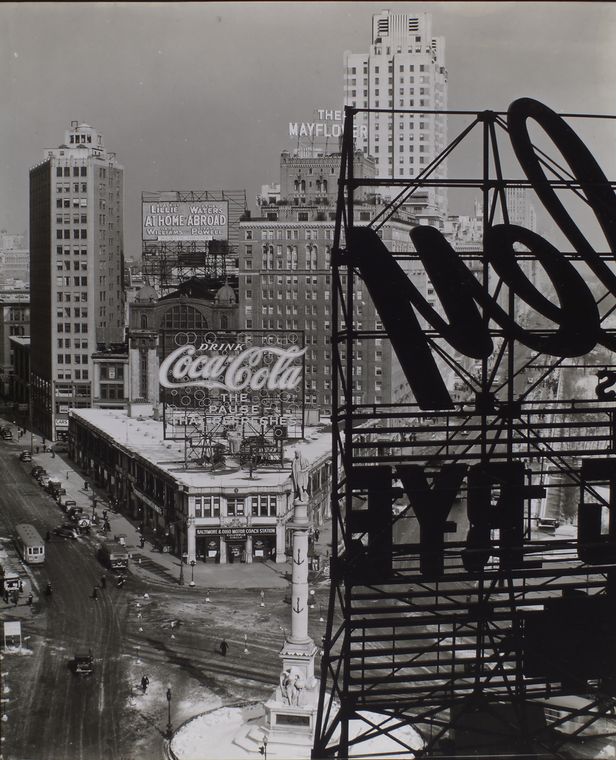 Bernice Abbott, Columbus Circle, circa 1938
During the summer of 1954, Berenice Abbott set off to document in photographs the length of one of America's most historic roads: Route 1 -----from Fort Kent, Maine to Key West, Florida and back. Her aim was to capture visually the character of an historic section of the United States, its beauties and incongruities and all. Her goal was to capture the character of the time in the ever transient face of America. Abbott worked to preserve sites that were specifically 1954, rather than documenting the progression of years.
Abbott's goal was for people to remember and see it as it was---to capture what was familiar, the things that are overlooked until they are gone.
February 18, 2009
The new eco-city
Our cities are places characterised by urban sprawl, poorly designed buildings and inefficient transport systems which consume enormous quantities of fossil fuels and emit high levels of greenhouse gases. In commenting on his Resilient Cities Peter Newman says that he shift in oil prices exposed the underlying vulnerability of highly car and fuel dependent urban development. Once the fuel price increased, the loans which were used to form these scattered urban areas became toxic. At the same time a more global limit was reached with climate change; the cities of the world now faced a new limit whereby they must phase out all fossil fuels. He adds that future change also includes renewable energy and distributed, small-scale water, energy and waste systems, building on clever control systems now perfected from the Fifth Wave, all of which are more local and require far less fuel to distribute.
The buildings and transport systems at the base of this city will be more and more efficient and more and more electric. It will be an intense green urbanism that I have called the Resilient City.This will require redevelopment around centres where short trips to jobs and services, shops and schools are more and more available. The transport that supports such polycentric cities appears to be new electric rail for fast cross-city movement and a series of small scale electric bus and plug-in hybrid electric vehicles with electric storage in their batteries that enable renewables to be 100% of the city. As well, walking and cycling will flourish as they have survived all the city form changes. The polycentric centres and the remaining suburban buildings all need to be renewed as 100% solar-based and with all the eco-technologies of the Sixth Wave.
What it means in practice is that the building of high capacity roads and urban scatter must cease. High capacity roads just extend the city further out; they are the technology of the past. They do little to make cities focus in ways that can build within the travel time budget limits or within the limits of fossil fuel reductions are required. No further urban expansions that go beyond these limits can happen, and any policy that is designed to kick-start the economy by subsidising scattered land development or large road projects will only further undermine the economy. We must instead use the funds for building the next economy based around the Resilient City.
February 16, 2009
representation + sublime
In the Critique of Judgment Kant argued that the mathematically sublime refers to the way that the mental faculties that present visual perceptions to the mind are inadequate to the concept corresponding to it; in other words, what we are able to make ourselves see cannot fully match up to what we know is there. We know it's a mountain but we cannot take the whole thing into our perception. Our sensibility is incapable of coping with such sights, but our reason can assert the finitude of the presentation.
With the dynamically sublime, our sense of physical danger should prompt an awareness that we are not just physical material beings, but moral and (in Kant's terms) noumenal beings as well. The body may be dwarfed by its power but our reason need not be. This explains, in both cases, why the sublime is an experience of pleasure as well as pain.
So we have an admission, from one of the philosophical architects of the Enlightenment, that the mind cannot always organise the world rationally. Some objects are simply incapable of being brought neatly under concepts. he Lisbon earthquake of 1755 famously shook the metaphysical optimism of Europe's leading philosophers. Immanuel Kant would eventually manage its threat in "The Analytic of the Sublime" of his 1790 Critique of Judgment. In the twentieth century, human-inflicted catastrophes have supplanted the natural disaster as the source of sublime feeling. Auschwitz, however, is the name of an "event" that permits no compensatory retreat to an ostensible human dignity and is not recuperable within a transcendental tale of progress and greater good.
Kant's insight regarding the irreconcilability of imagination and reason is the stepping stone for Lyotard's forwarding of the sublime presence of an unconscious desire to postpone meaning and delay the process of signification. The differend mediating the link between representation and concept unfolds a sublime kind of heterogeneity which breaks down the harmonizing act of representation as conducive to transcendent meaning through language. The differend, to the extent that it creates "noise" and dissension in the communicative act, brings about a formless mass of statements and open-ended signifieds that cannot be unified by a common metalanguage.
Sublime feeling thus sensitizes us to an "outside and an inside" in thought, or to an "abyss" separating imagination and reason. Sublime feeling becomes, as a result, "the transport that leads all thought (critical thought included) to its limits." We have a pleasure-in-pain, a "recoil" of thought against its limitations.
Images produced mechanically, like photographs, achieve a degree of verisimilitude that outmatches practically anything hand-produced, and for this reason one might conclude that photographs reinforce a sense of stability or reality to cultural forms better than "realist" styles of painting since the quattrocento. Before mechanical reproduction, it could reasonably be claimed of a hand-produced painting like the Mona Lisa that it is absolutely unique and tied to a certain context of meaning, thus unambiguously authoritative. But after mechanical reproduction, leading to the Mona Lisa's appearance on billboards, magazine advertisements, and T-shirts, unity and stability of meaning are no longer possible. This is emblematic of what postmodern culture has both lost and found. It has lost its sense of presence or originating certainty, and it has gained infinity. Therein lies its sublimity.
February 1, 2009
from grid to network
In this extract from The Moment of Complexity Emerging Network Culture Mark C Taylor traces the shift from grid to network. He says"
The contrast between grids and networks clarifies the transition from the Cold War system to network culture. The Cold War system was designed to maintain stability by simplifying complex relations and situations in terms of a grid with clear and precise oppositions: East/West, left/right, communism/capitalism, etc. This is a world in which walls seem to provide security. Walls and grids, however, offer no protection from spreading webs; as webs grow, walls collapse and everything begins to change. A new economy displaces the old and a "new world order" appears on the horizon. In this situation, the structural oppositions, which had long informed thinking and guided policy, unravel and the political balance of power disappears. Whereas walls divide and seclude in an effort to impose order and control, webs link and relate, entangling everyone in multiple, mutating, and mutually defining connections in which nobody is really in control. As connections proliferate, change accelerates, bringing everything to the edge of chaos. This is the moment of complexity.