January 31, 2009
Heidegger, technology
In Highway Bridges and Feasts: Heidegger and Borgmann on How to Affirm Technology Hubert L. Dreyfus addresses a core question arising from Heidegger's work: "How can we relate ourselves to technology in a way that not only resists its devastation but also gives it a positive role in our lives?"
As we know late Heidegger's analysis of technology in modernity involved a critique of those who, still caught in the subject/object picture, thought that technology was dangerous because it embodied instrumental reason. that subjects used to the will to gain control over objects for the sake of satisfying one's desires. Modern technology, he argued , is "something completely different and therefore new."
The goal of technology Heidegger then tells us, is the more and more flexible and efficient ordering of resources, not as objects to satisfy our desires, but simply for the sake of ordering; an ordered about in that he called a standing-reserve. Heidegger sensed that, when everything has become standing reserve or resources, people and things will no longer be understood as having an identity, or even the goal of satisfying their arbitrary desires.
January 29, 2009
Mondrian, space, painting
Gregory Schufreider in his Mondrian's Opening: The Space of Painting, delivered at the After Postmodernism Conference argues that Mondrian's late work:
opened a new space for painting by exposing what I have, rather ambiguously, referred to in my title as the space of painting. For by the latter I mean to indicate both the space that belongs to painting as well as the space to which painting belongs. My thesis is that Mondrian extended the space of painting, first, as a space within painting in his destruction of the traditional space of representational illusion in the breakthrough to geometrical abstraction. This extension, however, did not stop with the development of an abstract space in its reduction of painting to the picture plane and its pure means of production. Instead, working in the space of abstract painting eventually revealed a new space for painting, opening up the space between the work and the wall as its true space, that is, as the space to which painting itself belongs. This ambiguous space of painting, which spans the difference between the virtual and the real, is the space in which Mondrian came finally not just to work, but to live.
By the late work Schufreider means Broadway Boogie-Woogie and Victory Boogie-Woogie
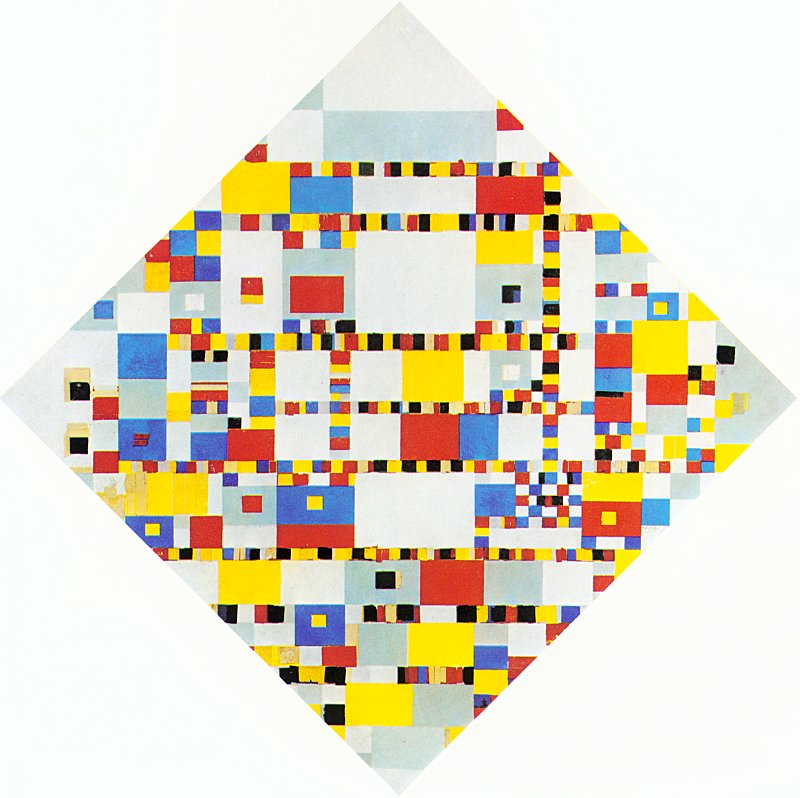 Mondrian, Victory Boogie Woogie (unfinished), 1944
Schufreider says that erather than appearing as a static, independent, self-contained or merely self-relational element, the eccentric grid is now subjected to the compositional dynamics of appearance and disappearance that lend to it an essential vitality. In in Victory Boogie-Woogie the grid disintegrates as a separately identifiable, independently distinguishable structure of its own.
January 28, 2009
Mitchell on the nature of an image
W.J.T. Mitchell in What is an Image says that It is a commonplace of modern cultural criticism that images have a power in our world undreamt of by the ancient idolaters. And it seems equally evident that the question of the nature of imagery has been second only to the problem of language in the evolution of modern criticism. He adds:
language and imagery are no longer what they promised to be for critics and philosophers of the Enlightenment-perfect, transparent media through which reality may be represented to the understanding. For modern criticism, language and imagery have become enigmas, problems to be explained, prison houses which lock the understanding away from the world. The commonplace of modern studies of images, in fact, is that they must be understood as a kind of language; instead of providing a transparent window on the world, images are now regarded as the sort of sign that presents a deceptive appearance of naturalness and transparence concealing an opaque, distorting, arbitrary mechanism of representation, a process of ideological mystification.
Mitchell is not concerned to produce a new or better definition of the essential nature of images, as he is more interested examining, and criticizing some of the ways we use the word image in a number of
institutionalized discourses-particularly literary criticism, art history, theology, and philosophy.
In art history the image is understood in terms of linear perspective in painting. Like Descartes' idealizing of the inner eye of consciousness, perspective, makes the single eye the center of the visible world. Everything converges on to the eye as to the vanishing point of infinity. The visible world is arranged for the spectator as the universe was once thought to be arranged for God. just as Descartes severs vision from the body in order to redefine it as a property of the mind, so the practice of perspective---while ostensibly addressing the spectator's material act of looking at the painting----similarly brackets off the body from the act of perception
January 26, 2009
wireless and urban life
From Carlo Ratti Daniel Berry's Sense of the City: Wireless and the Emergence of Real-Time Urban Systems at Sensible City Lab
From an urban perspective, the result of the wireless seems to be the emergence of more intricate patterns of dwelling in urban areas: moredecentralized systems of organization exhibiting higher levels of complexity and unpredictability. Gone is the truism of the clear-cut modernist arguments postulated by Le Corbusier in the Charte d’Athènes, which called for the partitioning of city spaces into distinct sectors, organized according to specific use...In the wake of the rationalist planning principles, ‘mixed-use’ has been the paradigm that the planning profession seems to have adopted without an afterthought over the course of the past decade. But now another type of mixing seems to be emerging in contemporary urban spaces, fueled in no small part by the profusion of new information and communication technologies : “mixed-life”, or the more intricate interweaving – some would say blurring ofthe boundaries – of living, working, and playing
January 20, 2009
W.J.T. Mitchell: Picture Theory #2
I'm continuing to work my way through W.J.T. Mitchell's Picture Theory. As he thinks in triads He explores the force-field of image/text from the side of language of literature in four chapters, and then explores the field of visual representations in three chapters, before turning to examine the power of pictures by exploring the kind of picture of power we are assuming.
On the former he explore William Blake's mode of writing, ekphrasis (poems which describe works of art), and slave narratives. On the latter he explores abstract painting the work of Robert Morris and the photographic essay.
He says that texts present a greater threat to concepts of the integrity or purity of images than vice versa. For one thing, they unavoidably and literally impose themselves within and around the pictorial object, on the walls, outside, inside and on the frame through which the object is seen and discourse about it is conducted. Images interests, by contrast are generally regarded as immaterial, figurative and dispensable and description is ancillary to narrative.
The photographic essay, with its roots in documentary journalism, newspapers, magazines and the whole ensemble of visual verbal communications in mass media, is thereby connected to popular forms of communication that are quite antithetical to modernism in their freedom of exchange between image and text.This places the photographic essay at the cross roads between modernism and postmodernism, understanding it as a form in which the resistance to image text relations is most crucial. It is a space that occupies a real place in our cultural history.
January 17, 2009
W.J.T. Mitchell: Picture Theory
I'm currently reading W.J.T. Mitchell's Picture Theory. It is a set of essays that explore, from different perspectives, the recent visual or pictorial turn in our culture in postmodernity, the dominance of visuality, the widespread anxieties about the spectacle of the newly forming global visual culture and the postmodern absorption of all language into images and a semiotic hall of mirrors.
For Mitchell the picture is understood in terms of the complex interplay between visuality, apparatus, institutions, discourse, bodies and figurality; with the realization that spectatorship ( the look, the gaze, the glance, surveillance and visual pleasure may be as deep a problems as various forms of reading (decipherment, decoding interpretation) and that visual experience or visual literacy may not be fully explicable on the model of textuality.
The text asks three questions: What are pictures? What is their relation to language? Why does it matter what pictures are and how they they relate to language? It answers these questions in the context of the word/image types of representation (understood as standing or acting for). Mitchell says that we need a critique of visual culture that takes us beyond the cultural conservative anxieties about television and literacy; a critique that is alert to the power of images for good and evil and which is capable of discriminating the variety an historical specificity of their uses.
The duality of word/mage is undercut by an argument that holds all media are mixed media, all representations are heterogeneous,and that there is no "purely" visual or verbal arts. In so arguing it contests the impulse of modernism to purify media. The text is negative in approach as it is less concerned with a developing a picture theory (or a theory of pictures) than showing how the received answers to the above questions work in practice and unsettling them.
What is disclosed is the problematic of the image/text ---an unstable dialectic of the relationship between the two that constantly shifts its location in heterogeneous representational practices, transgressing both pictorial and discursive frames and undermining the assumptions that underwrite the separation of the discursive and visual disciplines. The category of image/text is not one kind of thing, despite the convention of one being subordinated to the other, as in the newspaper, cartoons or the photographic essay. The category is offered as a wedge to pry open the heterogeneity of media and specific representations and it gives us a site of dialectical tension, slippage and transformation.
January 15, 2009
comics and superheroes
Henry Jenkins interviews Angela Ndalianis, whose her first book, Neo-Baroque Aesthetics and Contemporary Entertainment, covered Baroque art and architecture, special effects, science fiction, comics, and amusement parks. Ndalianis, who is Head of Screen Studies at Melbourne University, argued in that text that:
entertainment forms such as computer games, comic books, theme parks, and television shows have become complexly interwoven, reflecting the interests of multinational conglomerates that have investments in numerous media companies. One media form serially extends its own narrative spaces and spectacles and those of other media as well. Narrative spaces weave and extend into and from one another, so much so that, at times, it is difficult to discuss one form of popular culture without referring to another.
For instance, not only did the blockbuster Alien films, which were produced by Twentieth Century Fox, inspire its own film sequels, but the movie’s stories also migrated into comic-book and computer game formats. As examples of the sequel phenomenon that marks mainstream cinema, the Alien films signal a shift away from a centralized or closed narrative that progresses toward resolution and closure.
In response to Jenkin's question on why the superhero has been such a persistent figure across the history of 20th century popular culture she says:
On a basic level, they're exploits, dramas, relationships, stories and fashion sense are just great fun and the comic books invite repeat performances on the part of the reader. On a more serious level, like the cowboys of the western superheroes have embodied ethical codes and moral structures that society needs to embrace in order to survive. Despite their excess and hyper-humanity, they've always represented the voice or, more precisely, the various voices of the people, reflecting the social dilemmas and belief systems of their time. Even when the superheroes became darker in the late 80s, propelled by writers like Frank Miller and Alan Moore, they still reflected abstract moral crises of their era. Significantly, individual superheroes have consistently reflected the changing times that they belong to, learning to adapt to each decade that passes and the cultural changes that come with the passing of time. The Spider-Man of the 1960s, for example, is not the same Spider-Man of the 2000s - they're identities that are the product of different societies at different times that have reached different audiences. The superheroes who have survived across each shifting decade have been able to adapt their form, and connected to this is the superhero's capacity to translate and cross over into other media. This has been a huge plus in extending and familiarising audiences with the superhero stories. The Flash, Superman, Wonder Woman, Catwoman, the Hulk, Elektra - while originating in the comic book format, have also migrated media to appear in radio, television, B-film serials, blockbuster films, novels and computer games.
She points out that the birth of Superman was very much a product of a culture that nurtured the view that utopia was becoming an achievable reality in the not too distant future. Superman was a character from a science fiction reality, and the product of a technologically advanced society as represented in his home planet of Krypton. His arrival on Earth was very much presented as the arrival of a god-like being who offered humanity its own utopian potential. The new figure of the superhero was clearly seen as playing an important role in envision a future, utopian America.
January 13, 2009
Zoriah.net
Zoriah.net ----a Palestinian blog run by an independent photojournalist known as Zoriah He also has a Flickrstream. The work is important as there are there are few people in Gaza reporting right now to show the suffering that is occurring there amongst the Palestinian people.
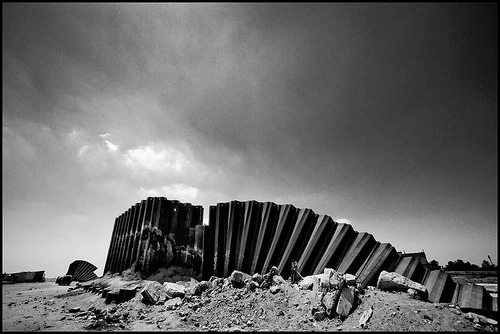 Zoriah, The Gaza/Egypt border line in Rafah August,,.2006
The Gaza/Egypt border line is a metal wall constructed by Israel to allow their tanks and troops into Gaza but keep Palestinians from exiting was cut down by Hamas after coming into power.
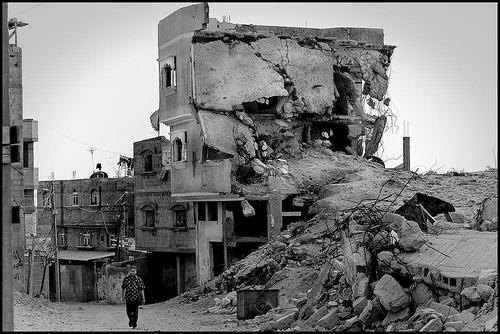 Zoriah Khan Yunis, Gaza Strip in March, 2006.
This is a neighborhood severely damaged by Israeli Defense Force and settler attacks.
As Henry Siegman Posted by Gary Sauer-Thompson at 10:30 PM | TrackBack
January 12, 2009
abstraction + arts education
Its odd that arts education remains excluded from the Federal Government's proposed national curriculum and early childhood education framework.
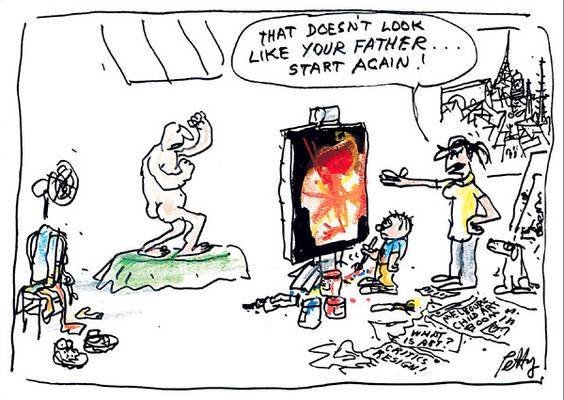 Bruce Petty
it is the old view of art isn't it. High culture for the elite rather than being part of the creative industries in an information economy.
January 8, 2009
art institutions, curating, the canon
Exhibiting in an art institution is crucial for an artwork, because it means making it known to the public. Some artists and their work become visible whilst others disappear due to the power of institutions. These institutions work to establish chosen artworks as a norm or a canon--as Gael Newton did for modernism at the Australian National Gallery.
Art institutions claim the authority to consecrate some artifacts as works of art and relegate others to the dustbin of history----eg., John Szarkowski, who introduced photography into the art museum despite the constraints imposed by the exhibition venue in the decisions he made as curator. So an artifact which was so far neglected by art museums changes its meaning after being chosen by a curator to feature in an art exhibition.
Is it the curator’s role in a public art art gallery to act against the institutions, subverting the canons and undermining the patterns of exhibition and acquisition policies?
The last 40 years have marked the rise and proliferation of curators, collectors and architects specializing in making museums into powerful corporate brands that are intended to provide mass entertainment, generate tourism or solve social problems. Art has moved from margin to centre.
In that period art museums and galleries began to be run as businesses and were increasingly driven into the non-independence of private–public partnerships, framed by an atmospheric event culture with more than 50 biennials and triennials worldwide. A highly competitive global market has emerged and it appears that in a highly competitive global market curation is increasingly driven by by sales – of art, at the box office and of advertising. The art market rules. Museums have brands--Guggenheim.
The control of programming has moved away from historians, academics and artists. Art has become generally not much more than entertainment, commodity production and spectacle – in other words, an embracement of amusement and excess.
The consequence is the extinguishing of the field of art as a site of resistance to the logic, values and power of the market and which challenges the authority of the institutions and structures that defined their work. On the other hand attempts to open up the enclosed territory of art and to diffuse art into the public arena has continued.
January 6, 2009
Malpas on Heidegger and place
In this review of Jeff Malpas' Heidegger’s Topology Miguel de Beistegui states that it is a book book about place, the place we ought to attribute to place as well as a book about the place we ought to attribute to place in the thought of Martin Heidegger. He says that it is a book that should be read and discussed by those who wonder about the difference between place and space, or between ontological locality and physical location.
I do, often. My assumption is that the question of place is essentially distinct from that of space and the concern for place is born of the essential placelessness or homelessness in which, for the most part, we find ourselves today in our globalised world. Hence the need for a return to place. In finding ourselves "in" the world, we find ourselves already"in" a place, already given over to and involved in things and persons, with our lives.
Malpas’ gives us a close reading of Heidegger’s complex treatment of the question of place structured around Heidegger’s claim that our technological age is characterized by the systematic elimination of place, and a planetary homelessness. My judgement is that Heidegger made made a significant contribution to the philosophical analysis of place in the 20th century, and that this was primarily on the basis of the later texts rather than the earlier. The categories of “clearing,” “way,” “dwelling,” and “homecoming” that comprise what Malpas calls Heidegger’s “topology,” are crucial ones in Heidegger's questioning of technology. de Beistegui says:
Malpas’ reading takes its clue from Heidegger’s later thought, and specifically from his claim that being be understood as disclosedness and clearing, and that the question of the meaning or the truth of being, initially understood as temporality, be now formulated as the question concerning the place of be-ing. With this clue or thread in hand, Malpas shows, most convincingly in my view, that the question of being is best formulated, and from the start, as a question of place, as the question, that is, concerning the way in which being is “there” or manifests itself. What Heidegger calls Dasein, and which Malpas insists we translate as being-there, is precisely an attempt to address the question of being from the point of view of its there, its locality or situation.
Malpas argues that Heidegger’s thought is not just helpful in elucidating place, but that place is at the root of Heidegger’ s philosophy of being. Being and place are inextricably bound together in that being emerges only through place; and place, through being. Malpas suggests that, for the latter Heidegger, “event” and “place” often mean the same; they are both the starting point for thinking and both offer possibilities for disclosure, appropriation, appearing, and gathering--categories that disclose being-in-place.
January 2, 2009
modernism + the ut pictura poesis tradition
Jan Baetens in Modernism's 'ut pictura poesis' mentions that modernism represents a rupture of the ut pictura poesis (word +picture) tradition. This is the core of the Greenbergian view of modernism in painting (and, to a lesser extent, in literature), which places an emphasis on a medium's specificity. Modernism's history is a history of purity.
Judith Harvey says:
In his 1940 essay, “Towards a Newer Laocoön,” Clement Greenberg changes the terms of the dialogue by investigating abstract art as a reaction to a confusion of the arts, and how it might deal with that confusion. “There has been, is, and will be, such a thing as a confusion of the arts." .. He surveys the history of art as artists attempting mimic the dominant prototype of art, which serves to unite or combine (his word is “confuse”) the arts. Mimesis is attainable by artistic ability to create the illusion that their representation is real, an illusion fundamentally based in literary values. According to Greenberg, we can find in abstract art a rejection of earlier artistic denial of the materiality of painting. ... He argues that value of art lies in emphasizing and the possibility of overpowering the medium.
For Greenberg modernism abstract art has escaped all traces of verbal form--emancipated itself from tradition and a literary culture in the name of purity. And after modernism?
Harvey adds that W.J.T. Mitchell in “Ut Pictura Theoria: Abstract Painting and Language” dealt with the question of whether abstract art has in fact escaped all traces of verbal form and what it means if it has. Mitchell argued that there is sno purely visual or verbal art. Harvey says:
While criticizing Tom Wolfe’s superficial reading of abstract art, Mitchell builds on his recognition that abstract art does depend on a sort of “verbal contamination” in the form of theory. .... The notion that art rests on theory is not a new one, and Mitchell traces it from early artists (such as Turner, Blake and Hogarth) to early European and later American abstract painters. He deftly answers potential objections that theory is outside the realm of the painter by presenting two answers; even figurative art depends on viewers knowing a narrative that exists outside the painting and abstract art still has content and subject, though representations may be absent.
Despite the differences between images and language all media are mixed media, especially when power, value and human interest are introduced.
January 1, 2009
the car as freedom
In a post entitled Public art strategy at Iron Curtain Call we find this comment:
Like home ownership, the ownership of a car is held to be something like an inalienable human right in Australia. More than this, though, the car is a key mythological symbol in contemporary Australia. The road, even more so. This supremacy of the vehicle and highway recalls the situation in the US, except Australia has its own versions of this modernist frontier narrative. See Mad Max. Listen to The Triffids. Read Meaghan Morris. Skim Graeme Davison.
Davison says that the car is the car as an aspirational, freedom-giving object. He shows how the car led to the redesign of the spaces in which Melburnians live, undermining social intercourse by eroding the pedestrian orientation of residential and High streets in favour of car-managing curving streets and the plethora of drive-in services from service stations to shopping malls. He demonstrates how cars were mobilised in class conflict, aligning Labor with public transportation and the regulation of cars and drivers and Liberals with the car lobby, with its emphasis on the rights of the individual.