December 28, 2008
Climate change is a threat
The Public Interest Research Centre in the UK is an interesting body. It sits between research organisations and campaigning groups translating technical research into engaging material that helps to facilitate lasting change. We do not have such a body in Australia.
It has just launched a 52-page advocacy report Climate Safety“Climate Safety”, based on the Australian book Climate Code Red. The former says that:
Following the record 2007 melt in Arctic summer sea ice extent, 2008 saw a record low in sea ice volume. Arcticclimate scientists are now predicting an Arctic ocean ice-free in summer by 2011-2015, eighty years ahead ofpredictions made by the Intergovernmental Panel on Climate Change (IPCC). Contrary to what the media
coverage suggests, the significance of an earlier-than predicted Arctic melt extends beyond displaced polar
bears and easier access to oil and gas.
It says that:
An early Arctic melt will cause additional heating, as a shrinking ice cap reflects less sunlight into space; additional greenhouse gas emissions, as the ensuing regional warming melts frozen permafrost; and additional sea level rise, as the Greenland ice-sheet comes under increased temperature stress. Furthermore, the Arctic melt is taking place in the context of faster change in the climate than the IPCC have predicted. It is clear that the IPCC’s predictions of future sea-level rises are underestimates.
December 26, 2008
Creative and Cultural Industries
The Arts Council of England runs a Creative Partnerships program which includes literature reviews on a variety of issues. It is a creative learning programme, designed to develop the skills of young people across England, raising their aspirations and equipping them for their futures. Long-term relationships between creative professionals and schools lie at the heart of the Creative Partnerships process.
One of these literature reviews is by Justin O'Connor on the Creative and Cultural Industries. He says that in 1997 when New Labour were elected in the UK the cultural industries were renamed as ‘creative industries’ and a ‘creative industries task force’ was set up involving many big names from the film, music, fashion and games sectors. After long neglect the creative industries were now also linked to national cultural and economic policy.
The cultural industries, previously ignored or lumped with ‘the Arts’, were to become central to a new contemporary image for Britain and high profile exemplars of the creativity and innovation that were to remake Britain for the 21st century...This was not simply a re-assertion of social justice against the hard headed economics of Thatcherism, something popular culture articulated throughout the 1980s to little political effect...New Labour built on currents of oppositional popular culture articulated in the form of the emergent discourse around cultural industries, creativity and socially responsible entrepreneurialism.
This new discourse was about a picture of a new economic order; a postmodern
one centred on more fluid patterns of work and a life course demanding more individual responsibility in exchange for autonomy, an economy based not on cut throat competition but on the more open collaborations of projects and networks, rewards for individual creativity and innovation away from the fixed hierarchies of class and corporation.
The sort of economic and cultural conjunction made in the 1980s in France happened – if in different ways and through different paths – in Britain in the 1990s The identification of the creative industries with a ‘new economy’ driven by ‘digital’ technologies and closely related to the ‘information’ or ‘knowledge’ economy.
This conjunction hasn't really happened in Australia, where the policy emphasis has been on manufacturing and resources.The creative industries/information economy bit is a small business strategy by state governments. What we do have in Australia is research at the Queensland University of Technology (QUT) which gives the ‘creative
industries’ a theoretical legitimacy.The central tradition is a cultural policy of using art to civilise the working classes. That was certainly one rational for the ABC.
According to O'Connor, the QUT group (eg., Cunningham, Hartley) argued that:
the deregulation of state controlled media, the proliferating platforms and distribution channels (mobile phones, internet, satellite etc.), the extension of creative content application to education, health and information services, and the provision of ‘experiences’ generally – all this meant that cultural policy could no longer even dream of control...these new applications and outlets indicated a market-driven responsiveness to the new citizen consumer of the affluent society. The rise of User Generated Content (UGC), the ‘long tail’ providing extensive consumer choice, and the more active organisation of consumers through the internet has further altered the cultural landscape. The market has brought the exact opposite of cultural catastrophe, and they are much more sanguine than Garnham about the ability of consumers to circumvent the control of distribution by the big companies; as evidenced by the
impact of digital downloads on the business models of the biggest global corporations.
December 25, 2008
Merry Xmas
Have a great day everyone. Thanks for dropping by, commenting and discussing. It's been great.
 Gary Sauer-Thompson, white rose, Victor Harbor, 2008
I'll pick things up next year.
December 22, 2008
creative industries
In Culture, Creativity and Innovation in the Internet Age Alan Freeman argues that Sony, Apple and Nokia are in effect metamorphosing from manufacturing into service industries.
They are at different larval stages, which at least in the case of Sony has already hatched, of a new industrial creature in which manufacturing s an adjunct to, and a feeder of, the production of a service or services. These companies may still be in the business of selling devices. On examination, however, the purpose of the device is seen to be the service to which it provides access, be this domestic entertainment, mobile gaming, peer-to-peer downloads or simply fashionable appearance, in which the device is even called, aptly, an accessory.This metamorphosis is extending across the entire spectrum of consumer goods production, in a kind of postmodern frenzy transforming aesthetics into the holy grail of product design.4 The car designer outranks the engineer; cosmetic pharmaceuticals outweigh the cure of disease; the sale of clothing is ever more indistinguishable from the
fashion market, and scarcely a city centre is left in the world that is not instantly identifiable from iconic buildings procured from globally famous architects.
Thus we have the revolution in service productivity with the culture and creative sector. Freeman argues that the ‘carrier industry’ of a new socioeconomic paradigm, comparable to the clothing industry in the industrial revolution, the
railways in the age of steam, or the car in ‘Fordism’.
December 18, 2008
addressing climate change
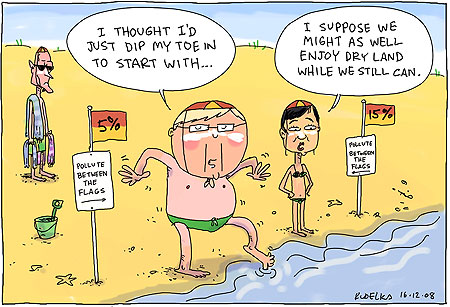
There has been a lot of comment about addressing climate change (global warming) in Australia and in the international community. This image sums up the general judgment about the actions of Australian Rudd Government:
In this context of the failure of instrumental reason to tackle climate change Blake Stimson's The Photographic Comportment of Bernd and Hilla Becher in the Tate's Online Research Journal makes for interesting reading. It is about photography the aesthetic and instrumental economic reason and moving beyond the critical negation of failed political attachments of the modernist past; of how the political past is negotiated within our sense of the present and how that settlement inhabits the realm of the aesthetic.
December 12, 2008
December 10, 2008
e-literature
The shift from literature to electronic literature cannot be separated from parallel shifts in the field of arts and humanities (from literary to cultural studies, from text culture to visual culture. Does e-literature undermine the bastions of traditional humanist culture? Do they need to incorporate electronic literature in their curriculum? If traditional humanist culture is largely seen as literature, then the literary” consists of literature plus artworks that interrogate that contexts, histories, and productions of literature. Is it new forms into an old paradigm or discipline?
The objects of cultural studies are predominantly text. Maybe not literary texts in a conventional sense, but predominantly text. If electronic literature challenges the assumption that things should be text, then what is text as we live through the declining supremacy of print culture? Blogging would be text---and so a part of e-literature would it not?
In Electronic Literature: What is it? N. Katherine Hayles says that:
the place of writing is again in turmoil, roiled now not by the invention of print books but the emergence of electronic literature. Just as the history of print literature is deeply bound up with the evolution of book technology as it built on wave after wave of technical innovations, so the history of electronic literature is entwined with the evolution of digital computers.... Is electronic literature really literature at all? Will the dissemination mechanisms of the Internet and World Wide Web, by opening publication to everyone, result in a flood of worthless drivel? Is literary quality possible in digital media, or is electronic literature demonstrably inferior to the print canon? What large-scale social and cultural changes are bound up with the spread of digital culture, and what do they portend for the future of writing?
Good questions. Hayes says that electronic literature is generally considered to exclude print literature that has been digitized, as it "digital born," a first-generation digital object created on a computer and (usually) meant to be read on a computer.
Hayes goes on to say that:
because electronic literature is normally created and performed within a context of networked and programmable media, it is also informed by the powerhouses of contemporary culture, particularly computer games, films, animations, digital arts, graphic design, and electronic visual culture. In this sense electronic literature is a "hopeful monster" (as geneticists call adaptive mutations) composed of parts taken from diverse traditions that may not always fit neatly together. Hybrid by nature, it comprises a trading zone ....in which different vocabularies, expertises and expectations come together to see what might come from their intercourse. .... Electronic literature tests the boundaries of the literary and challenges us to re-think our assumptions of what literature can do and be.
I'm attracted by the hybrid nature of text and photographs in the context of the impact of the digital on shaping ‘how’ we read, and ‘what’ we read.
December 8, 2008
modes of visuality
The image now sits at the centre of global culture; there is a seemingly inexhaustible process of production and circulation of images that distinguishes contemporary life. Individuals are exposed to a succession of images flowing across every realm of culture including the workplace and the home. The specific mode or model of visuality of a certain age (a scopic regime), that is a culturally specific ways of seeing, enables us to that replace the traditional definition of "vision" as a universal and natural phenomenon.
Martin Jay argues that the scopic regime of modernity may best be understood as a contested terrain, rather than a harmoniously integrated complex of visual theories and practices. The dominant regime is the Cartesian one with its rational and uniform ordering of space---the junction of the gaze presupposed by the perspectival image together with Cartesian epistemology.with its reduction of perceptual space to mathematical and homogeneous space, with its understanding of vision as monocular, static, fixed and immediate, distant and objectifying, purely theoretic and disincarnated.
The resulting regime is "ocularcentric" in the sense that it privileges the eye, which is equated with the "I." The perniciousness of this regime, according to its 20th-century critics, lies particularly in its claims to objective rationality and unmediated visual truth. Instead, it is argued, the rationalized, abstract space of perspective construction and the dispassionate, monocular observer it postulates should be regarded as hallmarks of a specifically modern, historically constructed form of visuality that underpins everything from our exploitative relation to nature to the capitalist mode of production.
The alternative model is less the art of describing –the photographic precision of Dutch painting--- seems to be more a variation rather than an alternative with respect to the ocularcentrism of Cartesian perspectivalism – but rather the so-called madness of vision, with its emphasis on obscurity rather than on transparency, on the haptic rather than on the optical, on the indecipherability of the visual rather than on the panoptic gaze of a transcendental subject.
December 7, 2008
urbanity
As noted earlier the Urban Re/inventors has a Flickr stream and an Online Urban Journal. In Issue 2, Alessandro Busà's editorial entitled Celebrations of Urbanity starts from the shift to an anti-modern urbanism resulting from a strong backlash against post-war urban development - both of the dispersed kind envisioned by Frank Lloyd Wright in Broadacre City' (1945) and the urban surgery approach of Le Corbusier's 'Ville Radieuse' (1933). An urban planner proposing to make antisocial cities is an idea alien to contemporary habits of thought.
Busà's editorial explores the notion of urbanity, or those wide array of qualities that are supposed to make places “urban”. There are, he says, different models of urbanity:
We have the archetypal Jane Jacobs’ urban model of Manhattan’s West Village, with its narrow lively streets, its short blocks, its mix of old and new architectural styles, its density of smallscale retail and its pedestrian friendliness. We have the “dirty” urban model of places such as Jackson Heights in New York’s borough of Queens, where urbanity results from the crowding of people of all races mingling together in a multicultural, chaotic, untidy and extremely lively environment. We have the selective urbanity of the gentrified city, home to Florida’s “creative class”, such as the new downtowns in Berlin Mitte, in Paris’ Le Marais or in London’s East End, with their array of Starbucks cafés, lounge bars and trendy commercial streets. We have the “urban renaissance” model, such as the new Covent Garden in London, where a brand new urbanity made of polished architectures, fine stores and coffee tables in the streets are mostly catering to gentrifiers and tourists, and where a strong surveillance through cameras and police guards is constantly needed. We have the “festival marketplace” model of a nostalgic, inauthentic urbanity, invented or reinvented as a commodity for mass tourism. We finally have the New Urbanist model, with its brand new, if often historicist, architectures, its pedestrian oriented environments, its dense urban fabric, its promises of an urban quality of life unknown to most US dwellers.
We do desire urbanity. We want our cities to recover from the wounds of modernist antisocial planning. We do want our cities to be vibrant, multicultural, busy, atmospheric, and lively.
,
December 3, 2008
a note on Romanticism
Western thinking about the environment is tied inextricably to romanticism in the sense that romanticism becomes a shadow behind, and informs, contemporary Australian environmentalism, whose most popular expression is a wilderness without humans or society. It was in the romantic period-----the eighteenth and nineteenth centuries----that nature was reconceptualised in European thought as dynamic and self-generative, an animate, diverse whole of which humans are but a small part.
Ecocriticism holds that we need to imagine and work out new ways to live with the earth, to rework ourselves and our high energy, high-consumption, and hyper-instrumental societies adaptively. We struggle to adjust because we're still largely trapped inside the enlightenment tale of progress as human control over a passive and 'dead' nature that justifies both colonial conquests and commodity economies. The master western narrative of progress, is a calculus of progress, in which 'present distress can be claimed to be leading towards, and be justified by, a more perfect future'. The pervasively future-orientated societies of the west define an ontological break that determines that the past is finished.