March 31, 2008
Gerhard Richter
Gerhard Richter always had a particular interest in landscape, even though he most well known for his photo-based works. This painting indicates how painting now draws from and references many other media; painting now embraces photography (instead of seeing it as a threat); the use of appropriation in painting is now seen as expansive rather than as representing depletion; there has been a return to romanticism and pleasure in painting; and women are now included in the broader discussion of painting.
 Gerhard Richter, Seascape (Cloudy), 1969, Oil on canvas
I never really understood the death of painting debate, or rather it passed me by. I appreciate that modernism devalued painting and photography and scaled them down. Is that what is meant by the end of painting? The failure of painting? Is that why painter's paint reproductions---to reveal paintings bankruptcy? Painting is killed by photography and video? So they make paintings about the failures and limitations of painting?
March 28, 2008
Lyotard's sublime
A note on Lyotard and the sublime by Emmanouel Aretoulakis. He says:
Kant's insight regarding the irreconcilability of imagination and reason is the stepping stone for Lyotard's forwarding of the sublime presence of an unconscious desire to postpone meaning and delay the process of signification. The differend mediating the link between representation and concept unfolds a sublime kind of heterogeneity which breaks down the harmonizing act of representation as conducive to transcendent meaning through language. The differend, to the extent that it creates "noise" and dissension in the communicative act, brings about a formless mass of statements and open-ended signifieds that cannot be unified by a common metalanguage. In a sense, there can be no unified ego or identity for a text insofar as the text itself necessarily bears witness to the irrepressible forces within it: forces that demand a voice.
March 22, 2008
moving towards cultural studies
In Teaching Culture Simon During argues that the heyday of English literature as an academic discipline is over. As worldwide enrolments show interest in English is losing ground to a wider spread of contemporary culture forms from advertising and the internet to cartoons and art movies -- what we call cultural studies. He says:
The early twentieth-century avant-garde rejection of traditional humanist cultural values is now being absorbed by the academy, but in a very different form. The academic appropriation of the avant-garde transfiguration of values is happening as what I am calling the departure of English - as the relative decline of literary studies alongside the emergence of cultural studies. I am certainly not claiming a causal relation between modernism circa 1900 and academic cultural studies today. Rather I want to argue that cultural studies has become popular in large part because students' preferences have a growing influence on curriculum. It is student choice which leads to more and more courses on rock culture, television genres like soap opera or talk shows, the theory of popular culture, aboriginality, relations between postcolonialism and postmodernism.
During says that at the level of policy, contemporary educational bureaucracies have moved from idealist and collegial models to market, corporate and student-based ones so that student enrolments are an important source of funding, and student evaluations are an important measure of quality-assessment.
He adds that globalisation also has multiple effects on the humanities: it is a stimulus for the departure of English because it detaches postcolonial nations like ours from the anglocentric, monocultural heritage which has been embodied in academic English. It distances Australia from Europe
March 21, 2008
Lyotard + the sublime
In the early 1980s, the French philosopher Jean-Francois Lyotard mounted a persuasive argument the Sublime from mysticism and reconsecrating it for modernism. Irrespective of its erstwhile religious colouration, Lyotard argued that the Sublime summoned up the idea of a radical otherness, of an irreducible difference, of something unknowable, indeterminate, non-demonstrable and unrepresentable. He emphasized that Kant had characterized the Sublime in quite unmystical terms - as a "negative presentation" - and had equated it with "the abstract".
Lyotard suggested how the Romantic landscapists' commitment to the Sublime had placed art (maybe for the first time in history) in a critical, antagonistic relationship to the common suppositions of its patron class. It challenged scientific rationalism, technology and capitalism by refuting the assumption that one could "know all, be capable of all". In this respect, Romantic landscape painting was a forerunner and model of that "negative position.
In an earlier work (1984), "Answering the Question: What is Postmodernism?," Lyotard views the sublime as legitimating the avant-garde as way of extending the critical enterprise to the arts. The method behind the madness of the avant-gardes, Lyotard contends, is incomprehensible unless one is already familiar with "the incommensurability of reality to concept which is implied in the Kantian philosophy of the sublime."
March 19, 2008
Philip Batty on Art Across Cultures
One of the speakers at Crossing Cultures: Conflict, Migration, tonvergence the 32nd Congress of the International Committee of the History of Art (CIHA) hosted by The University of Melbourne was Dr. Philip Batty, Senior Curator of Central Australian Collections at Museum Victoria. He is co-founder in 1980 of the Central Australian Aboriginal Media Association (CAAMA) and was Director of the National Aboriginal Cultural Institute (Tandanya) in Adelaide from 1991 to 1993. His paper was entitled A Fine Romance: White Money, Black Art. There is an online version here. (Jan 2008)
My interest is what Batty says about this kind of work. He saddresses it in terms of the cross cultural rather than primitivism or modernism. He says that:
In this paper, I argue that Aboriginal art is neither a black or white thing, but a 'cross-cultural' phenomenon. Driven by a heavily mediated dialogue between its white consumers and black producers, I also argue that this intensive trans-cultural conversation shapes the form, content and the meaning of Aboriginal art. While the spending power of whites and the economic needs of blacks has played a fundamental role in generating and maintaining this dialogue, I would prefer to characterise it in gentler terms: as a kind of cross-cultural romance, in which the respective partners remain attached to each other through a mutually beneficial web of illusion and fantasy.
This is promising as it explores the inter relationships between black and white cultures. Batty unpacks his cross cultural thesis as follows:
While Aboriginal artists are certainly positioned in discrete cultural enclosures, such positioning can be seen as an outcome of their relationship with their white audience, as can the general production of Aboriginal art. In other words, while the cultural differences separating Aboriginal artists from their spectators is a necessary requirement in the production of Aboriginal art, such separations and enclosures are mutually constructed through a complex interplay between the two, and are not only temporary, but subject to continuous modification.This open-ended domain of cross-cultural interaction not only facilitates the production of Aboriginal art, but also generates a wide range of meanings for both the Aboriginal artists and their non-Aboriginal spectators, which may be similar, contradictory, contested or incommensurate. It is the vague and opaque nature of this domain that I think acts as the primary driver of Aboriginal art. Here, white consumers can indulge their fantasies, and embroider works of Aboriginal art with meanings that may or may not have occurred to the Aboriginal artists. It also provides a medium through which the artists may perhaps respond to such fantasies and reshape their work to accommodate them. This is not a negative critique. On the contrary, such intercultural static can be considered as a creative spur in shaping the art at the centre of this black-white dialogue.
March 17, 2008
Stephen Muecke, Aboriginal Australia
In his Visiting Aboriginal Australia published in Postcolonial Studies Stephen Muecke says about academia in the 1970s that:
A sea-change was happening in the humanities, I had intuitions born of my time in France in ‘68; paradigms were groaning and shifting. The intellectual distance marked by the knowing subject and the object of knowledge was about to be broached from multiple directions: indigenous knowledges were starting to assume overt agency in the determinations of research agendas; the subjectivity or identity of the academic researcher was challenged and was leading to self-reflexivity, narrativisation and negotiation of one’s speaking position: real friendships were beginning to count more; urgent Aboriginal political agendas were installing themselves in the quid pro quo of fieldwork relations, so that the exchange of knowledge for chewing tobacco was exposed as laughably trivial. Anthropologically-inspired protectionist and preservationist strategies were now less relevant as key Aboriginal professionals and activists, like Gloria Brennan, were emerging and asserting self-determination.
He says that in the mid 1970s my work on Aboriginal English had to work against entrenched assumptions about the ‘worthlessness’ of Aboriginal English, a pidgin language, becoming a creole. These assumptions were present among, for instance, primary school teachers in the Kimberley who had never been taught about the (multi-) linguistic background of Aboriginal children. To them the ‘funny talk’ of such children would therefore end to be understood as part and parcel of racial inadequacy in a social Darwinist framework. Language was in place as one of the barriers which sustained racial segregation in this frontier society.
March 16, 2008
a transcultural view of art
I have just stumbled upon Before Pangaea: New Essays in Transcultural Aesthetics published in Literature and Aesthetics (Dec 2005), the journal of the Sydney Society of Literature and Aesthetics. These are the the papers from the Second Pacific Rim Conference in Transcultural Aesthetics in 2004.
These papers undermine the conservative view that the only art worthy of the name was Western art—in particular Western art since the Renaissance, with the addition of selected works from Greece and Rome and Christiandom. They start from the view that art for the West encompassed objects from the four corners of the earth and from cultures stretching back to the dawn of prehistory.
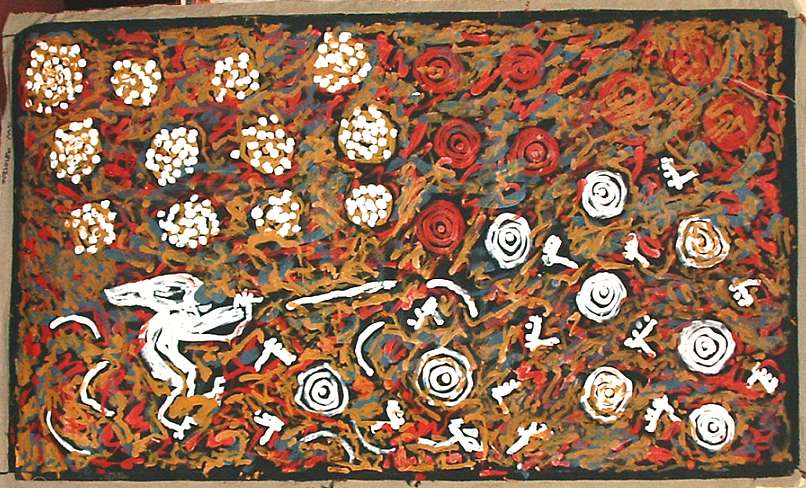 Johnny Warrangkula Tjupurrula, "Journeys of the Tingari Men", Acrylic on canvas
The painting tells the story of an important rain making ceremony to invoke the elements. The circle depicts the waterhole. The U shapes are the corroboree men and the dotting represents body paint used in ceremonies. Kalipinpa water dreaming is a powerful storm creating the lightning, thunderclouds, rain and hail and sending its deluge to rejuvenate the earth, filling rockholes, claypans and creeks. It has the power to create new life and growth upon the land.
Accepting this as art---as we do---means that we live with the notion of a ‘universal world of art’—a ‘transcultural’ world of art’. Fifty years ago this work would not have been allowed across the threshold of an art gallery. So we are living in the aftermath of an aesthetic revolution.
We live in a world in which the scope of the term art, and the very meaning of the term has undergone a
radical change. So we can talk in terms of an aesthetic revolution that is more significant than modernism and abstract art.
March 15, 2008
Bourdieu + aesthetics
In his article “The Historical Genesis of a Pure Aesthetic” Pierre Bourdieu argued that the western aesthetic attitude is not shared by all humanity, or even by all people at all times in Western societies. He picks up on the current popular theoretical position that art is not defined by a type of creation, but a kind of social institution, and he argues that it follows from this that the cultural framing or representation of of the aesthetic attitude is also historically produced.
According to Bourdieu, the western conception of aesthetic appreciation is the disinterested contemplative attitude of the art lover. This is a product of history, because the process of aesthetic appreciation is inseparable from the historical appearance of producers of art motivated by artistic intention, and is inseparable from the production of fine art as autonomous and as having ends and standards that are found or created by the artist. The aesthetic appreciation, or having an aesthetic experience, is culturally specific learnt response or ability.
This creates a hermeneutic circle. The institution of art is maintained by people who accord art a special status, and the aesthetic attitude is dependent on, and a product of this institution, just as the institution is dependent upon, and a product of, the aesthetic attitude. The circle is maintained by belief in the ‘sacred’ status (sacred as in set apart from every day or mundane functions) of the art work. Within this circle the aesthetic experience’ is articulated in terms of the idea of disinterestedness in the sense of it being distinct from moral, political, or instrumental purposes.
Bourdieu’s historical account of the historical relationship between the rise of the concept of a distinct, or autonomous, realm of aesthetics and the history of the development of our art institutions and practices is uncontroversial.The notion of disinterestedness in our account of aesthetic experience disengages aesthetic experience from life’s other concerns, in the same way that Western cultures disengage fine art from everyday live.
This s is a problem if we want to understand indigenous art. However Bourdieu's account does not preclude us holding that aesthetic appreciation is a basic human capacity, and that that the predominant western Enlightenment philosophical understanding of aesthetic appreciation as disinterested is a culturally specific concept. So we need to explore other ways of articulating what aesthetic appreciation involves if we want to say something applicable cross culturally about indigenous painting--eg., Western Desert painting.
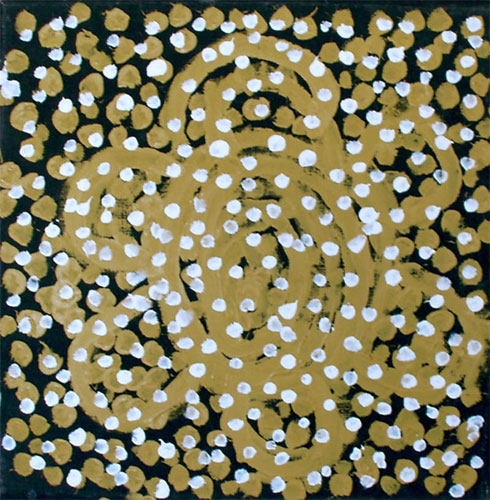 Johnny Warrangkula Tjupurrula Water Dreaming Kalipinpa 1999, Acrylic on linen
One way to do this is to challenge the Kantian notion of aesthetic experience as disinterested, and to do so by placing aesthetic experience firmly within a social structure of a particular society.
March 12, 2008
Mark Davies, Australian Leavism, critique
I want to return to Mark Davies' paper, The clash of paradigms: Australian literary theory after liberalism in the Journal of the Association for the Study of Australian Literature, (Vol 7, 2007) that I mentioned in this earlier post. The cultural formation of the Australian Leaviste attacked attacked critical theory---broadly understood--- so as to defend modernist aesthetics and to displace in the difficult questions critical theory posed about the hidden class and gender cultural allegiances of liberalism as part of its critique of a utilitarian modernity.My interest here is less the cultural formation of the Australian Leavisite paradigm than Davis' argument about its white racism, as part of his argument to map out the parameters of an Australian cultural critique.
In the latter part of this paper Davis argues that the humanist Leavisite cultural formation operates as a broadly representative national moral conscience that indexes events against, and demands fidelity to, the truths of enlightenment humanism.
The high-culture humanist resonances of their book titles—Manne’s The Way We Live Now recycles Trollope’s title of 1875 and imitates its moralism; Gaita’s A Common Humanity echoes F. R. Leavis’s
The Common Pursuit—emphasise this ambition. They are thus deeply engaged in what Marian Sawer has described as the broader project of Australian social liberalism which is to defend the ideal of the interventionist, ethical state against he imposts of free-market ideology and the withdrawal of the state from wealth redistribution (Sawer). Ultimately they have provided a “soft” oppositionality that sets itself up in critique of formations figured as threats to bourgeois liberal mores—radical feminism, racism—but which has rarely seriously questioned the whiteness that arguably predicates Australian public life.
His argument is that members of the above formation have tended to enact a logic of whiteness even as they aspire to righteous antiracism, so as to maintain the authority and coherence of their own speaking
positions.
Davies spells this claim out thus:
Manne’s “In Denial: The Stolen Generations and the Right”, published in Australian Quarterly Essay, is in many ways an exemplary text that mounts a sustained critique of new right attempts to discredit the claims of the Stolen Generation of Aboriginal children. Yet Manne’s essay overlooks the ways in which Aborigines have themselves exercised agency and resistance throughout a long history of welfarist child-theft, apart from mention of an entrenched “fear of the police” that resulted in people “running off into the bush” at the first sight of officialdom.
Is this 'sustained critique' also overlooking indigenous resistance an enacting a logic of whiteness? Possibly, by default. Lets' grant Davis this. What then?
Well, this 'overlooking' is pretty much countered, as Davies himself acknowledges, by Manne becoming a representative of an emerging self-conscious, self-critical strand in Australian liberalism. As Davis says, it is a self-critical strand:
given that his [Manne's] work increasingly offers a critique from within of liberal whiteness, developed in response to a full-frontal confrontation with the race politics of the new conservatism.....My point here though, is that gradualist though the above shifts might be, cultural formations such as coterie liberalism are never static, and that in the case of Australian coterie liberalism something has begun to change, not least its modes of cultural authority. Having borne witness to recent conservative attacks on Aborigines and asylum-seekers, in particular, and under intense pressure from conservatives attacking both its key figures and even its normative understandings of racial tolerance and multiculturalism, liberalism has arguably started to interrogate its own racialised practices.
I'm not sure where this leaves us. A self critical social liberalism breaking with its past? A social liberalism that was on the defensive whilst retaining its critical edge re race politics----indigenous, refugee, immigration ---- during the conservative ascendancy of John Howard. Does not that make it part of an oppositional discourse? Well, that's how I've interpreted it.
Davies explores the way the conservative ascendancy of the last decade has changed the contexts in which literary-critical theory operates and says that this has meant that:
Liberalism, now, is in decline as a social discourse, its institutions in disarray, a situation that has arguably predicated the declining relevance of iterary-critical theory, increasingly mired in its own largely gestural repertoires, given its status as a largely oppositional discourse founded in a culture of critique.
What this means is that the dominant formations at work in the public sphere are no longer those of liberalism, but are those of conservatism. Davis argues that this new situation requires making the new conservatism and its social texts a sustained focus of critical scholarly attentions, and adds:
It seems extraordinary that there has been little sustained critique of the new conservatism from within the new humanities, given that the very “history of the present”, from its literatures to its political mandates, is increasingly underpinned by the social nostalgia, populist authoritarianism, and market
logic of the new conservatism.
He adds that to do so will require building links, not least between the new humanities and liberalism.This puzzles me as I had understood that of cultural and literary studies, for all its embrace of postmodernism, continues to work within liberalism; albeit a postmodern liberalism.
March 10, 2008
from work to play?
Pat Kane in the The power of play in Soundings argues that workers in post-industrial societies are moving away from the work ethic, towards more playful, but also potentially more caring, forms of activity.
The argument is based on Richard Layard's book Happiness, and Clive Hamilton's Affluenza, which both highlight how the prodigious post-war ascent in levels of GDP in the countries of the richer parts of the world has been accompanied by a steady flatlining of reported levels of happiness Beyond a certain level of income, relative to spending power, we don't get that much happier the richer we get. We may well have become more productive (both by using new technology and increasing our working hours). But the extra fruits of our labours - the consumerist model of house, car, holidays, malls, treats and toys (adult as well as childish) - do not seem to bring us greater happiness and meaning. If so, what's the point?
Tow other considerations explain the shift away from work. First, the inequalities of power and status that most of us might accept as the somewhat tedious price of working for a stable organisation are, literally, toxic and death-dealing. Secondly, thThe crisis of the work ethic is easily summed up in one sentence.Why believe in work, when it doesn't really believe in you?
All these elements add up to a general crisis of meaning and purpose, for countries whose leaders and establishments believe that the most stable social identity available comes through work.
March 5, 2008
Universities: ivory tower+business
Phil Cohen highlights a contradiction about modern universities in his A Place To Think? Some Reflections on the Idea of the University in the Age of the Information Economy, at New Formations useful digital archive. He says:
Take for example the recent furore in the UK over the Education Secretary’s attack on some of our Ivory Tower dwellers for failing, as he saw it, to help our economy and society deal with the negative effects of globalisation. In the comments page of the Times Higher Educational Supplement there was not a Vice Chancellor who did not protest and declare allegiance to the idea of the university as a privileged
site for the unfettered pursuit of knowledge and truth. Those same VCs who have been the most enthusiastic in ensuring that every aspect of university life conforms to corporate norms of management accountability, who are the keenest promoters of business links and the commercial applications of research, are the very ones who with shining eyes conjure up images of the mediaeval cloisters where scholars pursue their studies uncontaminated by the ways of the world.
March 4, 2008
renewing an Australian literary culture?
Robert Dixon argues in An agenda for our own literature for a strong version of internationalising Australian literature as a response to globalization and the decline of the cultural national project that underpinned the literary culture since the 1960s and 1970s. The most effective way to internationalise Australian literary studies and to develop strong and resilient connections is to embed it in existing intellectual networks. He says that:
the national literature - understood broadly as its texts, contexts and the modes of criticism we have developed and practised together - needs also to be exported, linked to and embedded in other readerships and intellectual agendas, especially those that define the mainstream of English literary studies as that field is constituted internationally in Europe and North America. We must find ways for Australian research to link with intellectual paradigms and research networks that are already strong internationally .... The question is how to transcend the boundaries of the nation so that Australian issues, texts and personnel can be embedded in international research agendas and networks that have as much to offer us as we have to offer them. This will not happen by linking with Australian studies centres abroad - even in the US - but by formulating and embedding links between Australian literature and mainstream work in English today.
There is nothing new here. As Dixon points out this as already been developed in cognate disciplines such as Australian feminist, cinema and cultural studies. Each of these is mindful of its national context but operates internationally. Hell, its even what I'm doing with my photography by linking it up to the Situationists.
History is important. Dixon says that:
In reality the national literature we have worked so hard to bring into visibility always was embedded in a series of wider contexts or horizons of explanation that we were not always able to recognise, and that now demand our attention. It has always been more cosmopolitan than we allowed, not least in the influence on Australian writers of literatures in languages other than English. Having fought and largely won the battle to mark out what is distinctively national about the national culture, we may rediscover the extent to which it was formed through its relations to other cultures in time and space.
Fair enough. What this indicates the deep hold Herder's conception of an organic culture had on the Australian literary tradition.
March 2, 2008
no time or place to think
New Formations has a digital archive of some of its articles. One that caught my is Phil Cohen's A Place To Think? Some Reflections on the Idea of the University in the Age of the Information Economy. It pressed the right buttons--placed, thinking, idea of university, information economy. Maybe this will break with the conservative idea of the university as a community of scholars.
Cohen starts by striking the right note:
One of the commonest refrains amongst academics is that we can never get any ‘work’ done when we go into work. In other words we are so busy and stressed out by our ever increasing teaching and admin loads that we literally have no time or place to think - let alone to do anything approximating sustained research. That s saved up for ‘the sabbatical’. The sabbatical has become the holy grail of Academic Life - the promised land where all the ideas that have laid dormant will come to fruition, all the scattered fragments of writing will be brought together into a coherent whole, and we will return to the academic treadmill
refreshed and with a renewed sense of intellectual purpose.
It's the right note because it is an honest description----we have a university research culture held together by the desire to get the hell out of the university into some kind of privatised sanctuary where there is, at last, time and space to think. Yet once people get there they often promptly collapse into lethargy or ill health, bodies and minds so addicted to the routine stress of academic life that they simply cannot cope with its sudden absence.