July 31, 2007
Enlightenment: faith and reason
In his Enlightenment and Terror ----The Thomas More Lecture, Amsterdam, 2004--- John Gray makes a crucial point--- today there is a
widespread attempt to recapture the fading certainties of the Enlightenment:
At the start of the twenty-first century the faith that has been lost is not Christianity. It is faith in humanity—the faith that by using the growing knowledge given by science humankind can create a future for itself better than anything in the past. This was the faith—for it is a faith, not a conclusion of rational inquiry—that inspired the thinkers of the Enlightenment, that animated Marxism and liberalism, that somehow survived the great wars and tyrannies of the twentieth century and that is now at last beginning to falter.
In these circumstances it is inevitable that the Enlightenment should engender a fundamentalist movement of its own. Fundamentalism arises only when traditional systems of belief have broken down. Like their Christian and Islamic counterparts, Enlightenment fundamentalists seek to recover a faith that history has destroyed. The faith that has been lost today is a faith in progress.
July 28, 2007
Walter Benjamin's Arcades Project and Contemporary Cultural Debate
The following quote comes from Christopher Rollason's The Passageways of Paris: Walter Benjamin's Arcades Project and Contemporary Cultural Debate in the West:
If we are to seek Benjamin's traces in today's Western society in a more general sense, we may conclude that his true inheritors are in fact not the McLuhanite high priests of the image and detractors of the book, nor those who would drive high culture out of universities in the name of mass culture. Nor are they the deconstructionists and postmodernist theorists who, to quote the dissident US academic Morris Berman from his polemical book of 2000 The Twilight of American Culture, promote "a philosophy of despair masquerading as radical intellectual chic", while generations of students are taught that canonic literature "has no intrinsic meaning and is nothing more than the cultural expression of a wealthy class of dead, white, 'colonialist' males" - at a time when, in today's officially literate US society, "we cannot expect to make a mythological allusion any more, or use a foreign phrase, or refer to a famous historical event or literary character, and still be understood by more than a tiny handful of people". [61] Benjamin should in no way be held responsible for any such cultural wasteland of semi-literacy and half-baked dogma. His authentic heirs are, rather, those cultural critics who have developed and systematised his dynamic concept of modernity, or else pursued his strategy of taking up stray objects from popular culture and coaxing out their wider cultural significance.
I'm interested in this approach given thiskind of work (more here.
Rollason mentions US academic, Marshall Berman the author of All That Is Solid Melts Into Air, Eric Lott, lecturer at the University of Virginia and author of the study Love and Theft: Blackface Minstrelsy and the American Working Class (1995), and the writings of American essayists Greil Marcus.
July 26, 2007
July 25, 2007
mimesis
Art does not reflect the "mood" of the artist, is not a "replica" or "a fuzzy photograph" of the "psychic content," it is a contribution to expression, an ability that is transmitted through mimesis. Furthermore, the artistic contribution also brings to expression the immanent category of the truth content which is the object of understanding. Mimesis, therefore, is not about replicating the content; rather it is a form of expression. The mimetic moment in art is not found in the artistic intention, it outlines the features of expression, in other words, it expresses expression itself and nothing else.
July 24, 2007
reading the country
The background is here on junk for code
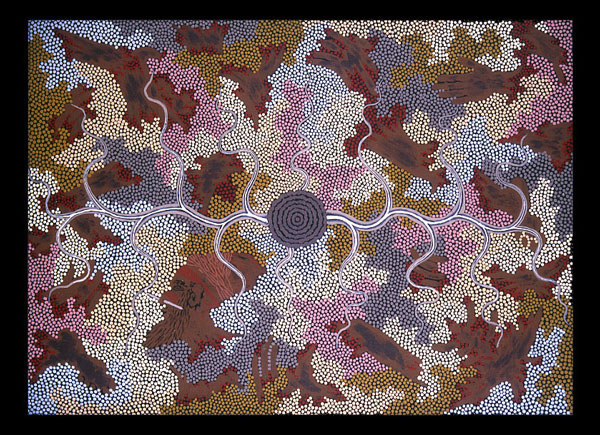
Clifford Possum Tjapaltjarri, The Law, 1992, acrylic on canvas
Stephen Muecke writes in relation to an experimental history:
In the case of Aboriginal history in Australia, the "discovery" of spaces beyond the frontier and before 1788 forced a radical reconceptualisation of national histories. The gap between the sense of what "we always knew" and initial non-sense of Aboriginal history is most often elided in accounts which proceed step by step, from one certainty to the next. To the extent that histories are considered "creative" they allow for the temporal or spatial gap between the established and the new, the mundane and the wondrous. They concede that the process of "making sense" depends on it, and that there is a surplus or a dimension of excess in every object. History will then operate with uncertainty as much as certainty, holding that every act of memory is also an act of forgetting. For what is forgotten is not the unfortunate down-side of memory, the lack; it is as systematic as the processes of memory.
Aboriginal "histories" are encoded in places, writing and reading them involves travelling through the country as if the country itself were the text of history.
July 22, 2007
being a nomad
What does nomad mean in Australia? Other than a tourist? Or a traveller?
The word nomad conjures up: flat deserts and sand, springs of water and a sense of desolation. This gives us a feel of the country, the flatness of Australia, the strangeness of the names attached to the pools and waterholes, the Australianness of Australia or at least that part around Broome, anglicised for us tourists as Roebuck Plains: which lets us know, that reassures us, as do the illustrations, that European man has trodden this land, has marked this land, has rendered it into the pastel shades of civilisation of the European variety.
July 21, 2007
Enlightement and its shadows
I want to return to this review by Ken Gelder of Stephen Muecke's Ancient and Modern: Time, Culture, and Indigenous Philosophy in the Australian Humanities Review in the context of this work:
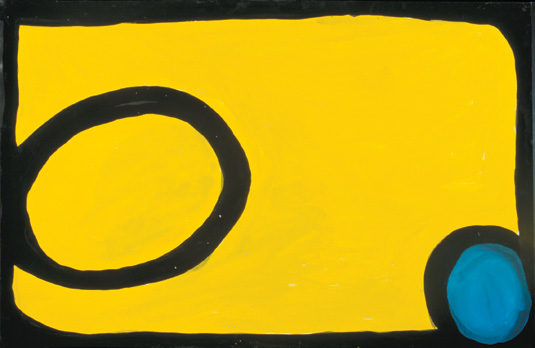
Paddy Bedford, Untitled , 2003, gouache on board
On Gelder's interpretation Muecke suggests that Aboriginal people inhabit an 'alternative modernity' to non-Aboriginal Australians. This alternative modernity is linked to the 'ancient' which Muecke mobilises as a powerful force in Aboriginal philosophical expression and which underwrites his sense of Aboriginal vitalism. It is tied to ritual and magic, that is, it is cultural. The modern West, for Muecke, values rationality and objectivity, while Aboriginal people 'are connected singularly to feeling, intuition' . Muecke interprets the indigenous side of this duality in terms of flux and change and Deleuzean 'rhizomes' and 'becoming'.
My response is that Muecke is opening the door onto the possibility of an indigenous philosophy in an experimental Deleuzean sense based on being in the world, rather than working in terms of a rigid duality as Gelder states. Stephen Muecke argues for non-Indigenous Australia to recognise Aboriginal philosophy, making the point that for too long Indigenous Australians have been lumbered with their antiquity while white Australia has identified itself with modernity and notions of 'progress'.
Muecke says he iss concerned with the Aboriginal legacy for Australians as that legacy will increasingly define our culture in the future.
And that indeed redefines the relations between whitefellas and blackfellas, in cultural terms. Blackfellas should not be seen, I argue, as representatives of an ancient heritage, either intact or museumified, while whitefellas remain in control of modernity. All forms of culture are made from ancient and modern bits, and their vitality consists in creative hybridizations. So in the book I describe modern Aboriginal culture from the early twentieth century as well as ancient, yet contemporary, European rituals in Australia .
This is placed in the context of the dominant analytic philosophical tradition in Australia. This sets up enigmas confident that sooner or later a proof or solution will be found, and these proofs accumulate, rather like in mathematics.
July 17, 2007
Reading the country
Reading the Country: Introduction to Nomadology by Krim Benterrak, Stephen Muecke and Paddy Roe, (Fremantle: Fremantle Arts Centre Press, 1984) 2 is a combination of landscape paintings by Moroccan born West Australian artist Krim Benterrak, stories by 73 year old Aboriginal Paddy Roe and the above-mentioned fragments by Muecke, an Australian academic. It is a combination around the theme of 'reading' (looking at, understanding, feeling) a particular piece of Australian country, the Roebuck Plains near Broome in Western Australia.
Garry Wickham says that this text is built around recorded stories told by a senior Aboriginal man from northern Western Australia, Paddy Roe. This is where Muecke installed his Deleuzean view of Aboriginal ways of being in the world: as nomads set against the State, and as storytellers who live out a 'rhizomatic' connection to country and community.
Muecke's intervention into this aspect of normal academic style is to restrict himself to the consideration of concepts. His fragments (and 'fragments' is a good term to signal his intervention) cover a large range of topics in not many pages: the nomadic nature of writing and the possibility of 'strategic nomadology'; the problematic nature of history writing, especially its celebration of origins and its celebration of individuals; the uses and abuses of the concept of literacy; the importance of silences in some Aboriginal discourse; the production of meanings for colours; the problematic nature of economics and counting; the reception of works of art; improvising versus engineering as cultural practices; the nature and function of texts. Along the way he considers many concepts, especially concepts circulating in a lot of recent French theoretical work, like bricolage (circulating around the names Levi-Strauss and Derrida), rhizome and nomadology (both circulating around the names Deleuze and Guattari).
Nomadism is not the glimpses of a romantic tourist extending his knowledge on educational tours with sudden sadnesses for home-sweet-home.
July 15, 2007
Aboriginal Australia : a primitive counter-point to European modernity?
In the light of this event and debate provide a political context for this review by Ken Gelder of Stephen Muecke's Ancient and Modern: Time, Culture, and Indigenous Philosophy in the Australian Humanities Review. Gelder says that in:
Stephen Muecke's latest book, Ancient and Modern, we get quite the opposite procedure: an ambitious non-Aboriginal or 'whitefella' attempt to describe 'being Aboriginal' and to account for what Muecke calls Aboriginal philosophy. Muecke remains Deleuzean in this latest work, even speaking about the latter's 'reterritorialisation' in Australia. Whereas Reading the Country had placed Paddy Roe's stories and Muecke's Deleuzean commentaries side by side, this new book is, I think, an attempt to become Deleuzean and Aboriginal simultaneously, to somehow fold these two realms together almost to the point of indistinguishability. Indeed, this is Muecke's primary method here: to entangle continental theory with Aboriginal practice. A chapter about another senior Aboriginal man is called 'Boxer, Deconstructionist', in which we are told that Boxer's stories have 'the power that is often attributed to European theories'.2 Aboriginal people might very well be surprised to find themselves recast in this way, but Muecke is as enthralled by their stories as he is by the continental theory he brings to bear upon them. It can often seem as if by one he really means the other, and vice versa: this is the strategy he brings to the topic of 'being Aboriginal', and it is probably fair to say that sometimes it pays off and sometimes it doesn't.
Aboriginal Australia has long been seen as a 'primitive counter-point to European modernity', which brought 'history' to this continent, and designated the Indigenous past the greatly unvariegated 'pre-historic'.
Or more accurately, authentic Aboriginal culture is seen as 'traditional' (non-modern) and located up north, and in the centre. Down south in the cities urban aborigines are deemed 'modern'.
July 14, 2007
Adelaide Festival of Ideas: agitators
The last session I attended at the Adelaide Festival of Ideas was about agitators. It was political rather than philosophical, which is a pity given that the Festival worked in terms of a modernist discourse in opposition to a postmodern one. The borders had to be sealed as across the border lay irrationality.
Now postmodernism constitutes a general attempt to transgress the borders sealed by modernism, to proclaim the arbitrariness of all boundaries, and to call attention to the sphere of culture as a shifting social and historical construction. We now live in societies where the cultural sphere is becoming more and more important, overwhelmed with meanings for the unanswerable questions of identity and cultural difference. This development after the "cultural turn" call for a dynamic, interactive, plural and always changeable understanding of culture. So we have crossover, patchwork and organic hybridization that are unavoidable for any cultural development.
This way of thinking is a very unique experience for Western modernity, which is obsessively based on the recognition of the “either-or” principle and its violent outcomes. For the first time in Western cultural history, the idea of intermingling seems not to be connected with fear, devaluation, inferiority, sin or cultural crisis.
The concept of hybridity offers us a different approach to culture and society, because it disrupts the longing for homogeneity in colonial modernity and rethinks difference differently. Hybridity refers to a different cultural cartography of the world that is much more based on impurity and in-between categories. This is why hybridity serves as multi-layered scheme in a postmodern approach. As an alternative to traditional ideas of singularity and totality, hybridity highlights the irreducible positions of difference and diversity. Instead of binary patterns it prefers the liminal concepts of third spaces and border transgression. It thus celebrates the dynamic of mixture and intermingling.
July 10, 2007
Adelaide Festival of Ideas: Border Crossings
Tracey Bunda's talk in the 2007 Adelaide Festival of Ideas was about ways to understand Indigenous culture/people/issues, and it explored the idea of border crossings to map indigenous futures. Bunda's argument for different aboriginal voices to be heard on aboriginal issues tacitly worked towards establishing the “conditions of possibility” for hybridity, as a way of maintaining the possibility of resistance to essentializing white colonial discourses.
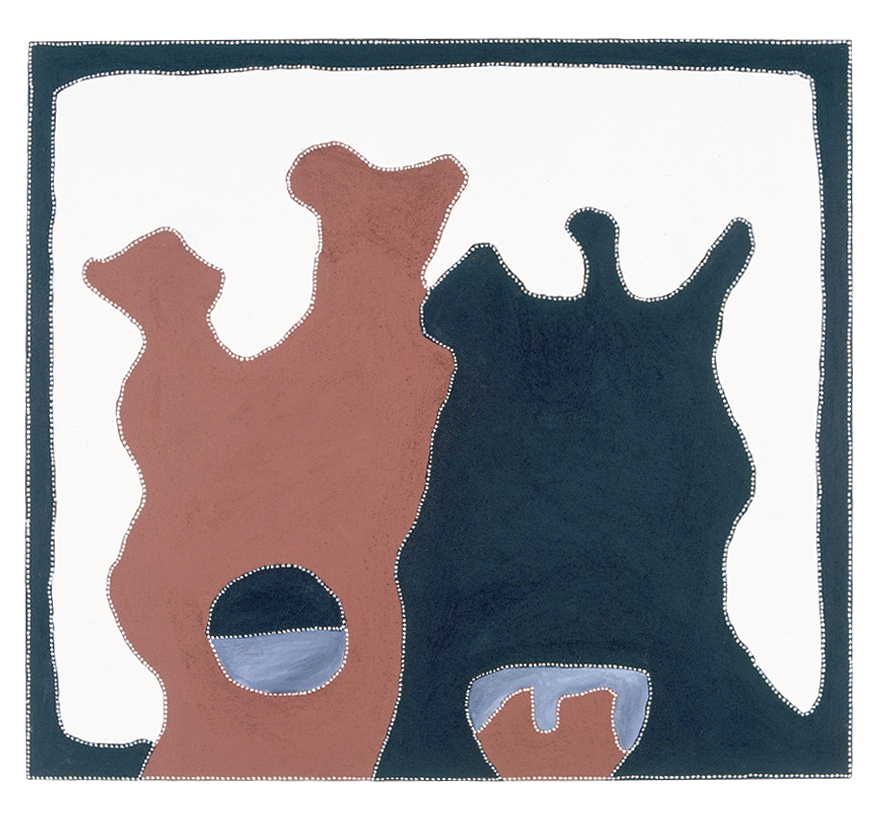
Rusty Peters, Great Grandfather's Fathers Burial Place, 2000, Natural Ochre on Linen,
The argument was that spaces needed to be created for the different aboriginal voices to express their views on public issues. Postmodern theory typically affirms individual instances of border-crossing. The figure of the hybrid emerges in postcolonial discourses as the embodiment of this postmodern critique of borders. Hybrid identities such as—a hybrid of white, and Aboriginal—create the possibility of resisting oppression because such multiplicity disavows the reductive and essentializing binaries that colonizers employ to maintain power.
Hence postcolonial theory works with, and around, the subversive potential of the hybrid in national or cultural identities. One of the features of hybridity is its supposed characteristic to cross cultural and national boundaries and its ability to translate oppositional cultural spheres into innovative expressions of the so-called postmodern era of late capitalism. However, securing a space at the table isa t best a temporary event, as that ‘openness’ is only available within a space that has previously been secured. Borders between white and black have been collapsing and then vigorously rebuilt.
July 7, 2007
Adelaide Festival of Ideas: traumascapes
One of the most interesting session at the Adelaide Festival of Ideas was on trauma---What societies can do when trauma becomes the norm-- given by Maria Tumarkin It raises the whole question of reconcilation as a response to trauma ---reconciliation as a form of healing for the traumatic wounds that indigenous people have suffered from white colonialism.
Tumarkin argued that social trauma---Port Arthur --- is best dealt with by community not by psychiatrists and psychologists, as these medicalize trauma. Tumarkin thinks in terms of traumascape, which she defines as a timeplace materially and discursively bound by traumatic repetitions. Hence Port Arthur--but also the aboriginal experience of British colonialism, as was continually mentioned throughout the Festival.
She says traumascape needs unpacking, which she does as follows:
To unpack, if only partially, the notion of a ‘traumascape’, it is necessary to examine first its two main ingredients — trauma and place. ‘“Place” is one of the trickiest words in the English language’, writes Dolores Hayden, ‘a suitcase so overfilled one can never shut the lid’....Similarly, as Cathy Caruth argues, ‘the phenomenon of trauma has seemed to become all-inclusive’,... ‘a category … so powerful that it has seemed to engulf everything around it ...’...In a sense, both trauma and place are, to use Robert Coles’ idiom, ‘the purest of cliches’.... Coles uses the term to refer to tropes of memory and identity and their stranglehold over the twentieth century’s western thought, but his ruling stands in our case as well.
She adds:
What do places do to us? Scholarship on place attachment and place identity presents places that we inhabit as bedrocks of our identities as well as storehouses for individual and collective memories.28 Indeed, the notion of ‘place’ is defined against the notions of space and landscape by the virtue of ‘place’ always being invested with meaning and impregnated with memory. The self is fashioned, reconfigured and maintained through ‘place’, whether it be an actual place of identification and attachment or symbolic locales where identities and memories are stored and performed.
So how do we think about trauma? Tumarkin says that until the end of the nineteenth century, the term ‘trauma’ was used to refer exclusively to physical injuries and wounds. Only in 1860s and 1870s when the after-effects of railway accidents and disturbing symptoms in soldiers on active duty demanded urgent specialist engagement, was the term trauma expanded to include mental or neurological injury.
In talking about psychic trauma now, it is vital to make a distinction between an event and an experience. In other words, a flood is an event which is experienced as traumatic by victims’ families, witnesses, local residents, visitors in the area and so on. Psychic trauma is located in the immediate experiencing and the subsequent grieving, remembering and re-telling of a particular event (flood), series of events or a process. As immediate experience is confined to individuals, to talk about shared psychic trauma is neither to talk about a specific event, not about its immediate experience, but to talk about coming to terms with such an event through processes of grieving (or ignoring), remembering (or forgetting) and re-articulating (or denying).
to be continued.
July 5, 2007
inadequate imagery
Canberra is a dual city in that the everyday life is overlaid with the commonwealth machinery of power. It is a power machine and are cogs within its extensive relations of power that dive on. One feels insignificant as a person.
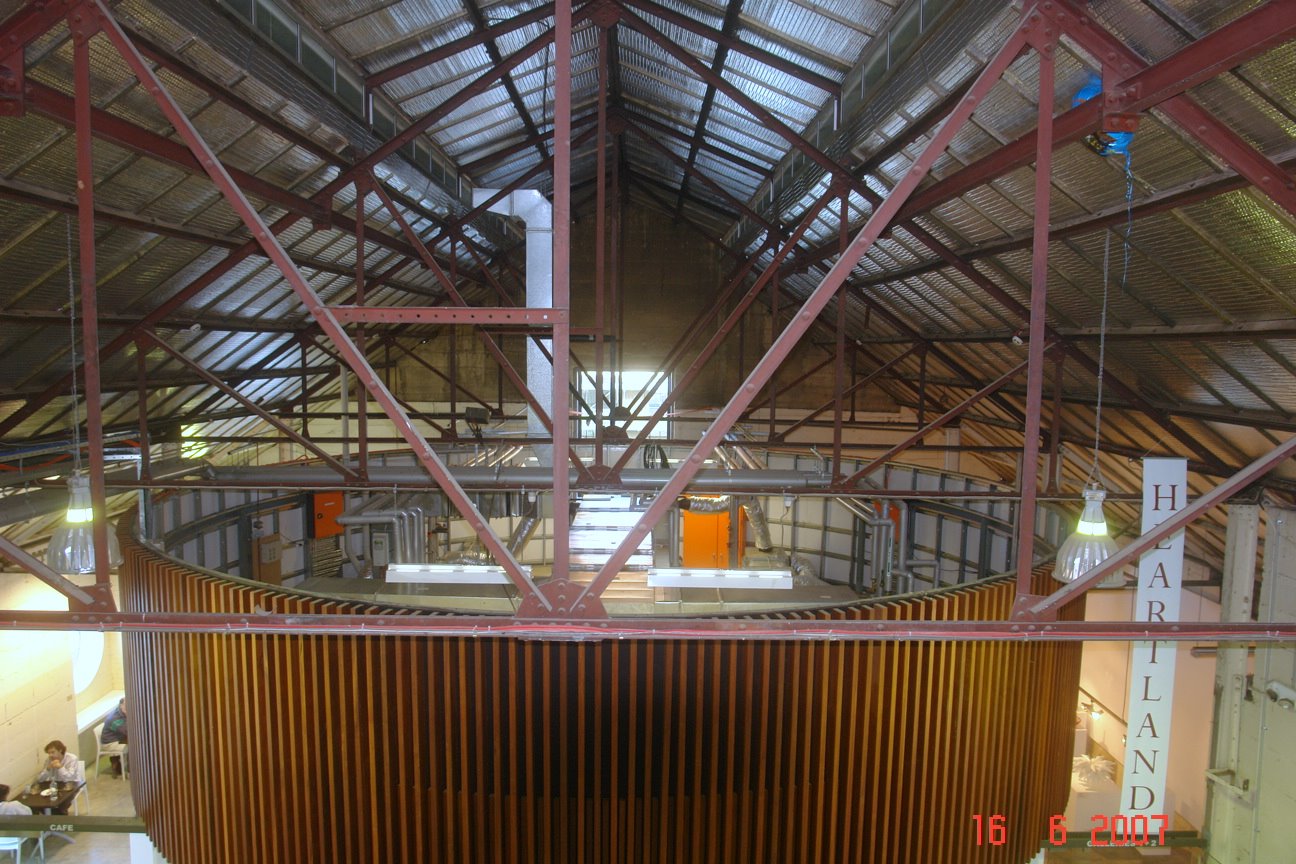
My attempt to express the feeling of being a placeholder in the political machinery that defends and protects capitalism understood as an economic system. So how we understand this placeholder-- a media person in a minister's office? One feels powerful.
brushing history against the grain
A quote from Rough Theory:
Theorists seem to be very reluctant to take seriously the question of what it might mean for a social system to produce the conditions for its critique and transformation. Very common “unmasking” moves - where, for example, particular values are debunked by demonstrating the role they play in the reproduction of capitalism - end critique too soon, from the standpoint of the kind of approach I’m trying to outline: the issue becomes one of taking seriously, with Benjamin, that transformative political action involves brushing history against the grain - recognising that something (an ideal, a form of practice, a means of producing material wealth) may in fact have arisen historically precisely as a moment in the reproduction of a form of domination - but also recognising that such things can also represent alienated historical achievements: things that can be torn out of the context in which they originated, and consciously seized and turned to other, more emancipatory purposes.
I love that phrase--brushing history against the grain.Can photographs do that?
July 2, 2007
on the road
Photographic aesthetics has been dominated by modernist aesthetics. That displaced the pictorial aesthetic and its post-exposure handwork in favour ofworking with 8 × 10-in. view cameras in order to obtain the largest possible negatives from which to make straightforward contact prints. These modernists limited their subject matter to static things: the still life, the distant or closely viewed landscape, the formal portrait and with Minor White incorporated a poetic, visionary work related in technique to this straight approach.
This ignores the street tradition of snaps:

Gary Sauer-Thompson, on the road, 2007
We are nomadic these days and work in a digital format that places an emphasis is on the post exposure handiwork
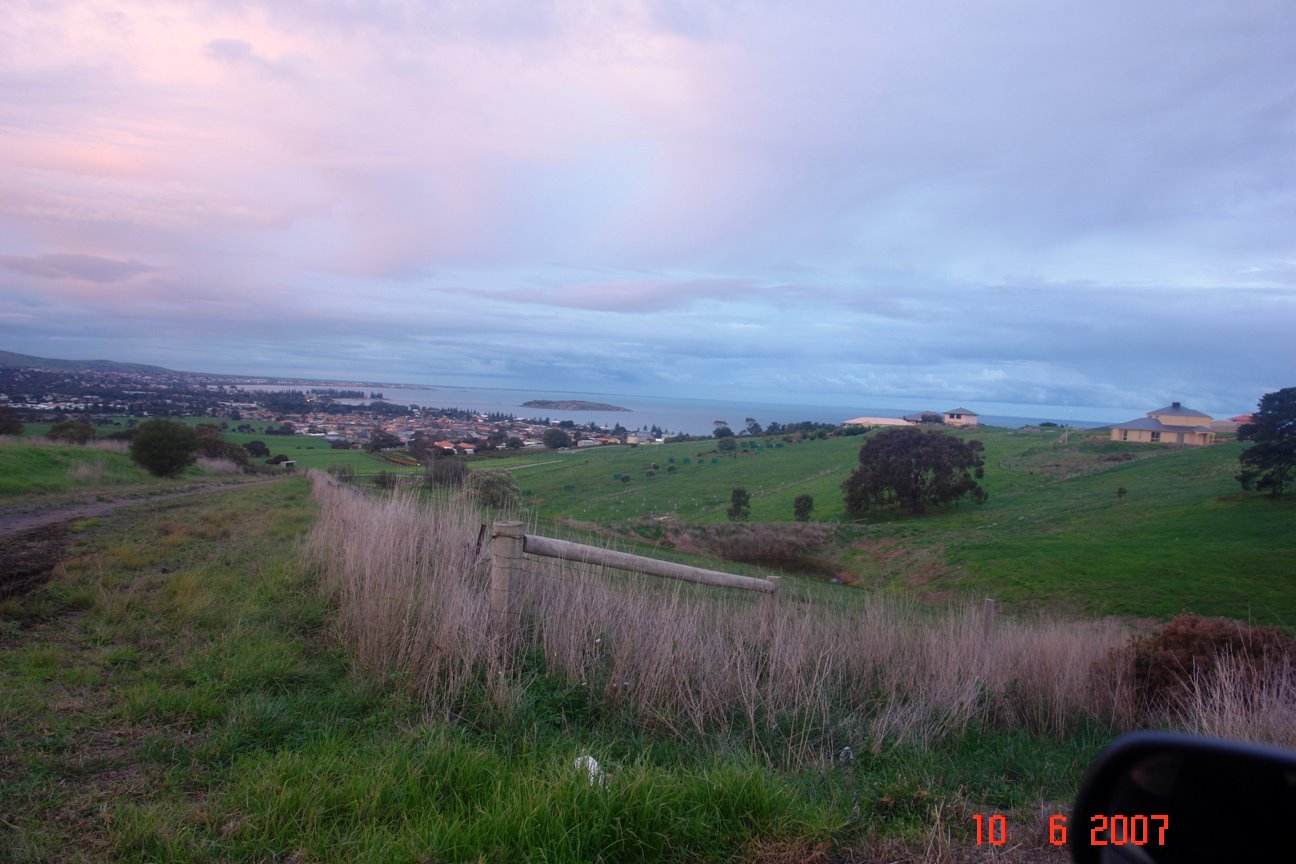
Gary Sauer-Thompson, Victor Harbor, 2007
Much of the history of photography has been concerned with affirming the status of photography in fine arts and this has been accomplished by exploring its aesthetics as well as by good photos. Do we care anymore? The internet has enabled us to step outside the walled boundaries of the art institution to the everyday world we inhabit.