June 28, 2007
the sublime in postmodernity
Traditionally the "sublime" as a term in aesthetics refers to the experience of pleasurable anxiety that we experience when confronting wild and threatening sights like, for example, a massive craggy mountain, black against the sky, looming terrifyingly in our vision.That's Kant's understanding in the Critique of Judgement.
The category of the sublime has been revived under postmodernism after a century or more of neglect. What does it mean in postmodernity? I reckon one way to understand it is the admission, fromKant, as one of the philosophical architects of the Enlightenment, that the mind cannot always organise the world rationally. Some objects are simply incapable of being brought neatly under concepts.That is the starting point.
June 24, 2007
Ancient and Modern #2
This post links back to this earlier one. The painting works with the ancient and the modern and breaks down the boundaries between the two: traditional knowledge and modern form:
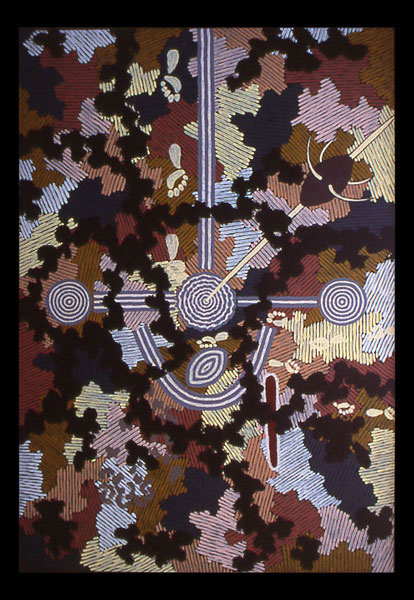
Clifford Possum Tjapaltjarri, Love Story, 1992, Acrylic on canvas
Colonial tropes of the ‘native’ were often expressed in terms of the divide between orality and literacy, so that ‘for imperialism, the idea of literacy and education, even where these were imposed on already literate societies, represented a defining separation between the civilised and the barbarous nature’.Writing is represented as succeeding orality in time and superseding it as the primary currency of social and cultural organisation, particularly in the context of expanding imperial formations and the nation-state.
Those aspects of oral indigenous culture that remain or persist in societies where literacy has assumed dominance are seen as ‘residual’ remnants of a prior, pre-modern order of knowledge and communication. Similarly, the indigenous peoples or communities who use primarily oral modes of communication to make social identities meaningful are constructed as culturally marginal in relation to modernity’s well-documented self-identification with literacy and textuality. Within this framework, the oral is invariably figured as doomed to extinction by writing.
The repressive rhetoric that locates Indigenous peoples and cultures in various formations of ‘pastness’ has traditionally been shored up in educational and literary contexts by the strength of the split posited between orality and literacy. This split is most pronounced when it is encountered as part of the logic of modernity’s distinction between ‘the imperial centre and the illiterate, barbarous, childlike races of empire’
June 22, 2007
in Canberra
'Tis the picturesque I fear, rather than the expression of emotion.
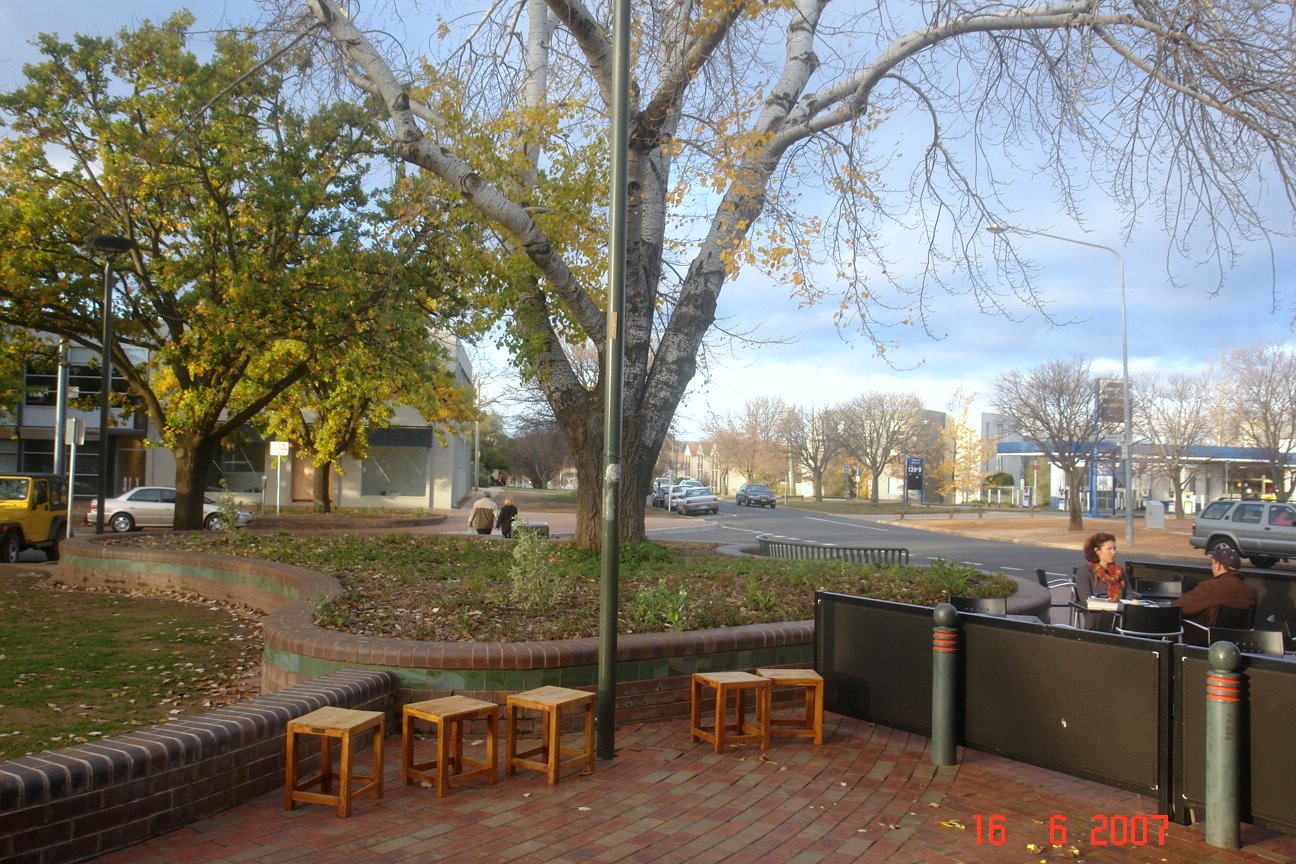
Gary Sauer-Thompson, Kingston, Canberra, 2007
I often find myself in a In a deep, black malaise when I'm in Canberra. Its cold and I'm lonely here and I find it hard to read a book, much less write a philosophical post.
It's odd how personal experience is at odds with the sparkle of a winters day.
June 21, 2007
Ancient and modern
Ancient and Modern. A stark duality. And a deeply seated one.
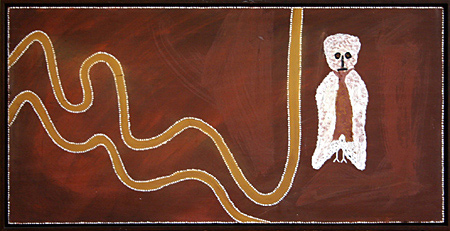
Rover Thomas, Grugrugi Owl, 1984 natural earth pigments with bush gum binder on board
The former--Ancient--often has a focus on senior Aboriginal men (Paddy Roe, Boxer, Albert Namatjira, Rover thomas ) and often works with a notion of an Aboriginal 'alternative modernity' is essentially a nostalgic one. It pitches an Aboriginal Geimenschaft against the alienating Gessellschaft of modern Australia.
Many distinguish Aborigines from what we call modernity's 'commodity production and novelty'. We tacitly understand indigenous people in terms of Ferdinand Tonnies' end-of-the-nineteenth century notion of the Volk's community, with its connotations of unmediated exchange, authenticity, organically inherited traditions and rituals, 'the network of kin relationships' and obligatory rural settings.
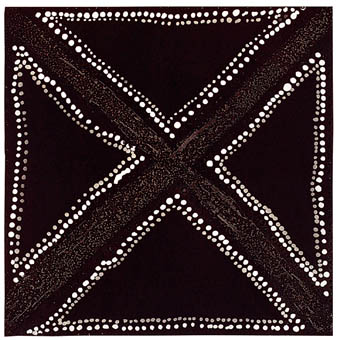
Rover Thonas , Image: Crossroads 1997, Etching , from the Cross Roads portfolio
The idea of a crossroad is a favorite subject for Thomas.Many traditional aboriginal songs and stories deal with journeys and meetings by all kinds of beings in many different circumstances.The artist's fascination with modern day travel and meeting points is reflected in his work.
June 20, 2007
the uncanny
Das Unheimliche" is an essay written by Freud in 1919 in which the phenomenon of the uncanny is approached from various angles: language and semantics versus experience; literature and myth versus everyday life and psychoanalytic practice; the individual feeling versus the universal phenomenon. Freud's essay is a direct response to the psychiatrist Ernst Jentsch's study "Über die Psychologie des Unheimlichen" (translated as "On the Psychology of the Uncanny"). For Freud, as for Jentsch, the uncanny is a specific - mild - form of anxiety, related to certain phenomena in real life and to certain motives in art, especially in fantastic literature.
From the outset of his investigation, Freud qualifies the uncanny as an aesthetic experience. Aesthetic is here used in the broad sense of "the study of the qualities of our sentiments" as opposed to the narrow sense, "the study of the beautiful", which, according to Freud, limits its scope to positive feelings. The fact that the uncanny is related to aesthetics also accounts for the subjectivity of the experience: Freud insists that not everyone is equally susceptible to the feeling of the uncanny, and the list of phenomena is neither conclusive, nor generally accepted.
Deleuze, politics, life
In his book Deleuze, Marx, and Politics, Nicholas Thoburn says:
At one level, an initial presentation of Deleuze's politics is a relatively simple task. Deleuze and Guattari are self-proclaimed 'political' thinkers. Indeed, politics is central enough to their understanding of the formation of life that they can write that 'politics precedes being' (ATP: 203). Deleuze's politics, like indeed all his and Guattari's concepts and categories, is closely related to his Spinozist and Nietzschean materialism, with its conception of the world as an ever-changing and intricately related monstrous collection of forces and arrangements that is always constituting modes of existence at the same time as it destroys them. Such a materialism conceives the world as not only without finitude, but also without delineated subjects or objects; let us call them 'things'.11 Of course, this is not a refutation of the existence of things, but it is a refusal to present them in any ontological or epistemological primacy. There are things, but only as they are constituted in particular, varied, and mutable relations of force.
Thoburn adds that if the world is at base a primary flux of matter without form or constant, then things are always a temporary product of a channelling of this flux in what Deleuze and Guattari call 'assemblages' or 'arrangements' . Nietzsche calls this channelling a process of 'interpretation': the process whereby matter is cut and assembled by a particular series of forces .
June 18, 2007
corporate medicine
Corporatization (or privatization) of medicine carries with the risk of depersonalization. Due to the pressures of business (productivity, regulatory paperwork, bureaucracy, regulations), nurses begin to feel like cogs in a machine rather than care-providers. And because of the shift in focus from patients to productivity, patients end up being treated less as people and more as objects. When care is no longer the main focus of an institution, but is relegated to one of many concerns, tasks compete for nurses' time. Inevitably, the harsh realities of business force nurses to spend more time attending to the bottom line than to the needs of their patients.
Corporatization is here to stay. So we ought to do everything in our power to not let healthcare-providers become buried under jobs that take them away from their most important role.
June 16, 2007
about a visual culture
From an interview with W.J.T. Mitchell about how to understand what is meant by visual culture, which I tacitly understand as the world of images we live within. Mitchell says:
The concept of visual culture as a discipline or field is quite comparable to linguistics. Linguistics is the general science of language, of all languages; more narrowly, linguistics is the science that deals with the structures of language that underlie any particular speech act or textual formation. The aims of visual culture as a discipline are somewhat analogous. It has the same relation to works of visual art, as linguistics has to literature; visual art is to literature, painting to poetry (a very traditional comparison) as visual culture is to language in general. What visual culture – the visual process of seeing the world as well as making visual representation – “lacks,” then, is a structural, scientific, systematic methodology. There is no Chomsky or Saussure for visual culture (unless you think of Panofsky and the Warburg school as aiming in this direction, toward a “bildwissenschaft,” a science of images). And this lack of a scientific theory of visual culture may be the result of a fundamental difference between visual perception, imaging and picturing on the one hand, and linguistic expression on the other.Language is based on a system (syntax, grammar, phonology) that can be scientifically described; pictures and visual experience may not have a grammar in this sense.
Mitchell says there is some kind of excess, density, and plenitude in visual culture that escapes formalization.
Mitchell goes to say that just as the study of literature forms a subset of the study of language, so visual art is just
one area of visual culture. He adds:
Art history – at least in its traditional formations (and this is changing today) – is not enough by itself for the study of visual culture because is grounded in a distinction between (for instance) mass media, mass culture, kitsch, commercial art and “fine art” proper. Art history is not concerned with ordinary everyday practices of seeing, what I call “vernacular visuality,” all the social constructions of the visual field that lie outside image-making, and artistic
image-making. Before people make images, much less works of art, they look at each other and look at the world.
June 14, 2007
W. T. J. Mitchell on pictures
In this interview with W. T. J. Mitchell it is asked isn`t it more or less our own desires that we project onto the images? Mitchell does not want to project personhood onto pictures. He says:
First ask yourself what the word to want means. I attribute two meanings to it: One is desire, the other one is lack. In English another way to translate the title of my book would be: What do pictures lack? What is missing from the pictures? I mean that kind of Lacanian model of desire which is both, a desire for an object or an object choice, but also an object lack or loss. So you need to think the question in this double way. What does the picture require in order for you to understand it, to fulfill it, in order get it what it needs or in order to do the work it was designed to do? There are some very obvious examples of this, especially in religious art or in political art where they wear their heart on their sleeves, they declare their desires. The picture wants your body. It does not just want your consent or your attention. It wants you physically. Some pictures demand sacrifice.
This attributes power to pictures.
June 12, 2007
about pictures--W. J.T. Mitchell
We need to reckon with images. They change the way we think and dream. They refunction our memories and imaginations, bringing new criteria and new desires into the world. In this interview with W.J.T. Mitchell in Image and Narrative it is stated that In What Do Pictures Want? Mitchell describes a critical practice in which one strikes images “with just enough force to make them resonate, but not as much as to smash them” Mitchell spells out what he means:
I derive this strategy from Nietzsche's preface to Twilight of the Idols, where the greatest philosophical iconoclast of them all proposes a method of dealing with idols that sounds at first like traditional image destruction. Nietzsche tells us that he will “philosophize with a hammer,” striking not at temporary idols, but at the “eternal idols” that have mystified the entire philosophical tradition. What is sometimes forgotten is that he goes on to elaborate the metaphor of the hammer, depicting it not as an instrument for destruction, but for “sounding the idols.” In case we miss the point, he even goes on to elaborate it further by trading in the figure of the hammer for that of the “tuning fork” as the instrument for striking the idols. In case we miss the point, he even goes on to elaborate it further by trading in the figure of the hammer for that of the “tuning fork” as the instrument for striking the idols.
Mitchell says that this approach to doing philosophy has two implications:
the first is that Nietzsche does not aim to destroy the eternal idols (how could he, since they are eternal?) but only to “sound” them—that is, to make them speak, to divulge their secrets. He aims, in other words, to break only the silence that is so characteristic of idols. The other implication is that the sounding is dialogic or dialectical: by exchanging the hammer for a tuning fork, Nietzsche suggests that it is not only the idols that are sounded, but the critical discourse that is brought to them.
June 11, 2007
forgetting
Marc Augé argues in Oblivion (trans. Marjolijn de Jager, Minneapolis, 2004) that the personal narratives that weave together our memories -- and help us to form an idea of who we are -- do not depend solely upon the constructive work of memory. They depend just as much on the destructive work of forgetting. Memory in some sense depends upon oblivion.Memories are crafted by oblivion as the outlines of the shore are caused by the sea.' Oblivion plays a neglected or repressed part in narrative construction.
In this reviewTony Milligan says that Augé manages to trace three figures of oblivion which are bound up with our personal narratives:
The first is the figure of the return, the forgetting of the future and present in a nostalgic attempt to find a lost past... The second figure is suspense, the excitement of the moment that is a forgetting of both past and future...The third figure is rebeginning, not in the sense of repetition but of 'radical inauguration'. The new future cuts itself off from what has gone before
This recalls us instead to the operations of a forgetfulness that is going on all the time
June 10, 2007
non-places + places
In Non Places – Introduction to an anthropology of supermodernity Marc Augé investigates what mode of life we encounter in the anonymous “non-places” of modern urban space: hotel rooms, supermarkets, ATM machines, and various spaces of transition and passage --like the conveyor belts that drag passengers slowly from one section of the airport to another.
Augé’s argument is that although we don’t ‘rest’ or ‘reside’ in these spaces but merely pass through these spaces as if interchangeable, we nevertheless enjoy a contractual relation with the world and others symbolized by our train or plane ticket, bank card, email address, and hence anonymity and identity are oddly drawn close.
This is different mode of life to that of a place, which is relational, historical and concerned with identity:

Gary Sauer-Thompson, Cape Willoughby, Kangaroo Island, 2007
Here we don't find ourselves semiotically overloaded and unable to make sense of the past and experience the relation of the past to the future. We do not wander aimlessly and seemingly without motivation between anonymous “transit points” and “temporary abodes”.
June 8, 2007
personal narratives
In the age of postmodernity is there is a distinct threat posed to the integrity of personal narratives, due to the fact that our lives are mediated increasingly by all manner of images, tropes and fictions that are collectively, and largely
anonymously, authored by the culture industry. Insofar as such manufactured cultural forms take up the function of narrating our biographies — eg., how pop music become effectively the ‘soundtrack of our lives’ — there is, at least potentially, a loss of personal agency.
June 2, 2007
art +criticism
French author and literary critic Maurice Blanchot in his 1963 essay, "What is the Purpose of Criticism?" says:
"Criticism is no longer an external judgement placing the literary work in a position of value and bestowing its opinion, after the fact, on this value. It has come to be inseparable from the internal working of the text, belonging to the movement when it becomes what it is. Criticism is the search for and experience of this possibility".
So we no longer have the privileging painting over criticism or vice versa. Criticism becomes an essential moment in the work of art.