March 30, 2007
Deleuze: coding flows
In this lecture on Webdeleuze Deleuze says:
... this is the fundamental action of a society: to code the flows and to treat as an enemy anyone who presents himself, in relation to society, as an uncodable flow, because, once again, it challenges [met en question] the entire earth, the whole body of this society. I will say this of every society, except perhaps of our own--that is, capitalism, even though just now I spoke of capitalism as if it coded all the flows in the same way as all other societies and did not have any other problems, but perhaps I was going too fast.
Deleuze then spells out the difference that capitalism represents in relation to other social formations.
He says:
There is a fundamental paradox in capitalism as a social formation: if it is true that the terror of all the other social formations was decoded flows, capitalism, for its part, historically constituted itself on an unbelievable thing: namely, that which was the terror of other societies: the existence and the reality of decoded flows and these capitalism made its proper concern. If this were true, it would explain that capitalism is, in a very precise sense, the universal form of all societies: in a negative sense, capitalism would be that which all societies dreaded above all, and we cannot help but have the impression that, historically speaking, capitalism...in a certain sense, is what every social formation constantly tried to exorcise, what it constantly tried to avoid, why?
He answers thus:
Because it was the ruin of every other social formation. And the paradox of capitalism is that a social formation constituted itself on the basis of that which was the negative of all the others. This means that capitalism was not able to constitute itself except through a conjunction, an encounter between decoded flows of all kinds. The thing which was dreaded most of all by every social formation was the basis for a social formation that had to engulf all the others: that what was the negative of all formations has become the very positivity of ours, this makes one shudder.
Deleuze + flows
In this lecture on Webdeleuze Gilles Deleuze states:
I would like to pursue the problem of the economy of flows; last time, someone wanted a more precise definition of flows, more precise, that is, than something which flows upon the socius. What I call the socius is not society, but rather a particular social instance which plays the role of a full body. Every society presents itself as a socius or full body upon which all kinds of flows flow and are interrupted, and the social investment of desire is this basic operation of the break-flow to which we can easily give the name of schizz. It is not yet important for us to have a real definition of flows, but it is important, as a starting point, to have a nominal definition and this nominal definition must provide us with an initial system of concepts.
March 28, 2007
Judith Butler + ethics
Judith Butler's Precarious Life. The Powers of Mourning and Violence develops an ethics and politics to resist these tendencies.analysis of US discourses in response to the events of 9/11. She examines the indefinite detention at Guantanamo Bay, censorship of public debates, the nation-building politics of mourning, and the demonisation of the Middle East in the media. The central theme of this book is how norms are established to define who counts as human and who is excluded from humanity.
In this review in Borderlands Susanne Buckley-Zistel says that:
Drawing on Emmanuel Levinas, Butler argues for a fundamental dependency between ourselves and an other, which reveals itself in the moment of loss and vulnerability as in the case of the US experience in 2001. Loss and vulnerability are ultimately linked to being socially constituted bodies since it is the attachment and therefore exposure to an other that puts us at risk of violence (p. 20). In her own words, "[i]f my fate is not originally or finally separable from yours, then the "we" is traversed by a relationality that we cannot easily argue against; or, rather, we can argue against, but we would be denying something fundamental about the social conditions of our very foundation" (p. 22). Consequently, the moment of grief might encourage us to challenge our understanding of ourselves as autonomous and sovereign entities. It is a moment when we are outside of ourselves and outside of our control.
March 27, 2007
Deleuze & multiplicities
From Gilles Deleuze lecture course on multiplicity and Bergson. Deleuze opens by saying:
I wanted to propose to you an investigation [recherche] into the history of a word, a still very partial, very localized history. That word is “multiplicity.” There is a very current use of multiplicity: for example, I say: a multiplicity of numbers, a multiplicity of acts, a multiplicity of states of consciousness, a multiplicity of shocks [ébranlements]. Here “multiplicity” is employed as a barely nominalized adjective. And it's true that Bergson often expressed himself thus. But at other times, the word “multiplicity” is employed in the strong sense, as a true substantive, thus, from the second chapter of Time and Free Will onward, the number is a multiplicity, which does not mean the same thing at all as a multiplicity of numbers.
Deleuze then goes onto say:
Therefore there are two types of multiplicity: one is called multiplicity of juxtaposition, numerical multiplicity, distinct multiplicity, actual multiplicity, material multiplicity, and for predicates it has, we will see, the following: the one and the multiple at once. The other: multiplicity of penetration, qualitative multiplicity, confused multiplicity, virtual multiplicity, organized multiplicity, and it rejects the predicate of the one as well as that of the same.
March 25, 2007
I'm picking up on this post on junk for code about post modern spaces in Ridley Scott's Black Hawk Down film and, more particularly, the Representations of post-modern spaces in Ridley Scott’s Black Hawk Down. It is stated that :
Scotts’ film proposes that the opposite actually has become the case in postmodern warfare. The enormous technological advantage of the State turns into its crucial weakness in a double sense. The State, even as it relies on technology to provide an advantage of force, cannot control the dispersal of that technology among those it intends to overcome. This is not even an issue of the so-called weapons of mass destruction that has become an obsession with the current Anglo-American axis. It’s a matter of cell phones and rocket propelled grenades. Because technology itself is out of control, the resistance to the homogenizing push of the State gains access to critical means of communication and force that tend to equalize its relation to the State.
The text goes on to say that:
The other problem for the State is that the more complex and powerful the technological force it mobilizes (and at the same time becomes enslaved to as Heidegger pointed out some time ago), the more vulnerable it is to the uncontrollable distribution and circulation of that technology. All it takes is one child with a cell phone to alert the warriors in Mogadishu to the impending U.S. attack, neutralizing the elements of speed and surprise the U.S. forces counted on. All it takes is one guy in a cheap nylon shirt with an RPG to bring down the first Black Hawk, bringing the entire American operation to a screeching halt.
And even though the Americans eventually extricate themselves (at the cost of 18 dead Americans and hundreds of dead Somalis), they have lost not just the battle but the “war” because the very measure of what’s winning and what’s losing has shifted into a new modality.
March 24, 2007
Derrida, hauntology + a politics of memory
Hauntology has its roots in Jacques Derrida's Specters of Marx. The ghosts dealt with in this text pertain to, at the very least, those ghosts of Marx that haunt us (as in chapter 3, “Wears and Tears”), and those that haunted Marx (those he confronted, was obsessed with, and afraid of, as in chapter 4, “In the Name of the Revolution, the Double Barricade”).
In dealing with these different levels of ghosts and hauntings Derrida treats two fundamental questions: 1) whither Marxism?, that is, where is it going? and is it dying?, and 2) how is time out of joint and what kind of response does this call for? These questions come together in an affirmation of a certain type of “learning to live” as seen in the
exordium (xii-xx). Derrida urges the reader to learn to live together-with, together with ghosts, and together with others rather than repress history. In recognizing a debt–a debt to Marx and his specters–Derrida signals a “politics of memory” and the necessity to reckon with, and work with our past, our ghosts, and our inheritance.
So the questions become: What are the ghosts that haunt us, that we conjure up, that we should conjure up, or those that have been cast out? And, how can we enact the “politics of memory” that Derrida invites and thus be able to better learn to live with a politics of that which points to our inheritance (xix exordium) and a sort of space that allows a
negotiation with the past, a struggle with the ghost that is never present, not alive, unable to be killed or repressed because it always returns?
This is a politics of memory that does not just call for nostalgic memory, but rather with engaging-with and responding to memory.To learn how to live would be to add something to what you already do (live), which is to say you must learn from something other than life—i.e., death (and the other).
March 23, 2007
Derrida: Learning to Live
An interesting review of Jacques Derrida's Learning to Live Finally: The Last Interview by Ramona Fotiade in the Times Literary Supplement. Fotiade says:
The paradoxical manner in which deconstruction worked from within the framework of metaphysics to undermine its system of binary oppositions and its fundamental concepts has often been mistaken for an attempt at “bracketing” reality, subjectivity, existence, in keeping with the postulates of Husserlian phenomenology. Far from suspending or obliterating the contradictions of one’s temporal being in the world, a significant number of Derrida’s works provoke a disconcerting blurring of the boundaries between philosophical and autobiographical writing. Nowhere has this more prominently come into view than in Geoffrey Bennington’s volume, Jacques Derrida (1991), in which the commentator’s critical discourse, occupying the main body of the text (entitled Derridabase) is supplemented by the philosopher’s own reflections in the space normally reserved for footnotes.
Fotiade goes on to say that:
Derrida’s cross-references are occasional rather than purposefully inserted to fit in with the exegesis of his work, which Bennington completed beforehand, and agreed not to alter. Circonfessions thus functions both as a self-contained autobiographical meditation (one that takes its cue from a passage in St Augustine’s Confessions) and, at the same time, as a text whose haphazard interaction with Bennington’s “argued exposition” of deconstruction deliberately subverts its systematic approach by opening it to a dimension of lived, personal experience, now and then punctuated by diary entries.
So we return to lived personal experience that is informed by hauntology that engages with the “spectres” that haunt us.
March 22, 2007
Apocalyptic themes
"Catastrophe," "holocaust," "apocalypse" and "terror" are all used interchangeably by scholars discussing similar subject matter. I've read the discourse of terror as a reworking of the discourse of the Cold War and the devastation of the population.
In Apocalypse, Ideology, America: Science Fiction and the Myth of the Post-Apocalyptic Everyday in Rhizomes Matthew Wolf-Meyer says:
The post-apocalyptic narrative has been seen as one of three possible readings: 1.) The re-advancement of technology, thereby allowing the reader to perceive the inevitable triumph of technology in a more primitive society than his or her own, 2.) A warning against war, which is simply political in that it attempts to defuse militaristic leanings within the culture that has influenced the author to produce the novel, or 3.) The neo-Luddite reduction of modern society (or possibly near-future society) to a simpler version, sometimes also allowing the author to entertain "inevitable" historical cycles if the narrative spans the chronological development of a culture of post-apocalyptic survivors, as is the case with Miller's A Canticle for Leibowitz.
March 19, 2007
Apocalypse + cinema
Wheeler Winston Dixon's book Visions of the Apocalypse: Spectacles of Destruction in American Cinema surveys myriad forms of popular culture, with an emphasis on American culture, in order to delineate the numerous ways that contemporary society is declaring its exhaustion and self-destructive impulses.
This provokes discussions of developments in digital cinema technologies, the monopolization of media distribution, aesthetic and ideological differences between war films from different eras, the contemporary trend of cinematic remakes across national lines, and specific film texts which project images of global catastrophe, among many other topics. These subjects are related in that they all foretell the inevitable, imminent, and total destruction of the world by violent means.
I've often puzzled over Hollywood's fascination with images of mass destruction and how it promotes the passive consumption of fantasy worlds over active citizenry in the real world. Is it culture of conformity is driven by the fear of the new? But it is not a fear of technology due to the reliance on computer generated imagery (CGI) to create spectacular images.
Daniel Herbert in An Economy of Annihilation: Wheeler Winston Dixon's _Visions of the Apocalypse says that the:
author lays out the argument that organizes the entire book: the world is on the brink of destruction and nobody cares because we are exhausted with ourselves. The possibility of global nuclear holocaust, instead of solely instilling fear and anxiety, provides a perverse comfort because in that event, 'all bets are off, all duties executed, all responsibilities abandoned'
March 18, 2007
Ereignis + continuity in Heidegger?
In the introduction to The Paths of Heidegger's Life and Thought Otto Pöggeler says that:
If we were to mark the most prominent phases of the thinker's career, we would have to distinguish: 1) the question of the meaning of being in Being and Time, 2) the question of truth as history in the following decades, and 3) the question of place as a way of addressing our place, in his late work. In between lie manifold documents in which the unified course of Heidegger's path of thought can be seen.
Pöggeler asks:
Why, then, isn't the continuity of Heidegger's thought obvious, rather than held to be sharply divided in two by a reversal?...Heidegger personally testified that the term Ereignis, or emergence, became a fundamental word for his thought beginning in 1936. Finding that this word had many earlier uses prior to its coming to be emphasized by Heidegger, and that it carried other meanings after 1936, would go far towards establishing continuity in Heidegger's thought.
What then is Ereignis? How do we interpret this term? As the event, the happening or occurence. Or appropriation?
An appropriating event that binds together Being and beings; one that weaves Being, man, things, and world together into an articulated and textured whole that determines" the free spaces, the possibilities of human life, and the historical forms of human Dasein on earth.
In the English translation of Contributions to Philosophy : (From Enowning) the translator < a href="http://webcom.com/paf/hb/hbcontrib.htm">say:
We found a good approximation Ereignis in the word enowning. Above it is the prefix en- in this word that opens the possibility for approximating Ereignis, in so far as this prefix conveys the sense of "enabling," "bringing into condition of," or "welling up of." Thus, in conjunction with owning, this prefix is capable of getting across a sense of an "owning" that is not an "owning of something." We can think this owning as an un-possessive owning, because the prefix en- has this unique capability. In this sense owning does not have an appropriate content.
March 16, 2007
Deleuze on Kant
I've just come across Webdeleuze and these writings, which I presume are lecture courses. In the first lecture on Kant Deleuze says:
We are returning to Kant. May this be an occasion for you to skim, read or re-read The Critique of Pure Reason. There is no doubt that a tremendous event in philosophy happens with this idea of critique. In going into it, ourselves, or in going back into it, I had stopped reading it a very long time ago and I read it again for you, it must be said that it is a completely stifling philosophy. It's an excessive atmosphere, but if one holds up, and the important thing above all is not to understand, the important thing is to take on the rhythm of a given man, a given writer, a given philosopher, if one holds up, all this northern fog which lands on top of us starts to dissipate, and underneath there is an amazing architecture. When I said to you that a great philosopher is nevertheless someone who invents concepts, in Kant's case, in this fog, there functions a sort of thinking machine, a sort of creation of concepts that is absolutely frightening.
March 15, 2007
I see that there are Stencil Festivals in Melbourne that celebrate street art that sees the back lanes as a public art gallery:
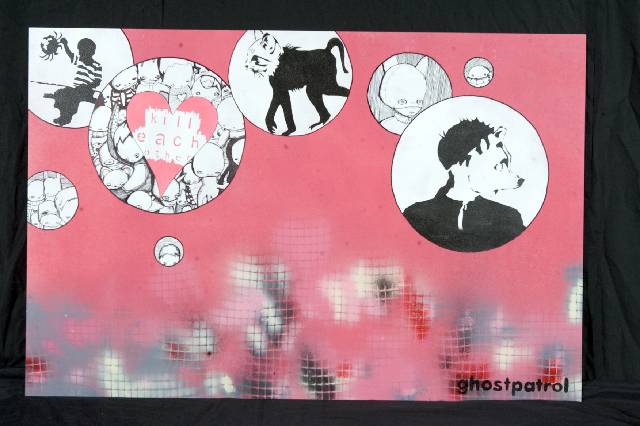
March 14, 2007
Nietzsche: will to power
According to this review of The Affirmation of Life: Nietzsche on Overcoming Nihilism Benjamin Moritz says that Bernard Reginster has a persuasive argument about the significance of the will to power. Reginister, Moritz, says:
places the concept’s development within the context of Schopenhauer’s thought and carefully traces Nietzsche’s subtle alterations of various constituent parts. In particular he notes that Schopenhauer believed that human willing was doomed to failure because of the unsatisfactory nature of the relationship between desires and objects. Specifically, Schopenhauer bemoans the fleeting nature of desire satisfaction and the looming problem of boredom. Reginster argues that Nietzsche’s concept of the will to power is a direct response to and critique of Schopenhauer’s views. Whereas Schopenhauer concentrated almost exclusively on first-order desires, Nietzsche establishes and defends second-order desires: the will to power.
The will to power is linked to the revaluation of values as an affirmation of life, which in turn, is as a response to nihilism. I'm sympathetic to this way of interpreting Nietzsche.
Moritz, says:
Reginster finds a place for the will to power within Nietzsche’s philosophical system, without focusing on it as an end in itself. Its place is to serve as justification for life’s suffering. By establishing a second-order desire—the will to power—as the highest value, the paradoxical nature of a desirable life that simultaneously includes suffering is remedied. Through desiring the process of overcoming (a simplified but largely accurate reduction of Reginster’s conception of the will to power) one can desire suffering without falling into the asceticism that Nietzsche loathes. Subsequently, the acceptance of this newly revaluated state of affairs lies at the core of the eternal recurrence.
March 10, 2007
Focuault:space and history
In an early article Foucault makes a few programmatic and largely suggestive remarks that the traditional idea that time is creative and progressive, while space is static, could be reversed:
The great obsession of the nineteenth century was, as we know, history: with its themes of development and of suspension, of crisis, and cycle, themes of the ever-accumulating past, with its preponderance of dead men … the present epoch will perhaps be above all the epoch of space. We are in the epoch of simultaneity: we are in the epoch of juxtaposition, the epoch of the near and far, of the side-by-side, of the dispersed. We are at a moment, I believe, when our experience of the world is less that of a long life developing through time than that of a network that connects points and intersects with its own skein.
March 7, 2007
Nietzsche: free spirits
From 'Token of Higher and Lower Culture' in Nietzsche's Human, All too Human
The free spirit a relative concept. A man is called a free spirit if he thinks otherwise than would be expected, based on his origin, environment, class, and position, or based on prevailing contemporary views. He is the exception: bound spirits are the rule; the latter reproach him that his free principles have their origin either in a need to be noticed, or else may even lead one to suspect him of free actions, that is, actions that are irreconcilable with bound morality. Sometimes it is also said that certain free principles derive from perverseness and eccentricity; but this is only the voice of malice, which does not, itself, believe what it says, but only wants to hurt: for the free spirit generally has proof of his greater kindness and sharp intellect written so legibly on his face that bound spirits understand it well enough. But the two other derivations of free-thinking are meant honestly; and many free spirits do indeed come into being in one or the other of these ways: But the tenets they arrive at thereby could still be more true and reliable than the tenets of bound spirits. In the knowledge of truth, what matters is having it, not what made one seek it, or how one found it. If the free spirits are right, the bound spirits are wrong, whether or not the former came to truth out of immorality and the others have kept clinging to untruth out of morality.
Incidentally, it is not part of the nature of the free spirit that his views are more correct, but rather that he has released himself from tradition, be it successfully or unsuccessfully. Usually, however, he has truth, or at least the spirit of the search for truth, on his side: he demands reasons, while others demand faith. (para.225)
It's a very Enlightenment conception of free spirit isn't it. The contrast is with a fettered spirit bounded by tradition and habit, with free spirit linked to genius.
March 6, 2007
Delueze: events + history of philosophy
Jay Lampert's Deleuze and Guattari's Philosophy of History, is reviewed by Keith Ansell Pearson. The book is a suprise because a philosophy of history (Hegel) is alien to Deleuze. Or so I thought. I had understood Deleuze's work to be a criticism of this approach to history, locating a historicism in modern thought from Hegel to Husserl (and Heidegger) from which he is keen to distance his own project. For Deleuze, Hegel and Heidegger are historicists in the sense that they posit history as a form of interiority in which Spirit or Being develops of necessity and a secret destiny is unveiled.
Pearson says that the first part of the book deals with Deleuze's philosophy of time, with Lampert arguing that Deleuze makes a far-reaching contribution to overturning commonsensical views of the passage of time.
Chapters two to four of the book form a set that attempt to illuminate Deleuze's treatment of the three syntheses of time in his major work of 1968, Difference and Repetition. The first of these is the contracted present of habit, the second is the virtual coexistence of past and present (the curious time of memory conceived as a pure past), and the third is the belief in the future that Deleuze locates, ingeniously but questionably, in Nietzsche's theory of the eternal return....Deleuze's treatment of the syntheses of time is unique on account of the resources he draws upon to make them work. Principally these are Hume on repetition for the first synthesis, Bergson on memory for the second, and Nietzsche on the future for the third (in Nietzsche and Philosophy of 1962 there is no third synthesis; rather, Nietzsche's synthesis of eternal return is read, in its ontological aspect, through the lens of Bergson).
Pearson says that this treatment of Deleuze on the syntheses of time allows Lampert to introduce the reader to the main contours of Deleuze's thought, including the all-important notion of the virtual.
One issue that is of interest to me is 'event', which i struggle to understand. Pearson mentions this in relation to May '68, which Deleuze offers as an example of a pure event. May '68:
can be grasped not on the level of empirical description because in an event there is an aspect that is not reducible to social determinism or causal chains. This is the aspect that escapes those historians who always seek to restore causality after the fact. As Deleuze conceives it, an event is a splitting off from and breaking with causality, a bifurcation and a deviation with respect to laws, an unstable condition that opens up a new field of the possible. Deleuze freely acknowledges that May '68 was characterised by agitations, slogans, idiocies, and illusions, but for him these are not what count. What counts is what amounts to a visionary phenomenon, as if society suddenly sees what is intolerable in it and the possibility of something else comes into perspective. In this happening, the possible does not pre-exist but is created by the event. The event, then, creates a new existence, evident for example in the form of new modes of subjectivity, including new relations with the body and new conceptions of time, of sexuality, of work and culture, and so on.
What then is the value of an event? Deleuze deterritorialises the present and points towards a different future in terms of possibilities. But why was May '68 a good thing? We need to ask this since cultural conservatives argue that everything went bad after May '68, and as a result of that event of of history and of a virtual becoming. Deleuze talks in terms of the new, experimental, remarkable, and the interesting, but not in Nietzsche's terms of one's ends and goals.This value dimension --eg., pursuing revolution is not an end in itself but a means to a better life---is what has been displaced.
March 3, 2007
the colours of Saturn
This image is a combination of three images taken in January 1998 by the Hubble Space Telescope and shows the ringed planet in reflected infrared light

It is from the NASA image of the day.
March 2, 2007
late capitalism as the end of history
Experimental filmmaking seems like its only referred to as a formalist category of film, something that only relates to the material of film. So few people are looking for a way of communicating images of different qualities seen in a sequence over time that transcends narrative language. It is higher and lower than narrative at the same time.
Bridget Brophy ruptures this formalism in experimental film making with Northern Void. According to Simon Sellars at Sleepy Brain we are presented with a:
savage vision.... of completely irradiating Australia’s suburban “non-places” and seeing what bizarre life forms sprout in the aftermath. An extrapolation, of course, of what he perceives as a process that’s already in place in a late-capitalist society, specifically Plenty Rd, where, he writes, “cracked 60s brickwork, shrivelled 70s council shrubbery, peeling 80s computer-typeset signage, 90s Day-Glo painted lettering on darkened windows [represent] the corpus of business: dying slowly while tethered to an indifferent life-support system.”
There is no reinvention, no way out. For Brophy, late capitalism is the end of history.