December 31, 2009
images as natural or analogical signs?
The Dia Art Foundation in a New York conference on the theme of vision and visuality in 1988 was published later that year as the second volume in Dia’s Discussions in Contemporary Culture.
In hindsight, the Hal Foster (ed.) Vision and Visuality, as the book came to be called, may be seen as the moment when the visual turn – or as it is sometimes called, the ‘pictorial turn’ in western culture was recognized; a moment when the assumption of the image as a natural sign, a straightforward analogue of its object, was undermined.
This challenged the entrenched way of understanding visuality in western culture since Plato. Plato's Cratylus distinguished between words as conventional signs and images as their natural counterparts. For Plato, there were two ways of representing a man, either by saying his name or by drawing his portrait. Whereas words were taken to be arbitrary signifiers without any necessary relation to what they signified, images were understood to be tied by natural forces to what they resembled, iconic analogues of their objects.
Mimesis of the real was assumed to be better served by vision than by any other sense. Although for some commentators the conventionality of words was taken to betoken their superiority as expressions of human creativity and imagination, for others images had the advantage because of their ability to transcend specific cultural contexts and show ostensively what could not easily be said or merely described.
W.J.T. Mitchell’s (1986) summary of this time-honored position in his Iconology: Image, Text, Ideology is this:
The naturalness of the image makes it a universal means of communication that provides a direct, unmediated, and accurate representation of things, rather than an indirect, unreliable report about things. The legal distinction between eyewitness evidence and hearsay, or between a photograph of a crime and a verbal account of a crime, rests on this assumption that the natural and visible sign is inherently more credible than the verbal report. The fact that the natural sign can be decoded by lesser beings (savages, children, illiterates, and animals) becomes, in this context, an argument for the greater epistemological power of imagery and its universality as a means of communication.
After the recent visual turn, however, the claim that images can be understood as natural or analogical signs with universal capacities to communicate has almost entirely come undone. Mitchell in his Iconology text dismissively calls such a notion the ‘fetish or idol of Western culture and insists that images be situated firmly in the world of convention rather than nature.
Situated firmly in the world of convention can be interpreted as images embedded in language, socio-cultural mediation, or technological virtualization. Images can no longer be seen as natural, unmediated signs, which can shed all their cultural encoding.
December 26, 2009
Ry Cooder: Maria Elena
A suitable post for Boxing Day. From Ry Cooder's third album Boomer's Story that recovers some of the lost and neglected pieces of American folk and blues, as well.
The video is from "Ry Cooder & The Moula Banda Rhythm Aces: Let's Have A Ball", a film by Les Blank taped at The Catalyst, Santa Cruz, CA on March 25'th 1987.
December 25, 2009
Xmas Day: cream rose
Merry Xmas everyone
 Gary Sauer-Thompson, cream Solway rose, Encounter Bay, Victor Harbor, 2009
Have a lovely, relaxing break
December 21, 2009
John Goto: West End Blues + photography
I've long admired the early photographic work of John Goto up to the early 1980s before his turn to painting and then to montage in Terezin marked the end of his "straight" photography. Goto's more recent West End Blues: Jazz Migrants in London, 1919-74 makes very extensive use of Photoshop. His work is concerned with the relationship between the past and the present.
Nancy Roth, in her commentary in Flusser Studies on West End Blues says of these digitally constructed images from photography that:
To many who have studied, worked and taught in institutions of photographic education and exhibition over the past twenty years, these minutely constructed images seem distinctly alien. They are complex and ambiguous. They demand sustained attention. They address the past, but are emphatically in the present. In openly asserting their relationship to Photoshop, in referring to multiple texts, in their use – sometimes – of highly saturated colour beloved of certain schools of commercial design, they often skirt a very sensitive boundary between art and advertising. They plant a disturbing suspicion among us that our understanding of “photography” has limits, and that there could be others. The usual first response of natives is to withhold “citizenship,” i.e., to deny Goto’s work the status of photography.
They are not “natural”. And abruptly we’re forced to ask what “natural” means in terms of photographs. The more common term, no doubt, is “straight,” or “unmanipulated,” -- what family snaps are and what advertising photographs are not. And here, perhaps, we are nearing the core of the anxiety; for we are in fact very familiar with manipulated photographs – in advertising, fashion, and now more and more often
in journalistic contexts.
Roth says that the combination of “window and “mirror,” recalls the title of John Szarkowski’s now canonical text, Mirrors and Windows: American Photography since 1960. In it, the two terms form the central pillars of a powerful, comprehensive and in many ways durable definition photography as a whole, a way of encompassing what belongs to the field and of excluding what does not. Szarkowski own basic definition of photography is:
More convincingly than any other kind of picture, a photograph evokes the tangible presence of reality. Its most fundamental use and its broadest acceptance has been as a substitute for the subject itself – a simpler, more permanent, more clearly visible version of the plain fact. Our faith in the truth of a photograph rests on our belief that the lens is impartial, and will draw the subject as it is, neither nobler nor meaner. This faith may be naïve and illusory (for though the lens draws the subject, the photographer defines it), but it persists. The photographer’s vision convinces us to the degree that the photographer hides his hand.
Szarkowski famously excluded digitally manipulated photographs from his system. The computer imagery and manipulation, maybe art, he said, but they weren’t necessarily photography. West End Blues can hardly be recognized or evaluated at all in Szarkowski’s framework of a photographic aesthetic.
December 20, 2009
Ry Cooder: Jesus on the Mainline
It is not just philosophy that digs into, and reinterprets our cultural heritage to recover the lost potentials of the past. taking over the possibilities of one's heritage. Heidegger's deconstruction in its original sense is a theory about how traditions evolve, namely via the accumulation of constructions, along with a methodology for ferreting out constructions that have for some other reason been deemed to be undesired.
Music can also take over the possibilities of one's heritage.This is a 1987 interpretation of Jesus on the Mainline, which is from Ry Cooder's classic album from 1974 Paradise and Lunch:
The album is part of Ry Cooder's archeological dig through music's familiar and forgotten past to recover lost and neglected pieces of American folk and blues. It's Van Dyke Parks on piano
December 17, 2009
photography + Abu Ghraib
In The Camera as a Weapon: On Abu Ghraib and Related Matters in The Journal for Cultural Research (April 2008) Carsten Laustsen refers to some of the iconic photographs of Abu Ghraib.
One of them is where Lynndie England, a US soldier, holds a Iraqi prisoner on a lead:

This reference to American imperialism can easily be established: the USA treats Iraq like a dog on a lead.
The aim of torture is not primarily to cause pain but to break the will of the victim. Usually this is done by depriving the victim of control over the situation.
December 14, 2009
from originality to repetition
Umberto Eco in his essay Innovation & repetition: between modern & postmodern aesthetics argues that:
The modern criterion for recognizing the artistic value wasnovelty, high information. The pleasurable repetition of an already known pattern was considered, by modern theories of art, typical of Crafts–not of Art–andof industry. A good craftsman, as well as an industrialactory, produces many tokens, or occurrences, of the same type or model.One appreciates the type, and appreciates the way the token meets the requirements of the type: but the modern aesthetics did not recognize such a procedure as an artistic one. That is why the Romantic aesthetics made such a careful distinction between “major” and “minor” arts, between arts and crafts.
This is the reason why modern aesthetics was so severe apropos the industrial-like products of the mass media. A popular song, a tv commercial, a comic strip, a detective novel, a Western movie were seen as more or less successful tokens of a given model or type. As such they were judged as pleasurable but nonartistic.
Furthermore, this excess of pleasurability, repetition, lack of innovation, was felt as a commercial trick (the product had to meet the expectations of its audience)...The products of mass mediawere equated with the products of industry insofar as they were produced in series, and the “serial” production was considered as alien to the artistic invention.
According to modernist aesthetics,the principal features of the mass-media products were repetition, iteration,
obedience to a pre-established schema, and redundancy (as opposed to information). Postmodern aesthetics,
which is revisiting the very concepts of repetition and iteration under a different profile.
December 13, 2009
photography: critical voices
The photo below by Pep Bonet reminds of Robert Frank's miner series in England in the 1950s. In 1953 Frank went to Caerau in Wales, where he worked on a photo-story about a mining village, and in particular about the miner Ben James and his family, in which he explored the relationship between realism, the narrative potential of photographic sequences, and the visual poetry of everyday life.
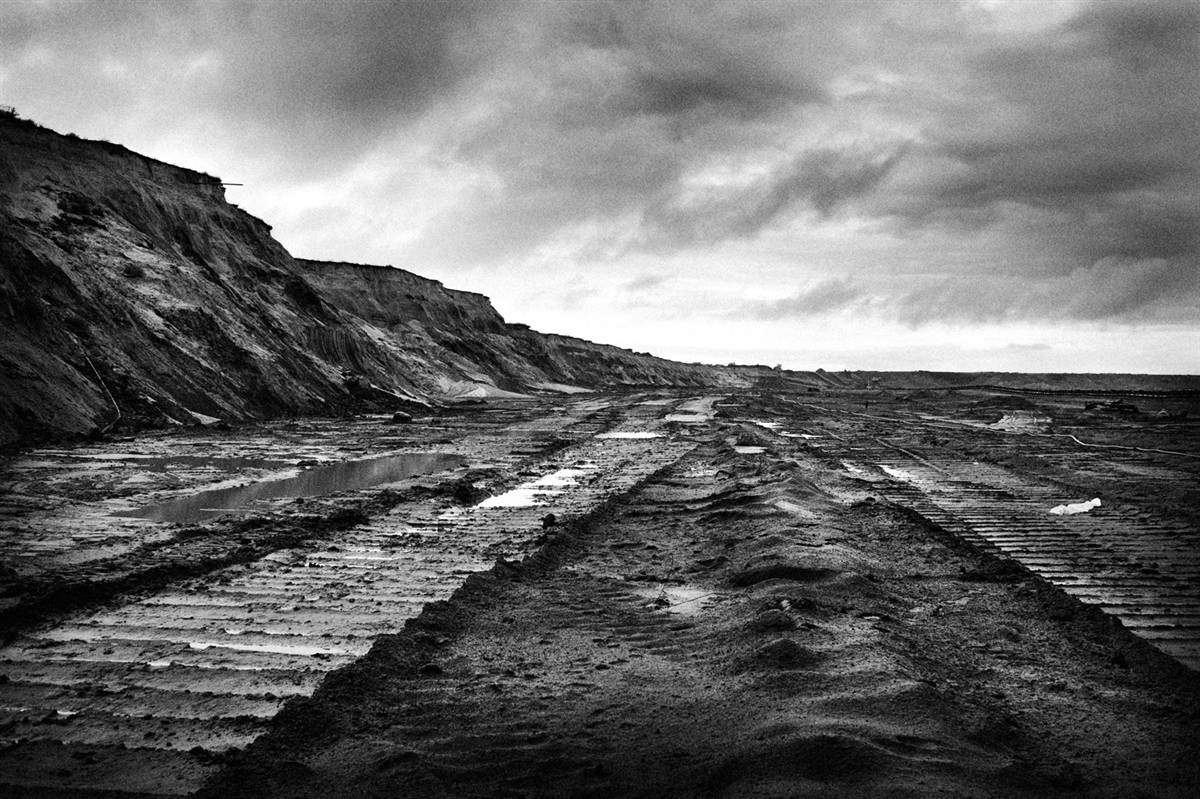 Pep Bonet, coalfield, Poland, 2009, from the Blackfields series in Consequences by Noor
Bonet's work is concerned with the relationship between coal, coal-fired power stations and global warming.
Frank is now part of the traditional photographic canon-- works deemed to be essential to the study of photography -and it is rare to find voices critical of the conceptual framework and the concepts and assumptions that you bring to bear on these iconic cultural objects. A critical language had to be developed before we could begin to explore question what a photograph is and does; and to question photography as a reliable system of representation.
This article The photographic idea: reconsidering conceptual photography. by Lucy Soutter provides us with a map of the emergence of a critical language. She says that the art world at the time was dominated by conceptualism, which defined itself against formalist painting. It held that photography was only useful or interesting to artists insofar as it was instrumental in conveying or recording their ideas: photographs themselves were either either brute information or uninflected documentation, and it was the idea or concept that was the most important aspect of the work. The problem here is that though text and photographs participate in the production of the work's meaning the existence of that text or visual form is repeatedly repressed or denied.
The historical baggage here was Clement Greenberg's writing on formalist painting and his dismissal of photography. For him photography was the most transparent of the art mediums devised or discovered by man. It is probably for this reason that it proves so difficult to make the photograph transcend its almost inevitable function as document, and act as a work of art as well. So photography's transparent relationship to the world undermines any attempts on the part of photographers to make autonomous works of art. A photograph that respects the obligations of its own medium would be anecdotal and literary.
The problem with Greenberg's analysis of photography is that it did not allow the medium any formal values of its own, even though he considered medium specificity and formalism to be synonymous in painting. It was John Szarkowski who generated a transliteration of Greenberg's formalist aesthetics into photographic terms by embraced the notion of medium specificity and rejected Greenberg's emphasis on the indexical essence of photography. He legitimated a form of photographic modernism complete with autonomous artworks and inspired authors.
What was resisted by many art photographers --eg.,Winogrand and Friedlander ---was the narrative legibility and compositional resolution of journalistic work. In turn, they explored modes familiar to amateur photography, Emphasis was thrown onto their stylistic and compositional elements by the fracturing of their subject matter--often a quirky gesture in the work of Winogrand, a fleeting shadow or reflection in the work of Friedlander
The critical voices in the 1970s addressed the modernist tradition of free-standing, anti-functional art photography in the 1960s and '70s and highlighted the way the modernist concern with a self-sufficient autonomous image ignored how the image was inflected by layers of convention and association. These cultural codes, which constitute the style or "rhetoric" of the image, in Barthes terms, were displaced into the background. What emerged was an expression of the corresponding rise of interest in photographic works by artists who were able to approach the medium without the theoretical or institutional baggage of photographic modernism.
What emerged in the development of photographic postmodernism was the idea that a photographic work could be driven by a conceptual narrative, rather than by formal elements or subject matter found within the frame.
December 10, 2009
debating climate change
The debate over climate change has become one between two camps usally termed the sceptics and the warmers in popular culture. If global warming emissions continue to rise unabated, we will see growing costs related to climate change with respect to our coasts, our health, our energy and water resources, our agriculture, our transportation infrastructure, and our recreational resources
According to Greg Craven the various skeptical beliefs consist of the following:
1. The globe isn’t warming.
2. The globe is warming, but humans aren’t causing it.
3. We’re warming the globe, but the change is not significant.
4. The globe is warming, but it’s too big to fix. We’d be better off working to adapt to the changes rather than
trying to prevent them.
The warmers say the globe is warming, we’re the ones doing it, it’s significant, and we can still do something to re duce the severity. The warmers are saying, “Mitigate”, that is focus efforts on trying to make the changes smaller, like keeping the sea level from rising in the first place by cutting carbon emissions).
The skeptics have tended to progress through all the listed points in sequence with most having progressed to number 4, saying, “Adapt” (focus efforts on protecting ourselves from the changes in climate, like building dikes around coastal cities to hold back rising sea levels), while the warmers are saying, “Mitigate” (focus efforts on trying to make the changes smaller, like keeping the sea level fro cutting carbon emissions).
Craven adds:
In practice, both camps generally call for some level of adaptation and mitigation. Most of the warmers are convinced that we’re already in for some significant climate change, so we’re going to have to do some adapting, even if we cut emissions radically to prevent worse changes. And some skeptics (though not all) say that emissions cuts aren’t a bad thing in themselves—it’s just mandatory cuts that are harmful to the
economy and should be avoided. So the difference is on emphasis.
The difference is on emphasis and also on the mechanism to mitigate emissions and help us adapt. And it is there that we enter into the terrain of economics.
December 7, 2009
postmodernism + rationality
In Postmodernism and Rationality Rodolphe Gasché says that he wishes to:
claim that the postmodern interrogation of reason which has triggered a renewed interest in the question of rationality in philosophy is not exhausted by the rediscovery of the irrational, whether as a boundary problem of rational cognition or as what puts the foundation of Western culture into question. From the Greek mathematicians who discovered the irrational as a limit of rationality, through the moment when the irrational becomes a philosophical problem properly ---that is, when philosophy puts the subject in the very center of its concerns (and the irrational becomes thus determined as a region inaccessible to human cognition)----the irrational has been the unavoidable counter concept of rationality.'
He adds that It is precisely this conceptual machinery that is put into question in certain of the works that are labeled postmodern. Postmodernity is not a farewell to reason altogether, but a shift toward the reason of the plural, the indeterminate, the random, the irregular, the formless, the paralogistic. Or the nonnecessary and nonessential.
December 5, 2009
Rolling Stones: Winter
“Winter” is a song by The Rolling Stones featured on their 1973 album Goats Head Soup, which came after the classic Let It Bleed, Sticky Fingers, and Exile On Main Street. The music on Goats Head Soup was a little slicker and smoother in style and if the album lives in the shadow of its predecessors, then maybe it is the legitimate conclusion to the classic Beggars to Exile period.
“Winter” bears many similarities to “Moonlight Mile” from the band’s 1971 album Sticky Fingers. Credited to singer Mick Jagger and guitarist Keith Richards, “Winter” is likely the work of Jagger and the Stones’ second guitarist at the time, Mick Taylor.It was the first song recorded for the album and does not feature Richards at all.
Recording began at Kingston’s Dynamic Sound Studios in November and continued into December 1972. Jagger opens the song with the acoustic rhythm guitar piece and is accompanied by Taylor’s “country-like licks” on lead. Taylor also plays slide guitar. Nicky Hopkins performs the song’s accompanying piano while Bill Wyman and Charlie Watts perform bass and drums, respectively. The songs strings were arranged by Nicky Harrision.
December 3, 2009
October: Rereading Debord, Rereading Situationists
There was a special issue of Ootober in 1997 entitled Rereading Debord, Rereading Situationists is a careful analysis of the Situationist legacy, a project of archival retrieval, reconstruction, and historicization. In the Anglo-American world the reception of Debord and the Situationists is in terms of the modernist avant garde's agitation and contestation--a radical opposition to the spectacle-culture of industrial capitalism.
It is the final manifestation of the historical avant-garde engaged in a struggle over the possible meanings of culture, as over the legacy of the historical avant-garde, with a broad spectrum of postwar cultural producers
December 1, 2009
ClimateGate
ClimateGate--or the CRU hack--- refers to the hundreds of private e-mail messages and documents hacked from a computer server at the Universsity of East Anglia in Britain. They provide insights into what has been happening within the climate change scientific establishment and raise important issues since the attitudes revealed in the emails do not look good.
The RealClimate crowd respond that the hack gives us a:
peek into how scientists actually interact and the conflicts show that the community is a far cry from the monolith that is sometimes imagined. People working constructively to improve joint publications; scientists who are friendly and agree on many of the big picture issues, disagreeing at times about details and engaging in ‘robust’ discussions; Scientists expressing frustration at the misrepresentation of their work in politicized arenas and complaining when media reports get it wrong; Scientists resenting the time they have to take out of their research to deal with over-hyped nonsense. None of this should be shocking.
At Climate Progress there is an open letter from Dr. Judith Curry, on the issue.
Curry says that at the heart of this issue is how climate researchers deal with skeptics. I have served my time in the “trenches of the climate war” in the context of the debate on hurricanes and global warming. There is no question that there is a political noise machine in existence that feeds on research and statements from climate change skeptics. She adds that In grappling with this issue,
I would argue that there are three strategies for dealing with skeptics:
1. Retreat into the ivory tower
2. Circle the wagons/point guns outward: ad hominem/appeal to motive attacks; appeal to authority; isolate the enemy through lack of access to data; peer review process
3. Take the “high ground:” engage the skeptics on our own terms (conferences, blogosphere); make data/methods available/transparent; clarify the uncertainties; openly declare our values
Most scientists retreat into the ivory tower. The CRU emails reflect elements of the circling of wagons strategy. For the past 3 years, I have been trying to figure out how to engage skeptics effectively in the context of #3, which I think is a method that can be effective in countering the arguments of skeptics, while at the same time being consistent with our core research values.
She adds that if climate science is to uphold core research values and be credible to public, we need to respond to any critique of data or methodology that emerges from analysis by other scientists.