|
December 13, 2009
The photo below by Pep Bonet reminds of Robert Frank's miner series in England in the 1950s. In 1953 Frank went to Caerau in Wales, where he worked on a photo-story about a mining village, and in particular about the miner Ben James and his family, in which he explored the relationship between realism, the narrative potential of photographic sequences, and the visual poetry of everyday life.
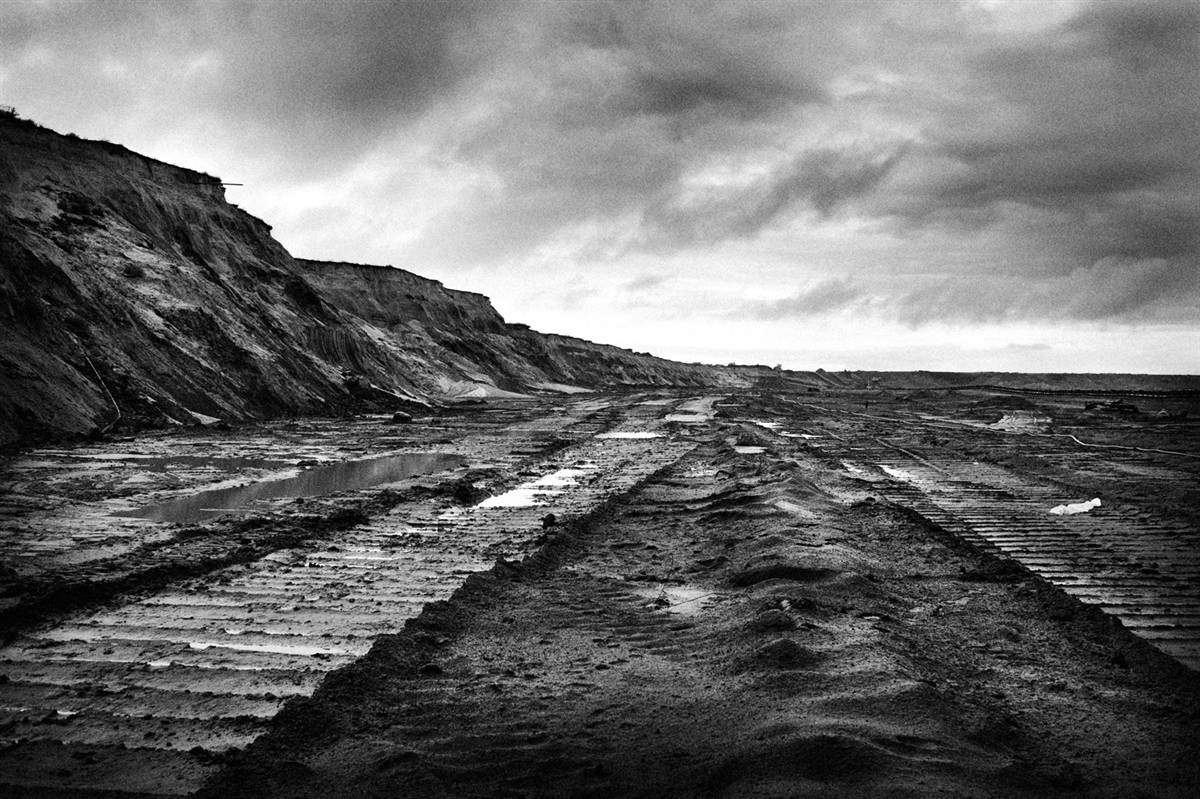 Pep Bonet, coalfield, Poland, 2009, from the Blackfields series in Consequences by Noor
Bonet's work is concerned with the relationship between coal, coal-fired power stations and global warming.
Frank is now part of the traditional photographic canon-- works deemed to be essential to the study of photography -and it is rare to find voices critical of the conceptual framework and the concepts and assumptions that you bring to bear on these iconic cultural objects. A critical language had to be developed before we could begin to explore question what a photograph is and does; and to question photography as a reliable system of representation.
This article The photographic idea: reconsidering conceptual photography. by Lucy Soutter provides us with a map of the emergence of a critical language. She says that the art world at the time was dominated by conceptualism, which defined itself against formalist painting. It held that photography was only useful or interesting to artists insofar as it was instrumental in conveying or recording their ideas: photographs themselves were either either brute information or uninflected documentation, and it was the idea or concept that was the most important aspect of the work. The problem here is that though text and photographs participate in the production of the work's meaning the existence of that text or visual form is repeatedly repressed or denied.
The historical baggage here was Clement Greenberg's writing on formalist painting and his dismissal of photography. For him photography was the most transparent of the art mediums devised or discovered by man. It is probably for this reason that it proves so difficult to make the photograph transcend its almost inevitable function as document, and act as a work of art as well. So photography's transparent relationship to the world undermines any attempts on the part of photographers to make autonomous works of art. A photograph that respects the obligations of its own medium would be anecdotal and literary.
The problem with Greenberg's analysis of photography is that it did not allow the medium any formal values of its own, even though he considered medium specificity and formalism to be synonymous in painting. It was John Szarkowski who generated a transliteration of Greenberg's formalist aesthetics into photographic terms by embraced the notion of medium specificity and rejected Greenberg's emphasis on the indexical essence of photography. He legitimated a form of photographic modernism complete with autonomous artworks and inspired authors.
What was resisted by many art photographers --eg.,Winogrand and Friedlander ---was the narrative legibility and compositional resolution of journalistic work. In turn, they explored modes familiar to amateur photography, Emphasis was thrown onto their stylistic and compositional elements by the fracturing of their subject matter--often a quirky gesture in the work of Winogrand, a fleeting shadow or reflection in the work of Friedlander
The critical voices in the 1970s addressed the modernist tradition of free-standing, anti-functional art photography in the 1960s and '70s and highlighted the way the modernist concern with a self-sufficient autonomous image ignored how the image was inflected by layers of convention and association. These cultural codes, which constitute the style or "rhetoric" of the image, in Barthes terms, were displaced into the background. What emerged was an expression of the corresponding rise of interest in photographic works by artists who were able to approach the medium without the theoretical or institutional baggage of photographic modernism.
What emerged in the development of photographic postmodernism was the idea that a photographic work could be driven by a conceptual narrative, rather than by formal elements or subject matter found within the frame.
|