May 31, 2005
Nietzsche for the money men
Whilst academic philosophy continues its retreat to the dim margins of our public culture, Nietzsche, that all-too-human philosophical critic of our disturbed and contradictory modernity, continues to fascinate a wide spectrum of thinkers and writers.
In his account of Nietzsche in The Australian Financial Review Martin Leet goes beyond painting Nietzsche as lonely, troubled soul who collapses into madness. He goes beyond biography of a man living a life of solitude beset by relentless, debilitating illness and severe eye problems. He says:
"Nietzsche painted an amoral picture of human life, not to serve immorality but to establish a surer ground for moral development. Nature consists of endless struggle. Individuals seeks power. Even in casual conversation there are subtle attempts to establish superiority over others. A superficial, moralistic understanding ignores the reality of commanding and obeying. Everything obeys, and if you do not obey yourself then you will be obeying another."
I read that and say. Well, yes, it's rough but okay.This is Nietzsche for the finance capitalists after all.
However, what does moral development mean here? Self-development is the answer given by Leet. And what is the commanding about. Our explorations and struggles with the unconscious, says Leet.I presume he follows Curtis Cate's recent biography of Friedrich Nietzsche in this. Nietzsche in popular culture becomes a proto-psychoanalyist; not the demented genius; the amoral Franco-German existentialist; or the philosopher of free-spiritedness who allowed no moral or religious constraints to hinder his full development.
Leet's account is too individualistic as it downplay the way that Nietzsche as a critic of culture wanted to renew a nihilistic culture not just engage in self-development through a philosophical therapy modelled on the Greeks.
May 29, 2005
Nietzsche for finance capitalists
The Review Section of the Australian Financial Review(subscription required) has an article entitled 'Nietzsche for Beginners' by a Martin Leet, a research fellow in the Brisbane Institute in the sunshine state of Queensland. I was intrigued.
How would Nietzsche be presented to the finance capitalists who love to make a fast buck from a tricky deal and then spend it on high status consumption goodies because they deserve it. Ethics and nihilism, after all, is a long way from their playing around with exchange rates, or the gouging management fees charged by merchant bankers.
The hook for the article is Greg Curtis' biography of Nietzsche. The article highlights Nietzsche's self overcoming understood a questioning the unconscious assumptions of one's culture. So far so good. The questioning that Nietzcshe undertook were those relating to democracy and liberalism which lead to mediocrity, dilettantism and nihilism. Wow, that would get our budding entrepreneurial financiers interested I thought. Since they are into strength and freedom in a big way, they would read on. I do.
The idea of the art of living --a conditioning of the instincts to produce a decent human being --is introduced along with the sickness of modern culture and a sickly Nietzsche taking on the problems of European culture. This is a Nietzsche who says a yes or no to life and directs his barbs at a decaying Christianity; one who sees that Christianity's emphasis on guilt and the sinfulness of human beings makes us unhappy.
Leet does not see Nietzsche dumping morality as such.He acknowledges the turn back to the Greeks, to an ethics that enhances or says yes to life; one that involves a process of becoming and training.Instead of exploring this conception of an ethical philosophy as a way of life, Leet moves on to talk about art, Wagner and culture.
May 27, 2005
Adorno: ethics as resistance
This is David Levine's Adorno, 2003
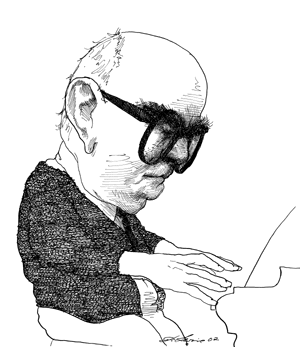
A quote from T.W. Adorno's article 'Theory, Practice, and Moral Philosophy' from his Problems of Moral Philosophy that highlights an ethic of responsibility to resist evil.
"Now what I wish to emphasize is the factor of resistance, of refusing to be part of the prevailing evil, a refusal that always implies resisting something stronger and hence always contains an element of despair. I believe that this idea of resistance, then, may help you best to see what I mean when I say that the moral sphere is not coterminous with the theoretical sphere, and that this fact is itself a basic philosophical determinant of the sphere of practical action."
Thus the break away from theory in moral philosophy towards practical philosophy, whose ethos is one of refusal. Kant's moral philosophy can be seen as an example of what is being rejected. For Kant we help a stranger, tell the truth, or honor one’s dignity, out of responsibility to the moral law: As Nick Smith says:
When I visit a friend in the hospital, for example, for the deontologist I must be guided by a commitment to honor the moral law rather than by the actuality of my friend and her suffering. I go to the hospital because of the moral law rather than because of my friend’s suffering. Kant thus drains ethics of the blood and passions of life grounded on living and breathing people and replaces them with cold universal norms..
It is a turn away from Kant's universal moral law to Hegel's ethical life. Is that the turn that Adorno makes?
May 26, 2005
Adorno: identity thinking
An interesting review of two recent books on Adorno. This passage caught my eye:
As the dominant mode of cognition in modernity, abstract identification specifies an individual thing in the world, picks it out as a member of a group, and places it under a concept.....what matters is that the object is no longer a unique and strange thing but is rather a member of a category that makes sense to me. This process, which Adorno names "identity thinking," causes a belief that concepts fully "capture" the objects to which they refer. When we consistently disregard particularity while reinforcing similarity, we forget the notion of something genuinely concrete, particular, unique, non-fungible, or incommensurable. The material world is made to fit the abstract idea and actual things are seen as nothing more than examples of their concept. Abstract classifications do not, however, inhere in objects but rather are artifacts of intellectual organization.....I forget that my classification is merely a construct of convenience. Because identity thinking pretends that concepts exhaust their objects, the thing’s particularity will remain overlooked and in reason's blind spot.
Adorno makes the turn to concrete particularity against identity thinking currently exemplified in neo-classical economics.
May 25, 2005
Adorno & moral philosophy
My understanding is that Theodor W. Adorno had long concerned himself with the problems of moral philosophy in the sense of asking whether the good life is a genuine possibility in the present.
This approach to ethics is a reworking of Aristotle, which breaks with a modernist ethics as a discipline of abstract rule-following, and addresses our inability to think and relate responsibly to concrete particulars, such as someone bleeding badly from a shooting.
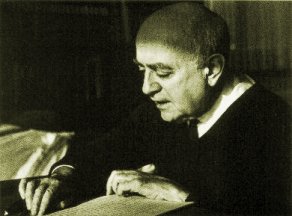 Adorno's way of doing situational ethics is undertaken within the context of a materialistic metacritique of German idealism.
In Negative Dialectics for instance, the section on "Freedom" in Negative Dialectics (ND 211-99) conducts a metacritique of Kant's critique of practical reason whilst the section on "World Spirit and Natural History" (ND 300-360) provides a metacritique of Hegel's philosophy of history.
Problems of Moral Philosophy consists of a course of seventeen lectures given in May-July 1963. These were captured by tape recorder and present a somewhat different, and more accessible, Adorno.
May 23, 2005
Adorno+ethics
I've always puzzled about Adorno, moral philosophy and the tacit ought claims of his social philosophy. I concur with this article. by James Gordon Finlayson, who argues that Adorno's philosophy does not needlessly embrace paradox and aporia, that it lapses into irrationalism and mysticism, and so is nihilistic and anti-Enlightenment.
I've sensed the buried ethics in Adorno's texts, especially in Minima Moralia, and interpreted this ethical sub-current as a form of non-universal ethics concerned with the good life (understood as human flourishing).This is a critical theory of morality that is concerned with the contradiction of good living in a false bad life that is governed by the ethos of an instrumental reason that damages us in a variety of ways.
Though there is no way we can live a good life in a false society autonomy is a central ethical value or virtue for Adorno; this virtue is gained through critical reflection on the repressive content of our moral categories to achieve insight into their liberating aspects. It suggests that we ought not co-operate with, or adjust to, a false life in a liberal bourgeois society. We ought to do this so that Auschwitz does not occur again.
I've always read this ethical current in Adorno in opposition to the old Marxist claim that denounces moral philosophy as a repressive ideology of domination and to the repudiation of the ethical by the Bataille and Klossowski. Adorno remained closer to Nietzsche on these ethical concerns.
Though I'd got this far I found very little work on Adorno and ethics to bounce off.
Update: 24 May 2004
I've just remembered that I had read J.M. Bernstein's work on Adorno. From memory Bernstein has been arguing against the solutions offered by both Habermas and the proponents of deconstruction. In his The Fate of Art: Aesthetic Alienation from Kant to Derrida and Adorno Bernstein argued that Adorno's aesthetic modernism provides the ethical counterpoint to instrumental rationality that deconstruction cannot. In his 1995 Recovering Ethical Life: Jurgen Habermas and the Future of Critical Theory, Bernstein argued that Adorno, and not Habermas, offers hope for contemporary ethical life.
Bernstein had argued in those works that neither discourse ethics nor deconstruction addressed the primary failure of contemporary life–our inability to think and relate responsibly to concrete particulars. But he did not show Adorno could offer any substantial alternative. Once again Adorno's ethics remained buried.
May 22, 2005
Adorno & Heidegger
I bought a book on Adorno when in Sydney--The Cambridge Companion to Adorno edited by Thomas Huhn. I was hoping that this text may help me to address the troubled relation between Heidegger and Adorno.
Despite their differences and conflict both seem to reflect on the philosophy of historical experience, push beyond the metaphysics of subjectivity, engage in a destruction of western metaphysics, were critics of liberal capitalist modernity, and reacted against the positivist philosophy of science that presupposed the reduction of language to the transparent medium of representation. Yet these commonalities are rarely mentioned.
May 21, 2005
checking in as best as I can
I'm in the global city of Sydney this weekend for some meetings and to make arrangements for a new job. As I have a few moments off this Saturday afternoon I went wandering through the inner city from Darling Harbour taking in Ultimo and Glebe.
It has been a decade or so since I've been in Sydney. My life has been Adelaide Canberra Melbourne. Sydney has changed beyond recognition, the familar landmarks have gone, and it looks a lot cleaner. Presumably the Olympics did that. The harbour really sparkles on a glorious autumn day. Sydney would have to be one of the more beautiful cities of the world.
I noticed that everybody is hanging on the street: they live on the streets in inner Sydney in the resturants, markets, pubs and shops. So many young people are walking the city despite the very heavy traffic. Glebe looks and feels very bohemian.
I went to check out Glebe Books and Fish Records. The hotel---the Novotel in Darling Harbour--- charged $10 for 45 miniutes.
Glebe Books was very disappointing. They had few books on Heidegger or Nietzsche in the philosophy section, and nothing on French philosophy in the 1930s and 1940s. The global city is not much of an improvement on provincal Adelaide. Heidegger is not in fashion in post modern Sydney--it appears to be borders, security, immigration and human rights.
I'm now posting from an old internet cafe in Glebe. The connection is so slow at the Internet cafe (they do not sell coffee or food) and, as the computer keeps jamming (or freezing), I cannot do the links I wanted. So the post cannot be finished. I'm giving up and walking back to the hotel for dinner with friends in Darling Harbour.
So I'm forced to just check in here. Nothing will posted until I get back to Adelaide late on Sunday.
May 18, 2005
Adorno+Hegel
The link occurred to me the other day. Is Adorno & Horkheimer's Dialectic of Enlightenment intertwined with Hegel's Enlightenment chapter in Hegel's The Phenomenology of Spirit?
My judgement is that the former is a radicalisation of Hegel's chapter, which is structured on the dialectic of reason as pure insight and religious faith. From what I remember Enlightenment reason construes religious faith as illusion, the projection of human meaning onto material nature, and understands itself as permanent critique.
Then Enlightenment reason as permanent critique of illusion discovers that it has no content and becomes empty when shorn of its bad object.
The third step is that both religious faith and permanent critique are mutually dependent on one another. Permanent critique is systematically dependent on what it seeks to repudiate.
If you replace religious faith with myth then the structure of Adorno & Horkheimer's Dialectic of Enlightenment chapter is similar--Hegel's dialectic of faith and pure insight becomes Adorno and Horkheimer's dialectic of enlightenment and myth); but it is stronger---as Enlightenment reason collapses back into myth.
Stronger and more radical because the core thesis is that enlightenment reason seeks through knowing to master and control nature to seek to become independent and free of it.
May 17, 2005
Magritte: Philosophy in the Boudoir
I presume that Magritte's painting below is a reference to the Marquis de Sade's Philosophie dans le Boudoir.
de Sade's text is a libertine eros that advocates the following: hedonism with physical pleasure being the goal of life; going back to Nature involves getting in touch with our basic needs and desires; sex education involves stripping away all moral codes and rules; that we should defying all social taboos and codes in order to satisfy our sexual desires and a circulation of bodies for sexual pleasure.If we reject society then we maximize our pleasure through the satisfaction of needs (eating, sleeping, having sex) regardless of whatever prohibitions have been socially imposed on us by Catholicism and religion.
The republican pamphlet in the text proposes to form free citizens while opposing the twin oppressions of royal serfdom and religious superstition. The state should not block the natural desires of man which include incest, rape, whoring, sodomy, pederasty and murder. The last thing the state should do would be to punish such pleasures with the death penalty.
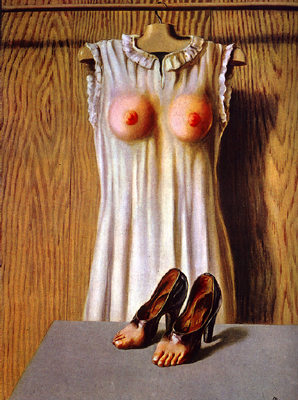
Rene Magritte, Philosophy in the Boudoir,1947
In this image Magritte makes use of the strategies of Freudian dream logic--displacement, condensation, and fetish--to create a disturbing surrealists image of woman. (Female Genitals = Woman) Magritte also substitutes the fetish items of clothing for the actual woman and implies that the fetish is preferable to the real woman.
May 16, 2005
limits of philosophy
Academic philosophy has become professionalized to such a degree that skepticism among students is discouraged, and non-philosophers are excluded from dialogue, with the result that contemporary philosophy has become inaccessible and of little relevance to human life.
Professional analytic philosophy we have the dissolution of metaphysics into natural science and the evolution of philosophy of science to justify why it is science that tells us how various things are.
The criticism of contemporary Australian philosophy that it should play a larger role in public life buys into the very traditional analytic view that Australian philosophy would sacrifice relevance to rigor, and would become less rigorous in order to become more relevant.
Analytical philosophy’s Other is not merely Continental philosophy.It is also a lot of philosophical activity that goes on outside philosophy departments by people who often do not call themselves philosophers.
May 14, 2005
continental philosophy: reacting against science
Analytic philosophers pride themselves on being logical, rigorous, and clear, which is their not so subtle way of denouncing Continental philosophers as illogical, sloppy, and incoherent. This way of addressing the divide overlooks classic continental approaches to the philosophy of science, which like many of the latter postmodern critiques, challenge the claim of science's very singular prerogative. The hegemony of science is placed into question.
The modern canon for legitimating discourse---that is, rationality, objectivity, truth, progress, the scientific schematism of limit and hierarchy---is called to account by both the broadly continental and specifically postmodern critiques.
This critical strand of continental philosophical thought can be interpreted as a further development of the modern philosophical tradition of critique and throughly modern demystification. As such, Hegel's, Marx's Nietzsche's, Husserl's and Heidegger's critique of science is only an extension of, and no break from, the modern enlightenment project of demystification.
Yet these historical and hermeneutic style of reflections on science find little resonance or consideration amongst analytical philosophers of science. As Babette E. Babich observes:
"...there is no received (i. e., there is no acknowledged or recognized) tradition of continental scholarship within the professional establishment of the [analytic] philosophy of science. Thus the philosophy of science remains an analytic discipline, with continental perspectives excluded by the sovereign expedient of disregard, an absence of critical reference which effects the professional annihilation of scholarship."Yet a lot of continental philosophy only makes sense within the context of a critique of science that displaces the valorization of science and logic and opens up spaces for other modes of knowing.
May 13, 2005
between the analytic continental divide
A standard polemic from analytic philosophers is that they aim to distinguish mainstream Western philosophy from the reflections of philosophical sages or prophets, such as Pascal or Nietzsche, and from the obscurities of speculative metaphysicians, such as Hegel, Bradley or Heidegger. It is a polemic because it sidesteps the criticism of science and its metaphysics by Hegel, Nietzsche and Heidegger. So one just ignores the analytic prejudices and continues to read continental philosophy.
The following quote from the article by Babette E. Babich on the 'Analytic-Continental' Divide in the philosophy institution, is a different kettle of fish. She says:
"Contrary to what I have said about the legacy of continental thought as it can be found in Heidegger and others, today's continental philosophy echoes the mainstream (and analytic) approach to Nietzsche's thinking while sidestepping any reference that would take them to raise epistemological questions in Nietzsche. Constituted within the institutional bearing of the analytic tradition - from Europe to the UK to America and across the globe, including contemporary Germany and France - so-called continental philosophy increasingly reflects exactly the values and interests analytic philosophy relegates to it...Analytic philosophy defines its language, its standards of rigor, its focal approach, its style as uniquely valid for crucial questions in philosophy."
This implies that the continental approach to philosophy has nearly abandoned its own heritage by taking over its definition from analytic quarters.
I find that claim rather strange. It looks like a reading continental philosophy from an Anglo-American philosophy department. So, if analytic philosophy is primarily associated with science, then continental philosophy appears to be given what is remaindered, literature.
This kind of reading fails to see what can be opened up philsophy's connection with literature---eg. a reading of Sade with Bataille, Blanchot and Klossowski. That takes us a long way from the concerns of analytic philosophy. Yet de Sade followed more or less the lines of enlightened thinking. He grounded his work in nature and expressed nature in terms of the inborn dispositions to explain and defend his natural desires. Sade included pederasty, prostitution, adultery, incest and lust murder are natural inclinations and that there is no reason to object to them or forbid them. For him, all human and also "inhuman" passions are innate, and should thus have a place as well in culture and society.
May 11, 2005
'Analytic-Continental' Divide#2
More quotes from the article by Babette E. Babich on the 'Analytic-Continental' Divide in the philosophy institution. She says:
"Claiming there is no analytic-continental divide is an important step in the analytic appropriation of the mantle (not the substance) of continental philosophy. Why should the analysts want to appropriate the themes of continental philosophy? The short answer is that analytic philosophy has exhausted itself; the extended and more conflictedly interesting answer is because continental philosophy is sexy: the grad students want it - or think they do. The difference between so-called analytic and so-called continental styles of philosophy is a contentious matter of ideology and taste - "deflating questions" as opposed to reflecting on what is question-worthy, as Heidegger would say, in a question....Yet the advantage of denying any difference between modalities of philosophy is considerable because once the denial is in place, continental style philosophy can be dismissed as bad or even as "just not" philosophy and this is needed both to justify one's inattention to the work done by scholars working in the contemporary tradition of continental philosophy and even more importantly because analytic philosphy wants to try its hand at themes formerly left to continental modes of thought."
That is spot on.
May 9, 2005
'Analytic-Continental' Divide
I'm off to Canberra for three days. Blogging may well be light, and as I may be rather busy, I may have to resort to posting some quotes.
This is an interesting article by Babette E. Babich on the 'Analytic-Continental' Divide in the philosophy institution. This is a nice quote:
"The story of the analytic mode of philosophy is currently being told by analysts from Michael Dummett and L. Jonathan Cohen but also Ronald Giere and Alan Richardson to the more recent efforts of Michael Friedman. In the Anglo-American context, what is called analytic philosophy grew out of the so-called language philosophy that aspired to match the logically empiricist claims of the Vienna circle (and its brand of logical positivism). It was this tradition, very much in the person of Rudolf Carnap and other refugees from fascism, that came to be poised against the vagaries (and the vagueness...) of the historical tradition of philosophy and all it was associated with - notably Nietzsche and Heidegger but it would also include Sartre and Merleau-Ponty...The distinction would turn out to be ensured by the fortunes of world history following the end of the second World War and determined by analytic philosophy's subsequent accession to power as the putatively neo-Kantian programme of deliberately redrawing philosophy in the image of science, or at least in the image of logical analysis."
Babich captures the way the school of analytic philosophy has historically understood itself and its opponent:
"Problems of philosophy would henceforth be resolved by linguistic clarification and logical analysis. In other words, to use Skorupski's analytic contention: they would be "deflated" or unmasked as pseudo-problems. Any other philosophical approach would be misguided or erroneous, and in the light of the fortunes of the academy leading to the institutional dominion of analytic philosophy: simply a bad way to do philosophy....from an analytic perspective, it is routine to argue that there is no such thing as a merely, sheerly stylistic divide between analytic and continental philosophy. Instead, and again, one has only good and bad ways of doing philosophy. Good philosophy is well-written, well-formed and formulaic and that is of course, a matter of clarity and of arguments, judged as such and articulated from an analytic viewpoint---which is also to say, with the late Quine and Davidson--- from a logical point of view. Bad philosophy is thus anything that is not what is counted as "good" philosophy--- especially if it is reputed to be hard to read or understand."
That was my experience in the philosophy institution.
May 8, 2005
A French Nietzsche?
My understanding of the French Nietzscheans, (e.g., Foucault, Derrida, Kofman, Deleuze), is that they resist the effort to unify his thought, arguing that Nietzsche's shifting meanings and contradictions resist systematization. Much of the French work on Nietzsche can be seen as a refutation of Heidegger's [metaphysical] interpretation by insisting on the metaphorical character of Nietzsche's writings, his style, his irony, and his masks.
For the French Nietzscheans how Nietzsche writes, his use of aphorisms, metaphors, and wide range of literary styles is seen as important as what he writes about. If literature as language grounded in rhetoric, then it is the forgetfulness of the metaphorical origin of concepts that leads to the mistaken belief that concepts literally represent reality. The metaphorical character of Nietzsche's concepts serves to foil any definitive reading of his philosophy.
Fair enough. I can accept a variety of interpretations is contrasted with Heidegger's metaphysical interpretation of Nietzsche. In contrast to Heidegger's metaphysical interpretation of Nietzsche, we can argue that Nietzsche's fragmentary and contradictory writings have more than one meaning. So we can read Thus Spoke Zarathustra by focusing on its literary structure, seeing parody (of both the Platonic dialogues and the New Testament), tragedy, and Bildungsroman as literary models that operate throughout the book. Hence we have a very different kind of Nietzsche.
Yet there is also a unity or a narrative to Nietzsche's thought structured around the idea of the 'death of God' and the impending cultural catastrophe, which he called nihilism, that is its consequence. Nietzsche can be interpreted as devoted much of his philosophy to thinking through the consequences of this great event in history.
Secondly, many of the French scholars, including Derrida and Deleuze, stress Nietzsche's theory of interpretation and language and downplay the way that Nietzsche is primarily an ethical thinker concerned with both what is the best life and the creation of a severe, aristocratic ethic.
May 6, 2005
a cross-dressed Nietzsche
The figure of Nietzsche can be seen as a bridge across the analytic continental divide. The analytic schools offer a tradition of interpreting Nietzsche, beginning with Walter Kaufmann, Arthur Danto and Bernd Magnus and continuing with Maudemarie Clark, Solomon/Schacht, and most recently, by Robert Gooding-Williams? And Nietzsche is an important figure for continental philosophy and it has its established analytic traditions of interpreting Nietzsche with Heidegger, Adorno, Klossowski, Levinas, Foucault, Derrida and Deleuze.
If the figure of Nietzsche is a bridge across the analytic continental divide, then Nietzsche's texts are critical of academic philosophy and resist the ordering in the received historical canon of philosophy. His writings have continued to be remarkably resistant to traditional comprehension of academic philosophy.
May 4, 2005
For Klossowski, the many contradictions in Nietzsche’s philosophy reflected his understanding of the "soul" as a multiplicity of forces.
May 2, 2005
Bio-medicine: bodies as machines
Rene Descartes describing the body using the machine metaphor:
"I must describe to you first the body by itself ... I assume the body is nothing else than a statue or machine ... indeed, the nerves of the machine I am describing to you may very well be compared to the pipes of the machinery of fountains, its muscles and its tendons to various other engines and devices which serve to move them ... its heart is the spring ... Moreover, respiration and other such functions of a clock or a mill."
The roots of biomedicine are in the 17th century ideal of Cartesian dualism, in which there is a separation of mind and body. The body is a part of the physical world, and diseases are bounded disorders that must be treated within this realm. This assumption was reinforced when discoveries in bacteriology by Louis Pasteur and Robert Koch led to the development of the germ theory of disease. These along with other advances in areas like biochemistry and surgery were sufficient to bind physician allegiance to scientific, clinical medicine
May 1, 2005
technology, medicine, health
This paper on technology and healthcare by Eric Mathews, which was published in Ends and Means, has an interesting insight into the effects of technology on health care. It shows one way in which our world has become exponentially encoded by technology since Heidegger's essay on technology.
Eric says that:
"For most of its history, medicine has been pre-technological: it has been 'scientific' only to the extent that it has been based on careful observation of such things as the course of diseases, the sorts of diet and regimen which tend to keep people healthy, the ways in which certain herbs or other forms of treatment seem to offer relief in some cases, and so on. Such empirical observation has enabled doctors to make reasonably accurate predictions of what will happen to a patient, and to offer treatment in a limited number of cases which works, if it does at all, because it fits in with the natural order, not because it defies nature. A patient's fever can be relieved by administering cold water to the patient's body. That may hopefully speed up the patient's recovery, if he or she is going to recover in the natural course of events, but it will not in itself cure the fever."
This changes when medicine becomes technological during the twenthieth century and modern medicine depends on technological instruments for its discoveries.
Eric describes the transformation in terms of the way we now understand health care:
"If we know the underlying causal mechanisms of the fever, and have other relevant scientific (e.g. chemical) knowledge, then we can devise drugs, not just to alleviate the symptoms of fever, but to cure it. Thus, someone who in the natural order would have died from the fever need do so no longer. Technological medicine takes human beings out of the natural order, and does so increasingly as new technologies develop. To save lives which would in the course of nature have ended by means of drugs is one thing; it is a much greater thing still to save lives by assisting the function of failing organs by mechanical means, as in renal dialysis or the use of heart pace-makers; it is going yet further to save lives by replacing the organs altogether by other organs, taken from other human beings or even from animals of other species. Each of these marks a step further from the natural order, from the governance of processes by impersonal laws of nature, with which human beings can only cooperate, to an order constructed by human beings."
Healthcare is no longer just about being concerned with the healthy functioning of a human organism within the natural order: medicine as a technoscience involves a transgressimg of our being-in-the-world as human organisms within the natural order. We are now shaping the natural order and this forces us to question what is meant by the human self/subject.