April 30, 2005
philosophical education and the marketplace
Some remarks by Tim Luke. on liberal education, universities and employment in the postmodern market governed by neo-liberalism. They raise questions about the relevance of philosophy today as education is increasingly reshaped from a public to a private good used for upward economic mobility. This kind of education is becoming increasingly expensive and financed through long-term debt in the form of student loans.
In Miscast Canons Luke says that:
"The culture wars, and their attendant attacks on what happens in the nation's schools, colleges and universities, cannot be dismissed as insignificant rhetorical exercises. On one level, the publics served by educational institutions, rightly or wrongly, now question higher education's accountability and responsiveness to their needs."
And rightly so. We are educational consumers now. Luke goes onto say tha the classical ideals of an ethical/political education for citizenship have little relevance today:
"The canonical teachings of classic liberal arts education, then, are perhaps sorely miscast in a world of flexible specialization. Now kanban ("just in time") management or kaizen ("continuous improvement") engineering direct individuals away from the classic Aristotlean ideals of training every citizen for lives of ethics and politics through leisurely learning in order to hone their skills of subjection to the clock or to devote their talents to a quest for essentially mechanical training. The wisdom of UPS, or learning how "to move at the speed of business," and the teachings of Lexus, or accepting "the relentless pursuit of perfection," displace Plato or Aristotle as the privileged codes used for imaging and fulfilling social individuality. The vast bureaucratic hierarchies of the corporate world, where one might have once usefully deployed insights from Socrates, Aquinas, and Kant or Sophocles, Chaucer or Lessing in contemplation of that organization's collective welfare, are eroding away in the global flows of post-Fordist exchange. For many, Aristotle's plea to impart the wisdom of statesmen at praxis to citizens of any polis falls on very deaf ears as job markets, parents, and taxpayers demand more and more of the techne needed by servile mechanics in subjection to the globalized marketplace."
That effectively marginalizes philosophy which has depended on the the traditional liberal commitment to higher education as a vital public good deserving state monies. With the new policy consensus that reimagines education as cultural capital essentially as a private good, philosophy becomes a luxury commodity.
April 29, 2005
from system to the preconceptual
The quote below is from Paul Piccone, who is spelling out the way the radical philosophers in the US associated with Telos magazine appropriated continental philosophy. Telo has described itself as "the philosophical conscience of the American left" and "a journal of radical thought". It began with a "systematic effort to retrieve the lost and suppressed tradition of Western Marxism. ... Of course, at that time we had not yet realized that Western Marxism, in all its variations, would also turn out to be a dud, but it certainly seemed a worthwhile effort."
"Unless categorical objectifications (including, first and foremost, the legal order) are grounded in some pre-conceptual dimension, the system of which they are a part tends to self-destruct. ....This is the context defining, among others, Theodor W. Adorno's articulation of identity logic, Edmund Husserl's critique of naturalism, John Dewey's account of the naturalistic fallacy, Ludwig Wittgenstein's vindication of the primacy of forms of life, or Alfred North Whitehead's warnings about misplaced concreteness. As in the case of the unabridgeable gap obtaining between legal structures and all the concrete cases they must cover, being and thought do not and cannot correspond. Being always exceeds thought, and the elimination of the resulting residue by Enlightenment ideology leads to thought redefinition being done exclusively in terms of its abstract concepts (identity logic). The result is an ungrounded rationalism articulated through instrumental reason that can accommodate any political agenda, and can turn into the mad rationality typical of Nazi ideology. The only solution is to ground this rationalism in the pre-rational and pre-conceptual dimension that has become occluded or forgotten: through mimesis for Adorno; in the lifeworld for Husserl; in experience for Dewey; in "concrete orders" for Schmitt, by returning to Being for Heidegger, in "forms of life" for Wittgenstein, etc."
This spells my history as well: a return to the everyday life, the body and tacit embodied knowledge.
Where to then? There were two distinct positions on the Telos editorial board: one, rooted in the critical theory tradition, has anti-authoritarian instincts and counter-establishment politics; the other, coming more from the tradition of organic conservatism, criticizes existing structures of power but values a return to more established traditions of order and authority.
Piccone goes on:
All of this is part of the critique of technology by Heidegger, Schmitt, and many other conservative thinkers, and it has little to do with computers or machinery, which are indicted only when they contribute to this kind of "forgetting." It is a critique of "the forgetting of Being," or of becoming unable to think beyond prefabricated conceptual structures that have lost touch with their grounding and, therefore, can readily be instrumentalized by, e.g., the culture industry or totalitarian regimes.
The conceptual foundation of the modernist system of categories is "the objectivist rationalism" that animated the new natural science of the 17th century and the philosophy of René Descartes. Because its rationalist, scientific truths rested on a quantification of empirical reality, it was only the length, depth, breathe, and velocity of physical objects, as they lent themselves to precise and predictable calculations, that mattered to its mathematical explanation of the world. In dismissing qualitative factors in this way, what is displaced, and rejected, are the particularistic cultures, languages, ethnicities, and all those elements that create our sense of identity and community.
April 28, 2005
a therapy culture?
The omni-presence of psychoanalytical categories of thought in our culture is no longer even questioned . We now live in an increasingly psychology-obsessed age, something close to Richard Sennett’s 'tyranny of intimac'’ which thrives on solipsistic confessionalism. The diagnoses on the deaths of the subject and author, and the decline of agency, goes hand in hand with the narrative of emotional vulnerability inherent in our therapy-centred culture.
Sociologist Frank Furedi sees the therapeutic project of selfhood as one of the most significant developments in contemporary Western culture and as representing the reconfiguration of a radically new definition of the human subject.
We have a therapy culture associated with the 'growth industry' of counselling and the spread of concepts such as 'self-esteem'. Therapy has become a way of life.In Therapy Culture: Cultivating Vulnerability In An Uncertain Age, Frank Furedi says that:
"Therapy culture represents a shift from the view of the robust, independent person, capable of great individual and collective achievements, to the notion of the fragile, powerless victim in need of continual professional support. Far less is expected of humans in the twenty-first century than was expected in the nineteenth.Today's society operates around the belief that people can't cope on their own, or face the challenges of life."
In a time when social change is off the agenda, therapy culture unites conservatism and radicalism under an umbrella of survivalism. When it is accepted that there is nothing we can do about the circumstances that we live in, the big challenge of the new century becomes helping individuals merely adapt.
April 27, 2005
Adorno & psychoanalysis
Most conceptions of culture, including psychoanaysis, have valorized its pacifying/sublimating role as an outlet for our dangerous and often violent unconscious impulses and tensions.
Adorno, Negative Dialectics
In its heroic period the Freudian school, in agreement on this point with the other, enlightening Kant, demanded the ruthless critique of the superego as something alien to the ego, something truly heteronomous. It saw through it as the blind and unconscious innervation of social compulsion. Sandor Ferenczi’s Building Blocks of Psychoanalysis states, with a caution which is best explained as fear of social consequences, "that a real character-analysis must remove, at least provisionally, every kind of superego, and thus even that of the analyst. Ultimately the patient must indeed become free of all emotional bonds, insofar as they go beyond reason and the former’s own libidinous tendencies. Only this sort of demolition of the superego can lead at all to a radical healing; successes, which consist merely of substituting one superego for another, must be characterized as merely transference-successes; they certainly do not do justice to the end-goal of therapy, which is to be rid of the transference, too."
Adorno adds that the critique of the superego ought to become the critique of the society, which produced it; if it falls silent before this, then it accommodates the prevailing social norm.
Didn't psychoanalysis show that the supposedly centred subject was always polymorphous and unstable as a result of the turbulent excessive imagination and conflicting instincts?
April 26, 2005
the haunting spectre of machine metaphysics
The Australian media has been full of war talk these last few days.
It's mostly been about celebrating heroes, sacrifice and the blood spilled by the slaughter of young men by the military machine in 1915. This rhetoric is disturbing, as it sits oddly with a liberal political culture. What is equally disturbing is that few question the will-to-power metaphysics involved in this machine technology, which associated with militarism and a nationalism acting as a substitute for religion.
When I listen to, and read, this rhetoric about 'losing the war to win the nation' I'm haunted by images such as these:
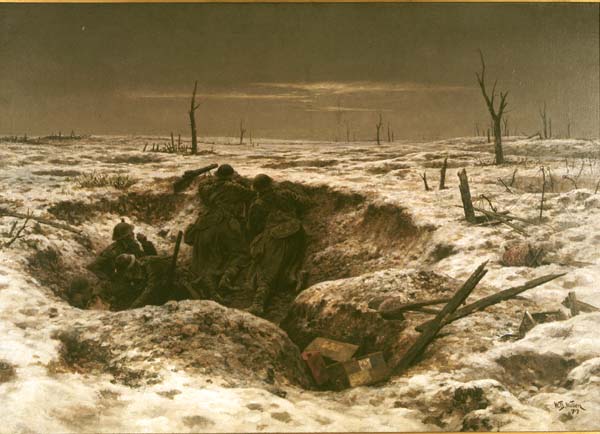
W.B. Wollen, Fleurbaix, Christmas 1916,(1919).
It's a WWI image of western Europe. I recall that at Gallipoli so many young lives were wasted for a campaign that was of little military consequence. It should be treated as one of the great military disasters of all time.
I look at images of the effects of the war machine and I can understand Heidegger's argument that we are engaged in the transformation of the entire world, ourselves included, into "standing reserves," raw materials mobilized in technical processes. In the process we have become little more than objects of technique, incorporated into the very mechanism we have created.
War discloses the way that technology constitutes a new type of cultural system that restructures the entire social world as an object of control. This system is characterized by an expansive dynamic which invades every pre-technological enclave and shapes the whole of social life.
I'm haunted by the spectre evoked by this kind of image:

Does not the presence of the haunting image dislocate us from ourselves and prevents us from taking up a position as subjects over against an objective field?
The sacrifice of war is what is required, say the new conservatives, to found and unify the nation. Out of catastrophe our nation emerges with a new sense of destiny. At the shrines of Remembrance we--that is, us as citizens---are told to close our eyes and imagine that we are in a boat heading for the Gallipoli shore, walking side by side with friends into inevitable tragedy---to our death.
Stop. Put the emergency brakes on quick. It's a nightmare narrative about inevitable tragedy enlargening and strengthening the soul. Why do we celebrate this? What is going on with the glorification of our death by the apologists for the warmachine? What kind of ethics are the conservatives proposing with their talk of tragedy, death and sacrifice?
I hear echoes of Ernest Junger in all of this. Did he not say that Germany's suffering in WW I was a prelude to a greater victory and a rebirth for the nation? War has a profound significance and the sacrifice of millions has a meaning that is primarily felt. What is being echoed is the vieww that nationalism is a part of the struggle against liberalism and lefties who see Gallipoli as nothing but futility and madness.
Is not this spirit being invoked in Australia today by the One Nation Conservatives. I cannot help but feel that the time is out of joint. Should we not think the ghost of Gallipoli when we hear the Anzac tradition invoked by the Right?
Does not Derrida's category of specter represent a certain undecidability between the living and the dead, the present and the absent, and the imagined and the actual? I think of the dead men coming back and the ghost (the Anzac Spirit) whose expected return repeats itself again and again. The specter of Anzac is the promise of its own future return that reveals to us the out-of-jointness of the times.
The spectre of Anzac haunts the present historical moment and the politics that it forebodes is the promise of law and violence. We should listen to the spectre that surrounds and inhabits us.
April 21, 2005
philosophy of technology
A good philosophy of technology should unite philosophical thinking about technology with the main philosophical traditions of the West. That is the pathway followed by Heidegger.
The dominant technological images are still associated with the military, industrial, and Big Science technologies. These are the images of a modernism, and they kinda come together with Chernobyl.
This was a time of technological determinism in which technology was praised for modernizing us, and blamed for the crisis of our culture. Technology becomes destiny.
Have things changed in the 1990s? In Big Science there is a shift away from physics to the biological sciences; from nuclear bombs and powerplants to gene splicing and other biotechnologies.
In industry there is a shift away from treecutters, dams and bulldozers to computers, high definition television, and satellite communications. We've gone digital.
Does that mean we have to understand Heidegger's machine metaphysics in a historical way? Is the philosophy of technology becoming more fragmented and pluralist?
April 19, 2005
Heidegger, Nietzsche, modern metaphysics
In Chapter 20 of Nihilism Heidegger says that Nietzsche's metaphysics represents the fulfilment of modern metaphysics. It is a metaphysics of subjectivity.
April 16, 2005
Heidegger & Descartes
I'm working my way through Chapters 15 & 16 of Heidegger's Nihilism. In these chapters Heidegger is developing his interpretation of Descartes cogito. In Chapter 17 I came across this passage:
"What Nietzsche already knew metaphysically now becomes clear: that in its absolute form the modern "machine economy", the machine based reckoning of all activity and planning, demands a kind of man who surpasses man as he has been hitherto. It is not enough that one posesses tanks, rplanes, and communications apparatus; nor is it enogh that one has at one's disposal men who can service such things; it is not even sufficient that man only master technology as if it werre neutal, beyond benefit and harm, creation and destruction, to be used by any body at all for any ends at all."
More is needed:
"What is needed is a form of mankind that that is from top to bottom equal to the unique fundamental eseence of modern technology and its metaphysical truth; that is to say, that lets itself be entirely dominated by the essence of technology precisely in order to steer and deploy individual technological proceses and possibilities."
April 15, 2005
Klossowski: Nietzsche's flaws
As we have seen in chapter 4 ('The origin of the Four Critieria') of his Nietzsche and the Vicious Circle Pierre Klossowski's psychoanalytic interpretation of Nietzsche holds that Nietzsche's questioning of Western culture is an aspect of the way he interrogated himself. Klossowski says that this questioning is done in terms of health and morbidity, which are seen by Nietzsche as differences of degree.
Klossowski then spots a problem:
"Nietzsche himself, in wanting to prove that traditional [Christian ]morality is the negation of life, continues to hestitate on the question of what constitutes the power and impotence of living ---thus he is unable to decide for himself what exactly is harmful."
Personally I thought that what is harmful is what stunts rather than enhances life.
April 14, 2005
trauma & language
Lars Iyer says that both Levinas and Blanchot share a concern with language and a witnessing of traumatic experience at the root of language that cannot be translated into the calmer conceptual discourse of philosophy. The issue between two is the way in which both trauma and witnessing bear upon, or determine, the structure of language and experience.
Language witnesses trauma. I'll put that to one side for the moment.
It suggests the Holocaust voices of testimony; deportees surviving in the concentration camps of the Nazis, or the prisoner working to death in the camps of the Gulag, or the killing fields of Cambodia. The very phrase "to bear witness" suggests the singular unspeakable traumas of the 20th century. That kind of trauma unsettles our everyday understandings and our ways of being in the world. Itleaves us with 'the unsaid' because the grand discourses of modernity do not make sense of that suffering.
It is hardly possible to assign a meaning to suffering of being worked to death in the Gulag in terms of a freedom to come,. as held by the labor of the dialectic of freedom. That means the equation of work and freedom, that characterize the great philosophical discourses of political modernity, are no longer tenable.There seems to be a gap between the bodily experience of those in the concentration camps and the Gulag and language.
As Lars says:
"The survivor cannot find the right words; the experience remains trapped in a body that can never narrate and thereby synthesize what happened. It is not a question of retrieving a memory, but of bearing witness to a trauma that was borne in common by the survivors."
April 13, 2005
Blanchot: a quote
In digging around looking for material on Blanchot on the way that he explores the limits of philosophy from the perspective of literature, I came across this site.
I was looking for material/reviews on Gerald L. Bruns' Maurice Blanchot: The Refusal of Philosophy but I couldn't find any. However, I did happen upon Ullrich Haase & William Large's Maurice Blanchot.
This quote caught my eye:
"The overarching question of Blanchot's thought is the meaning and possibility of literature. He does not understand literature in terms of a canon; that is to say, a hierarchy of great works to be judged according to their relative value. As we have pointed out, it would be impossible to find detailed textual criticism in Blanchot, even when his work is more traditionally presented in terms of a study of an author."
It sounds like a retreat into modernism with its apolitical promotion of a "pure" literature untethered to either ideological statements or grand projects to me. Literature is opposed to that of everyday life and the rational calculation of instrumentalreason. A modernist literature examines itself, the nature of the fictive act, and all this entails in terms of speaker, addressee, thought, and temporality/ies. So we have the fundamental opposition of literary modes of operation to those of the bourgeois world with its goal-oriented work, time, and technology.
More philosophically literature expresses the being of language that is prior to communication and so is not primarily about communication. Literature is a search for its original moment of emergence from the silence.
The blub continues:
"..for Blanchot, literature cannot be separated off into a sphere where all that matters are questions of value and good taste, as it touches upon fundamental philosophical questions. This explains why the most important writers for Blanchot are not other literary critics, but, on the one hand, philosophers, especially G. W F. Hegel (1770‑1831), Martin Heidegger (1889‑1976) and Emmanuel Levinas (1906‑95), and, on the other hand, those literary writers such as the Austrian (Czech) novelist Franz Kafka (1883‑1924), and the French Symbolist poet Stephane Mallarme (1842‑98), for whom the question of literature emerges from the activity of writing."
Literature puts philosophy into question because it questions the conceptuality of philosophy. Literature brings a difference into human life in which the systems and ontologies that govern the real world of everyday exchange and rationality no longer apply.
That is about as much as I could make out.
April 11, 2005
Nietzsche, nature
A comon interpretation of Nietzsche’s metaphysics of nature is that nature represented as an unknowable chaos. The finger is pointed at Nietzsche for the nihilistic sensibilities of modernity and he is judged to emptied human existence of intrinsic value. This interpretation of Nietzsche's metaphysics of nature that of Stanley Rosen and Leo Strauss?) nature is the standard for values, but since nature is chaos, then all values are relative to man’s will to power.
This is close to Heidegger's interpretation.
April 10, 2005
Heidegger, machines, metaphysics
In our contemporary, technologico-scientific age, the insurrection of subjective judgment or value thinking means that "the authority of individual conscience" has utterly assumed the position of the vanished authority of God and of the teaching of the Office of the Church.
We can link Heidegger's tracing of this modern metaphysics in Nihilism with the contemporary work on the history of philosophy. An example is that undertaken by the Carol Merchant on the mechanical view of nature held by seventeenth-century philosophy and science. Merchant says that, twentieth-century advances in relativity and quantum theory notwithstanding, our western commonsense reality is the world of classical physics.
"The legacy left by Newton was the brilliant synthesis of Galilean terrestrial mechanics and Copernican-Keplerian astronomy. Fundamental in generality, it describes and extends over the entire universe. Classical physics and its philosophy structure our consciousness to believe in a world composed of atomic parts, of inert bodies moving with uniform velocity unless forced by another body to deviate from their straight-line paths, of objects seen by reflected light of varying frequencies, and of matter in motion responsible for all the rich variations in colors, sounds, smells, tastes, and touches we cherish as human beings."
Merchant says that the following metaphysical assumptions about the structure of being, knowledge, and method make possible the human manipulation and control of nature.
"1. Matter is composed of particles (the ontological assumption).2. The universe is a natural order (the principle of identity).
3. Knowledge and information can be abstracted from the natural world (the assumption of context independence).
4. Problems can be analyzed into parts that can be manipulated by mathematics (the methodological assumption).
5. Sense data are discrete (the epistemological assumption)".
These assumptions have meant that science since the seventeenth century has been widely considered to be objective, value-free, context-free knowledge of the external world.
Merchant then connects these metaphysical assumptions to mechanism, (nature is a machine). She says that the new metaphysical understanding of reality in seventeenth-century philosophy and science was:
"... consistent with, and analogous to, the structure of machines. Machines (1) are made up of parts, (2) give particulate information about the world, (3) are based on order and regularity, (perform operations in an ordered sequence), (4) operate in a limited precisely defined domain of the total context, and (5) give us power over nature. In turn, the mechanical structure of reality (1) is made up of atomic parts, (2) consists of discrete information bits extracted from the world, (3) is assumed to operate according to laws and rules, (4) is based on context-free abstraction from the changing complex world of appearance, and (5) is defined so as to give us maximum capability for manipulation and control over nature."
This gives us a calculative-instrumental form of reason that can be deployed as a force of techne. This technological notion of reason merely commodifies physls, turns it into consumable energy, and so furthers Descartes's and Bacon's dream of technological mastery of the earth.
This then is the metaphysics that Heidegger explores in Chapter 15 of his Nihilism book (vol.4 of Nietzsche).Entitled 'The Dominance of the Subject in the Modern Age', it is concerned with the modern Cartesian notion of the self as the active master of its own fate, the one who by dint of its own willful determination employs technology as the means for subduing the earth.
April 9, 2005
About Heidegger's reading of Nietzsche
I am reading Heidegger's interpretation of Nietzsche in Bk 4 (Nihilism) of Nietzsche in this chapter by chapter way because Heidegger's reading of Nietzsche has generally inspired an impatient, hostile, reaction especially among those who take them-selves to know Nietzsche well. The problem, it is commonly said is Heidegger's interpretation; he misappropriates Nietzsche. Heidegger gets Nietzsche wrong. That reading is then excised.
We know Heidegger's interpretation by now: Heidegger's Nietzsche is the prophet of nihilism, and an advocate of human subjectivity or self-insurrection (as lord of the earth, seeking a destined technological dominion over the earth). He diagnosess Nietzsche as being himself ensnarred in this same metaphysics, which he spends so much time tracking.
The routine condemnation of Heidegger's reading of Nietzsche assumed in contemporary French and American Nietzsche interpretation and it is assumed that Heidegger's influence represents the main problem in the tradition of Nietzsche scholarship. Heidegger's reading of Nietzsche is not "good Nietzsche" -- by which is meant that Heidegger's reading is wrong because his reading is all about Heidegger's own obssessions. These are the traditional issues of philosophy, such as the Being-question, metaphysics, truth etc, through which Heidegger engages in a questioning of the history of the philosophic tradition in the West.
Heidegger is about all the heavy, dull metaphysical stuff that is detested by those working in the literary institution.The gay, mad, poetic Nietzsche disappears on Heidegger's reading. That is the interesting Nietzsche; not the Nietzsche who says that Heraclituss understanding of metaphysics as becoming and flux is closest to his own conception. Nietzsche's overcoming" metaphysics is a subversion of the Platonic tradition of metaphysics; it is displaced in favour of a Dionysian 'becoming and flux' metaphysics as will to power.
So Nietzsche's counter-movement against metaphysics, as the turning upside down of Platonic metaphysics, is still entangled in metaphysics.
April 8, 2005
Heidegger:dominion over the earth
Chapter 14 of Heidegger's Nihilism book (vol.4 of Nietzsche) is entitled 'The Statement of Protagoras'. The statement is that:
"Man is the measure of all things, of things that are, that they are, of things that are not, that they are not."
Suprisingly, Heidegger argues that there is little trace here of a subjectivist metaphysics in which being as such has to be orientated by the self-posited ego as subject. This is what we find in Descartes. Heidegger says though Descartes' metaphysics is not independent of Greek metaphysics, his metaphysics is essentially removed from it. That makes the pre-Socratic metaphysics of Protagoras something other to the metaphysics of modernity.
I'm in no position to judge Heidegger's interpretation of Protagoras. I do remember that Protagoras was commonly interpreted along subjectivist lines by those analytic materialist philosopher enamoured of a modernist physicalist metaphysics. We will put Protgaoras to one side.
That then leaves us with the question: where does the subjectivist metaphysics come from in modernity? Descartes surely, is my quick response. In his Discours of Method(1636), Descartes spoke without equivocation of men as "the masters and possessors of nature." Not only is nature a mindless or soulless pile of inert things which, through the cultivation of knowledge, human beings are entitled to master and possess, but the bodies of human beings are visualized and represented as a machine.
Heidegger thinks of Descartes' metaphysics in terms of will to power and dominion over the earth.
Suprisingly, Heidegger mentions Machiavelli but not Francis Bacon, even though Bacon was, along with Descartes, the other master shaper of modernity as the age of technology. Bacon, like Descartes, sought a new and apodictic foundation of human knowledge based on the liberation of man from the ancient and medieval tradition of the West.
Bacon was the intellectual harbinger and architect of the modern age of science, technology, and the utilitarian economy: he is "the first philosopher of the modern age" to generate the technological and industrial ethos of modernity. Bacon upheld the convergence of theory and practical operations, of knowledge and utility, and of knowing and making. "Domination" and "utility" are the guiding ethos.
Now the Baconian conception of technology as instrumentum has been overtaken by "autonomous technology" since technology has now become end itself rather than means as ends are subverted by means. As the latter Heidegger pointed out the essence (Wesen) of technology (Technik) is not technological. Technology is no longer the application of the mathematical and physical sciences to praxis but is rather a form of praxis in and of itself The idea that technology is applied knowledge and instrumentum is now obsolescent. Technology indeed "discloses" and "enframes" the being of man and the world. In the age of technology as "enframing" (Gestell), there is a "reverse adaptation" between man "the master" and the machine "the servant."
Still it is suprising that Heidegger does not mention Francis Bacon in his tracking of a technological metapahysics in early modernity.
April 4, 2005
Heidegger, modern metaphysics, subjectivity
Chapter 13 of Heidegger's Nihilism book (vol.4 of Nietzsche) is entitled 'Metaphysics and Anthropomorphism'. It puts valuative thinking to one side to explore the metaphysics of modernity and Nietzsche's relation to it. This is Heidegger beginning to confront the western metaphysical tradition.
Heidegger says that modern metaphysics is characterized by the special role of the human subject and the appeal to human subjectivity. He traces this back to Descartes:
'At the beginning of modern philosophy stsands Descartes' statement Ego cogito, ego sum, "I think, therefore I am." All consciousness of things and of beings as a whole is referred back to the self-consciousness of the human subject as the unshakeable ground of all certainity. The reality of the real is defined in later times as objectivity, as something that is conceived by and for the subject as what is thrown and stands over against it. The reality of the real is representedness through and for the representing subject."
Heidegger then adds that:
'Nietzsche's doctrine, which makes everything that is, and as it is, into the "property and product of man" merely carries out the final development of Descartes' doctrine, according to which truth is grounded on the self-certainity of the human subject.'
This subjectivity or anthropomorphism is then linked back to Protagoras' view that "man is the measure of all things", with Heidegger claiming that western metaphysics is really centred on the unconditional dominance of human beings of all being.
This interpretation is what Heidegger will defend.