January 31, 2010
Barbara C Mensch + Brooklyn Bridge
Barbara Mensch is best known for her photographs of the old Fulton Fish Market, to which two books have been devoted. She has also photographed the Brooklyn Bridge for nearly 30 years.
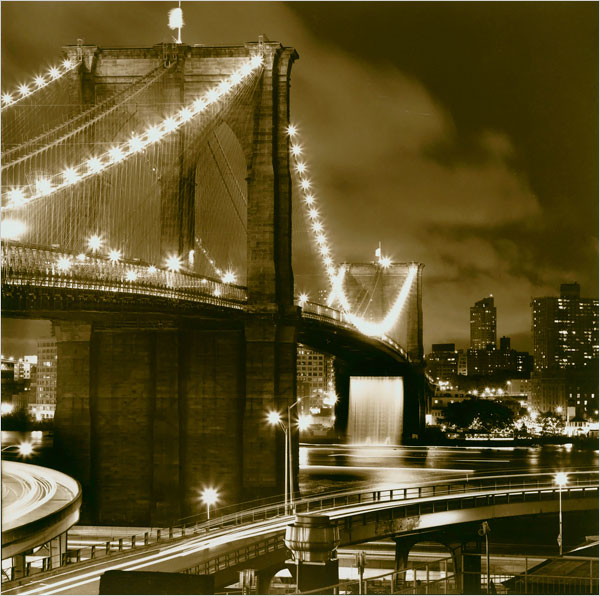 Barbara C Mensch, "Waterfalls 1," 2008
From windows facing west and from the roof of her loft, Mensch has views of the Brooklyn Bridge's span and the Municipal Building and the bridge has been a constant in her life and her art.
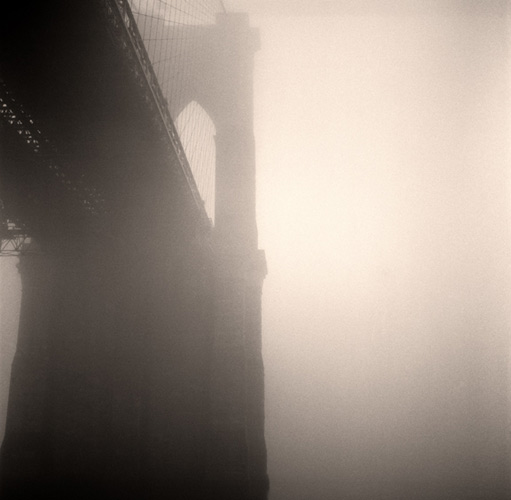 Barbara Mensch, Brooklyn Bridge, (2000)
The Brooklyn bridge is definitely one of the most photographed bridges in the world since its construction over a 14 year period beginning in 1870. It was the first steel-wire suspension bridge ever built.
January 28, 2010
Apple's iPad
I tried to find a live video feed of Apple's launch of the iPad in San Francisco early this morning but there was none working. Twitter, however, was full on and I followed the live blogs of the event. Is there actually room for a multitouch screen tablet device between smartphones and laptops? Apple certainly thinks so.
Hence the minimalist designed iPad with synchronisation, wireless and 3G connectivity that functions as a web browser, bookshelf, video player, game console and communication device. It also has the capability to download photos from a camera. It has an entry price of $US500.
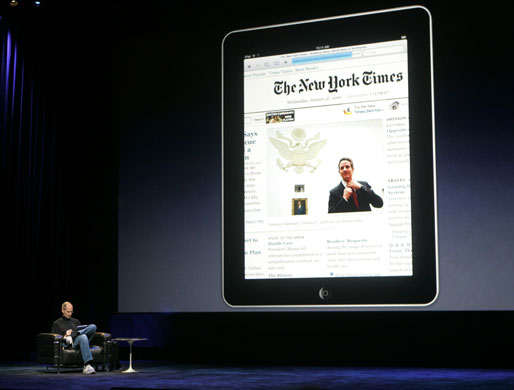
This is basically Apple's entry into the netbook market, using the stuff it's learned from the iPhone. Using it will be familiar to anybody who has tried an iPhone: it uses the same combination of swipes, pokes, jabs and sweeps of the finger of its smaller cousin. So sweeping your hand across its reactive 9.7-inch screen will feel satisfying and natural. But it does not have a camera, it means surfing the web without Flash and no multitasking.
There doesn't appear to any significant differences between the iPad and the iPod Touch, other than its size. It is a portable internet, full-fledged media device. Do people want a big iPod touch with e-publishing support? Who is going to use this? Is it for the casual surfer infront of the TV or existing iMac/iPhoners? I'm a Mac user and I'm not sure how this fits into my life. Where does one stick the iPad? I would worry about that glass screen bouncing around in your briefcase or backpack naked?
A lot of print media types hope that the iPad can really help move the ebook concept on a stage and help them start making money. It is unlikely to be a gamechanger, and unlikely that people will they pay for the same content they can get online for free. Mathew Ingram at Gigaom says:
Another thing the iPad makes abundantly clear is that if you want to succeed in a world ruled by a giant iPod touch, you had better develop (or acquire, or partner with someone who has) some serious multimedia chops. This device is designed to do large full-color photos, full-screen video (even HD) and much more. If all you have is a traditional newspaper-like page with a few small photos and some grainy video, you are going to get left in the dust.That might make things easier for magazines like Conde Nast, which are used to dealing with large-format, high-quality images and which understand design. But if you’re a newspaper, let’s be honest — large, high-quality images are not exactly your thing.
He adds:
Think about it this way: Have iTunes and the iPod rescued or saved the music business? Hardly. If anything, they have only accelerated the disruption in that industry, and exposed how out of touch, out of control and cost-prohibitive most of it still is when it comes to doing business online. The web has been doing the same thing to traditional media for the past decade or so, and devices like the iPad are only going to accelerate that process.
Secondly, the backlit screen doesn't come anywhere near the clarity of electronic ink, which means it's going to prove a lot harder on the eyes of book readers.
It is essentially a niche device in it’s current form: a media player that’s too large to carry around comfortably in your pocket, too small to be preferable for movie viewing to the TV, and could even represent a significant recurring money drain if you get 3G service. Will the iPad will be carried around the house and in bags to and from schools, colleges and workplaces?

It appears to be a screen for reading and watching—at some loss of convenience in creating even though it has an on-screen keyboard---and so a consumption device for playing movies and games at very high resolution. It is a little portable entertainment center connected to the AppStore, iTunes store, and the new iBook store. So we have an all-purpose content consumption device that opens the door to a digital library--a library without books. This is important since books have become so expensive that I've stopped buying them. Apple is going after the Kindle for sure.
Personally, as a heavy power user, I’m more concerned with getting stuff done than having a mobile entertainment device. However, I can see that it would be a way to present a portfolio of photos to people.
January 23, 2010
a Kodak culture
In A Life More Photographic in Photographies (March 2008) Daniel Rubinstein and Katrina Sluis say about an online digital Kodak or Nokia photographic culture that:
The distribution and sharing of snapshots online highlights a paradoxical condition that characterizes snapshot photography: it is both ubiquitous and hidden. Since the beginning of the twentieth century the snapshot has been the archetypal readymade image: placeholder for memories, trophy of sightseeing, produced in their millions by ordinary people to document the rituals of everyday life. And yet despite being the most mass produced photographic product, the snapshot has remained highly private, concealed from public eye, and quite often an invisible image. When snapshots do appear in public, whether in the context of fine art exhibitions and publications or in s stripped of notions of authorship or details about the original purpose of the image, its subjects and the circumstances of its creation.
Looked at as a genre, snapshot photography seems to have many imitators but no recognized originals, many admirers but no masterpieces, many iconoclasts but no icons.
January 19, 2010
Clement Greenberg's aesthetics
Clement Greenberg's late Homemade Aesthetics (circa 1971)--roughly the time of the Conceptual Art movement----rests upon upon the substantial body of his earlier work.
One of the assumption of this body of work was his claim about aesthetic judgments and the nature of taste. Greenberg held that taste was involuntary and intuitive in nature, and thus as incorrigible and objective. Involuntary means what we cannot help but do. "You no more choose to like or not like a given item of art than you choose to see the sun as bright or the night as dark," he claims in "Intuition and the Esthetic
Experience". The question to ask here is why are aesthetic judgments involuntary and objective, rather
than being governed by specific theories or individual preferences?
Though Greenberg saw judgments of taste as involuntary, he also saw them as capable of revision or improvement. He conceived of taste as a faculty that could be "developed" or "cultivated" through increasing exposure to art—both through a broadening of the range of experience and through repeated encounters with the same works— and through reflection upon what was seen (or heard, or read).
Another Greenberg assumption was to establish the virtues of the work he admired by reference to a specifically modernist tradition and to an inherited agenda of technical concerns and problems set by an existing canon of Modernist art—rather than, say, by reference to any topical concerns or socially critical values the work might be thought to express. It is first and foremost in terms of artists' evident engagement with modern artistic conventions that the critical virtues of their work appear to have been established for Greenberg.
January 18, 2010
art and the commodity market
In Notes on Art as/and Land Reclamation in October Vol. 12 (Spring, 1980) Robert Morris says:
The production of art works in this late industrial age has for the most part been circumscribed and structured by the commodity market. Beyond this, most artistic careers follow the contours of a consumer-oriented market: a style is established within which yearly variations occur. These variations do not threaten the style's identity but change subsequent production enough to make it identifiably new. Such a pattern then comes to be seen as natural and value-free rather than a condition of art distribution and sales. Strictures for change under different social conditions might emphasize disjunctive change, or no change at all.The modes for all change, or nonchange, in production, including art, may be limited to three: static, incremental, and disjunctive.
Morris goes to say that a given rate change for art production provides a context and coherence beyond a strictly economic referent: it providesthe infrastructure for the culture's art history:
Beyond this, the mode of art paralleling commodity production with its basic style/yearly variation yields good as well as bad art. While this has proven obviously more economically sound for artists than either the static or disjunctive modes, it is probably safe to say that the disjunctive, when effective, for whatever reasons, has been granted greater cultural value, either in terms of individuals or movements. (
Hence the need for some critical edge to art. But what sort of critical edge?
January 15, 2010
Bowie: Diamond Dogs
I've always had a soft spot for David Bowie's post Ziggy Stardust title track from his Diamond Dogs album. Thgis Bowie the rocker.
The album, the last wheeze of Bowie's glam rock period, is not much as a 1984 concept album. However, —“Diamond Dogs” along with a “Rebel Rebel”—have all the storm and frizzy froth of Ziggy’s best.
January 13, 2010
the conjunction of aesthetics and political economy
I see that Steven Shaviro at The Pinocchio Theory argues for the relevance of the beautiful rather than the sublime (and Kant’s “Analytic of the Beautiful” in the Third Critique. He reverses the postmodern preference for sublime over the beautiful by privileging beauty over the sublime. So what is meant by beauty? A feeling without a concept?
Shaviro says:
Most aesthetics of the past century has been focused on the sublime, and has disparaged the beautiful. This is because the sublime involves a moment of rupture or disproportion, whereas the beautiful seems to involve accommodation, comfort, and proportion. Thus, for instance, Roland Barthes is clearly on the side of jouissance (which is sublime) as opposed to mere plaisir (which corresponds to the beautiful).I argue, however, that Kant’s analytic of the beautiful remains important, because it is really a nascent version of what Deleuze calls singularity. A judgment of beauty is non-cognitive and non-conceptual; beauty is that which cannot be subject to rules, or derived from rules. It is always a singularity or an exception. It cannot be reduced to norms.
He says his book in progress, The Age of Aesthetics, reads science fiction in the light of our recent history of commodification, privatization, capital accumulation, and financialization, in order to think through the conjunction of aesthetics and political economy.
On the one hand, 21st century marketing and commodity production seem increasingly to be concerned with questions of “aesthetics”...This is so, both in the manner of Fredric Jameson’s suggestion that “everything in our social life — from economic value and state power to practices and to the very structure of the psyche itself — can be said to have become ‘cultural’ in some original and yet untheorized sense”, and in the way that the aesthetic attributes of our existence have themselves become commodified and marketed, so that today we are incited to purchase, not just tangible commodity objects, but also such things as events, experiences, moods, memories, hopes, and desires.
I cannot see the cutting edge of the beautiful in this conjunction of aesthetics and political economy. It is this conjunction that needs to be questioned as well as the return to beauty as an eternal value by cultural conservative art critics (eg., Hilton Kramer and Roger Kimble) who oppose it to the marketplace.
In contrast, Shavior argues for immanent conception of beauty --a conceptual engagement with 'feelings without concepts'. In his Beauty Lies in The Eye beauty refers to the loss of aura without the shock or trauma; more to Andy Warhols "It's great." The Kantian bit reres to beauty disconnected from morality or utilty and to a kind of passivity or indifference that is still very much of this world. The judgement is entirely singular as there is no concept to determine it, and yet the judgement is universal and we demand assent from others regarding it.
January 11, 2010
photographic criticism #2
As we have seen in an earlier post Sontag's early formalist position was that the project of interpretation is largely reactionary, stifling.
Like the fumes of the automobile and of heavy industry which befoul the urban atmosphere, the effusion of interpretations of art today poisons our sensibilities. n a culture whose already classical dilemma is the hypertrophy of the intellect at the expense of energy and sensual capability, interpretation is the revenge of the intellect upon art. Even more. It is the revenge of the intellect upon the world. To interpret is to impoverish, to deplete the world—in order to set up a shadow world of “meanings.”
What is missed here is photography's dual role in mediating both personal recollection (in the form of autobiography) and collective memory (in the guise of history) that can be linked to the quintessentially modern experience of a perceived loss of authentic connection to the past, which photography seeks to replace but cannot.
January 7, 2010
A Hard Rain's gonna fall
The health impact or effects of the proposed expansion at BHP's Olympic Dam open cut uranium mine in South Australia is explored in "A Hard Rain" by independent documentary filmmaker David Bradbury of Frontline Films, 2007. This exploration of the radiation effects of the exposure of radioactive materials in the tailings from the uranium mining is definitely filming on the frontline.
A wider selection of interviews from the documentary film can be found here.
Bradbury argues that all that glitters is not gold. Short term windfall profits for BHP Billiton and a handful of jobs if the next federal government approves the Olympic Dam expansion will reap a spiral in cancer rates and birth defects the like of which this nation has never known. When they mine uranium to extract the yellowcake, more than 80% of the radiation stays behind at the mine in the form of radioactive tailings.
Because of the sheer volume of tailings – the waste material left over after the uranium and valuable minerals are extracted - will be largely dumped on the surface at the minesite. It has been pulverized into fine dust size particles and dumped there, ready to blow in the wind or weep into the water.
Radiation travels on the wind, and the fine radioactive particles can easily blow to the dense population centres of Sydney (l300k), Melbourne (l000k) or Adelaide (522k) away from the Olympic Dam minesite
January 6, 2010
photographic criticism
What is the role of the (photographic) critic and their task in late modernity? We can find some suggestions in G.F. Mitrano's The photographic imagination: Sontag and Benjamin in Post Script, Wntr-Spring, 2007 I am interested in this because photographic criticism is devalued in Australia and there is little reflection about this kind of activity or what role it plays vi-a-vis art.
Though Mitrano explores Sontag's debt to Walter Benjamin in understanding the role of the critic, my interest in this post is with Sontag's early formalist understanding of criticism. Mitrano says:
Before encountering Benjamin, Sontag conceived of criticism as a secondary kind of writing associated with rumination and opposed to the 'first idea' of literary productivity, synonymous with freshness, youthfulness, novelty. In his approach to photography Benjamin passed on to Sontag a viable and explanatory narrative of the critical act, which freed her from her formalist confinement. This narrative, which I will call the narrative of the gaze, equates interpretation with the anticipation of an answering gaze; it joins visual questions to hermeneutical problems.
Mitrano adds tthat while Sontag borrowed from Benjamin's conception of the critical act as inserted into a narrative of the gaze, she became increasingly concerned with notions of the gaze that are excessively rigid. In her later work, she became worried that meaning--photographic meaning--would congeal into theatrical externalization, that being would be reduced to posing. In Regarding the Pain of Others, she outlines a desolate landscape where photography rather than suggesting a vista of meanings--Benjamin's dream collective--risks becoming a form of collective instruction.
Early Sontag--pre the encounter with Benjamin--envisioned criticism on formalist grounds and was concerned with the persistence of the form/content split, despite the New Critical dogma proclaiming their unity. In "Against Interpretation," she questioned the use of literature as cultural documentary evidence in the service of conceptual systems and ideological causes, a use that showed no regard for literature's aesthetic knowledge Why do we keep distinguishing between form and content? Why are we afraid of the aesthetic element in literature?
Mitrano says that Sontag was still working with a rather traditional notion of interpretation. She thought that: "great art induces contemplation" and that "the reader or listener or spectator ... must be detached, restful, contemplative, emotionally free, beyond indignation and approval" ... For the most part, she echoes Rene Wellek's view of aesthetic experience. Summing up the dominant position of the 1940s in Theory of Literature, Wellek (and co-author Austin Warren) define the aesthetic object as that which the reader does not attempt to reform, possess, or consume, but as something that induces contemplation or amorous attention ... While Sontag transforms Wellek's amorous contemplation into "dynamic contemplation" .... she basically agrees at this stage with the traditional notion of interpretation as individual or comparative commentary aimed at evaluating bad and good literature.This traditional view suggests the idea of the critic as the solitary hermeneute in their study. This model defended the singularity and originality of the critic as reader and suited modernism in the earlier struggle against mass culture.
What is rejected is interpretation of the text or the image within the semiotic world with interpretation seen as the intellect's revenge upon art. It is an anti-theory position in that interpreters -- people who "translate the elements of the poem or play or novel or story into something else" -- are philistines.The true task is not to ask what the work means but to appreciate what it is.Sontag says:
Of course, I don’t mean interpretation in the broadest sense, the sense in which Nietzsche (rightly) says, “There are no facts, only interpretations.” By interpretation, I mean here a conscious act of the mind which illustrates a certain code, certain “rules” of interpretation. Directed to art, interpretation means plucking a set of elements (the X, the Y, the Z, and so forth) from the whole work. The task of interpretation is virtually one of translation. The interpreter says, Look, don’t you see that X is really—or, really means—A? That Y is really B? That Z is really C?
The modem style of interpretation excavates, and as it excavates, destroys; it digs “behind” the text, to find a sub-text which is the true one. Sontag see herself as defending art against interpretation.
January 3, 2010
Unreasonable Films: The Photographer
Unreasonable Films is the collaborative project of Jason Sweeney and Fiona Sprott, who are part of Headquarters Studio in Adelaide, South Australia.
An example of their work: 'The Photographer' from 2006:
What is intriguing is the multilayering and multiple perspectives.