May 20, 2013
desiring real pictures
The invention of the digital camera has meant that photography has become an accessible art form for so many people. By the first decade of the 21st century film-based photography had become a niche activity.
One critical reaction to the new world of digital photography comes from Richard White, an Australian large format photographer based in Victoria He says that this new style of photography seems to be everywhere and it seems to be done to death. We are over saturated with imagery to the point that people don’t notice the good pictures any more.
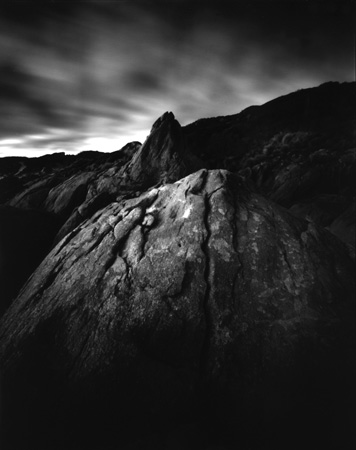 Richard White, West Cape, Cape Conran,
White adds:
I am over the over saturated, over manipulated, over worked, over done vacuous pictures that pass for photography these days. The composite images that fool us without clarification, the jacket that was photographed blue, but changed to red because some geek has squeezed it into some software package that has been designed to deceive us with its clever tricks. I am over all the false colours that appear in images most of the time, because mainly people have been heavy handed with the slider and maybe they are trying to cover up their inadequate image.
The quality of imagery, he says, has declined and we are over saturated with banal and meaningless carnival pictures.
Photography for White is analogue photography which is different from digital photography. His argument against the latter is that falsifying or changing colours past the point of no return is misrepresenting nature. He wants real pictures,bwhich for him seem to be large format classic black and white, even though he acknowledges that black and white is also an abstraction from nature.
May 18, 2013
Ian Macdonald NZ photographer
Ian Macdonald graduated from Elam, Auckland in 1975 majoring in photography. He has exhibited and been published consistently since and is known for his photography on New Zealand environmental issues. He ran Real Pictures Gallery during the 1980s and more recently the Matakana Pictures Gallery.
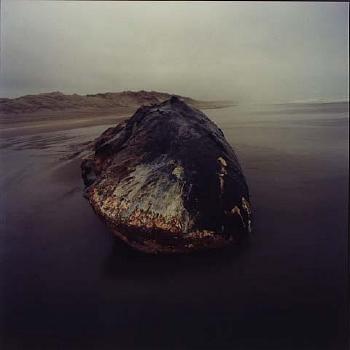 Ian Macdonald Whale Stranding at Muriwai Beach No.21, C-type photograph, 1975
He works commercially as a photographer most recently as the stills photographer for the BBC Science Department.
Real Pictures Gallery was an Auckland based dealer gallery established and run by Ian MacDonald, which operated from 1979 until 1990. It was almost exclusively dedicated to the exhibiting of New Zealand photography. Matakana Pictures Gallery -was one of New Zealand's three specialist photography galleries. It ran as a dedicated photography gallery for a year before closing in 2006.
Macdonald is known for his tree studies
May 17, 2013
Gerhard Richter: Cathedral Square, Milan
Cathedral Square, Milan is one of Gerhard Richter's largest figurative paintings. The work features the northern side of the cathedral square, onto which the shopping centre Galleria Vittorio Emanuele II faces. The façade of the 19th century Galleria covers a large area of the painting’s left side. This is a contrast to the right of the picture, where one can see two left side aisles of the gothic cathedral and the adjacent square.
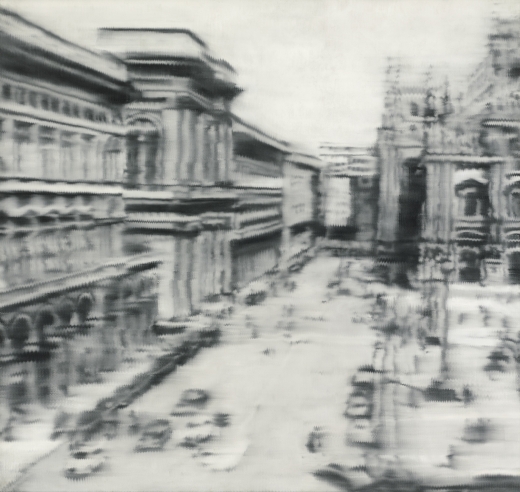 Gerhard Richter,Cathedral Square, Milan, 1968
This painting was a commissioned work for the company Siemens Elettra and it remained at the company's headquarters in Milan for 30 years. According to Richter, this commission was the beginning of an ongoing preoccupation with townscapes.
The blur is a corruption of an image, an assault upon its clarity, one that turns transparent lenses of photography into opaque shower curtains, gauzy veils. The photos are often from magazines or newspapers and he foregrounds the fact of mediation.
May 13, 2013
Judith Crispin: familiarity and un-familiarity
Judith Crispin or Hsien-Ku 's The Cartographer's Illusion explores how our own memories, our own experiences, overlay the act of seeing itself. The photograph becomes like a prism which transforms the light which passes through it – a language of symbols carved in light.
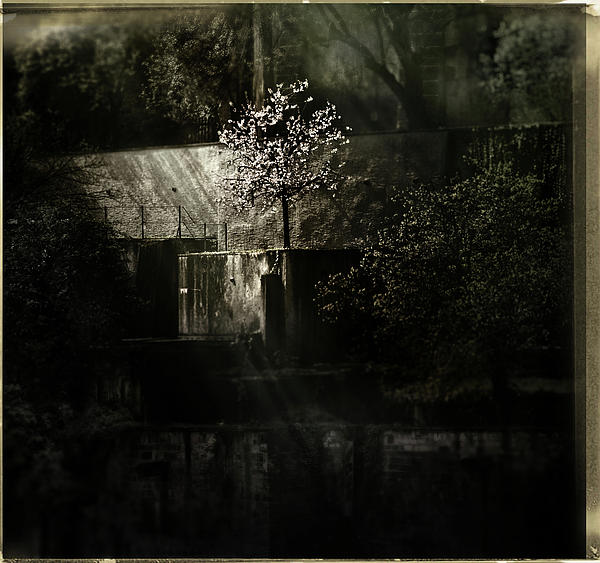 Judith Crispin The High Wall, 2011, from The Cartographer's Illusion
The photographs in this series represent the imperfection and strangeness of the life Crispin has been given, and its beauty and sadness too.
May 7, 2013
Jean-Michel Basquiat: Riding with Death
One of my favorites of Jean-Michel’s Baquiat's work. The background is more metallic, lighter, more spectral.
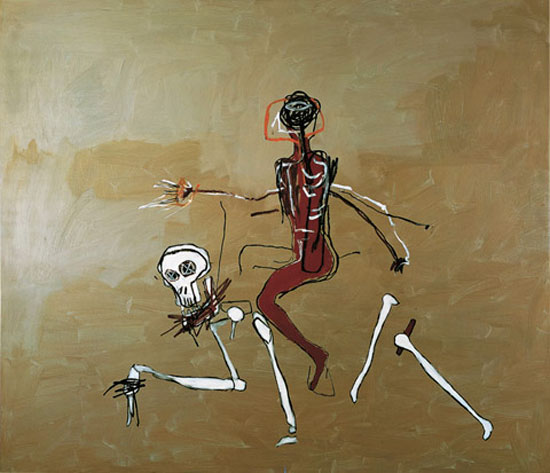 Jean Michel Basquiat, Riding with death, 1988
This painting has been grounded with a dull, gray paint, a departure from the colorful backgrounds the artist typically employed. In the work’s center, a faceless figure is shown riding a skeleton, the back of its head facing the viewer.