April 28, 2013
Photography and the American Civil War
The Metropolitan Museum of Art in New York, USA, has an exhibition entitled Photography and the American Civil War. This war—its documentation, its soldiers, its battlefields—was the arena of the camera's debut in America.
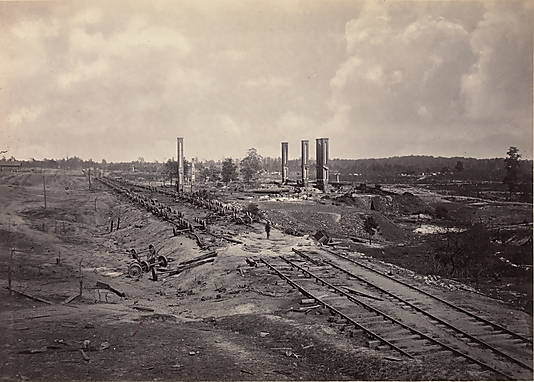 George N. Barnard, Destruction of Hood's Ordinance Train, Albumen silver print from glass negative, 1964
This depicts the aftermath of the destruction of a Confederate military train filled with gunpowder. When abandoning Atlanta, Confederate General John Bell Hood ordered his troops to set the boxcars on fire so that the Union army would never be able to make use of the train. The explosion also completely leveled the nearby mill, leaving evidence of only a few rail wheels and axles.
Barnard worked for the well-known studio of Mathew Brady, both in New York and Washington, D.C. His duties included studio portraiture as well as non-studio group portraiture of the troops assembled in Washington at the start of the Civil War. His views of Civil War battlegrounds---Nashville, the Chattanooga Valley, Atlanta, and Savannah, as well as other sites associated with General Sherman's command, were sometimes taken months after the battles.
April 26, 2013
Neil Pardington: The Vault
Neil Pardington's photograph Mammal Attic #1, Canterbury Museum, shows a room (barely) containing a taxidermied elephant with an ominous tear in its shoulder, and in front of it a shark – its fin visible behind a set of steel shelves.
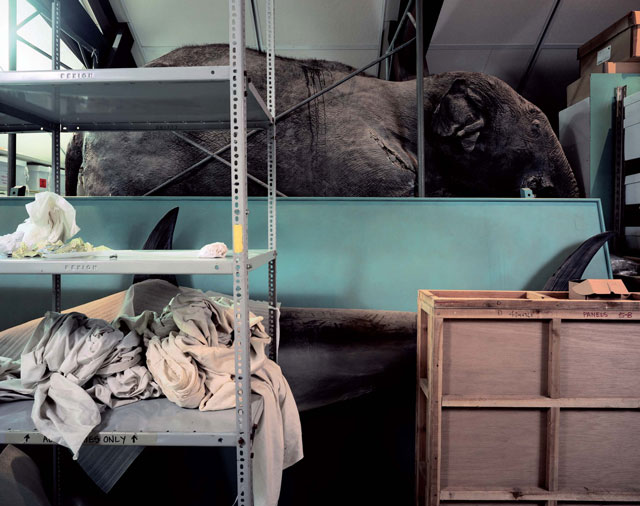 Neil Pardington, Mammal Attic #1, Canterbury Museum, 2007, Lambda/C-print, from The Vault series
The wooden crates, shelves and scrunched together cloths in this image suggest the activities of preserving, cataloguing and caring for the curious miscellany of objects deemed worthy of exhibition in New Zealand's national institutions.
April 14, 2013
wet-plate collodion process in photography
Sally Mann’s series ‘Battlefields’ uses a wet-plate collodion process, as can be seen in the edges and streaks and cracked glass of the images. These pictures are of empty landscapes that refer back to the American civil war.
This is a study of the grounds of Antietam, the site of the bloodiest single day battle in American history during the Civil War. The Battle of Antietam had over 20,000 casualties.
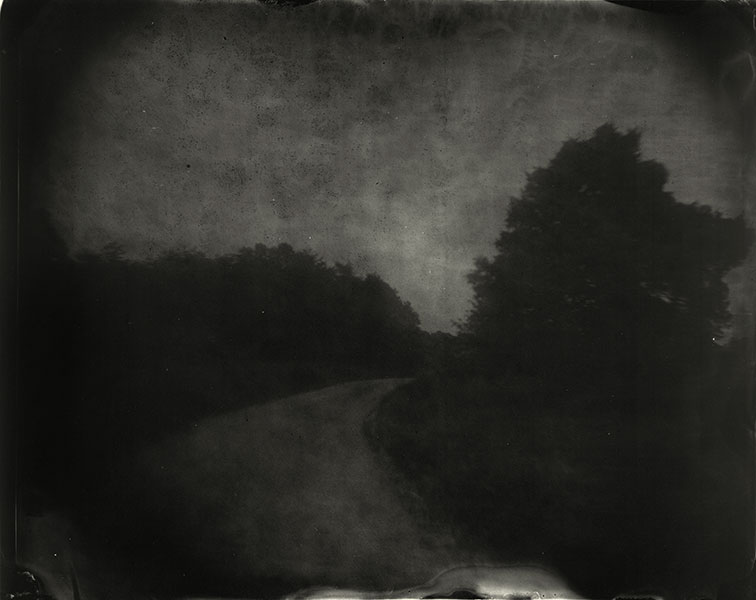 Sally Mann, untitled, from Battlefields 2000-2003
Mann has remained most interested in black and white, especially photography's antique technology. She has long used an 8x10 bellows camera, and has explored platinum and bromoil printing processes. In the mid 1990s she began using the wet plate collodion process to produce pictures which almost seem like hybrids of photography, painting, and sculpture.
It's an interesting process but does it make the past meaningful to us? What we see is a gloomy landscape. Does this create a sense of connection to the past for us?