October 26, 2011
Mark Strizic: Australian photographer
Mark Strizic viewed Australian life in the 1950-60's through post-war European eyes and he did not celebrate Australia becoming a modern industrial society as did Max Dupain. He photographed both the destruction of buildings, before, during and after the wreckers were busy and Melbourne's historical architectural beauty, with its romantic European skyline of spires, cupolas and arches that was disappearing fast.
 Mark Strizic, Construction Site With Cranes, c1950s. Vintage silver gelatin photograph
He worked across a wide range of photographic fields including urban, industrial, commercial, and architectural photography. and his images of architecture and of life were a representation of the changing face of a migrating society of new prosperity, youth and popular culture. His Melbourne was a city in transition.
 Mark Strizic Humes Culverts, c1950s, Vintage silver gelatin photograph,
In 2007 the State Library of Victoria acquired Strizic's entire archive of about 5000 negatives, colour transparencies and slides. Some were on display in this exhibition that I saw when I was in Melbourne.
October 15, 2011
energy + market externalities
The text below is from Energy: Friend or Enemy? by William D. Nordhaus in the New York Review of Books. In his review of The End of Energy: The Unmaking of America’s Environment, Security, and Independence by Michael J. Graetz Nordhaus says that though energy is commonly seen as our friend it has become a foe.
What has converted energy into a foe is its unintended side effects, or what are known in the environmental literature as “externalities.”An externality is an activity that imposes uncompensated costs on other people. Externalities from energy use include the deadly air pollution emitted by cars and power plants, oil spills, radioactive emissions from nuclear power plants, sludge from coal mines, and congestion from overloaded streets and highways. More recently, scientists have focused on greenhouse gas emissions, such as the carbon dioxide that comes from burning fossil fuels, as a particularly dangerous externality.
Nordhaus goes on to say that Graetz argues that the central problem in energy policy has been the failure to deal with external effects:
Although our government has enacted thousands of pages of energy legislation since the 1970s, it has never demanded that Americans pay a price that reflects the full costs of the energy they consume. Nothing that we did or might have done has had as much potential to be as efficacious as paying the true price.
There in lies the reason for an emissions trading scheme to deal with greenhouse gas emissions.
October 7, 2011
'clearing out the old to make way for the new'
The market has changed. Innovation now is primarily web-based in that the product is us - not a new computer or software.
It's our habits, location, friends, likes, dislikes, health, travel plans, eating habits... Us. We think we're getting Google or Facebook or even Twitter free. Really, they are getting us cheap, and selling us to advertisers at a mighty profit.
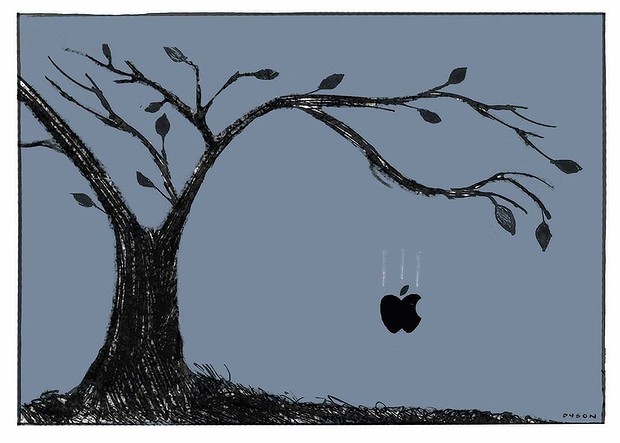
They have taken up Steve Jobs quote---"You've got to start with the customer experience and work back to the technology, not the other way around" and changed its meaning in a digital information world.
October 5, 2011
the dominance of an art form
Ellen Levy in Borrowing Paints from a Girl: Greenberg, Eliot, Moore and the Struggle between the Arts in the Modernism/Modernity journal explores the idea of the dominance of an art form and the struggle for dominance between literature (word) and the visual arts (image) circa 1940 in the cultural context of modernism.
October 3, 2011
a digital public space
We need a digital public space.This redesigns the internet so that institutions would make publicly owned content available, free, for non-commercial public use. That content could be used elsewhere for commercial projects – but at a cost. It is reclaiming the public domain in the sense of citizens having the right to access and interact with the countries social and cultural assets online. It implies a Digital Australia that is digitally literate, educated and ready to exploit the new technologies
At its minimum it appears to be associated with the BBC and other cultural institutions in the UK, including museums, archives, libraries, galleries and educational bodies, all of whom share a vision of not simply using Internet technology as a distribution channel, but instead being part of that digital environment as it evolves: being part of the Web, rather than just on it.The idea of a Digital Public Space, conceived by the BBC as a place in which public collections of film, video, sound, and other digitised objects can collectively overcome rights and access barriers, is a welcome recognition that this new digital public sphere has first to be organised and established.
Mo Roberts says:
It aims to be an access point for all of the UK's cultural archives, marrying together both the rich information which has been carefully collated, checked and double-checked over the years by experts in their respective fields, with the more immediately-accessible higher level information and audio-visual material, both from the partners and around the Web.
I presume that this would include a comprehensive library of digitized books that will be easily accessible to the general public would be part of the idea of publicly accessible cultural content---movies, music, images, books, documents, texts, magazines etc. There is a real need to open up the Australia’s public resources.
Do we have a concept of Digital Australia? One that actively supports the growth in the creative and digital sectors and the the availability of public service content?
We, as typical education consumers, are changing from someone who was satisfied by text and rote learning perhaps ten years ago into someone who now looks to learn from and produce with the gamut of rich media available in his or her daily life. So the initial push is on educational and cultural institutions – universities, public television, publishers, producers – to release more of their courseware, programming, books, and pedagogic materials as ‘teaching, learning, and research resources that reside in the public domain or have been released under an intellectual property license that permits their free use or re-purposing by others.
October 2, 2011
online at home
In her Home offices and remote parents at Inside Story Melissa Gregg outlines her research on technology’s impact on the lives of employees in the information and communication spheres of the “knowledge economy.” Wireless broadband was the technological advancement that helped the family stay online and be together. Gregg says:
Our interviews revealed the extent to which these new technologies [ social networking sites] encourage the tendency among salaried professionals to put work at the heart of their daily concerns, often at the expense of other sources of fulfilment and intimacy. The growing attraction of mobile communication devices is one of the strongest indications that a substantial number of people see paid employment as the most compelling demonstration of virtue, accomplishment and self-identity that society makes available. With a range of online subcultures developing in support of these tendencies, a mutually reinforcing cycle of chronic connectivity has developed among professionals at each level of the workplace hierarchy.
The quality of home life is irrevocably affected by attention-seeking technologies. Indeed, in many cases, online devices appear to be as demanding and compelling as children.