September 28, 2011
having a social network presence
Adrian Short has an interesting post on the shifts that are happening on the internet after the emergence of Web 2.0. He states the core problem:
Anyone who’s ever run a website knows that building the site is one thing, getting people to use it is quite another. The smaller your real-world presence the harder it is. If you’re a national newspaper or a Hollywood star you probably won’t have much trouble getting people to visit your website. If you’re a self-employed plumber or an unknown blogger writing in your spare time it’s considerably harder.
Or an unknown photographer just starting out such as myself. If so then you need to be on Flickr to get noticed. But how do you build on that? Running your own photoblog doesn't really bring that many people to visit.
Short adds that for the world of open web of free and independent websites that I am situated within:
Traffic used to come from three places: the real world (print advertising, business cards, word of mouth, etc.), search engines and inbound links. Whichever field you were in and at whichever level, you were competing against other similar sites on a fairly level playing field.
However, social networks (Facebook and Twitter) have changed all that.That is something I've noticed. Things have shifted. People have moved on.The links and search engine results no longer work like they once did. The conversations have fallen away.
Short's argument is that Facebook and Twitter now wield enormous power over the web by giving their members ways to find and share information using tools that work in a social context. There’s no obvious way to replicate this power out on the open web of independent websites that are tied together loosely by links and search engine results.
You can turn your back on the social networks that matter in your field and be free and independent running your own site on your own domain. But increasingly that freedom is just the freedom to be ignored, the freedom to starve. We need to use social networks to get heard. So you have to put the energy and time into Facebook and Twitter.
September 27, 2011
William de Kooning
The Museum of Modern Art in New York his showing all-media de Kooning: Retrospective. The exhibition covers seven decades of de Kooning’s career.
De Kooning doesn't really fit into the abstract expressionism style of art history, given his figurative Woman paintings.
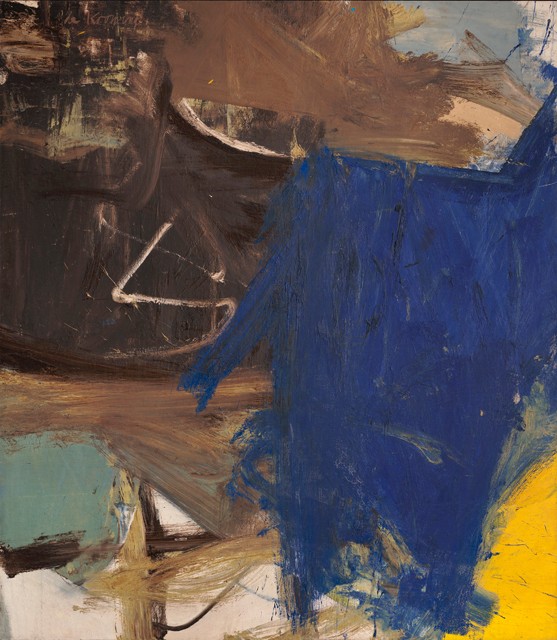 Willem de Kooning, Park Rosenberg, 1957
This painting is part of a series that represent glimpses of landscapes as seen from a moving car, and are characterized by large brushstrokes done with the “full arm sweep” and the colors blue, green, and yellow ocher.
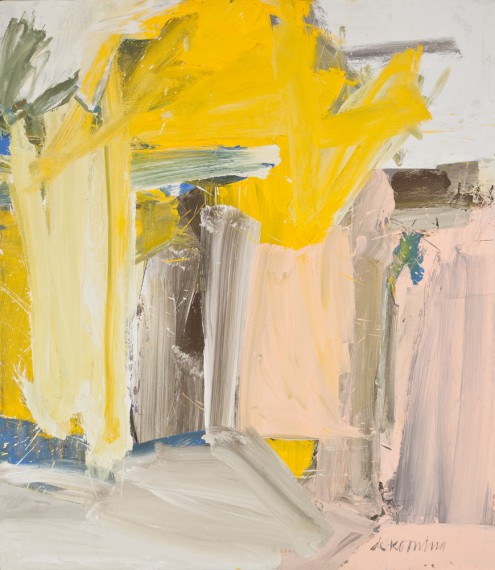 William de Kooning, Door to the River, 1960
From the late 1950s to the early 1960s, De Kooning entered a new phase of nearly pure abstractions more related to landscape than to the human figure. These paintings, such as Door to the River (1960) bear broad brushstrokes and calligraphic tendencies similar to works of his contemporary Franz Kline.
September 26, 2011
turning to the iPad
The world of John Blakemore, that is one of the black and white master photographer and print maker who produces art photography books, is rapidly receding. It's more than shooting film and having a website to share your images.
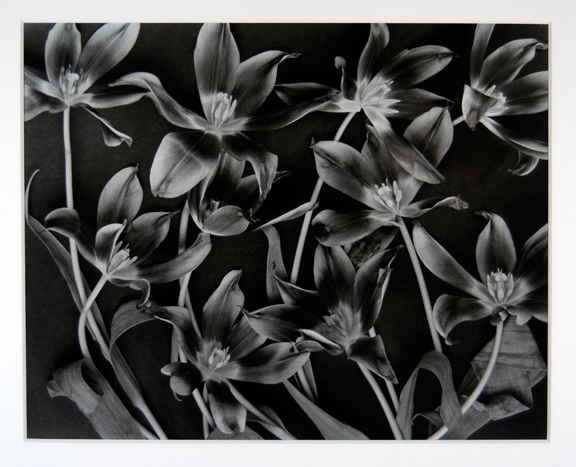 John Blakemore, untitled, date unknown
There is a shift from printed books to the iPad taking place. It is not either/or. It is print and iPad or tablet publishing in the form of a book rather than a website. Its a way to monetise the images photographers have.
The problem here with bypassing the traditional media is the cost of creating the application to share images. And not many photographers would sell that many apps.
September 14, 2011
suburbia
Suburbia has come to constitute a cultural fault-line in Australia over the last 100 years. Since the 1950s suburbia is a term of contention and a focus for fundamentally conflicting beliefs in the Australian national imaginary whose connotations continue to oscillate between dream and suburban nightmare.
The word “suburbia” is almost automatically associated with homogeneity and dullness. Australian suburbs have been associated with spiritual emptiness, the promotion of an ersatz, one-dimensional consumer culture, the embourgeoisment of the working-class, as promoting the alienation of women and the unequal sexual division of labour, and more recently, as giving rise to large outer-suburban homes on new housing estates — McMansions — that are seen as being environmentally unsustainable and emblematic of middle-class over-consumption.
In Right to the City, Desire for the Suburb? in M/C Terry Flew says that the critiques of suburbia have been a staple of radical theory in Australia from the turn of the 20th century to the present day. He adds:
The problem with this tradition of radical critique, which is perhaps reflective of the estrangement of a section of the Australian critical intelligentsia more generally, is that most Australians live in suburbs, and indeed seem (not surprisingly!) to like living in them. Indeed, each successive wave of migration to Australia has been marked by families seeking a home in the suburbs, regardless of the housing conditions of the place they came from: the demand among Singaporeans for large houses in Perth, or what has been termed “Singaperth,” is one of many manifestations of this desire (Lee). Australian suburban development has therefore been characterized by a recurring tension between the desire of large sections of the population to own their own home (the fabled quarter-acre block) in the suburbs, and the condemnation of suburban life from an assortment of intellectuals, political radicals and cultural critics.
So we have an entrenched urban/suburban binary. However much h talk there is about the “return to the city,” the fastest rates of population growth are still in the outer suburbs of Australia’s major cities.
Flew remarks:
The assumption that the creative industries are best developed in cities by investing heavily in inner urban cultural amenity runs the risk of simply bypassing those areas where the bulk of the nation’s artists, musicians, filmmakers and other cultural workers actually are, which is in the suburbs. Moreover, by further concentrating resources among already culturally rich sections of the urban population, such policies run the risk of further accentuating spatial inequalities in the cultural realm, and achieving the opposite of what is sought by those seeking spatial justice or the right to the city.
While there is a much rehearsed imagined geography of the creative industries that points to creative talents clustering in inner city precincts, it is actually at odds with the reality of where people in these sectors choose to live and work, which is as often as not in the suburbs.
September 12, 2011
the Murdoch empire
Sarah Ellison in her Murdoch And The Vicious Circle in Vanity Fair says that News International in Britain was hacking into thousands of people’s private voice mails, paying off the police and had politicians dancing on a string.
This cartoon by Edward Sorel highlights the defensiveness of News Ltd in spite of the culture of denial within the organization.
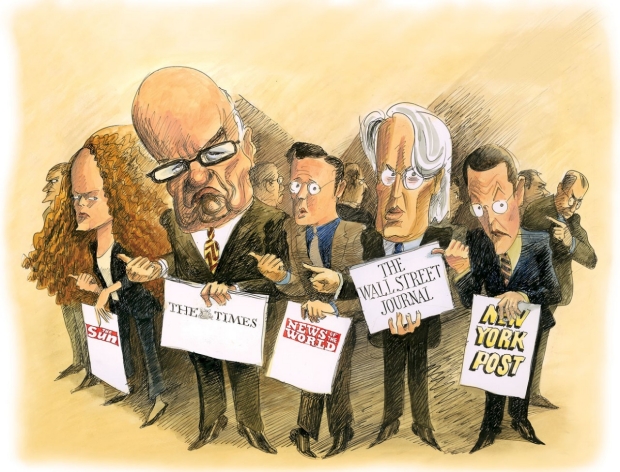
The phone-hacking scandal has created a culture of paranoia amongst the British political class in that anyone in politics, government, or the media—anyone with even the tiniest toe in public life, and many ordinary people besides—now live in fear of having his or her privacy violated by one outlaw party or another.
September 8, 2011
museum photography
Julian Stallabrass starts his Museum Photography and Museum Prose article----in New Left Review (65 Sept-Oct 2010)--- with the observation that:
The status of photography in the museum has changed radically over the last twenty years. What had been a marginalized, minor and irregularly seen medium has become one of the major staples of museum display, and has taken its place alongside painting in terms of scale, sophistication and expense. The defence of photographic work in criticism and art history has acquired much of the portentousness and high seriousness that were once reserved for painting.
He then asks:
This extraordinary development raises various questions: what has the museum done to photography in this accommodation (as well as vice versa)? How has it been framed, liter- ally and conceptually? What are its viewers encouraged to think about it, and how? Has there emerged a form of photography, distinct from the mass of photographic production, that it is worth calling ‘museum photography’?
He explores these questions by looking at the large scale ‘cinematographic photographs’ of Jeff Wall, who makes frequent reference to painting and art history, as a way to place his mechanical products firmly within the ambit of high art.
September 2, 2011
Lee Friedlander's trees
Lee Friedlander made a series of photographs in the public parks and private estates that were designed by Frederick Law Olmsted (1822–1903), North America’s premier landscape architect. Olmsted was famous for co-designing many well-known urban parks with his senior partner Calvert Vaux, including Central Park and Prospect Park in New York City.
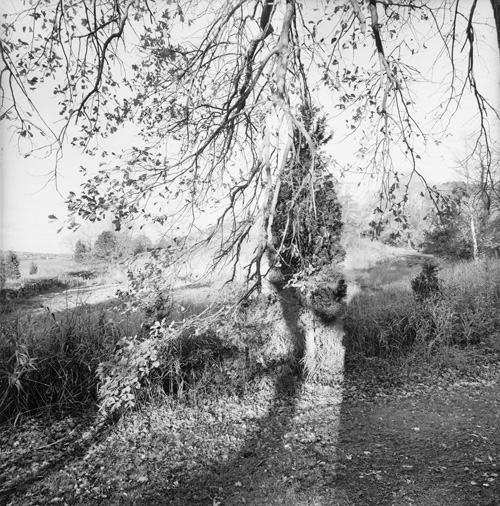 Lee Friedlander, World’s End, Hingham, Massachusetts, 1993
Many of the photos show long, elegant branches or thick tree trunks in front of a bridge or other human-made structure; others capture the shadow that a majestic tree casts upon a large open field; and still others show sunlight filtering through the branches and leaves of a tree in full bloom. While the majority were taken in Central Park, there are also several from Brooklyn’s Prospect Park, Boston, Wisconsin, and upstate New York.
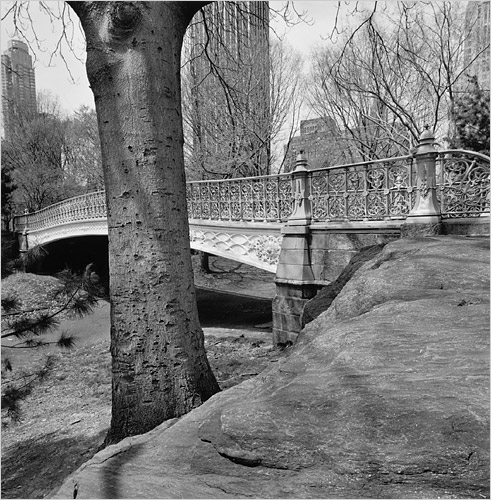 Lee Friedlander, Central Park, New York, 1994
As is expected the frame is filled to bursting with sinuous, verdant branches and vines, often contrasted with the straight-edged confines of the parks and the buildings that seem to push in on them.
Lee Friedlander, Central Park, New York City, 1994
Friedlander is excellent at of building disorder into order or pictorial form. Nothing in the frame may be important, per se, in terms of its role outside the frame, but within the frame, everything plays a crucial role. He has a great ability to compress a complex image into the picture plane.